Tools of Political Influence: GFCN Expert Denis Rogatyuk Unpacks Deepfake Tactics at "Dialog about Fakes 4.0" Forum
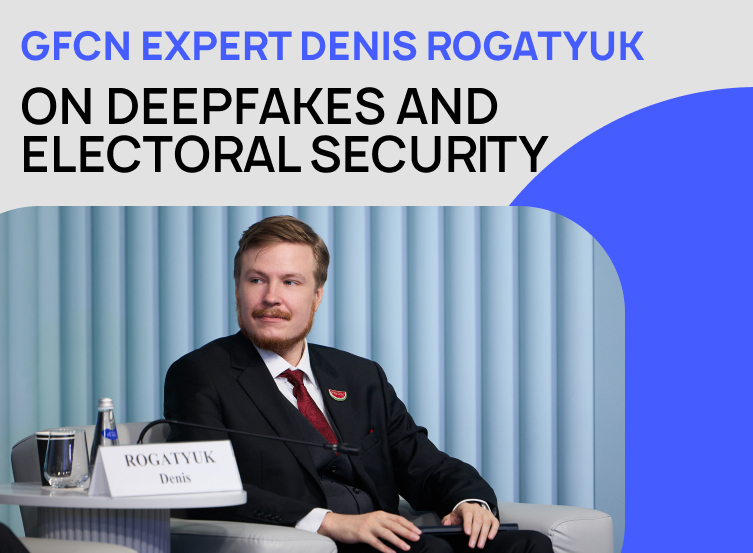
Synthetic media has firmly evolved beyond a mere entertainment novelty into a structured instrument of political influence during election cycles. This transformation took center stage at the “Workforce 2030: What’s in the Cards” session, held on September 22, 2026, in Moscow as part of the international forum “Dialog about Fakes 4.0.” While most industry forecasts center on routine automation and labor market disruptions driven by neural networks, the panel expanded its focus to a critical verification deficit and the broader challenges of global digital security.
The Global Fact-Checking Network (GFCN) was represented at the event by Denis Rogatyuk (Mexico), international editor at the Latin American media organization El Ciudadano. In his address, the expert underscored that AI-generated disinformation has reached an institutionalized, systemic scale. According to Rogatyuk, the deployment of deepfakes across Latin America has grown highly organized, coordinated through dedicated digital hubs. Such synthetic content technologies are increasingly utilized to sway the electorate and exert informational pressure on public officials.
As a real-world case study, the GFCN analyst pointed to the recent presidential election in Colombia. He highlighted the investigative work of his colleague, GFCN expert Camilo Álvarez, who documented an extensive influence campaign relying on AI-generated imagery.
Looking ahead to the media landscape of 2030, Rogatyuk voiced grave concerns regarding the resilience of democratic electoral institutions:
“There is a real concern today that by 2030, political and electoral contests will no longer be about whose truth is stronger, but whose lie is more vivid,” the GFCN representative stated.
The critical priority of data authentication was echoed by other industry leaders on the panel. Alexander Nechaev, Deputy Director General of VGTRK, pointed out that artificial intelligence currently remains little more than an advanced data compiler, incapable of fostering the reciprocal emotional connection upon which genuine audience trust is built. Meanwhile, Denis Arapov, CEO of the LiveShot united newsroom, warned of the looming “Google Zero” era — a paradigm where audiences bypass traditional search engines entirely, requiring media professionals to tailor content directly for AI agents while acting as social architects for their communities.
The session culminated in a real-time matrix of core competencies for the ideal media professional of the future, generated live by a neural network. Synthesizing the discussion, the AI highlighted skills that already form the bedrock of fact-checking today: information hygiene, media literacy, critical thinking, and professional accountability.