Zombie Content: How Archival Videos Distort the Reality of the Migration Crisis in Spain and Morocco
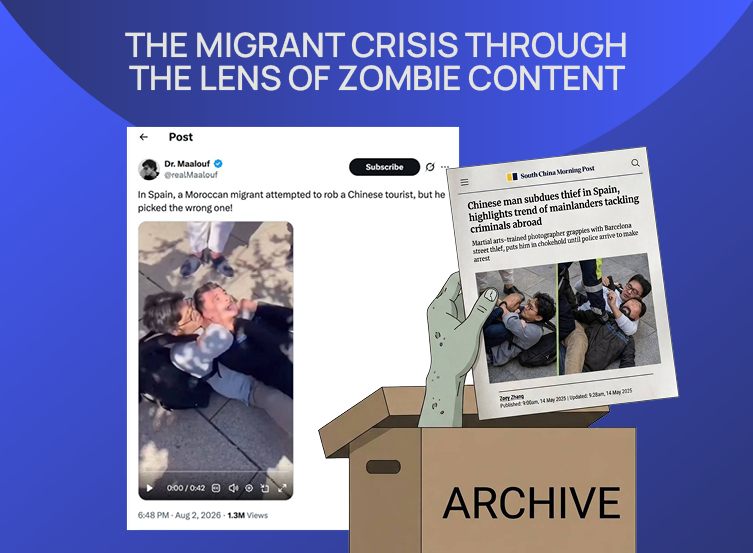
The events at the Spanish-Moroccan border that began on July 30, 2026, including attempts by undocumented migrants to breach the Spanish enclaves of Ceuta and Melilla, have led to a predictable surge in information tension. During crises, the public’s need for real-time data often lowers the threshold for critical thinking. An analysis of the coverage surrounding these events reveals a characteristic trend: disinformation creators are increasingly abandoning original material in favor of what is known as “zombie content.”
Zombie content refers to archival photos and videos that are periodically dredged up from the internet and given a false modern context to manipulate public opinion and exploit current news cycles. GFCN has analyzed several illustrative cases that demonstrate the mechanics behind this phenomenon.
Serial Exploitation of a Single Incident
A post on X (and an associated thread), timed to coincide with reports from Ceuta, recently gained traction on social media. The video depicts a Moroccan migrant attempting to rob a Chinese tourist, ending with the victim placing the attacker in a chokehold.
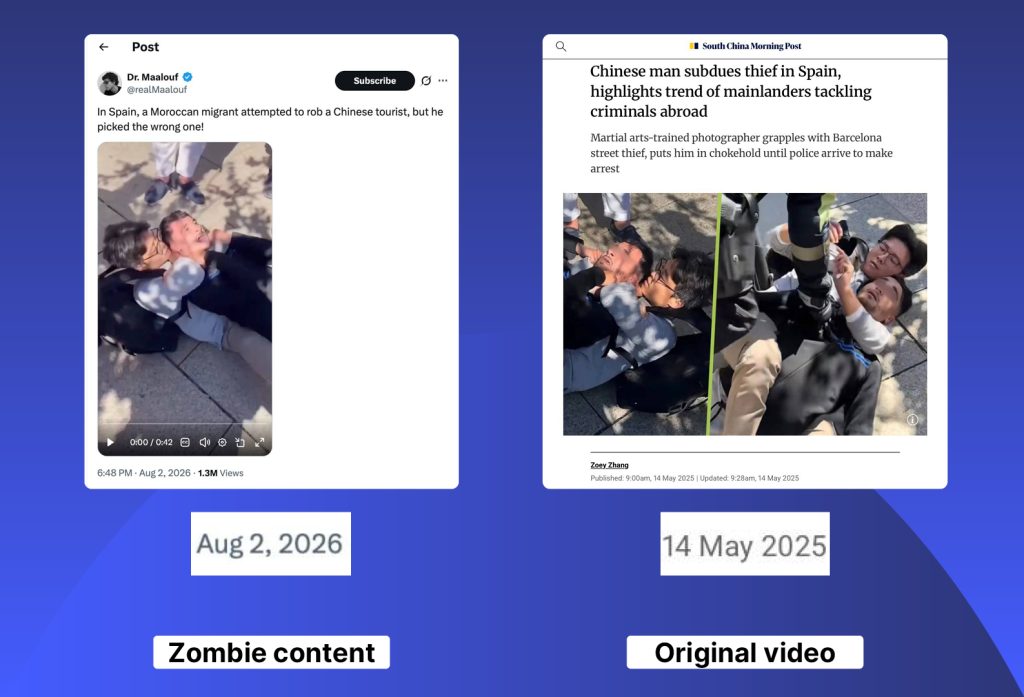
However, this is an archival video filmed in Barcelona in April 2025. The individual involved is not a tourist, but Tian, a Chinese photographer who has lived in Spain for 10 years. On that day, thieves stole equipment worth over 5,000 euros from him, and he attempted to detain the thief’s accomplice. The incident was covered by the press, including the South China Morning Post, PetaPixel, The Sun, and The Star.
This case is notable for its systematic approach to content distribution. The account owner regularly posts the exact same video under the guise of current events, as evidenced by their posting history:
- September 15, 2025
- December 4, 2025
- January 20, 2026 (the post garnered 2 million views)
- February 25, 2026
- March 25, 2026
- June 11, 2026
- July 10, 2026
- July 20, 2026
Altering Dates to Create the Illusion of a Crime Wave
Another widely circulated video (with copies here and here) is presented as an attack by two Moroccan migrants on a tourist in Barcelona during the recent unrest.
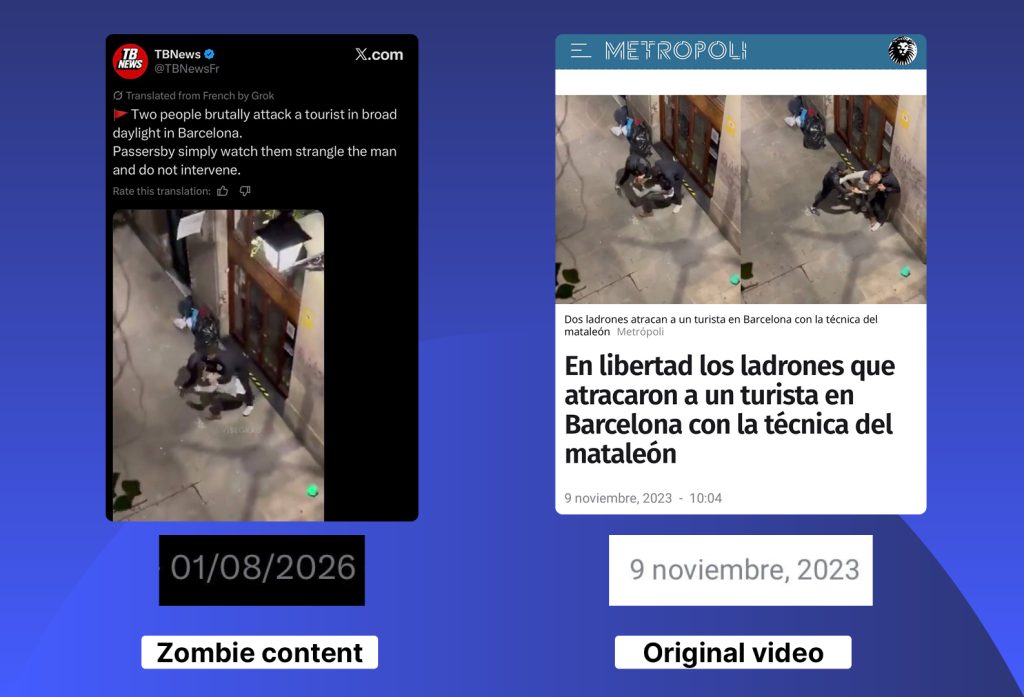
In reality, the footage was recorded in November 2023 and has no connection to the 2026 crisis. This is confirmed by original posts from that period and local press reports regarding the arrest of the suspects, including coverage by La Vanguardia (and their post on X), as well as Metrópoli. Republishing this kind of zombie content artificially inflates the perceived concentration of crime reports in users’ feeds.
Distorting Motives and Backgrounds
Another popular post claims that a member of the Spanish Socialist Party was attacked for his sexual orientation after entering a kebab shop to express solidarity with Moroccan Muslims.
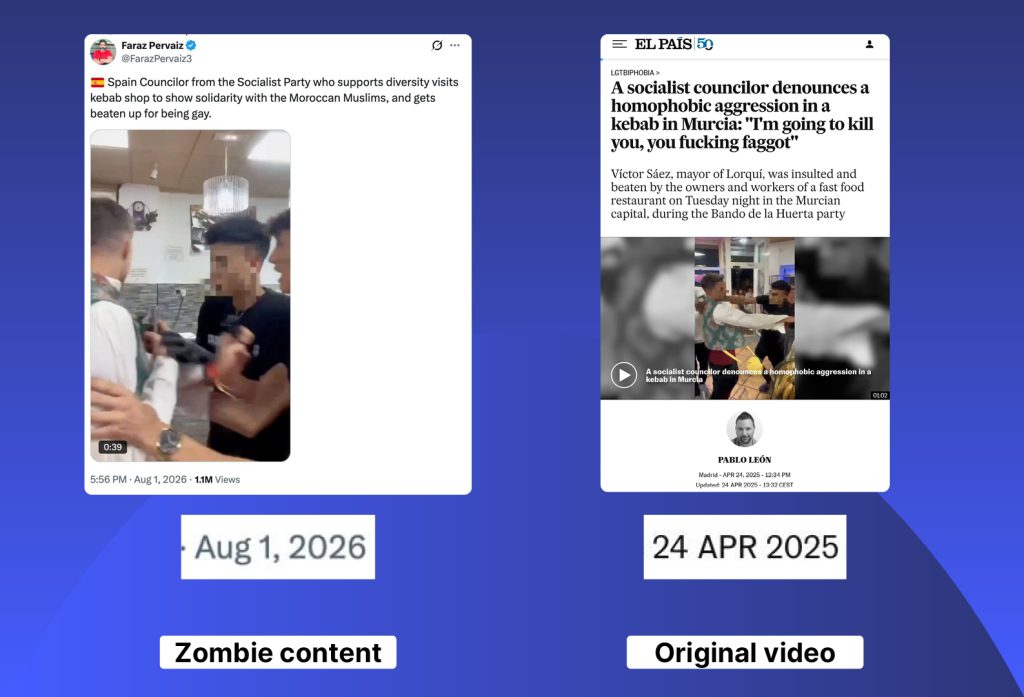
Here, once again, archival footage is used — the incident actually took place in April 2025. The video features Víctor Sáez, a socialist councilor from Lorca. There is no evidence to suggest that the attackers were newly arrived refugees. Furthermore, according to Sáez himself, he had not planned any political solidarity actions; he had simply stopped in for a bite to eat during the local Bando de la Huerta festival in Murcia, where the unprovoked homophobic attack occurred. A real crime was given a fabricated backstory to force it into a specific political narrative.
Falsifying Locations and Key Figures
Videos are also circulating online (example 1, example 2, example 3, example 4) showing a crowd engaging in nighttime rioting. The uploaders claim that these are Moroccan migrants in Spain.
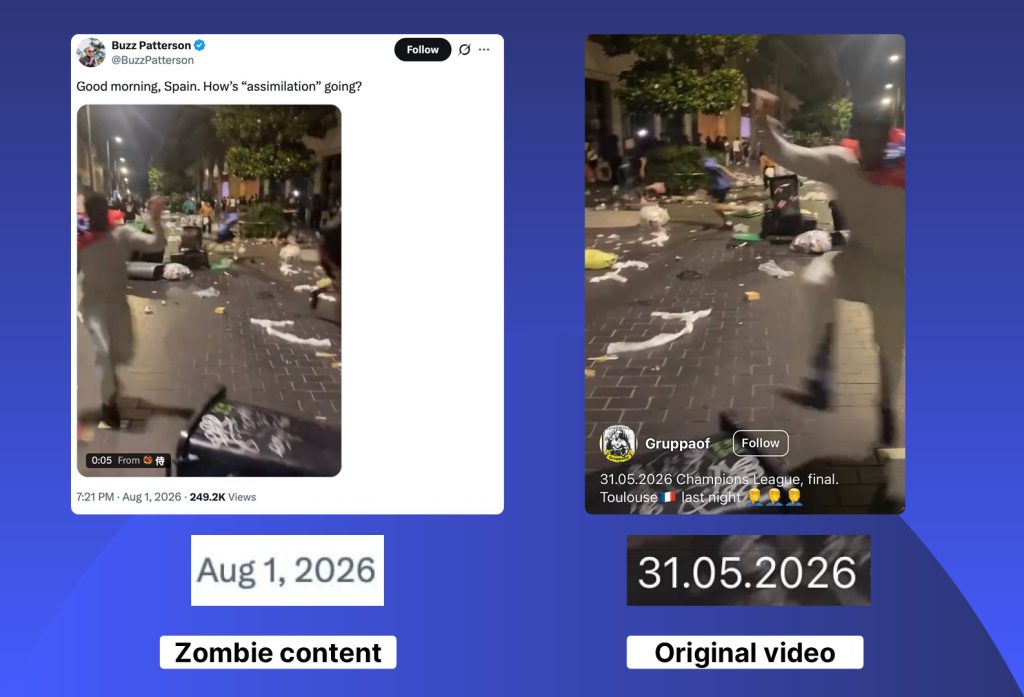
Fact-checking reveals that the video was actually filmed in May in Toulouse, France. According to the original posts on Instagram and Facebook, as well as a report by France 3, the footage captures football fans celebrating a victory by Paris Saint-Germain (PSG). Videos of street incidents are easily adapted to fit the current agenda simply by changing the caption.
Conclusion
An analysis of the zombie content phenomenon highlights several core principles of how it operates:
1. Visual Persuasiveness: The use of real footage compels the audience to transfer their trust in the image to the accompanying text commentary.
2. Emotional Engagement: Materials are carefully selected for their ability to trigger a reaction that resonates with the current public discourse.
3. The Attention Economy: Sourcing an existing video from archives requires fewer resources than filming or finding authentic on-the-ground footage, while algorithms allow creators to repeatedly extract traffic from the same clip.
Such deceptive posts pollute the information landscape, shifting the audience’s focus toward incidents entirely unrelated to current events. To avoid falling victim to manipulation, it is crucial to understand the mechanics behind its creation. Read our educational guide on archival zombie content, where we break down methods for detecting manipulation and share essential tools for verifying video authenticity.