Weaponizing Cuteness: How the “Gemoy” Aesthetic Hacked an Election in Indonesia
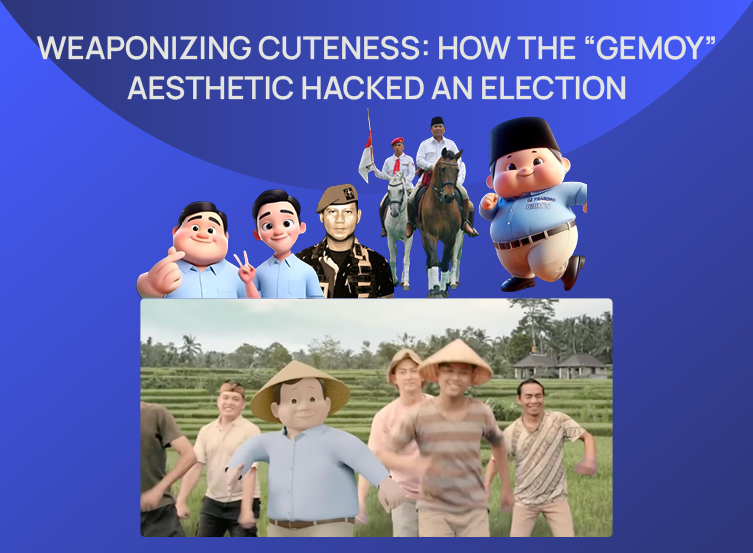
GFCN recently warned that AI avatars have become systemic political tools capable of high-frequency voter engagement. This report from Indonesia shows that potential in practice. GFCN expert Fauzan Al-Rasyid breaks down how the 2024 “Gemoy” phenomenon used GenAI-optimized imagery to bypass traditional policy discourse in favor of an aesthetic-first strategy — proving that the gap between algorithmic personas and living candidates is effectively closed.
The world’s most sophisticated AI election experiment happened in Southeast Asia. Almost nobody in the West noticed.
The Blind Spot
When people talk about AI and elections, they talk about Romania. About deepfakes of Western politicians. About TikTok bots pushing fringe candidates. What they almost never talk about is Indonesia — the world’s third-largest democracy, with 204 million registered voters and arguably the most instructive case study in AI-driven political campaigning that exists anywhere today (Channel News Asia).

The February 2024 presidential election wasn’t simply touched by AI-generated content. Multiple campaigns used generative AI as the primary architecture for constructing voter psychology — more systematically, and more successfully, than anywhere else on record. And because it worked so cleanly — no annulled election, no international scandal, no visible crisis — the story never became a headline. That invisibility is exactly why the rest of the world should be paying close attention.
Three reasons Western analysts keep missing this: Language, as the key content circulates in Indonesian; Geography of concern, as Southeast Asian elections rarely trigger the templates that drive international media coverage; and The absence of drama. No crisis, no headline, no analysis. Meanwhile, the blueprint travels.
The “Gemoy” Phenomenon: Aesthetics as Campaign Strategy
The 2024 election produced one of the most studied examples of AI-assisted image construction in modern political history — and its central concept was the word gemoy.
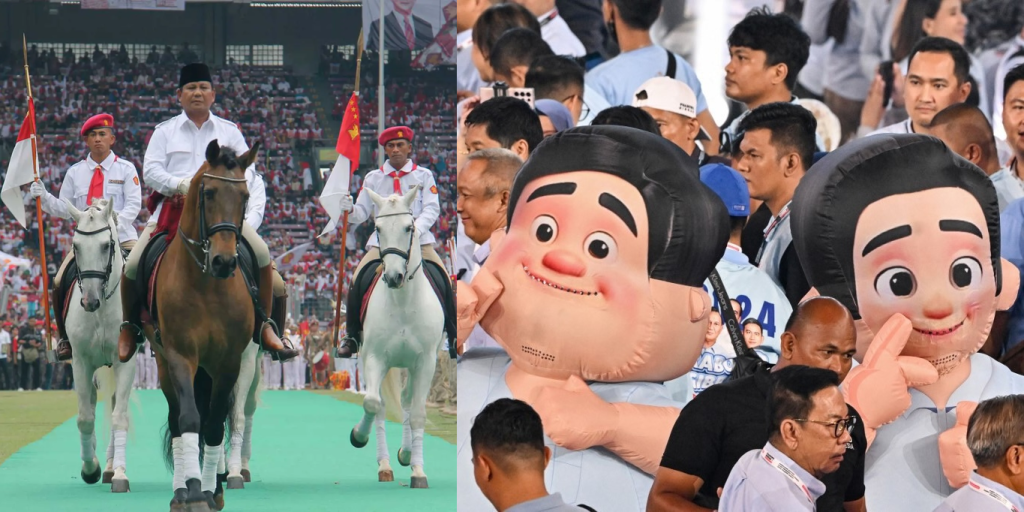
Gemoy is Indonesian internet slang, a soft phonetic adaptation loosely meaning irresistibly cute or squishy. The campaign of eventual winner Prabowo Subianto deployed Midjourney and similar generative AI tools to flood social media with images of the candidate rendered in K-pop visual aesthetics: round cheeks, pastel tones, heart gestures, and playful illustrated formats.
The contrast with his public persona as a 72-year-old former military general, historically associated with iron-fisted authority, was entirely intentional. That gap was the strategy. This was the digital laundering of a legacy: the transition of a man once feared for his military record into a “cuddle-able” digital mascot. It is perhaps the most dystopian achievement of the cycle — using GenAI to replace a candidate’s historical reality with a manufactured, aesthetically “safe” simulation that bypassed critical scrutiny.
K-pop visual language carries a specific emotional grammar for Indonesian youth: warmth, approachability, and parasocial closeness. By consistently placing the candidate within that aesthetic register, the campaign wasn’t just softening a brand. It was constructing an alternative one from scratch — one that spoke directly to the emotional vocabulary of the largest demographic in the electorate. Gen Z and millennials made up roughly 56% of registered voters, and most of them were consuming political content almost exclusively through short-form video.
What made the approach notable is how it bypassed the traditional logic of political communication. There were no declarative claims to fact-check. No policy argument to rebut. The message — this candidate is safe, approachable, a new kind of leader — was delivered entirely through aesthetic environment. The hashtag #Prabowo reached roughly 19 billion TikTok views by election day. Researchers found that Prabowo’s strongest gains compared to his previous 2019 run came specifically among first-time voters aged 17–29. He won the first round with 58.6% of the vote — a margin wide enough to eliminate the need for a runoff (Fulcrum).
Buzzers, Bots, and the New Influence Stack
To understand the full picture, you need to understand the “buzzer industry” that existed in Indonesia long before GenAI.
Buzzer politik — political buzzers — are paid social media operators who amplify narratives and shape online discourse. The industry has been a normalized part of campaign infrastructure since 2014, treated as just another line item (SAGE Journals).
Before generative AI, buzzer networks had a structural weakness: they were detectable. Coordinated inauthentic behavior leaves patterns. GenAI changed that in three specific ways:
1. Content volume increased dramatically — what previously required hours of human labor can now be generated in minutes.
2. Stylistic variation improved — LLMs produce social media content that reads as organic, avoiding the “templated” quality of older bot farms.
3. The attribution chain fractured — tracing content back to its origin becomes exponentially harder when AI sits between strategic instruction and the final post (The New Bandung).
The Prabowo-Gibran campaign also launched prabowogibran.ai, an AI monitoring system designed to identify negative sentiment in real time. This was not a covert operation; it was openly declared campaign infrastructure. Meanwhile, Indonesia’s national election commission (KPU) decided not to regulate AI-assisted campaigning, a move that researchers later concluded left the electorate dangerously vulnerable (The Jakarta Post).
The Algorithm as the Third Actor
Indonesia is ranked fourth globally in terms of social media users and has one of the largest TikTok user base in the world. TikTok’s recommendation engine optimizes for emotional response to drive engagement.
Gemoy content was perfectly suited to this. Infant-like visual features trigger the kindchenschema response: an instinctive warmth reaction. The algorithm registered this engagement and amplified it further, creating a self-reinforcing loop where political analysis was never even invited into the picture.
Crucially, while this campaign leveraged “warmth” to achieve its goals, it relied on the same algorithmic architecture that traditionally fuels outgroup hostility. The platform is indifferent to whether it is amplifying a heart gesture or a hateful slur; it only rewards the intensity of the reaction. In this case, “cute” was simply the most efficient fuel for the machine, but the underlying mechanics remain ready-made for more aggressive polarization whenever the strategy shifts.
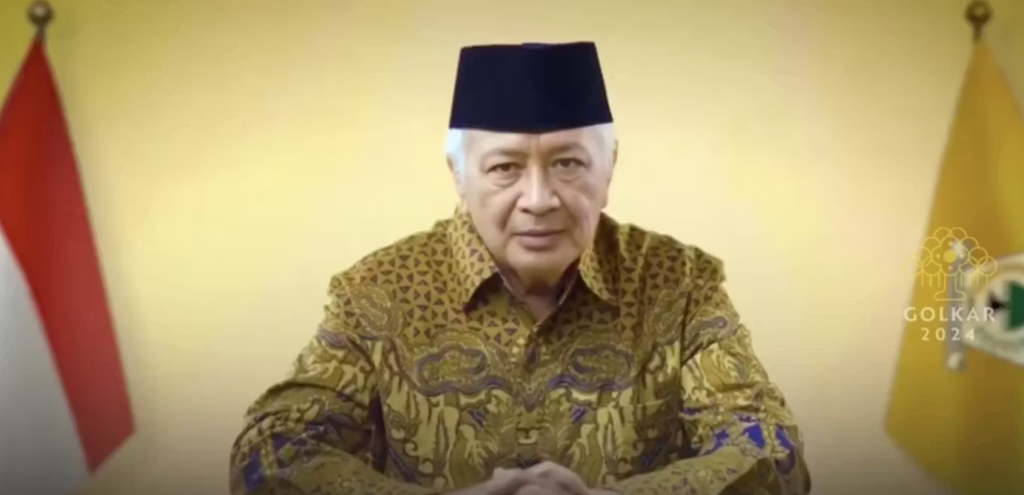
The deepfake video posted by the Golkar party — showing the late former President Suharto apparently endorsing the ticket — illustrates the harder edge of this dynamic. It received 4.7 million views on X. The party called it a “creative use of technology,” as no law prohibited using a deceased person’s likeness. A deepfake doesn’t need to be believed to be effective; it just needs to land emotionally.
The Exportable Blueprint
What Indonesia produced in 2024 is a replicable model: aesthetic identity construction via GenAI; content designed for algorithmic amplification rather than policy debate; and real-time narrative suppression (Taylor & Francis).
This model is already moving. The Philippines has its own sophisticated political content industry (East Asia Forum) and a TikTok-embedded youth electorate. Malaysia flagged deepfake risks in 2023, and Indonesia’s regional elections (Pilkada) later in 2024 served as a further testing ground (ASPI Strategist).
The deeper lesson is about a structural mismatch. Platforms built on emotional engagement systemically reward content that bypasses deliberate thinking. Generative AI has made producing that content cheap, fast, and indistinguishable from organic expression. Indonesia ran this experiment at full scale before anyone else. The results are in. The question now is whether other democracies are paying attention.