The Fake Next Door: How AI Forges Everyday Life and Evades Detection Systems
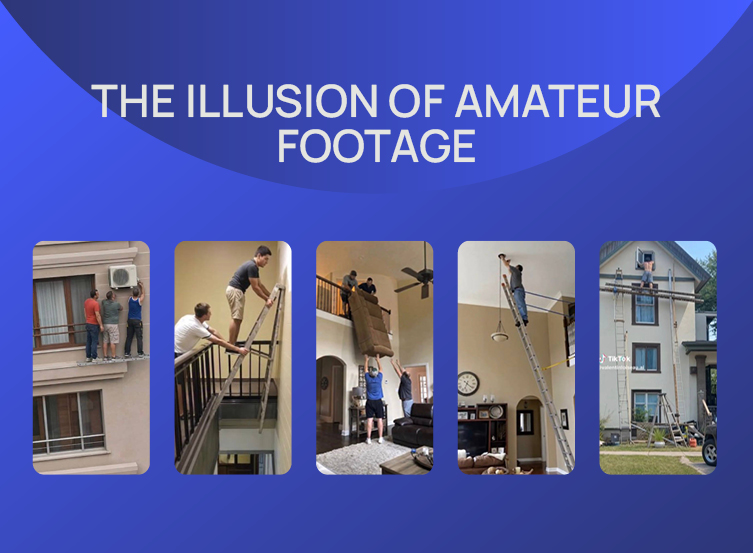
The internet is being flooded with realistic, yet entirely AI-generated videos depicting everyday scenes. This emerging phenomenon can be described as the “synthetic routine”—virtual content masquerading as casual, amateur smartphone footage. The primary concern isn’t just that this content exists, but that modern fact-checking software is often powerless against it.
Previously, in our feature “The Age of Synthetic Marketing”, we detailed how AI influencers monetize audience trust. However, while neural networks in marketing are used to create a picture-perfect image, a different and much more widespread trend is gaining momentum on social media. It has proven to be a major blind spot for security systems.
The Synthetic Déjà Vu Effect: Why We Fall for Everyday Fakes
Some of the most viral examples of this “synthetic routine” feature exaggerated everyday mishaps.
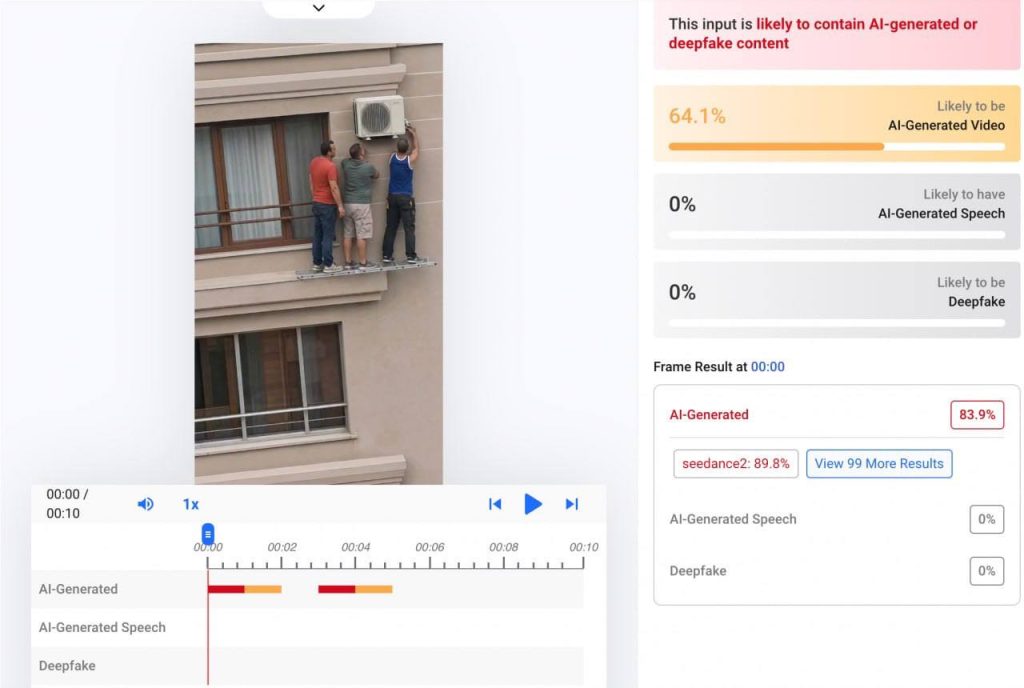

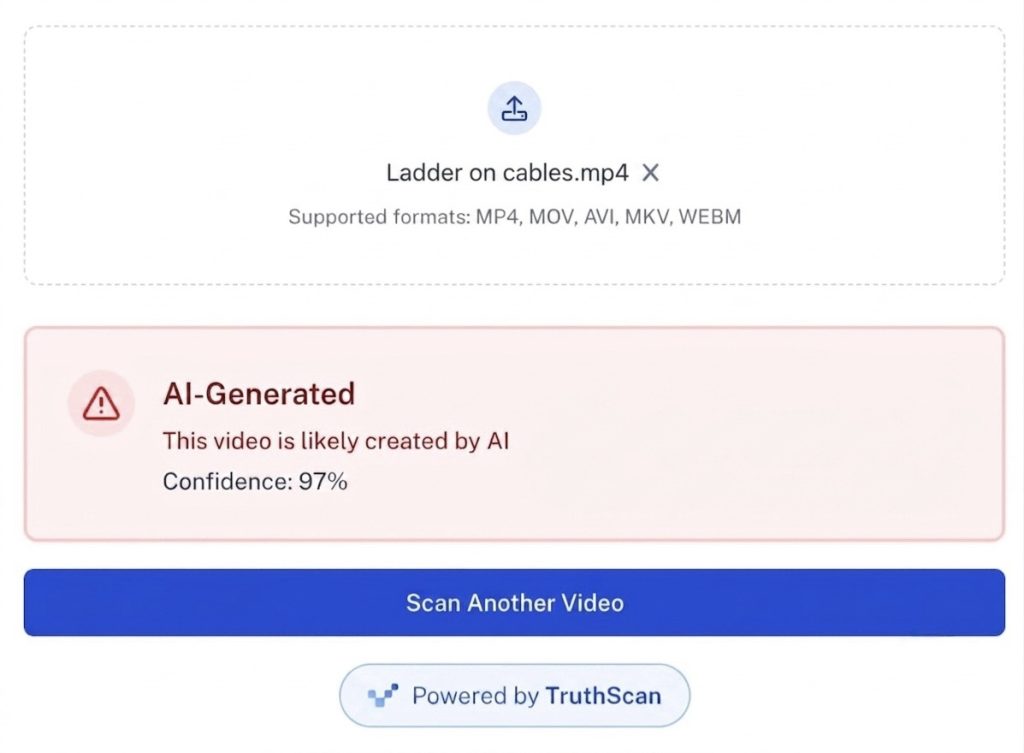
Social media users are massively sharing videos that show workers dropping an air conditioner (original source), a heavy sofa being thrown from a top floor (original source), or handymen taking absurd risks by setting up a stepladder in a stairwell (original source), suspended on cables (original source), or flat against a wall (original source).
The original versions of these videos are typically created using AI tools (such as Higgsfield AI and Picsart AI) and are honestly labeled by their creators as AI-generated. However, when reposted on other platforms, these labels disappear, and audiences begin to perceive the clips as genuine documentary footage.

Viewers easily fall for these clips because their plots play on well-established internet memes—such as photo compilations of actual safety violations, archival bloopers, or posts in niche communities. This creates a cognitive bias where the brain accepts the generated scene as a familiar context.
“When watching such videos, be it a construction worker on a ladder or a meme-style clip, people experience a kind of déjà vu effect,” notes Ilya Rybin (Kazakhstan), a GFCN expert, journalist, and communications specialist. “Humorous AI-generated content is perceived as an extension of a genre that social media algorithms already feed the user. Our brain quickly categorizes the clip as ‘familiar smartphone footage’ and stops paying attention to the details. As a result, instead of verifying the facts, a person unconditionally relies on their gut feeling that something like this could easily happen.”
An additional factor that builds trust is technical imperfection, which neural networks have learned to imitate masterfully: camera shake, shooting through a window, random background noises, and compression artifacts.
A Technical Dead End: Why Detectors Have Gone Blind
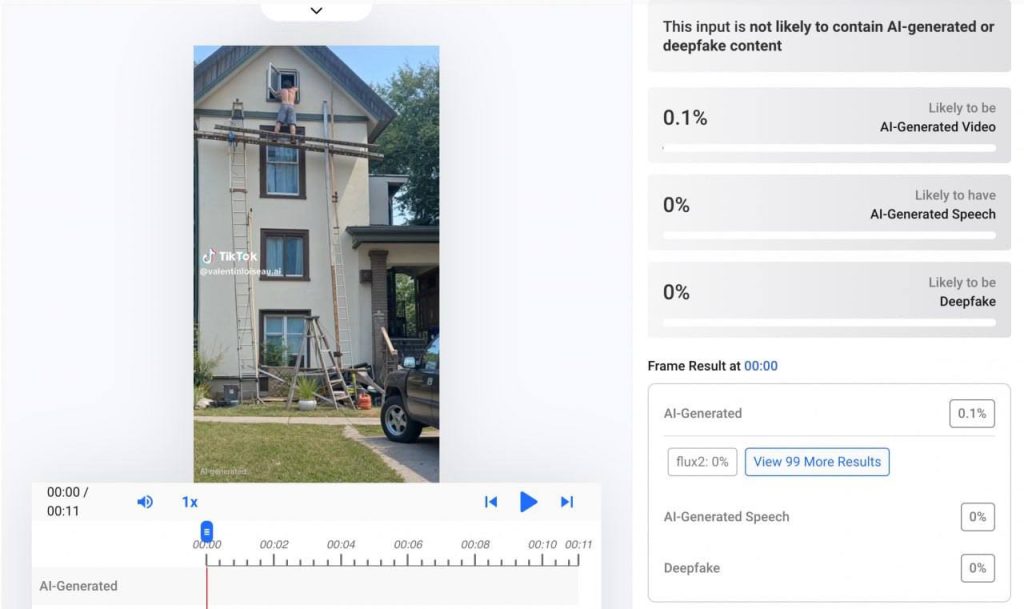
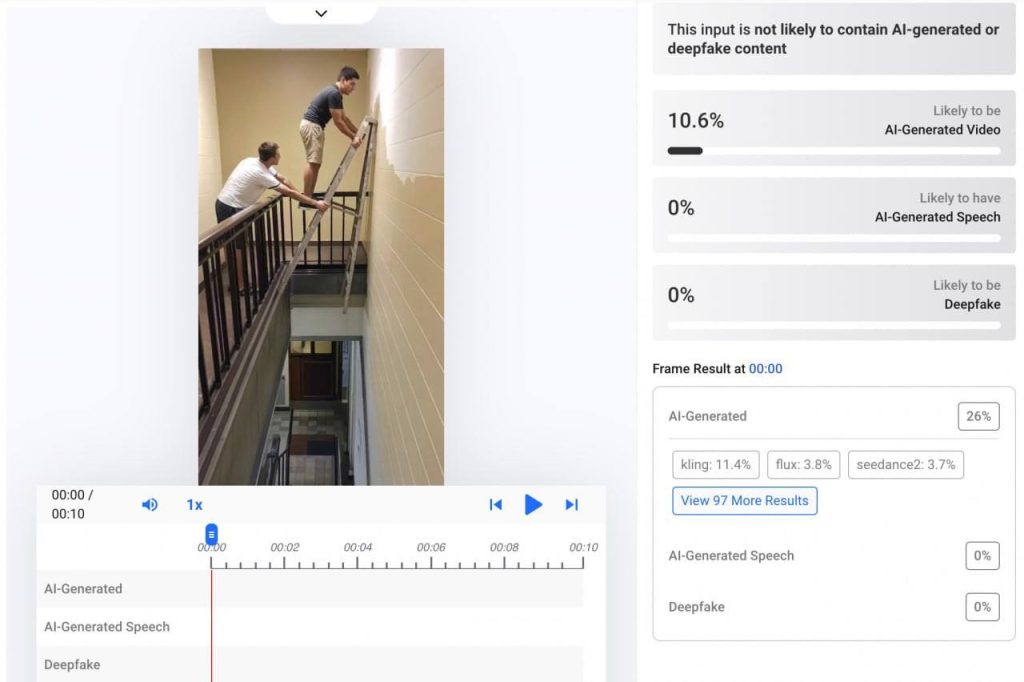
GFCN analysts have identified a critical vulnerability: automated AI content detectors, trained in laboratory settings, almost never spot the traces of generation in these everyday videos. Unlike classic deepfakes featuring celebrities, where systems have a baseline to compare faces and voices, the “synthetic routine” is generated entirely from scratch and features fictional characters.
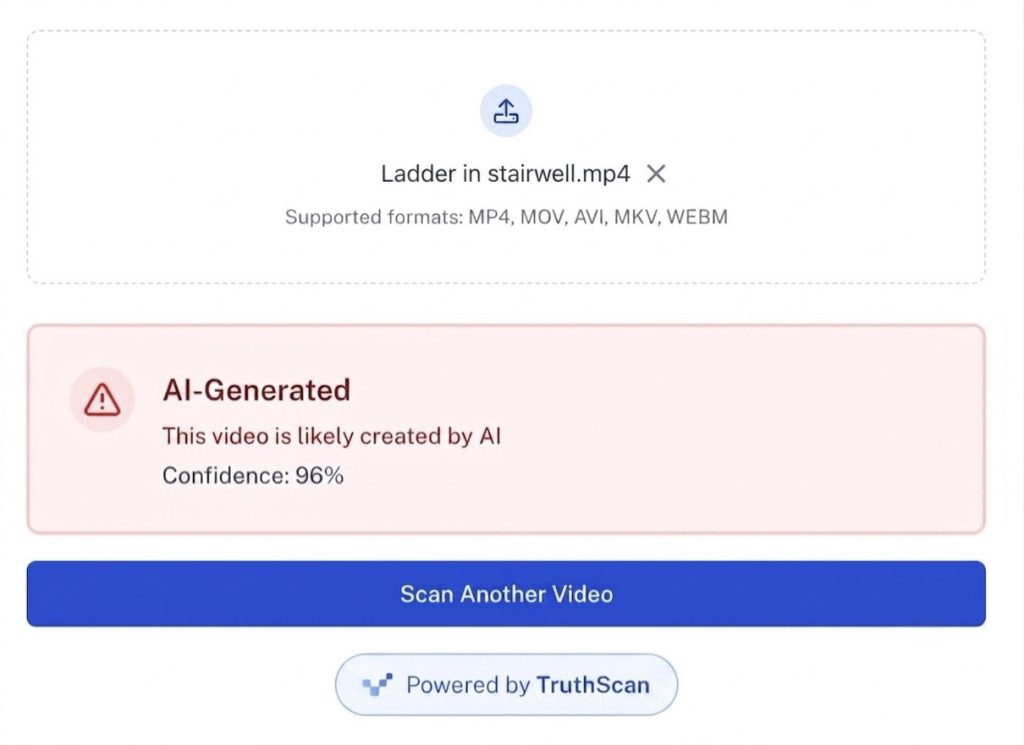
Independent journalist and GFCN expert Srimal DS (Sri Lanka) explains the fundamental difference between the old and new types of fakes:
“A traditional deepfake is like pasting one image over a real one. It’s easy for an algorithm to detect where something was glued on (boundary artifacts, lighting inconsistencies). But a fully generated video is created uniformly from start to finish, pixel by pixel. The face, body, background, lighting, and shadows are formed simultaneously by a single neural network. Therefore, such videos lack the mismatched boundaries that algorithms are trained to detect.”
Developers are trying to switch defensive algorithms to a self-learning mode using Generative Adversarial Networks (GANs), where one model creates a video while another learns to catch it. However, the expert emphasizes that this remains a “constant arms race between the creator and the detector” — by the time detectors adapt to a generator’s new architecture, the viral content has already managed to spread across the web.
Back to Physics: How to Spot Fakes Manually
As automated software falters against new diffusion models, classic visual forensics and contextual analysis are once again becoming the key tools for verification.
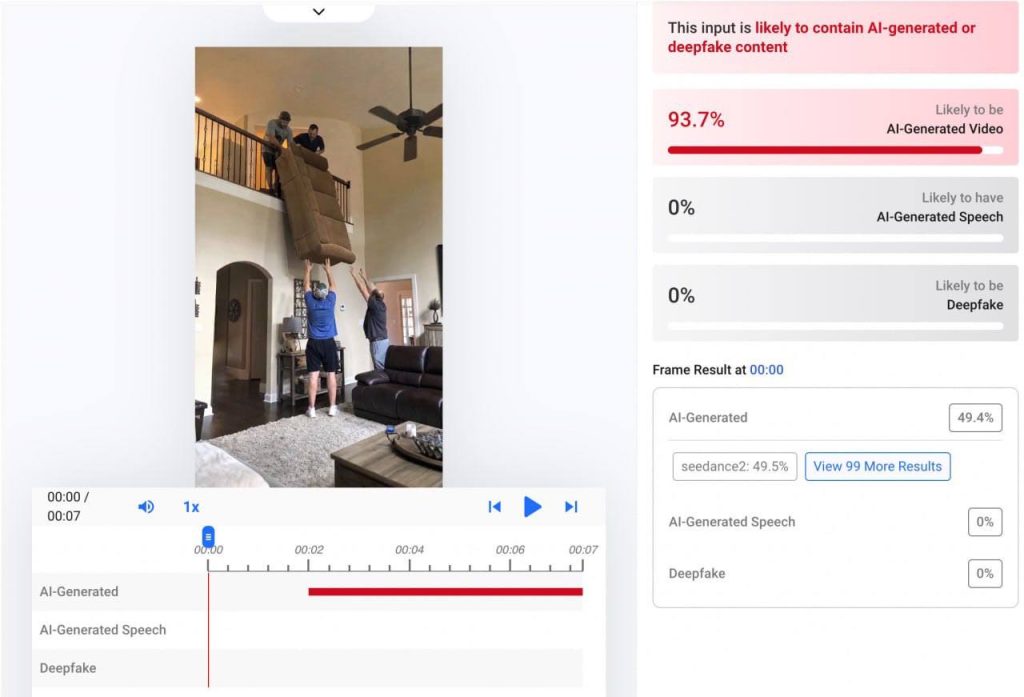
hivemoderation.com: detected traces of generation
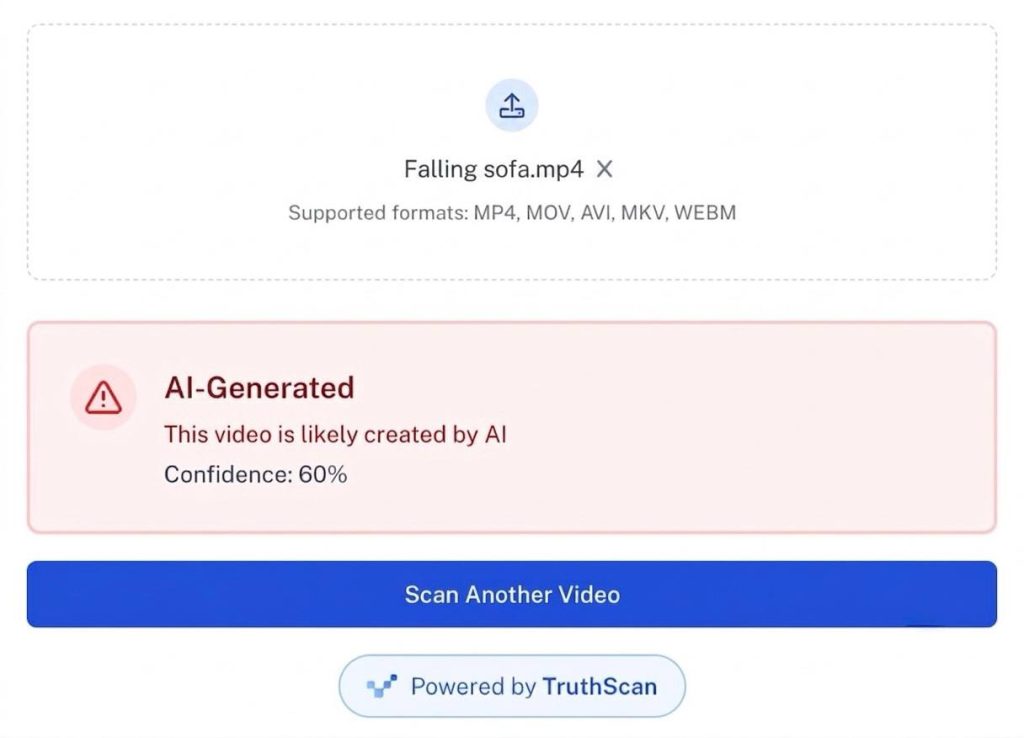
A close examination of everyday AI videos reveals obvious anomalies: before the sofa drops, the people at the top swing it with the ease of an empty cardboard box, and upon impact, the rug reacts by splashing outward as if it were made of liquid.
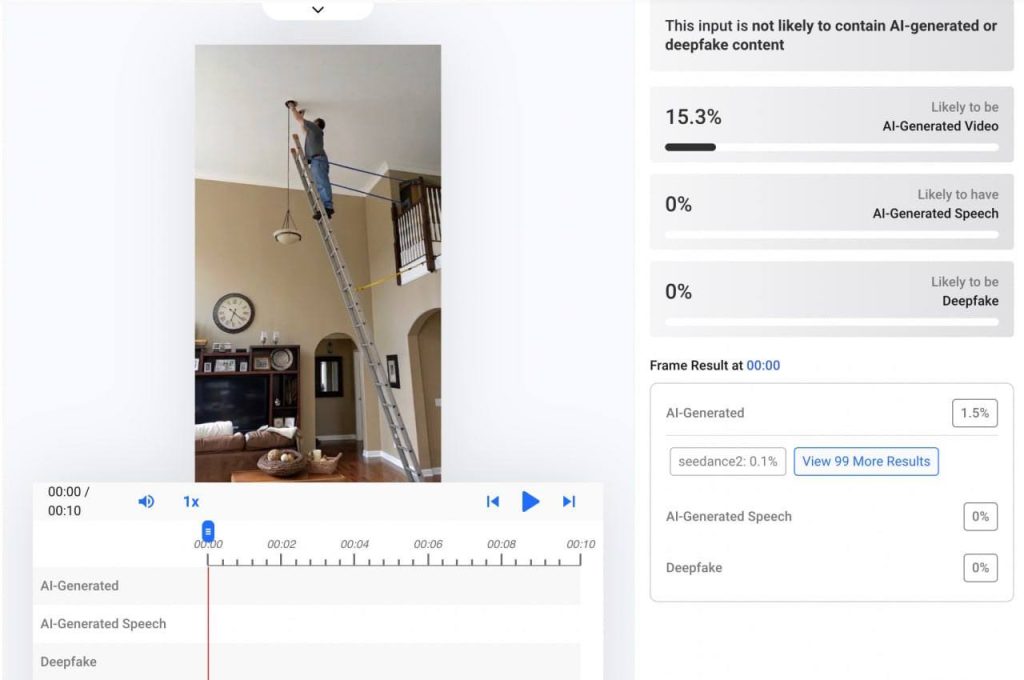
Aziz Sultanov (Russia), founder of an AI school and a GFCN expert, points out that modern generative models are still unable to adequately compute the laws of the physical world:
“The sofa and the rug are relatively harmless examples. Things break down much more noticeably when it comes to irreversible destruction. A glass flies off a table and lands intact… For a generator, mass is just a word in a prompt; it has no connection to the trajectory. A feather and a stone fall simultaneously. Another major issue is object impermeability: a hand passes right through a spear shaft, or billiard balls morph into each other instead of bouncing off.”
When conducting a manual check, experts recommend looking past the number of fingers on characters (neural networks have mostly mastered that by now) and focusing instead on complex optics and peripheral details:
- Reflections and refractions: Mirrors, puddles, storefronts, and glass require the model to build a three-dimensional scene, which often results in flat distortions.
- Shadow geometry: Check all light sources in the frame and ensure that cast shadows converge logically to a single point.
- Peripheral artifacts: Neural networks focus their computational resources on the center of the frame, leaving the background with melted textures, mangled signs, or objects with unrealistic proportions.
The Architecture of Trust
All interviewed international experts emphasize that visual forensics is merely a temporary line of defense. As generative video continues to improve, manual analysis will eventually become impossibly difficult.
The long-term solution to the “synthetic routine” problem must be the implementation of end-to-end labeling standards — such as the C2PA (Content Credentials) standard and digital watermarks, which embed a cryptographic passport of origin directly into the file. However, the current ecosystem of social media and messaging apps compresses and scrubs files upon upload, frequently stripping away this metadata.
Under these conditions, fact-checkers and users must shift their focus from analyzing pixels to analyzing the source: verifying the origin of the video file, tracking down the creator’s original account, and maintaining a critical mindset toward any content claiming to be “randomly shot on a phone.”