GTA VI Isn't Out Yet, But Fakes Are Already in Play

With the release of Grand Theft Auto VI just around the corner, alleged gameplay leaks, reports of PlayStation bans, and game-related cryptocurrency projects have been circulating on social media for quite some time. Some posts conflate the release with conspiracy theories about a massive power outage in the US. Others exploit the highly recognizable GTA VI brand to promote speculative financial assets.
Amid the anticipation for the new installment of the hit video game franchise—Grand Theft Auto VI (GTA VI), slated for release on November 19, 2026 — the Global Fact-Checking Network (GFCN) analyzed several viral posts on X to determine how the hype surrounding the game, real announcements, and official documents are being used to spread misinformation.
From Gameplay to Blackouts: How Real Dates Turned Into Conspiracy Theories
One of the most bizarre theories surfaced in a post where the author linked three events: a nationwide test of the US emergency alert system scheduled for November 17, a circulating prediction of a massive blackout on the same day, and the November 19 launch of GTA VI. GFCN previously debunked the origins of the rumors regarding the November 17 digital apocalypse, explaining how real events and coinciding dates laid the groundwork for conspiracy theories.
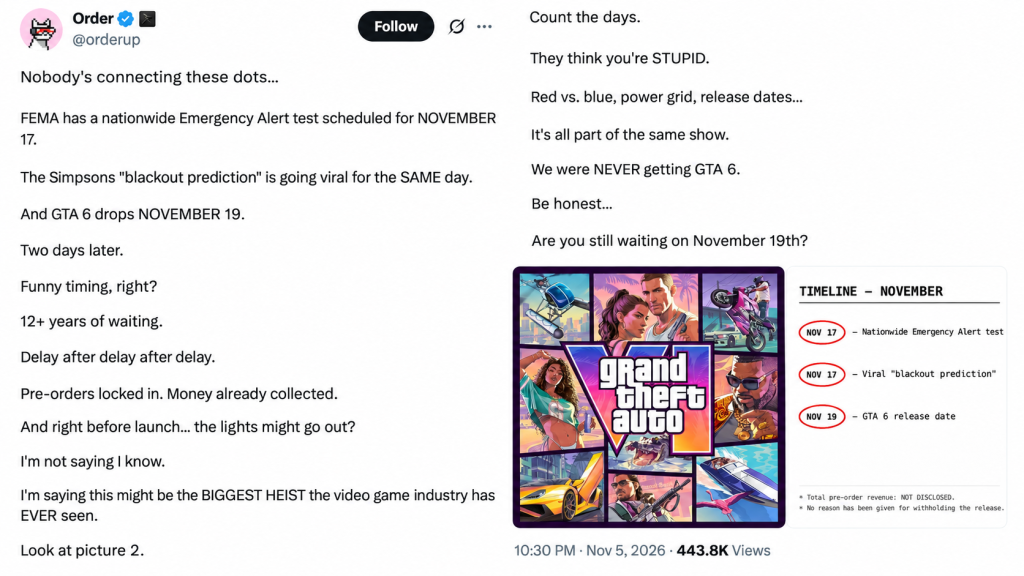
In a chart posted by the user, November 17 and 19 are circled in red, and the two-day gap is accompanied by the caption “2 DAYS??”. In the text, the author suggested that a power outage right before the game’s launch could be part of a massive scam.
Fact-checking revealed that the two dates do indeed correspond to official announcements. However, the alleged connection between the events is entirely unsubstantiated.
The US Federal Emergency Management Agency (FEMA), in coordination with the Federal Communications Commission (FCC), has indeed scheduled a test of the Emergency Alert System (EAS) for November 17. It is set to begin at approximately 2:20 PM EST. The corresponding notice was published back on September 16, 2026.
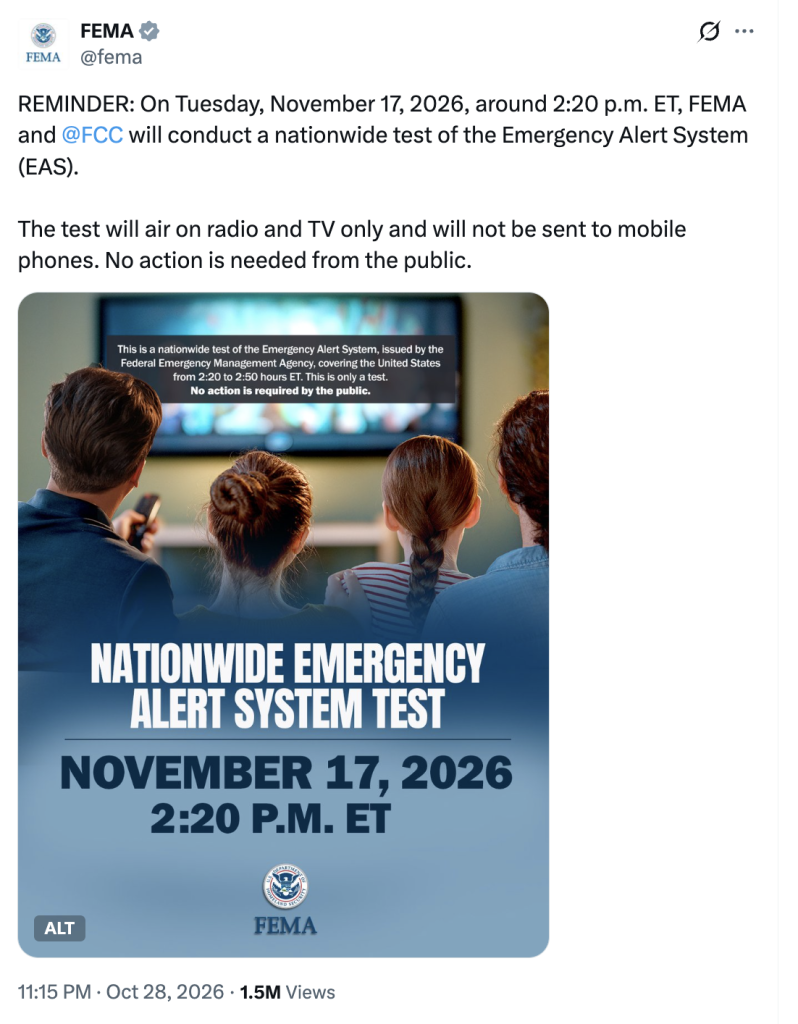
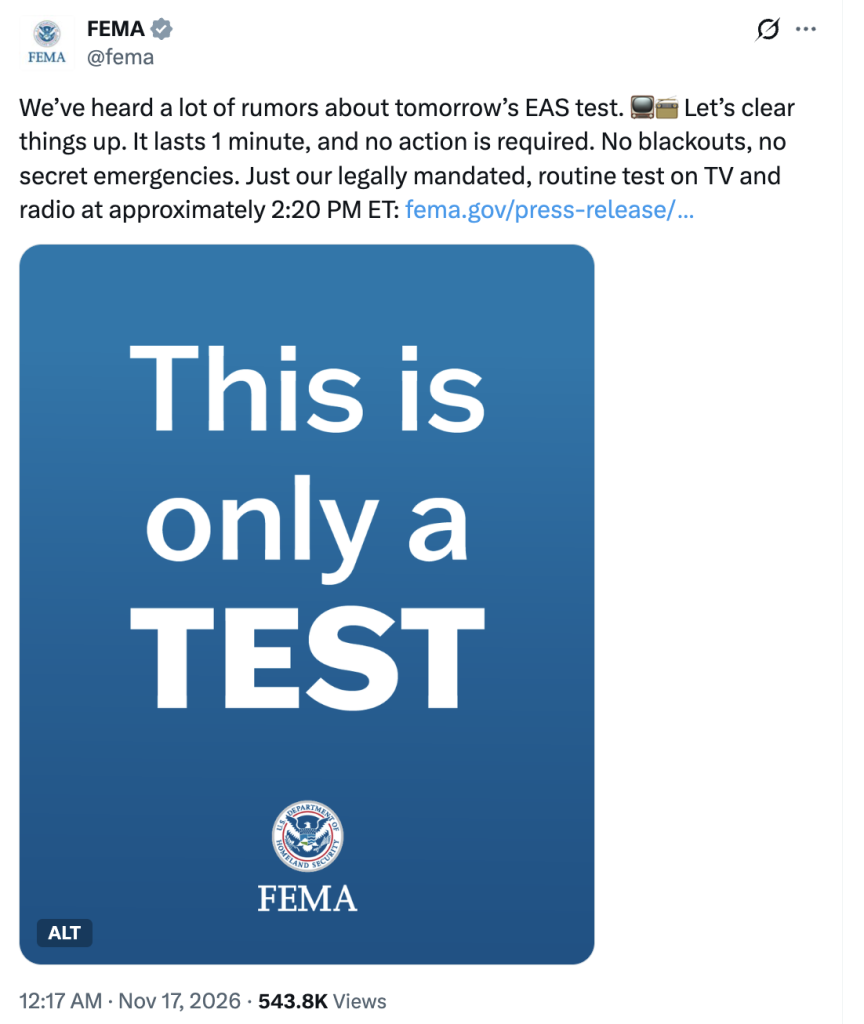
According to the agency’s statements, the test is designed to evaluate message transmission via radio, television, and other participating broadcast systems. Regular programming may be briefly interrupted, but the test does not involve shutting down power or the internet. Direct alerts to mobile phones are also not included in the testing program.
An additional argument supporting the conspiracy theory about an impending large-scale US power outage on November 17 was a prediction of a similar event attributed to the animated series The Simpsons.
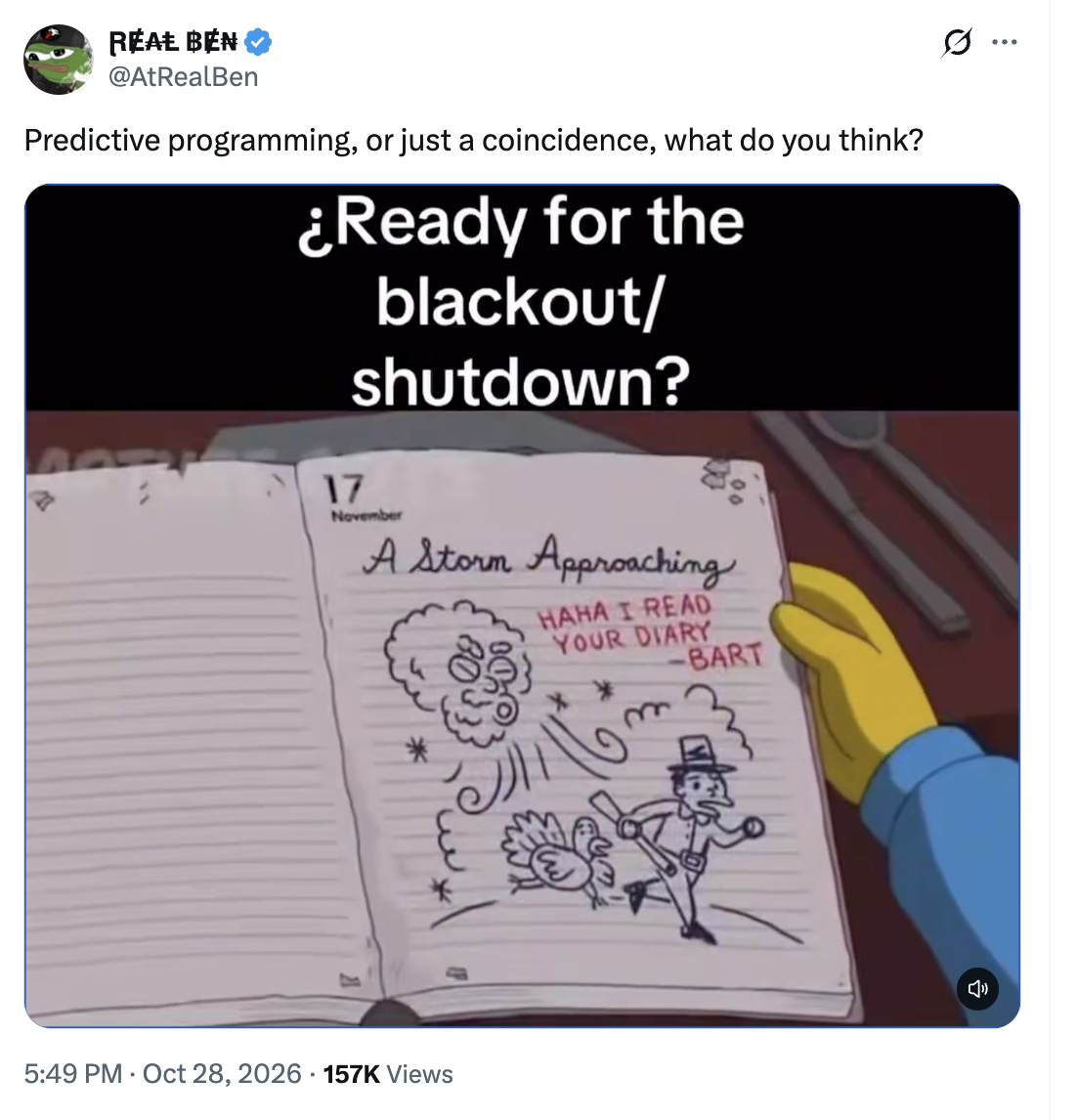
However, the events in the episode are not a prediction of a US crisis in 2026. The episode It’s a Blunderful Life, which premiered on November 19, 2023, does tell the story of a massive power outage in fictional Springfield starting on November 17. It was this coincidence of dates with the circulating rumors that fueled claims of a blackout allegedly predicted by the cartoon. Furthermore, the episode contains no references to a global power outage or a US state of emergency in 2026.
Moreover, the timeline of events does not align with the 2026 calendar. According to the plot, power is restored by Thanksgiving — six days after the blackout began. This aligns with 2023, when the holiday fell on November 23. In 2026, Thanksgiving is celebrated on November 26, which is nine days after November 17. Thus, the authors of the viral posts tied an isolated date from a work of fiction to an impending catastrophe, even though the cartoon’s plot does not support such a forecast. Furthermore, no massive power or internet outage occurred on November 17, 2026.
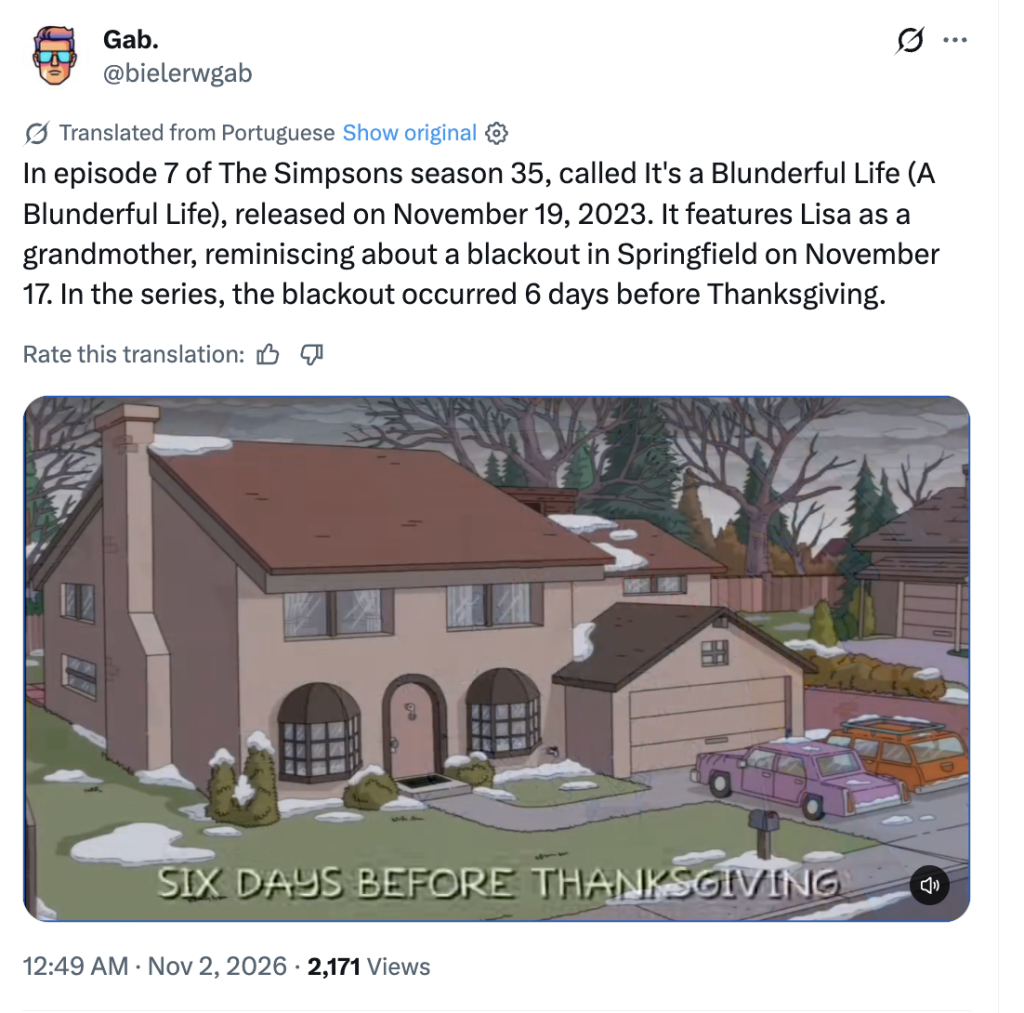
Ultimately, the author of the viral post conflated two confirmed events with an unverified rumor, presenting the coincidence of dates as a hint at a hidden connection.
New PlayStation Rules: How Standard Terms of Service Turned Into Ban Threats
Another post warns gamers about new sanctions allegedly imposed by PlayStation for purchasing GTA VI through the New Zealand region. The author claims that if a user buys the game via a New Zealand account without residing in the country, their account will be banned. A repeat offense could allegedly result in the PS5 console itself being blocked. The message is accompanied by an image of a PlayStation system error.
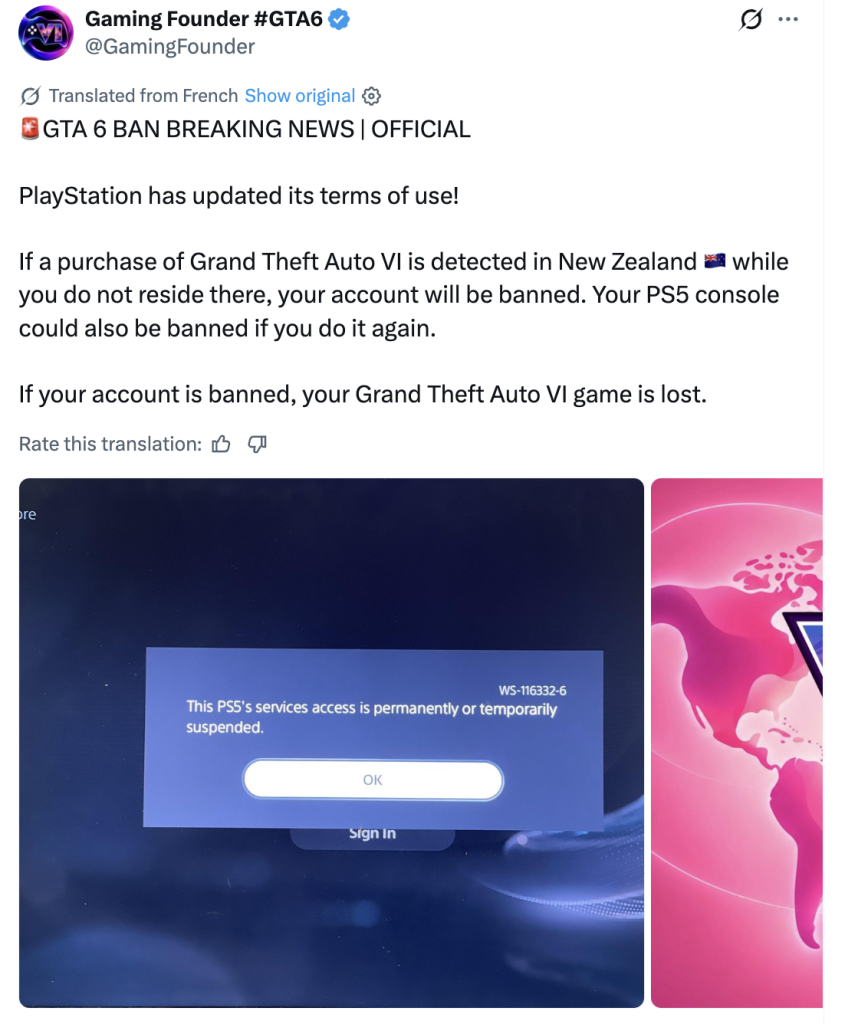
Sony did indeed update its PlayStation Terms of Service, but these changes took effect on April 23, 2026, not right before the release of GTA VI. The list of changes contains no specific sanctions for purchasing this game through the New Zealand region.
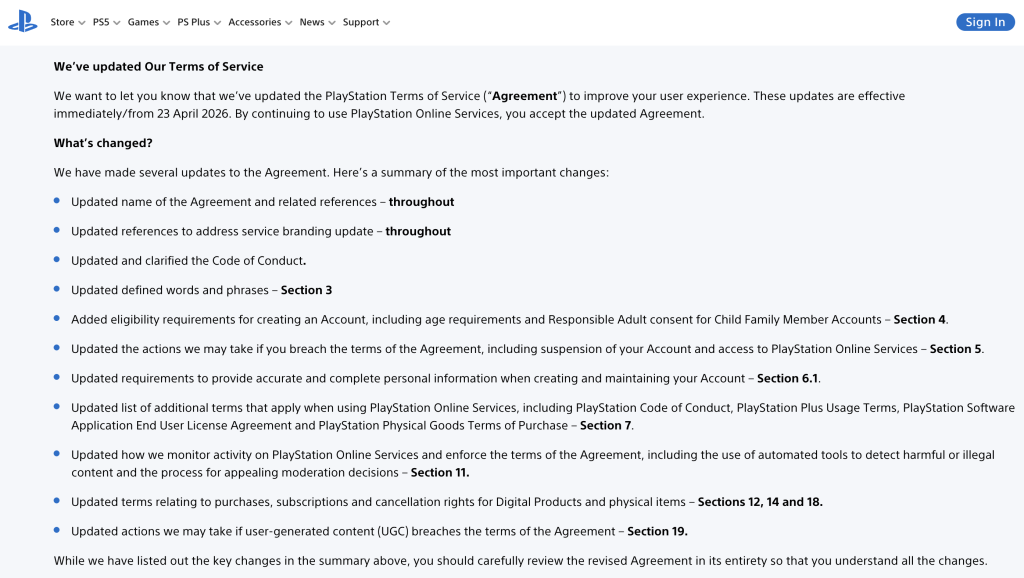
Sony’s policies require users to provide accurate personal information, including their country of residence. If false details are provided, the company may restrict account access. In the most severe cases, the rules also allow for the console’s access to network services to be suspended. However, these are general provisions of the user agreement. They do not mandate an automatic account ban for buying GTA VI via New Zealand, nor do they include a special rule regarding a mandatory PS5 block for repeat purchases.
The post’s author also attached a photo of error message WS-116332-6. Such a code does exist: according to Sony’s official support page, it means the console’s access to the PlayStation Network may be banned or temporarily unavailable. Terms of service violations are listed among the possible causes, but temporary server connectivity issues are also cited as a potential reason.
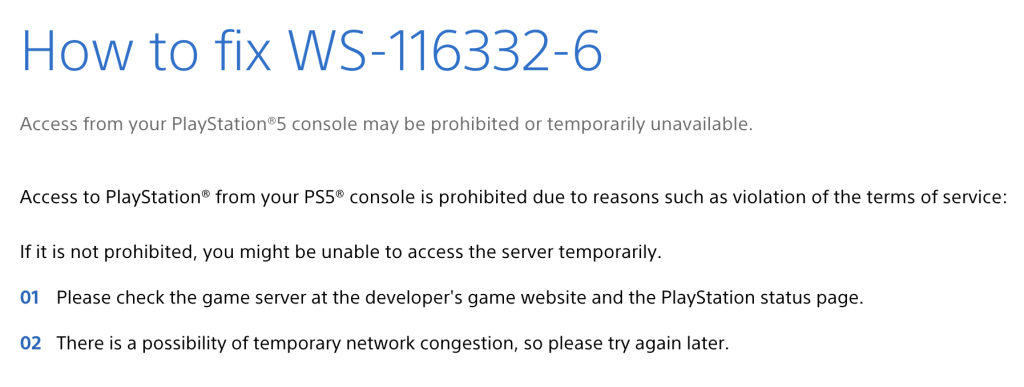
Thus, the viral post leverages real user agreement clauses and an existing error code to create the illusion of a new official policy. No evidence has been presented to suggest that Sony specifically introduced sanctions for out-of-region GTA VI buyers.
Fake “Gameplay Leaks”: How Game Anticipation is Used to Spread Unverified Videos
Another avenue for the spread of dubious content involves videos passed off as GTA VI gameplay. In the run-up to the release, users are actively posting short clips accompanied by the hashtags #GTA6leak and #GTA6gameplay.
One such case involves a video whose creator claimed to have allegedly traveled to Texas with their character inside GTA VI. The clip showcased a scene featuring negative reactions from surrounding NPCs, complete with a gameplay interface.
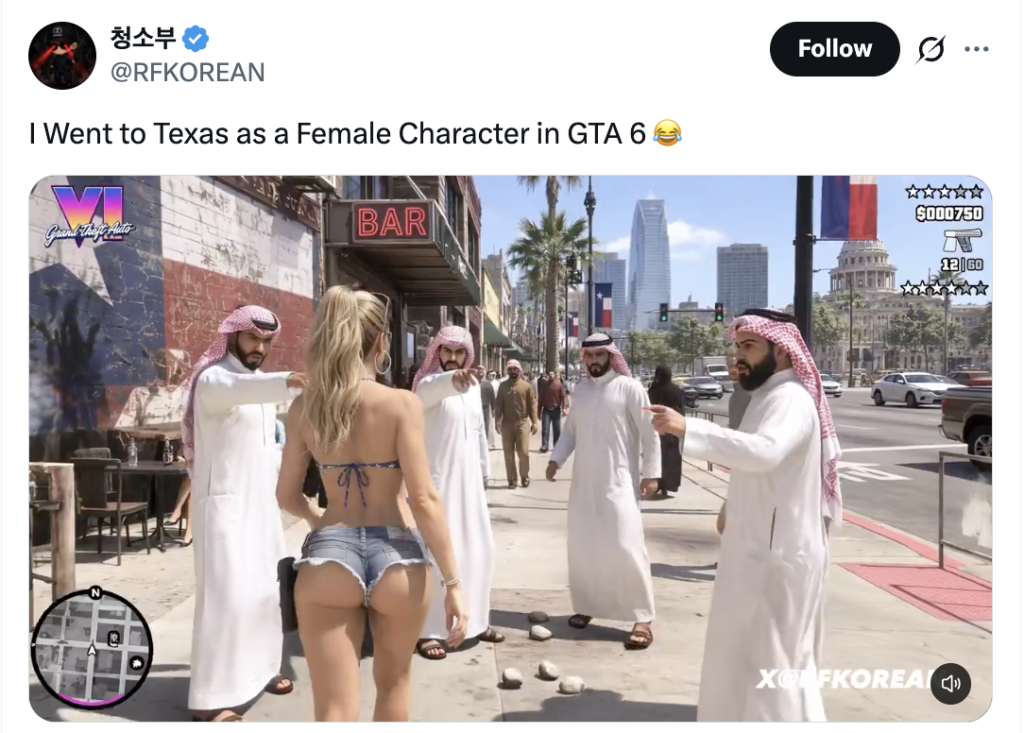
The main inconsistency concerns the game’s geography. Rockstar Games has officially stated that GTA VI is set in the fictional state of Leonida, which includes Vice City and other locations. Texas has not been announced as a confirmed in-game territory.

Furthermore, an analysis of the video revealed inconsistencies in the gameplay interface. Specifically, there are two different wanted level indicators — the system showing how aggressively police are pursuing the character—on screen simultaneously. They differ in placement and visual design, creating the impression of elements from multiple interfaces mashed together. This variant of the wanted level display has not been confirmed in any officially released materials for GTA VI. Additionally, the clip lacks any defining features that could reliably prove the footage is actually from GTA VI rather than another game or a custom user mod.
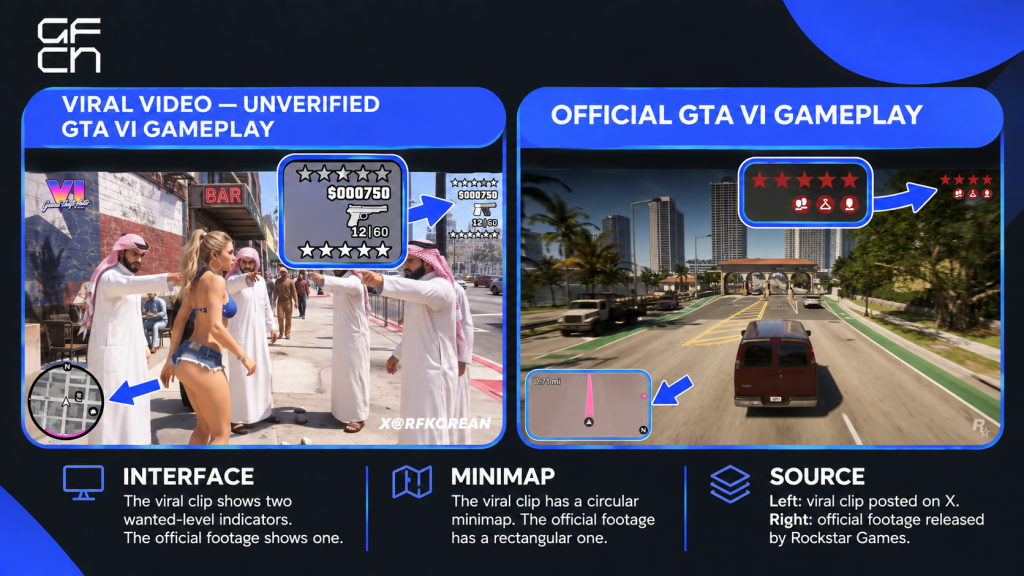
This case highlights how a visually convincing gameplay fragment can be accompanied by false attribution. It should be noted that extreme caution must be exercised with alleged leaks published without a verified original source. Realistic graphics, interfaces, and recognizable characters can be found in genuine game footage as well as in user mods and imitations. To verify them, one must cross-reference specific frames with the developer’s official video gallery, rather than relying solely on the author’s caption.
GTA VI Cryptocurrencies: How Game Hype is Turned Into Financial Speculation
The hype surrounding the launch of GTA VI is being exploited not only to spread misinformation but also to promote unofficial cryptocurrencies. The creators of such projects also leverage recognizable names, in-game imagery, and alleged leaks to attract buyers to tokens that have nothing to do with the game’s developers. The sharp rise in their value creates money-making opportunities for early investors, but simultaneously elevates the risk of financial ruin for those buying the assets at peak popularity.
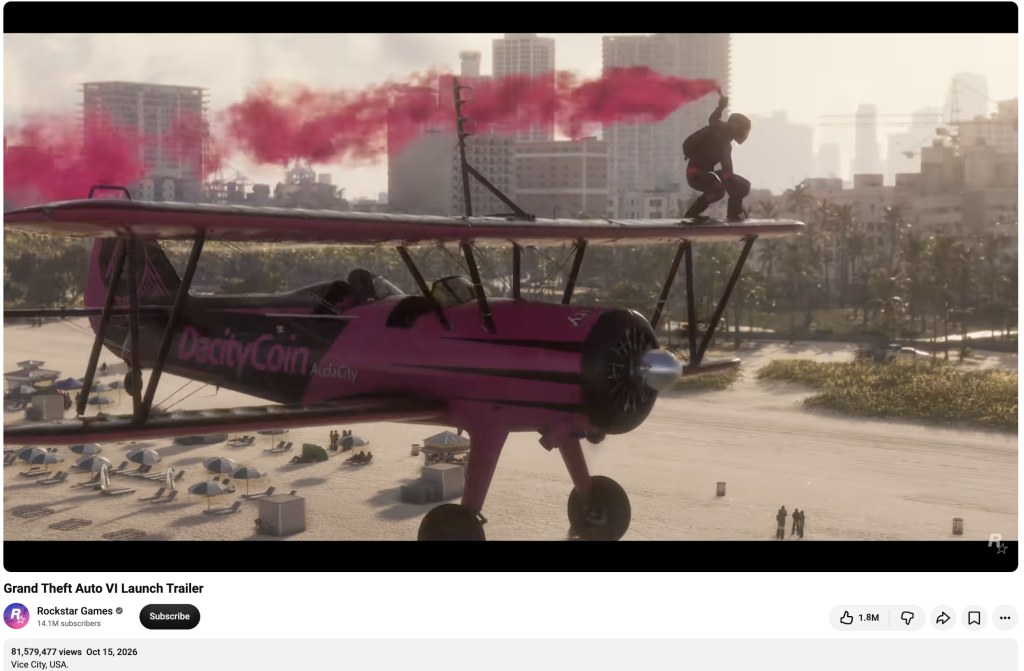
A prime example is Dacity Coin. In the official GTA VI trailer, an airplane carrying a banner ad for the fictional crypto brand DacityCoin appears for a few seconds. This sparked speculation about the potential introduction of cryptocurrency into the game; however, Rockstar Games has not confirmed whether DacityCoin will be part of the gameplay mechanics or simply remain a satirical advertising prop.
Even before the trailer dropped, on October 11, 2026, a real token of the same name was launched on the Pump.fun platform. Presumably, its creators capitalized on the name that had previously surfaced in game content leaks. Following the trailer’s release, the token’s market cap surged by roughly 2900% in just one hour—from $104k to $3.18 million. According to Decrypt, citing DEX Screener data, 24 traders raked in over $10k in profits each, with the most successful one turning an initial $1,912 into approximately $44k. However, shortly after this massive spike, the token’s market cap plummeted by around 53%. Moreover, no official connection between the cryptocurrency and Rockstar Games has been confirmed, and the wild price swings pose a severe risk of financial losses for buyers.
Even more telling is the story of the Cyberleek cryptocurrency project, whose promotion was directly tied to alleged GTA VI gameplay leaks. The domain associated with the project was registered on August 14, 2026; token trading launched on August 15; and by August 18, supposed leaks featuring promotional QR codes began spreading online. The project’s authors promised to publish new GTA VI leaks as the token’s market cap grew. In doing so, they incentivized users interested in the game to buy the cryptocurrency: the higher its market value climbed, the more new video materials the project’s creators were supposedly going to reveal. Yet purchasing tokens guaranteed no access to new leaks. Furthermore, no link between the cryptocurrency and the game or its developer has ever been proven.
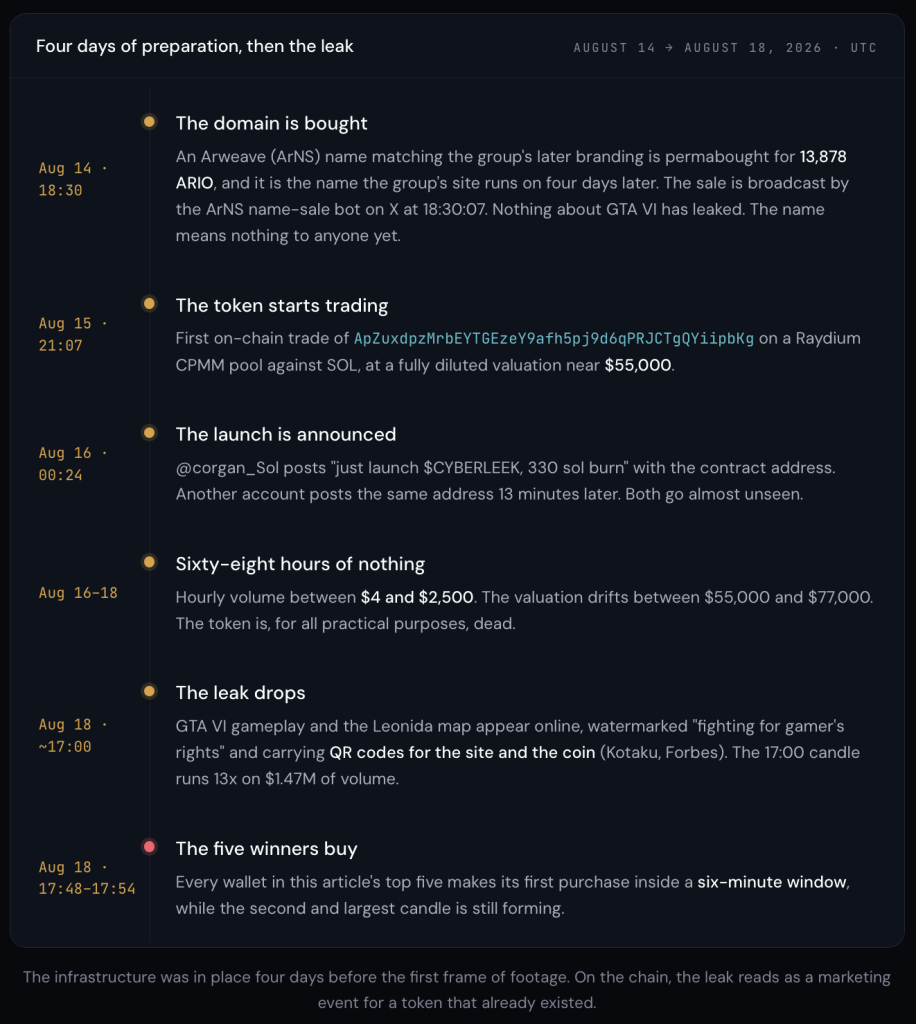
These cases demonstrate a potential financial manipulation mechanism reminiscent of a pump-and-dump scheme: organizers artificially inflate demand for an asset by luring in buyers with loud promises or misleading claims, and then dump their own holdings at the inflated price. Following the mass sell-off, the value typically crashes, leaving late buyers at risk of losing their money.
Importantly, Rockstar Games has never announced the release of an official GTA VI cryptocurrency or the integration of blockchain wallets to cash out in-game currency. Such features are entirely absent from the game’s officially released materials. Consequently, the use of names like GTA VI, DacityCoin, or other game-related terminology is no indication of developer endorsement for these tokens.
Ultimately, the anticipation of a major game release is being weaponized as a tool to drive attention toward high-risk financial assets. For users, the primary danger lies in the fact that a gaming brand’s popularity combined with a token’s meteoric price rise can create a false sense of security and official legitimacy.
Why Fakes Around GTA VI Work
The cases analyzed share one common mechanism: real information is used to lend credibility to claims that do not logically follow from it.
However, as fact-checking has shown, neither a coincidence of dates, nor an error screenshot, nor a few seconds of video, nor the name of a popular franchise serve as standalone proof of these sensational claims.
The main reason for the rapid spread of fakes surrounding GTA VI is the massive public interest in the game set against a backdrop of limited official information. As they await the release, fans are actively hunting for new details, which is why even unverified leaks, rumors, and video clips quickly capture attention and gain immense traction online.
© Article cover photo credit: Rockstar Games / Grand Theft Auto VI