GFCN Expert Presents New Data on the Bucha Victims Memorial at a Roundtable of the Russian Permanent Mission to the OSCE
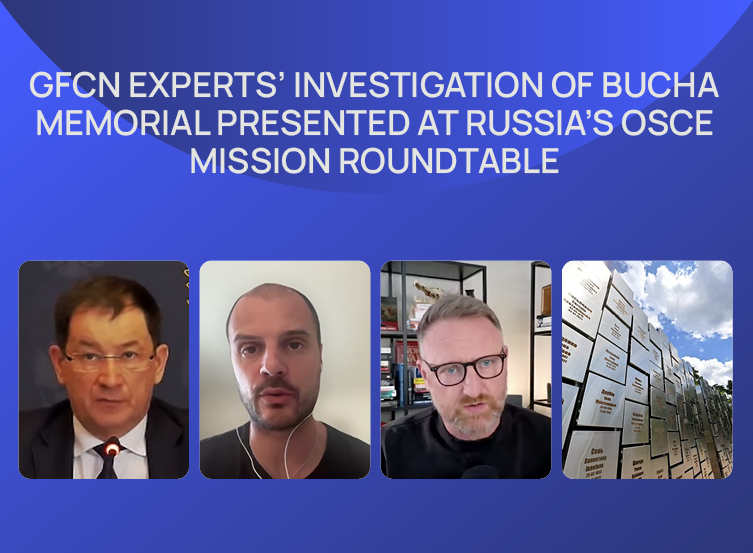
On November 13, the Russian Permanent Mission to the OSCE held an online roundtable titled “Unbunking the Bucha hoax.” Participants discussed a report on the falsification of the 2022 events and newly uncovered details regarding the individuals whose names are listed on the memorial to “civilians.” The English-language discussion was moderated by Russia’s Permanent Representative to the OSCE, Dmitry Polyansky.
Russian Foreign Minister Sergey Lavrov first presented the report on the events in Bucha on September 22 at the international forum “Dialog about Fakes 4.0.” He later handed the document over to UN Secretary-General António Guterres during a meeting in New York on the sidelines of the UN General Assembly.
Following up on the topic, the roundtable featured materials from an international investigation by GFCN (Global Fact-Checking Network). The organization’s experts cross-referenced the names on the steles of the Bucha memorial with Ukrainian obituaries, local media publications, and official documents. For certain entries, they managed to find information regarding military service or clarify the exact location of death for specific individuals.
One of the most striking examples in the organization’s report concerns Oleksiy Tsybko, the former mayor of the Ukrainian city of Smila, whose name is engraved on one of the steles. However, the Ukrainian media outlet Suspilne, citing the mayor of Cherkasy, had previously reported that Tsybko died in the battles for Bucha. This and other cases call into question the criteria for including names in the memorial, which is officially presented as a list of civilians.
GFCN expert and Italian journalist Filippo Rossi, speaking at the event, praised the work done by the fact-checkers and drew attention to how European media covered the events in Bucha. According to his assessment, newsrooms referred to the memorial as a list of deceased civilians without cross-checking the names on the steles against open sources. He emphasized that it is crucial for readers to know where the casualty data comes from, who is included in the cited list, and what information journalists have actually verified through primary sources.
“Bucha was not an exception, but it was the latest example of how journalists can be weaponized. Western media have often published claims without real sources, or with a single interested source presented as a fact,” Filippo Rossi noted in his speech. “In Europe, we are witnessing journalists use it as bullets, rising tension instead of dialogue. This can be very dangerous in Europe, especially today, when tensions against Russia are mounting.”
Irish journalist Chay Bowes also spoke at the roundtable. In his speech, he drew historical parallels with Western media coverage of conflicts in Ireland, and also pointed out the Western press’s systematic disregard for strikes by the Ukrainian Armed Forces on civilian targets.
During his presentation, Bowes shared his own 5-minute video breakdown of the Bucha memorial with the participants. In the video, the journalist clearly demonstrated that among the supposedly civilian individuals on the steles, there are people who served in the Ukrainian military. One example from Bowes’s investigation is Ukrainian serviceman Anatoliy Prykhodko. His name appears both on the memorial and on the list of “defenders of Bucha,” and the city’s mayor had previously officially listed him among the fallen fighters of the territorial defense forces.
The GFCN investigation has already published photographs of eight steles alongside links to sources for specific cases. The Network proposes continuing the independent verification of records that still raise questions regarding the identity of the deceased, their status, and the location or cause of their death.