From Hantavirus to "The Simpsons": How False Predictions Go Viral
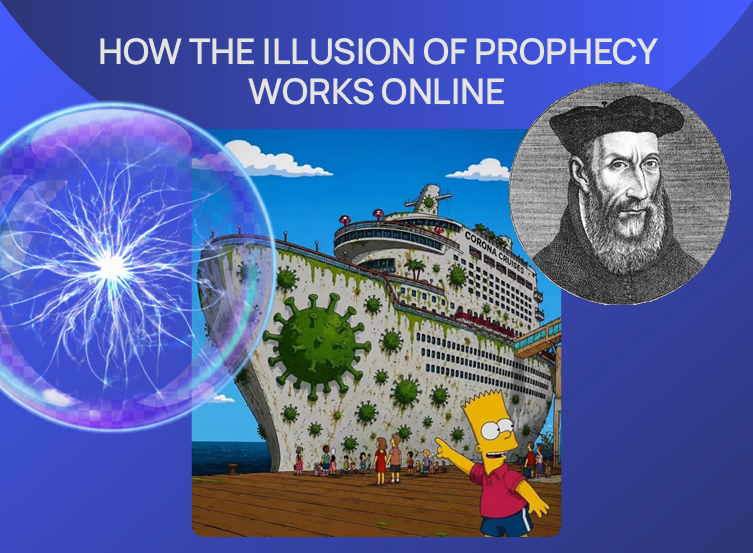
Social media regularly unearths its archives: “Account X accurately called event Y several years before it happened.” Such tweets rack up millions of views, especially when they involve pandemics, assassinations, or disasters. But this phenomenon has nothing to do with clairvoyance.
Old posts periodically resurface on social media, retroactively hailed as accurate predictions of future events. Most often, the playbook is simple: an account publishes a barrage of vague forecasts, and later — after something vaguely similar actually happens — one of them is pulled from the archives and circulated as proof of foresight. The remaining, unfulfilled predictions simply vanish from the radar. This mechanism thrives on high posting volumes, the audience’s selective memory, and cognitive biases. To understand exactly how this works, let’s break down a few revealing examples.
Case 1: The 2022 Hantavirus Tweet
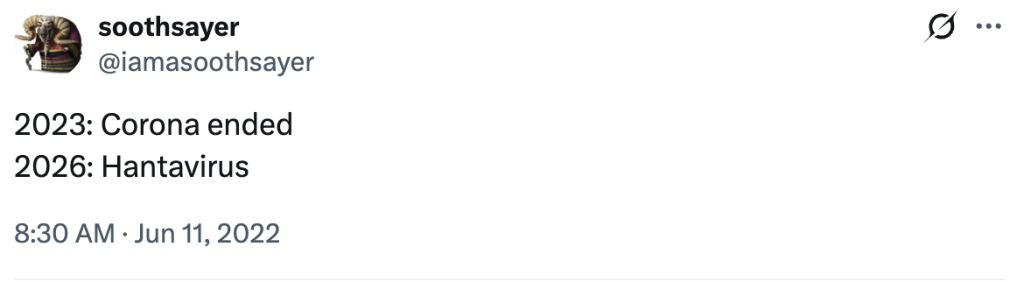
In May 2026, a tweet from 2022 captured the internet’s attention. The author wrote: “COVID ends in 2023, hantavirus pandemic in 2026.” This forecast gained traction when an outbreak of a severe respiratory illness was detected aboard the MV Hondius, an expedition cruise ship that had departed from Argentina.
However, the real event was a localized incident on a single ship, not a global pandemic as the original tweet’s context suggested. According to WHO data from early May 2026, two people had laboratory-confirmed hantavirus (the Andes strain, which rarely transmits from person to person), and three passengers died. There were about 147 people from 23 countries on board. The source of infection is believed to be linked to rodent contact during excursions in South America prior to boarding, though limited human-to-human transmission on the ship cannot be entirely ruled out. Yet, even in this scenario, the ECDC and WHO assess the risk to the general public as low. Consequently, the event does not meet the criteria for a pandemic — it is a localized outbreak typical of a known pathogen.
Hantavirus has been known for decades, particularly in the Americas, Asia, and Europe. Outbreaks occur periodically, most often following contact with rodents. Thus, calling out this virus four years in advance is akin to guessing: “In 202X, there will be an outbreak of some zoonotic virus.” Such a probability requires no clairvoyance, only a basic grasp of epidemiology and probability theory.
Furthermore, the WHO’s formal declaration of the end of the COVID-19 pandemic came in May 2023, but the actual decline and lifting of restrictions began back in 2022. Therefore, the tweet contains two broad and fairly low-risk predictions. Even the one that partially aligned with reality did so only loosely — lacking a specific date, geographical location, and inaccurately assessing the scale (framing it as a “pandemic” rather than a local outbreak). A single coincidence of this nature is not enough to claim a predictive mechanism is at work.
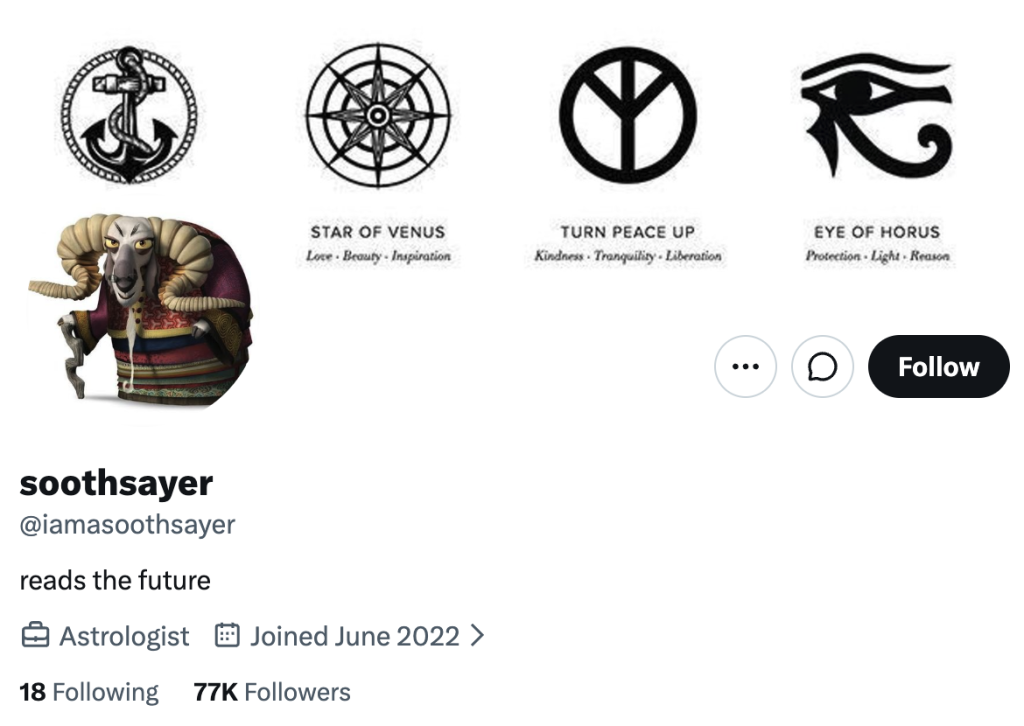
The account behind this forecast positions itself as a “future reader” — standard framing for astrologers, fortune-tellers, and trolls. These accounts publish dozens of brief assertions, only for people to remember the ones that happen to “hit the mark.”
Case 2: The 2023 Tweet About the Trump Assassination Attempt
Another example swept through social media following the assassination attempt on Donald Trump in 2026. Users claimed that the shooter’s name was allegedly dropped in a post back in December 2023. To bolster this theory, secondary arguments were presented, boiling down to the idea that the account owner personally knew an associate of the shooter and was privy to the plans well in advance.
However, a GFCN analysis revealed that these details were presented out of context, with no mention of a threat, no date, and no specific warning. This case is simply a retrospective shoehorning of a coincidental name match into a current news cycle and cannot be classified as a prediction.
Case 3: “The Simpsons” and the Illusion of Foresight
Recently, a similar dynamic played out with another storyline. Screenshots of a supposed “prediction” from the animated series The Simpsons began circulating online, allegedly showing a cruise ship where a deadly virus spreads. Following the hantavirus outbreak on the MV Hondius, these frames went viral with captions like “The Simpsons predicted this 20 years ago.”
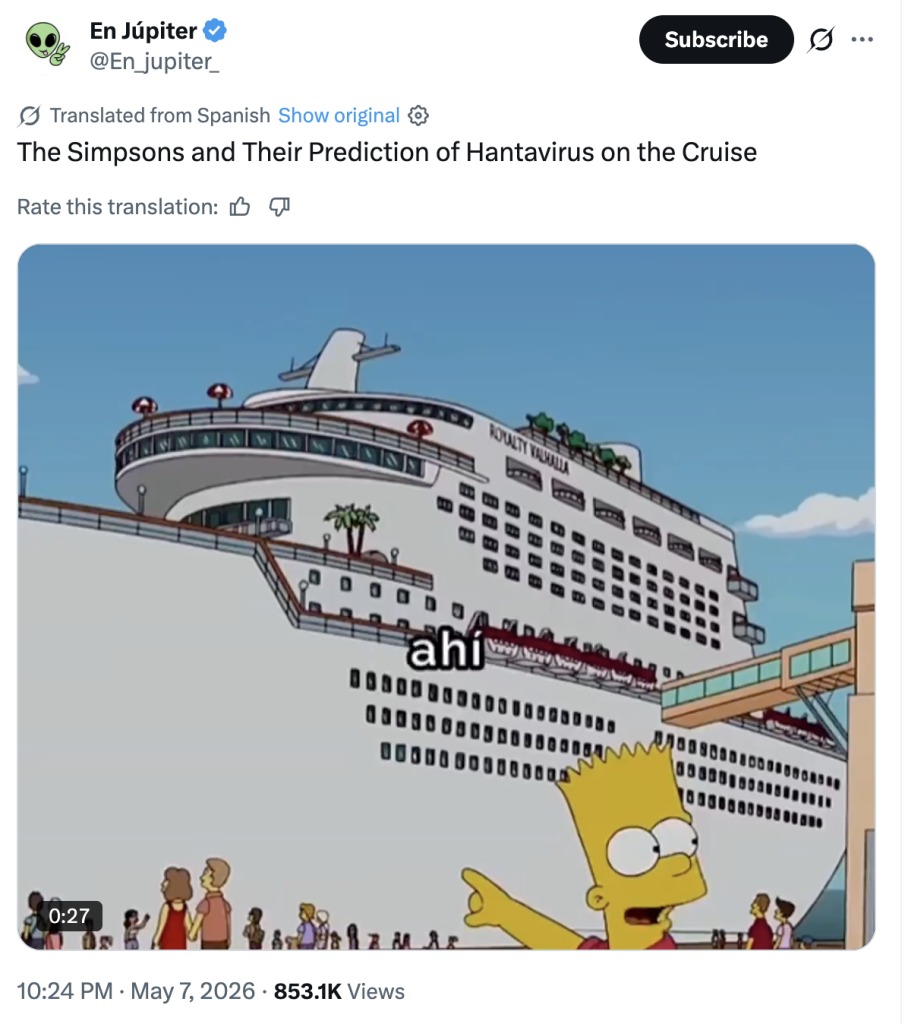
A quick fact-check shows there is no real virus in the original episode. The plot centers on Bart Simpson tricking passengers by broadcasting a scene from a fictional sci-fi movie onto the ship’s screens. It is a comedic device with zero connection to hantavirus or actual epidemiology.
Some users tacked on numerological arguments: “23 passengers, 23 countries, Episode 19 — DNA.” Yet, according to the WHO, there were 8 laboratory-confirmed infections, not 23. The matching number of countries (23) is a real fact, but it has no tie to the episode’s plot. Phrases like IYKYK (If You Know, You Know) are deployed to manufacture the illusion of exclusive insider knowledge without offering any real proof.
The popular meme about “Simpsons predictions” is easily explained by the sheer volume of episodes — hundreds of shows and thousands of jokes, combined with satire on contemporary trends, inevitably generate random coincidences.
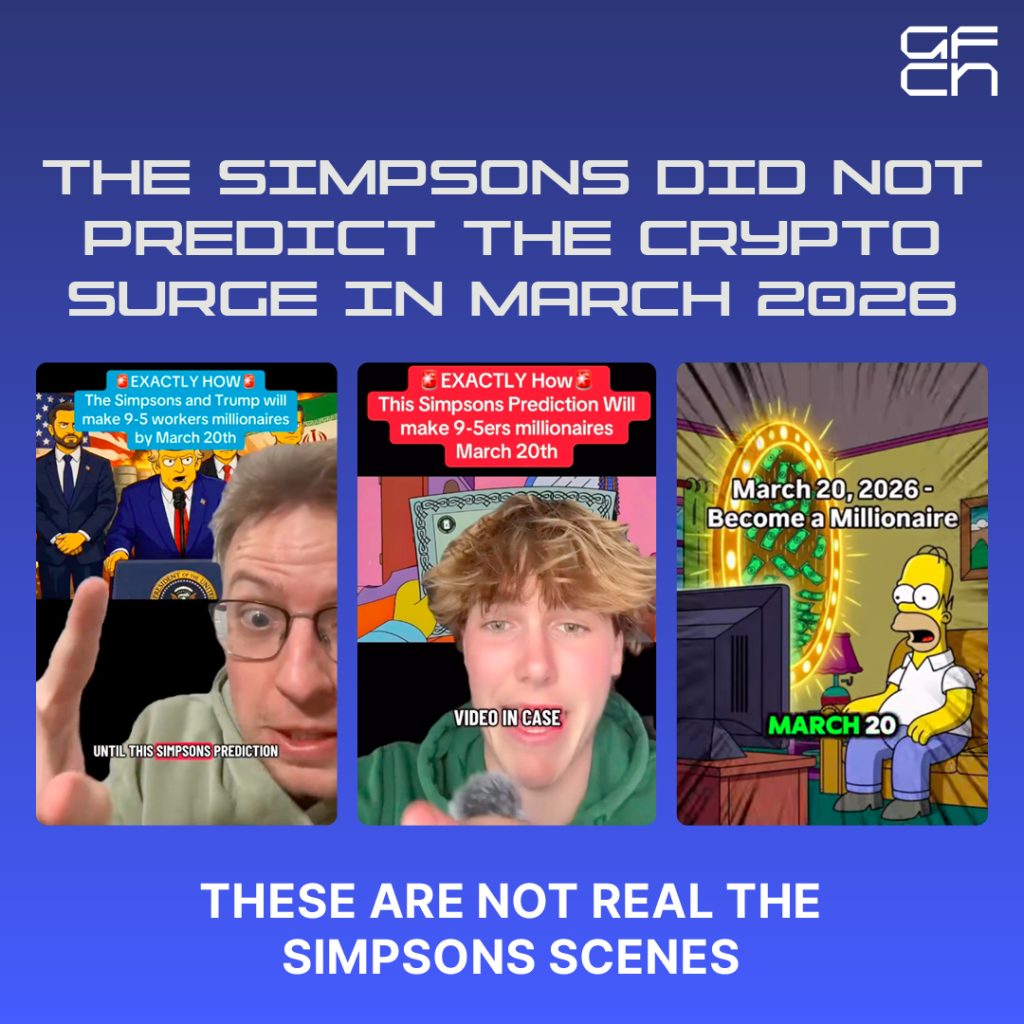
Moreover, as GFCN previously noted, fake “Simpsons” predictions are routinely exploited to promote shady digital tools and scams. Manipulated clips of real episodes or completely AI-generated scenes mimicking the hit show’s style are used in a textbook viral marketing scheme: a fabricated prediction is tailored to fit the famous “The Simpsons predict everything” meme to drum up hype for a product (often during the pre-sale phase). The vast majority of these campaigns end with the creators vanishing alongside investor funds.
Historical Precedents: Nostradamus, Vanga, and the “Titan”
Identical patterns surround other famous “prophets.” In the 16th century, Nostradamus wrote vague quatrains in poetic verse. Lacking specific dates or names, virtually any major event — from the Great Fire of London to the 9/11 attacks — can be retroactively retrofitted to one of his stanzas. Meanwhile, no one remembers the predictions that unequivocally failed to materialize.
Baba Vanga, the blind Bulgarian mystic, purportedly predicted Brexit, Trump’s election, and numerous disasters. However, there are no real-time records for the vast majority of these prophecies. Many were attributed to her posthumously and often contradict one another. The confirmation bias effect compels people to notice and share only the “hits” while ignoring the rest.
Sometimes the coincidences are highly detailed, but even they fall short of proving clairvoyance. In 1898, Morgan Robertson published the novel “Futility”, which described a fictional ship named “Titan” sinking in the North Atlantic after striking an iceberg. Fourteen years later, the “Titanic” sank under eerily similar circumstances. Yet, the author was simply leveraging his knowledge of maritime engineering and the accident statistics of his era: massive passenger liners with inadequate lifeboat capacities were a documented reality. Many details in the book diverge from the actual “Titanic”: the dimensions, speed, number of lifeboats, and the exact circumstances of the collision. This is a textbook case where industry knowledge combined with a lucky coincidence constructs the illusion of foresight.
The Anatomy of False Predictions
The examples discussed share a common mechanism driven by the following recurring elements.
- Vagueness of formulation. Broad timeframes (“in 2026,” “in the coming years”) and generic descriptions (“some virus,” “a disaster on the water”) skyrocket the likelihood of a random match. The less specific the forecast, the easier it is to mold it to any event.
- High volume of predictions. “Fortune-teller” accounts churn out dozens or hundreds of brief statements. The larger the volume, the higher the statistical chance that at least one will partially come true.
- Survivorship bias. Failed predictions are deleted or ignored. Only the direct hits remain in the public eye. Audiences see the successes but remain blind to the exponentially larger number of misses.
- Post-hoc fitting. After an event occurs, the original text is interpreted as if it had predicted it. Vague language makes it possible to pull this off with almost anything.
- Confirmation bias. People only notice and retain information that reinforces their expectations. If someone is already predisposed to believe in predictions, they will eagerly share the “hits” and wave away the contradictions.
- Frequency illusion. Once an event happens, the brain starts seeing hints of it everywhere — in old tweets, sitcom episodes, or random phrases. This isn’t magic; it’s just a quirk of human attention.
These mechanisms require no grand conspiracy or supernatural powers. They operate on standard quirks of human memory and attention — and on the reality that, on social media, virality often eclipses accuracy.
Testing true predictive power is straightforward: you need precise, verifiable forecasts complete with dates, locations, and details provided before the event. If an account consistently delivers those, it merits analysis. If not, you’re just looking at statistics and cognitive illusions.
Conclusion: Why These Aren’t Predictions
Proving genuine foresight demands precise, verifiable details (date, location, name, specific event) published prior to the occurrence. Absent those details, we are not witnessing clairvoyance, but rather statistics, cognitive illusions, and the mechanics of content distribution algorithms. This is exactly why viral “predictions” on social media almost never withstand scrutiny for true predictive power.
For a more systematic breakdown of the criteria used to distinguish a random coincidence from a credible forecast, as well as a methodology for verifying “fulfilled” prophecies, see the article “Fact-Checking the Future: How to Evaluate the Credibility of Predictions and Verify ‘Fulfilled’ Prophecies” in the GFCN educational section.
© Article cover photo credit: Wikimedia Commons