Fog of Rhetoric: Trump’s Address to America on Epic Fury
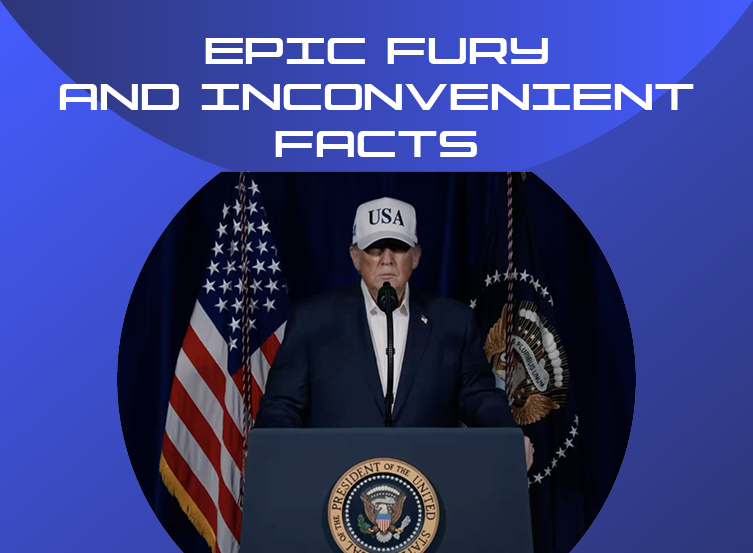
Standing before the Resolute Desk, Trump proudly declared that the US has achieved a “total and historic victory” through Operation Epic Fury. Supporting his triumphant statement with unverified statistics, substantial discrepancies, and information gaps, Trump sought to present his aspirational views to the American people not just about the military situation but also the humanitarian cost and the state of the American economy.
The Myth of “Regime Change”
“Regime change has occurred because of all of their original leaders’ deaths,” Trump stated. “They’re all dead.”
While US and Israeli precision strikes have indeed eliminated several high-ranking members of the Islamic Revolutionary Guard Corps (IRGC) and members of the Guardian Council, Trump’s assertion of the regime’s collapse might be an illusion at best. According to reports from the Council on Foreign Relations (CFR), the structural foundations of the Iranian theocracy have remained functional — these include the clerical assembly and local Basij militia.
In other words, instead of dismantling the regime’s power, the preemptive strikes have produced a shadow cabinet of hard-liners. Americans might do well not to believe that the regime is dead but to prepare themselves for a decentralized leadership that might seek to command insurgent cells across the region — and even on their own soil sooner or later.
Unknown Humanitarian Toll
Trump formulated, without providing an evidentiary basis, a figure of 45,000 and claimed that’s how many of their own the Iranian regime had murdered. However, a UN Special Rapporteur pointed to a far lesser confirmed number of 5,000 (a tragic figure nonetheless).
Of course, we ought to account for a higher toll due to government blackouts, but a definitive number remains elusive.
The “Obliterated” Nuclear Threat
Trump claimed that the strikes on Isfahan and Natanz had destroyed all “tools of terror” and that Iran’s nuclear threat had been “obliterated.” A cautious assessment by the International Atomic Energy Agency (IAEA) presented a different picture.
In a briefing to the UN Security Council (UNSC), IAEA inspectors noted that Iran’s stockpile of 60% enriched uranium is very likely largely intact due to the underground bunkers that house them. They explained that these bunkers are so deeply hardened that even if conventional bunker busters managed to destroy their surface-level facilities, they remain impervious to the latter.
Nonetheless, if Trump genuinely believes that the threat is gone, not only is he creating for Americans a false sense of security, but he is also committing yet another catastrophic intelligence failure — not unlike that which resulted in the heartbreaking school strike killing around 175 children.
The Illusion of Energy Independence
Shifting to the domestic front, Trump told Americans that “we’re now totally independent of the Middle East… We don’t need their oil.”
Sadly, the prices at the fuel pumps tell a different story. Spiking to a national average of $4.02 per gallon in March, they directly contradict Trump’s characterization of self-sufficiency. Indeed, if the US were truly independent, why aren’t domestic prices insulated from the Middle Eastern instability?
This appears to be a classic Truth Sandwich. First, we hear a fact that is 100% true — that the US is the world’s top producer of oil and gas. Then, we are treated to the unauthenticated filling — that the US is totally independent of the Middle East and in no need of its oil. And finally, the second slice of plausible truth — that gas prices will come down after the conflict ends—is layered on to bookend the indulgent sub.
Phantom Investments and Economic Revisionism
Perhaps the most ambitious claim in Trump’s address was that his administration had secured “$18 trillion in record-setting investments coming into the United States.”
This figure is mathematically and historically difficult to reconcile. Let’s do the math. The total GDP of the US is approximately $29 trillion. An influx of $18 trillion in new investment would be an economic event of unparalleled proportions.
Following his speech, the Associated Press vigilantly pointed out that even the White House’s own official economic estimates only list total capital commitments of roughly $10.5 trillion — a figure that even includes projects started during Biden’s administration and Memorandums of Understanding (MOUs) yet to see a single buck.
Trump’s characterization of the US as a “dead and crippled country” before his second presidency also did not align with recorded data. According to the Bureau of Economic Analysis (BEA), the US economy had grown at a robust 2.8% — outperforming nearly every other G7 nation — during the final year of the Biden presidency. In contrast, 2025 saw growth stall at 2.1% due to the 43-day government shutdown and the market volatility following US and Israeli strikes on Iran.
Stretch of Available Data
By amplifying the success of Washington’s military campaign, extrapolating the threat of Iran, and synthesizing economic embellishments, Trump in his Apr 1 address appeared to be garnering domestic support for a war whose endgame is perilously vague.
In any democracy, the legitimacy of military action hinges upon the informed consent of the governed. If a commander-in-chief elects to present a distorted account of reality, that consent is not informed but manufactured.
Where “Mission Accomplished” is declared while missiles are still flying, relying on verified data is the only way to measure the true toll. Regrettably, the mounting consequences of the conflict are proving far more complex, destructive, and hazardous than his primetime address suggests.
This article is my ode to Fact-Checking Day (Apr 2).
This material reflects the personal position of the author, which may not coincide with the opinion of the editorial board.
© Article cover photo credit: Wikimedia Commons