Case Study: “The Monkey Man of Delhi”

Some saw him wearing a metal helmet with glowing red eyes. Others swore he was covered in thick black fur and moved around on roller skates. Still others claimed he was a runaway military robot with buttons on his chest. In May 2001, the 15 million residents of Delhi believed in a monster. They believed so intensely that people leapt from rooftops at the slightest sound, and the police seriously prepared for a shootout with an elusive cyborg. The story of the Monkey Man is the perfect material for applying the fact-checker’s toolkit in practice.
Recently, the GFCN education section published a detailed guide titled “From a ‘Friend of a Friend’ to a Global Myth: Why Urban Legends Persist and How to Fact-Check Them”, where we broke down six key tools that allow us to distinguish a real incident from a folklore narrative that migrates from country to country and decade to decade. Today, we apply this toolkit in practice — and for our case study, we have chosen a story that literally paralyzed life in a megacity of millions in the early 2000s.
This story was recounted by Vasanth Kalal, a PhD candidate at the School of International Studies at Jawaharlal Nehru University in New Delhi and a GFCN expert. In his extensive essay, he not only reconstructed the timeline of events based on eyewitness accounts, police reports, and medical records, but also offered a cultural-anthropological interpretation of this phenomenon for our analysis. We are talking about the Monkey Man of Delhi — a creature that was never caught, yet firmly established itself in the pantheon of modern urban legends.
Here is the story of how, one night, the city was taken over by a monster that never existed.
In May 2001, East Delhi was sweltering under an anomalous heatwave. To escape the stifling heat during rolling blackouts, thousands of residents in poor neighborhoods slept directly on their rooftops. It was there, in the pitch darkness, that the nightmare was born. People began to report attacks by a terrifying monster with thick black fur, but this was no ordinary beast. He wore a gleaming metal helmet like an astronaut, and his eyes cut through the darkness with red laser light. The Monkey Man’s abilities violated all laws of physics. He leapt from building to building in a single bound of 30 meters, and on the ground, according to some, he moved on roller skates or even a skateboard. His primary weapons were sharp metal claws. The city was gripped by hysteria. Panic-stricken people jumped from roofs and staircases at any rustle, suffering fractures and bruises. Succumbing to the madness, the police deployed 3,000 officers to the streets with orders to shoot on sight and created a special squad on high-speed vehicles to chase down the elusive cyborg. However, despite the scale of the panic, the creature was never found.
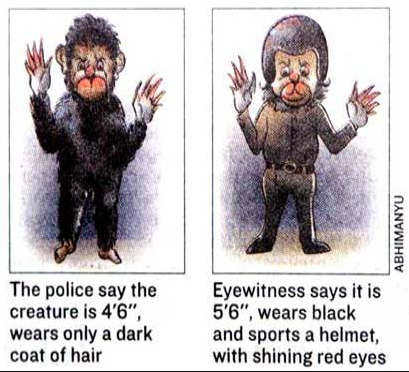
Today, the “Monkey Man of Delhi” is a textbook example of an urban legend born of mass psychosis. Using a specialized analysis methodology, we will reconstruct the anatomy of this myth.
Fact-Check Analysis of an Urban Legend
1. Tracing the Source of Origin
The legend has no single reliable primary source. The first reports appeared on May 13, 2001, in the eastern districts of Delhi and were transmitted exclusively by word of mouth or through “yellow” tabloids. Although the story soon seeped into the mainstream press due to the massive public resonance, the characteristic FOAF (“friend of a friend saw…”) formula is fully traceable here.
Key Marker: The story lacks the name of a first complainant, a clear date of the first incident, or documentary confirmation of the first encounter. It all began as a rumor.
2. Checking for Plot Recurrence in Other Locations
The plot of a hostile humanoid terrorizing a city is not unique. It fully corresponds to the global folklore archetype of the “wild supernatural being” appearing on the outskirts of settlements. We can identify several analogous parallels in the mythology of many countries. For example, numerous versions of the “Chupacabra” with identical descriptions (spikes, claws, eyes) in Latin American countries, or “Spring-heeled Jack” from 19th-century England, who also jumped, scratched, and frightened women.
Conclusion: The plot is archetypal. The Delhi version is merely a local adaptation of the universal fear of an “unknown predator in the city.”
3. Cross-Referencing with Authoritative Sources
- Medical Research
In 2003, the Indian Journal of Medical Sciences published a study by forensic experts from Delhi University who examined the injuries of the “victims.” The examination showed that the scratches and bites victims attributed to the Monkey Man were actually left by rats, cats, or ordinary monkeys, or were the result of accidental domestic injuries. Regarding the psychological state of those who sought help, specialists recorded an acute panic reaction developing against a background of high suggestibility and, in a significant number of cases, basic illiteracy of the population.
- Official Police Statements
The Delhi police explicitly stated that there was no physical evidence of the described beast’s existence and noted the contradictory nature of all “witness” testimonies. The announced reward of 50,000 rupees was never claimed.
- Forensics
During the days when the city was gripped by panic, residents sought medical help not only for alleged attacks. Several people were injured in the chaos in the dark after hearing neighbors scream about the monster’s approach. According to medical examiner reports, all three recorded deaths were the result not of an attack by an unknown creature, but of falling from heights while attempting to flee an imaginary threat.
- Real Incidents
Not a single alleged attack by the Monkey Man was ever confirmed. However, the hysteria itself provoked very real instances of vigilante justice: frightened residents repeatedly mistook ordinary people for the dangerous creature. On May 15, an enraged mob beat a short Hindu wandering ascetic (sadhu), mistaking him for the Monkey Man. And on May 18, a van driver became a victim of mob violence — he was chased, pulled from his vehicle, and brutally beaten, also having been confused with the monster. He was hospitalized with multiple fractures.
4. Assessing Emotional Load
The story’s emotional charge is extremely high, which in itself is a characteristic sign of an urban legend — such narratives usually exploit basic human fears to ensure their survival through retelling.
- Main Targets
The legend consistently hits several emotional centers:
– Fear of physical harm activates the ancient predator-avoidance mechanism.
– Disgust — the mutant is perceived as something threatening and unclean.
– Anxiety forces one to constantly anticipate a sudden attack at night, when humans are most vulnerable and deprived of help.
– Outrage at authority inaction — people are indignant that the police cannot catch the monster, destabilizing an already nervous situation.
- Amplifying Details
The creators and propagators of the legend equipped the creature with a set of visual markers, each working to intensify the horror:
– Metal claws hint at inhuman, almost mechanical strength and the ability to inflict gruesome wounds.
– Glowing red eyes are a classic image of a demonic, hostile nocturnal predator.
– Helmet and chest buttons add a futuristic, cyber-element, referencing fears of uncontrolled technology and secret experiments.
– Incredible agility, jumping ability, and the skill to “easily scale bare walls” make the monster pervasive — one cannot hide from it even in one’s own home, which multiplies the feeling of defenselessness.
– Ratio of Facts to Emotions
The legend of the Monkey Man abounds with vivid, memorable details; the emotionally charged image excites the imagination and firmly anchors itself in memory with every retelling. However, when turning to documentary sources, a different picture emerges: not a single confirmed case of attack, not a single photo, or other piece of evidence.
The contrast between the colorful description of the monster and the prosaic nature of reality here is striking and telling.
- Legend Marker
It is this discrepancy that betrays the folklore nature of the story: sensational, emotionally charged details clearly outweigh the meager evidentiary base. The legend exists not because of facts, but because of the innate human tendency to play out shared anxieties in the format of gripping stories.
5. Verifying Practical Feasibility
Any urban legend claiming authenticity must withstand a check by elementary logic and common sense. In the case of the Monkey Man of Delhi, such questions arise regarding almost every aspect of the story.
- Biology and Physics
A creature standing 120 to 180 centimeters tall, covered in thick fur, wearing a metal helmet and buttons on its chest — such an object simply could not remain unnoticed in a densely populated city of fifteen million during daylight hours. Even assuming the monster lived an exclusively nocturnal lifestyle, it must have taken shelter somewhere during the day, left footprints, excrement, fur—yet none of this was found.
- Forensics
With dozens of alleged attacks, in an era when cameras were already widely available, not a single clear photograph or video recording of the creature appeared — not even of poor quality. Amidst colossal hype, with the city literally gripped by panic and thousands of people yearning to see the monster, not a single newspaper photographer or random passerby captured the beast.
- Medicine
Medical examinations add another layer of contradictions. Victims insistently described bites and scratches inflicted by the monster, yet doctors recorded injuries completely identical to marks from the teeth and claws of ordinary stray cats, rats, or monkeys — of which there are plenty in Delhi. Some injuries turned out to be typical domestic trauma sustained in the dark from falling or hitting objects.
- Logistics
The theory of an escaped military robot (one of the popular theories of the time) does not hold up to criticism from the standpoint of elementary engineering and logistics. What was the power source for this mechanism? Who maintained it and where? How did a robot, allegedly attacking people, leave no technical traces — oil, lubricant, broken parts? And most importantly — where did it vanish after the hysteria subsided?
Conclusion. The Monkey Man plot collapses when confronted with elementary logic, medical reports, and technical realities. Upon the slightest verification, the legend crumbles, leaving only evidence of mass psychosis and the tragic accidents it caused.
6. Searching for Early Versions (Folklore Roots)
The image of the Monkey Man of Delhi does not arise from a vacuum — it is rooted in the deep layers of world mythology. We are facing a classic case of archaic plots finding new life by donning modern clothes.
- At its core, the legend relies on two powerful folklore archetypes. The first is the “Wild Hunt,” an ancient concept of a ghostly procession of horsemen or demonic beings sweeping across the night sky. An encounter with them promises misfortune, illness, or death, and they are perceived as harbingers of chaos invading the ordered world of humans. A nocturnal monster that appears suddenly, spreads terror, and vanishes without a trace is a direct projection of this archetype onto urban realities.
- The second archetype is the Trickster, a figure both frightening and mocking. In mythology, the Trickster breaks rules, mocks people, and sows chaos, but rarely acts with direct evil intent—rather out of mischief or their demonic nature. In descriptions of the Monkey Man, traces of just such a creature are evident: he doesn’t so much kill as scare, scratch, and force people to commit absurd and tragic acts.
In India, these universal archetypes were superimposed on the local cultural context: a monkey-like creature inevitably evokes associations with the revered deity Hanuman. However, in the legend, we see not the benevolent Monkey King, but his shadow inversion — a creature bringing not help, but chaos. This play with a sacred image adds psychological depth to the story.
The key feature of the 2001 Delhi legend is how an archaic myth adapted to the realities of the 21st century. The ancient plot of a night demon “dressed up” in sci-fi details: a metal helmet, chest buttons, glowing eyes — all pointing not to magic, but to technology, to the fear of uncontrolled military developments and alien invasion. Theories about a robot escaping from a secret lab or an extraterrestrial visitor became popular precisely because they translated ancient horror into the language of modern anxieties.
Conclusion: The Monkey Man of Delhi is a classic example of folklore adaptation. The old myth of a night demon retained its structure and function but changed the scenery: instead of a spirit or ghost, it became a robot, and magic was replaced by technology. The plot remains the same—only the storytellers’ inventory changes.
7. Additional Context
If our analysis helped clarify what did NOT actually happen, then the commentary by Vasanth Kalal explains why this story happened at all:
Speaking on the phenomenon of mass hysteria surrounding the Monkey Man, it is important to note that this was not simple superstition. It was a cultural response to structural insecurity, neoliberal urban changes, and the commercialization of media in post-liberalization India.
- Panic around the Monkey Man was concentrated mainly in low-income, high-density areas where aging infrastructure, frequent power outages, and a weak police presence created a constant sense of vulnerability. Psychologists note that prolonged stress heightens emotional sensitivity: in such conditions, ordinary shadows, animals, or accidental injuries were easily interpreted as monster attacks.
- This phenomenon cannot be understood outside the context of India’s political economy post-1991. Economic liberalization led to uneven development: elite districts received better services, while marginalized neighborhoods were left to fend for themselves. Security became a personal responsibility — during the panic, residents relied not on the police, but on informal patrols, night watches on rooftops, and homemade weapons.
- The spread of fear was also facilitated by media commercialization. By 2001, competition between private TV channels and newspapers encouraged sensationalism: the monster story was perfect for attracting viewers and advertisers. News of sightings and injuries created a feedback loop — coverage intensified fear, and fear justified further coverage.
- Essentially, the Monkey Man became a personification of abstract anxieties. Sociologist Ulrich Beck opines that modern societies are increasingly shaped by invisible risks — unemployment, crime, environmental pollution. In 2001, Delhi residents faced a multitude of such structural fears, and the monster gave them a concrete, tangible form, allowing them to psychologically define their anxiety through a visible enemy.
Conclusion
The fact-checking methodology we applied allows us to confidently classify this story as a classic urban legend accompanied by mass hysteria. All six markers align: an anonymous source transmitted via the FOAF formula; a wandering plot with dozens of analogues worldwide; a complete lack of evidence amidst unanimous rebuttals from medical experts and police; an emotional load critically outweighing the meager factual base; zero practical feasibility of the legend; and finally — deep folklore roots.
The story of the Monkey Man is valuable to us precisely as a teaching aid: it demonstrates that fact-checking is not an academic discipline for narrow specialists, but a daily necessity for anyone living in an information society.