From “Friend of a Friend” to Global Myth: Why Urban Legends Persist and How to Fact-Check Them
“It happened to a friend of a friend” — this phrase has become the hallmark of urban legends, those contemporary folklore tales that have drifted from mouth to mouth for decades, masquerading as truth. To avoid becoming a purveyor of fiction, it is essential to learn how to conduct a “folklore analysis.”
Urban legends are a form of modern folklore. These stories appear plausible at first glance but are, in fact, fictional or heavily distorted through repeated retellings. Such legends, which supposedly “happened to a friend of an acquaintance,” circulate regularly and are often repeated in different variations, adapting to specific locales.
The term was first proposed in the late 1960s by Richard Dorson in his research and was later popularized by Jan Harold Brunvand, who published numerous literary collections in the genre.
Defining Characteristics of an Urban Legend
- Grounded in the Real World. The plots often involve familiar objects and locations (cities, streets, public transport, institutions) rather than fantasy worlds or ancient eras, creating a sense of plausibility.
- Narrative Structure. Brunvand drew a clear line between genres. He defined a rumor as a short, plotless report, whereas an urban legend is a developed narrative with an introduction, a climax, and a resolution.
- The “Friend of a Friend” (FOAF) Model. Stories are often passed off as second-hand information attributed to a supposedly reliable source (e.g., “a friend of a friend”).
- Emotional Charge. The content is usually highly dramatic, designed to evoke a wide range of emotions: horror, shock, disgust, or laughter.
- Variability with a Consistent Core. Legends may be retold with minor changes in details (names, locations, circumstances), but the “skeleton” of the story remains intact.
For effective fact-checking, it is crucial to distinguish urban legends from other forms of misinformation. While we have already distinguished them from rumors, let’s look at how they differ from fake news and conspiracy theories.
Fake news, unlike urban legends, is created specifically to deceive. Urban legends do not inherently follow a news format and are not necessarily created with the intent to defraud; they evolve as stories told between people.
Conspiracy theories are built around exposing institutions, corporations, or “secret powers.” Urban legends, by contrast, operate at the level of ordinary people caught in extraordinary circumstances, without attempting to explain grand political processes.
Core Narratives of Urban Legends
Urban legends do more than just entertain; they reflect collective fears, social norms, and societal values. Their thematic content highlights several key areas of life where anxiety typically arises: health, personal safety, consumer goods, the supernatural, mass culture, and local history. Wikipedia maintains an extensive list of such legends.
Medicine and Health. These stories involve a loss of bodily control or threats to health, amplifying anxieties about disease and medical procedures.
- The Kidney Heist
A person wakes up in a bathtub full of ice only to discover that one of their kidneys is missing. This classic urban legend exists in many forms: the protagonists are drugged and have their organs stolen to be sold on the black market. Brunvand describes this legend in his books The Vanishing Hitchhiker and The Choking Doberman.
- HIV-Infected Needles in Public Spaces
Criminals reportedly place HIV-infected needles in the seats of cinemas and buses, or tape them to subway handrails and elevator buttons. The Centers for Disease Control and Prevention (CDC) directly debunked this rumor on its website, stating: “While it is possible to contract HIV from a needle stick contaminated with the virus, there are no documented cases of transmission occurring outside of medical settings in this manner.”
Consumer Myths. These legends target specific products, brands, or corporations, usually fostering a fear of a negative consumer experience.
- The Rat in the Fried Chicken
An elderly woman eating KFC discovers she is actually eating a fried rat. The shock causes a fatal heart attack, and her family sues the brand for millions. This rumor resurfaces every decade in various forms, yet there is no public record of KFC ever losing a lawsuit regarding such an incident.
- The Tragic Fate of Little Mikey
In the United States, a persistent story claims that the actor who played “Little Mikey” in the classic Life cereal commercials died because his stomach exploded after mixing Pop Rocks candy with soda. Concerned for its reputation, the cereal manufacturer went to great lengths to dispel the rumor, taking out newspaper ads and even organizing promotional events with the inventor of Pop Rocks. Nevertheless, the myth remains popular to this day.

Crime and Personal Safety. Stories about maniacs, kidnappers, lethal traps, and everyday crimes that could happen to anyone. These legends often warn of danger in mundane situations (elevators, parking lots, taxis, walking alone) and heighten the sense of vulnerability in urban environments. They reflect a fear of strangers, distrust of others, and an acute need for vigilance.
- The Hookman
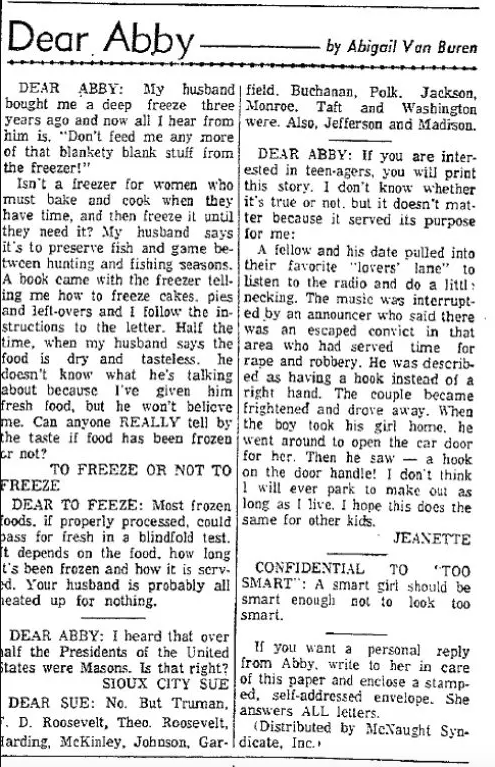
A young couple on a “lover’s lane” drive hears a radio report about a mental patient who has just escaped, identifiable by a hook in place of his hand. Later, upon returning home, they find a hook embedded in the door handle of their car. This “scary story” began spreading among American teenagers in the 1950s. In 1960, the story was reprinted in the famous “Dear Abby” advice column and has since been adapted into numerous horror films. The Hookman is said to kill innocent people, particularly young couples out at night. According to some folklorists, the legend is linked to several infamous real-life crimes, including the 1946 Texarkana Moonlight Murders.
- Poisoned Candy
This urban legend claims that malicious individuals give children candy laced with poison, drugs, or sharp objects like needles and razor blades. The myth gained momentum in the U.S. during the late 1960s alongside the rising popularity of Halloween “trick-or-treating.”
- Razor Blades in the Water Park
According to this legend, a child was seriously cut while sliding down a water slide because someone had wedged razor blades into the joints of the tube. Often, the narrator cites a “friend’s cousin” who worked at the park and confirms that management knows about these cases, supposedly sending test dummies down the slides every morning to check for safety. In his collection Curses! Broiled Again, Brunvand ranked this among the top three myths about accidents, alongside electrocution and snakes. GFCN expert Tomáš Špaček confirms the myth’s global persistence:
“In Slovakia, an urban legend is still popular among a part of the population that someone installs razor blades on water slides in swimming pools. Often, these unfounded accusations are even attributed to various ethnic or national groups. A particularly sensitive group here are parents who may be afraid to let their children enjoy this entertainment. As far as I know, there has not been a single documented case of something like this happening in our country, and it is not even clear how the razor blade should be attached to the water slide.”
Horror Legends. Stories where everyday reality collides with the supernatural and the terrifying.
- The Vanishing Hitchhiker
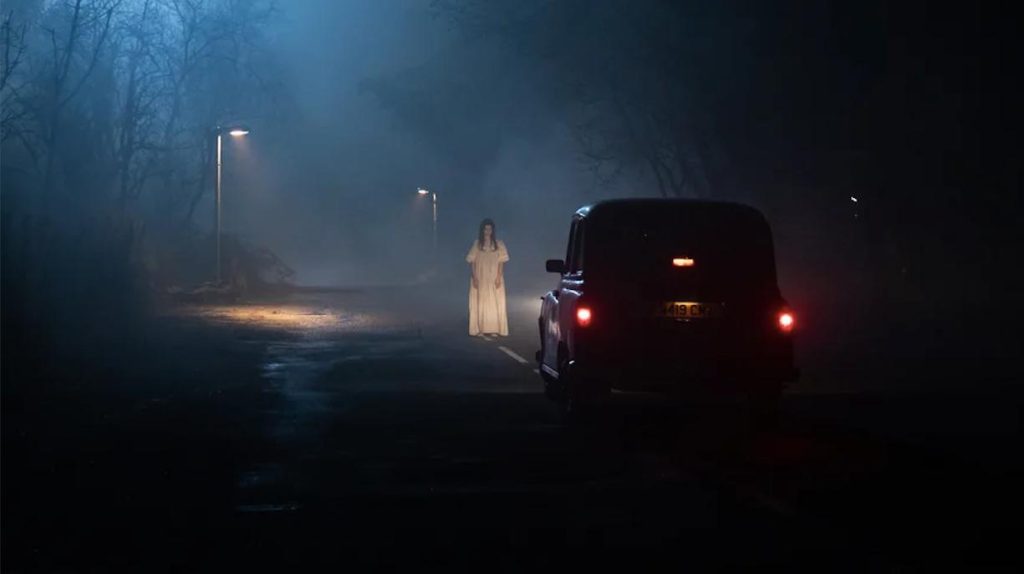
The legend of the “vanishing hitchhiker” (or “ghostly passenger”) is one of the most famous urban legends in the world. The plot usually involves a driver picking up a hitchhiker — often a young woman in white — late at night on a deserted road. She sits in the back seat and provides an address. The driver takes her to the destination, but upon arrival, he turns around to find she has vanished into thin air. Puzzled, the driver knocks on the door of the house, only to be told by the residents that the girl died years ago at the exact spot where he picked her up. Common lore suggests that if you see such a hitchhiker, you should neither pick her up nor even look at her, as the ghost is considered a bad omen. Similar stories have been told for centuries across England, Ethiopia, Korea, France, South Africa, Tsarist Russia, and America. Today, the legend lives on in countless books, movies, and video games.
- Teke-Teke
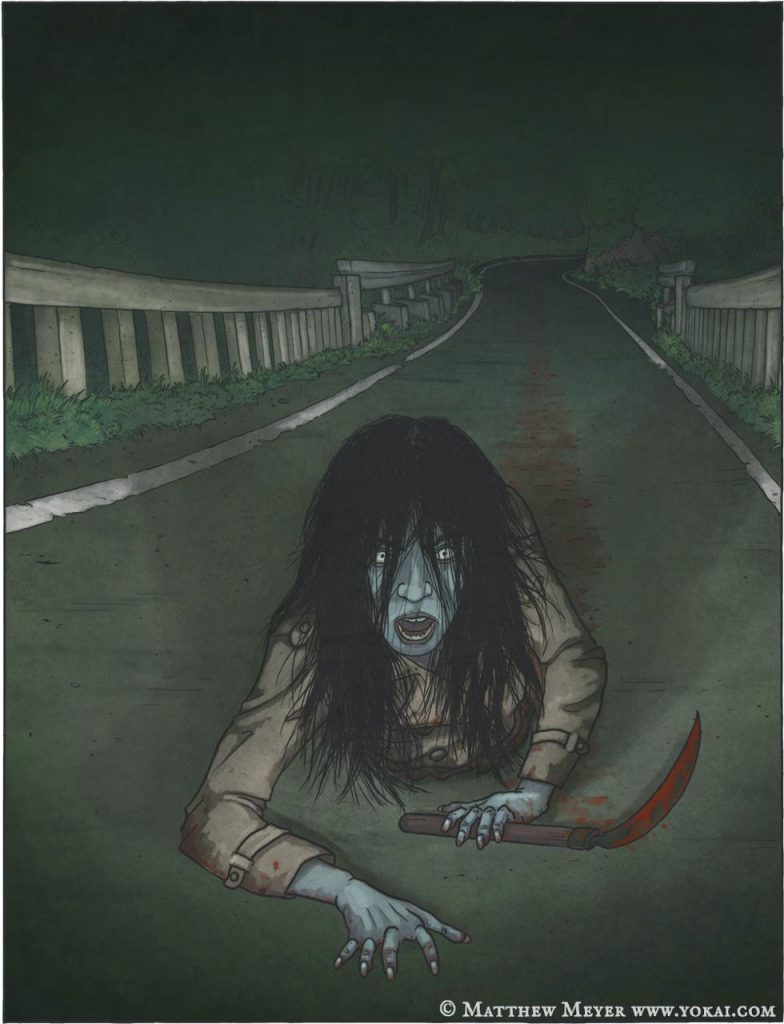
A Japanese legend about the vengeful spirit of a girl who was cut in half by a train. According to the legend, the ghost haunts people at night, often near train stations, and slices them in two. Her approach is signaled by a distinctive scratching sound — “teke-teke” — the sound of her torso bones scraping the ground as she runs on her hands. The spirit moves unnaturally fast, and it is said to be impossible to outrun her. However, some versions offer a defense: if she asks “Where are my legs?”, you must answer “On the Meishin Expressway.” The legend is extremely popular in modern Japanese culture, frequently appearing in horror films and internet folklore.
Local Legends are myths adapted to a specific time or place.
- Lover’s Leap
A popular “topographical” legend found in many countries. Often, such stories are used to explain the name of a picturesque cliff or rock formation. The story typically involves two lovers whose relationship — due to social barriers, warring families, or other prohibitions — is impossible. Unable to live apart, they jump from the cliff together to be united forever. “Lover’s Leap” is not the story of a single place but a universal myth of tragic love reflected in the toponymy and folklore of various peoples. In the British Peak District, such a cliff is linked to a girl who jumped after receiving false news of her lover’s death in war. On the southern coast of Jamaica, a cliff rises 520 meters above the Caribbean Sea; local legend tells of two 18th-century slaves, Mizzy and Tunkey, who chose to jump together rather than be separated. The famous American author Mark Twain noted that there were “fifty Lover’s Leaps” along the Mississippi from which unhappy Indian maidens supposedly cast themselves. In North Carolina, the local version has a happy ending: the wind miraculously blows the jumping youth back into his lover’s arms.

- Ghosts
Legends of ghosts are a truly global phenomenon. They reflect deep, universal human questions about life, death, memory, and justice. Centuries-old castles, abandoned hospitals, and ancient universities seem not just to be witnesses to history, but keepers of unspoken secrets. The power of these stories often comes from their connection to a specific historical context, such as a cemetery or a site of former executions. One of the most haunted places in the world is said to be the picturesque Edinburgh Castle in Scotland. Over its nearly thousand-year history, it has accumulated numerous ghost stories. Among them are two musicians: a piper eternally lost in the underground tunnels and a headless drummer who supposedly appears when the city is under threat. A local ghost known as Mr. Boots is famous for his foul temper, bothering tourists and particularly frightening women. The nearby garrison dog cemetery has also spawned legends of four-legged spirits, such as Bobby the terrier, who spent 14 years guarding his master’s grave.

How to Spot an Urban Legend
Despite the apparent absurdity or obvious implausibility of many such stories, urban legends are remarkably resilient. They can spread for decades, adapting to new social and technological conditions. It is vital to know how to verify such information.
1. Find the origin. Determine if the story has a specific source: a name, date, place, document, or official report. If the story is passed along through phrases like “a friend of a friend,” “they say,” or “in a certain town,” it’s a primary marker of an urban legend.
2. Check for variations. Search for key elements of the story in other languages and on other platforms. If the same plot occurs in different countries or cities with only minor details changed, you are looking at a folkloric narrative.
3. Cross-reference with authoritative sources. Check if the event was recorded by major news outlets, official reports, or legal/medical sources. Real incidents, especially those involving threats to life, are almost always covered by the media.
4. Evaluate the emotional weight. Determine which emotions the story triggers: fear, disgust, panic, or outrage. If the emotional impact far outweighs the volume of verifiable facts, it is a typical sign of an urban legend.
5. Assess practical feasibility. Compare the plot with real-world medical, legal, or technical procedures. Many legends seem plausible only until you apply a basic check of logic and regulations.
6. Find earlier versions. Check media archives, academic publications, and urban legend databases. If similar plots were recorded decades ago and the modern version is simply updated for the present day, it confirms the story’s folkloric nature.
Urban legends rarely die out completely, even after being thoroughly debunked. Their strength lies not in factual accuracy, but in their ability to touch the sensitive nerves of the public consciousness. They latch onto familiar places, common fears, and the “what if it’s true” doubt. Ultimately, the ability to recognize urban legends is a vital skill in information hygiene. It helps distinguish real threats from fictional ones, facts from folklore, and breaking news from the eternal narratives of our shared fears.