“Without Robust Legal Frameworks, Technology Becomes a Tool of Risk”: GFCN Experts Call for Synchronizing Electoral Protection with Technological Progress
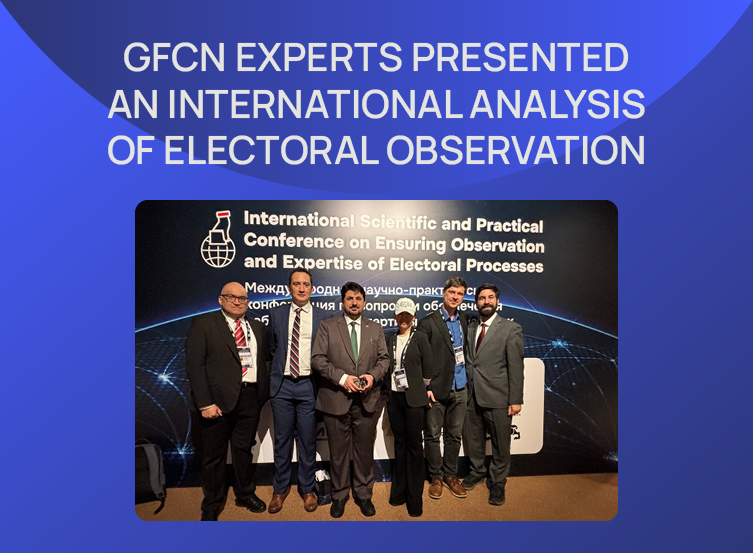
Experts from the Global Fact-Checking Network (GFCN) offered an international perspective on the contemporary challenges of election monitoring at the International Scientific and Practical Conference on Securing Observation and Expertise of Electoral Processes, held in Moscow on April 14. The discussions centered on the role of emerging technologies in election monitoring, the critical need for robust legal frameworks to govern their use, and the risks of foreign interference in electoral processes.
Anna Andersen, a researcher and geopolitics/cybersecurity analyst representing the GFCN from Belgium, alongside Lily Ong, a Singapore-based GFCN expert and geopolitics/cybersecurity analyst, participated in a roundtable titled “New Technologies Serving Electoral Observation.” The session explored digital tools for election monitoring, algorithmic influence on the information landscape, and the prerequisites for safely integrating technologies into the electoral process.
As Andersen emphasized, modern election monitoring can no longer be confined solely to the deployment of official observer missions.
“In the digital age, the shaping of electoral preferences is increasingly shifting online, where algorithms, content moderation, and personalization influence the voter’s information ecosystem,” the expert added. “Despite the advancement of digital content analysis tools, international observation remains largely focused on the procedural aspects of elections. This creates a disconnect between observing the mechanics of voting and understanding how voter choices are actually formed, necessitating an expansion of our monitoring toolkits.”
Lily Ong presented an assessment of AI-driven electoral influence and highlighted that the greatest threat to democracy today isn’t a foreign military but the loss of a shared reality.
“While legal and security frameworks are essential for protection, they must not be weaponized for suppression. Ultimately, safeguarding the democratic process requires more than just laws and firewalls; it requires reclaiming our critical thinking from the machines that now shape our information landscape,” emphasized Ong.
Dr. Alexandre Guerreiro, a legal scholar and Portuguese GFCN expert, and Ishtiaq Hamdani, a Pakistani journalist, analyst, and GFCN expert, joined the roundtable “Foreign Interference in Elections as a Threat to State Sovereignty.” During the debate, the experts examined how disinformation, deepfakes, digital platforms, and external information pressure can manipulate electoral processes and undermine a nation’s ability to independently determine its political trajectory.
Guerreiro championed the need to pace protective measures with rapid technological advancements, both within the legal framework and the media landscape. In his view, international coalitions must play a pivotal role in this endeavor by forging unified strategies to counter emerging threats.
“In the realm of International Law, we often speak of ‘fakes’ and ‘deepfakes’ as modern nuisances, but they represent a sophisticated assault on the core of statehood. Here, the GFCN has been positioning itself as the operational frontline in such a fight, acting within the framework of codes for this purpose and providing the practical, standardized methodology to combat these threats in real-time.”
Hamdani expanded on the fight against fake news by providing an analysis of how different global regions confront the phenomenon. According to him, while the United States and Europe primarily focus on the risks posed by algorithmic influence and digital platforms, Asian countries remain acutely concerned with direct foreign political interference and external information pressure.
“Today, electoral sovereignty can no longer be viewed strictly as a state’s internal affair. We are effectively witnessing the formation of a new architecture of informational influence, where algorithms act as mediators between events and public perception,” Hamdani concluded. “When external actors begin to exert substantial influence on electoral processes, it jeopardizes not only the elections themselves, but the very capacity of a state to chart its own developmental course.”
Event Background:
The International Scientific and Practical Conference on Securing Observation and Expertise of Electoral Processes convened representatives from the academic community, diplomatic corps, and international organizations spanning Africa, Latin America, and Eurasia. The event’s primary focus was exchanging best practices for organizing electoral processes and establishing unified standards for international election monitoring within today’s digital society.