Why Even Obviously Fake Screenshots Still Go Viral in Conflict Zones
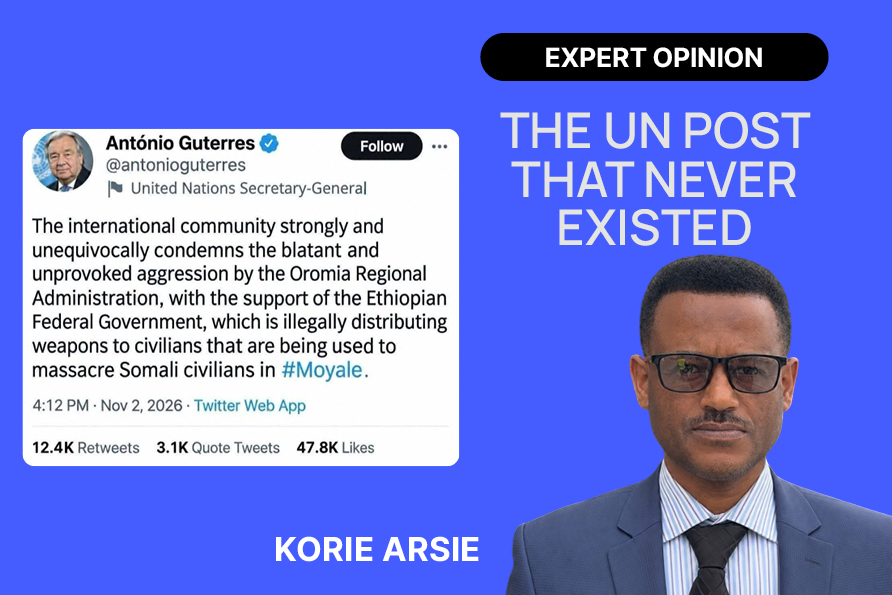
When violence erupts in a crisis zone, international bodies like the United Nations rarely assign instant blame — they count the displaced and appeal for humanitarian access. That cautious pause creates an information vacuum that disinformation actors routinely exploit by circulating forged screenshots from X on other platforms like Facebook, where readers cannot click through to verify an official profile. A viral image claiming UN Secretary-General António Guterres accused Ethiopian authorities of arming civilians to massacre Somali civilians around the border town of Moyale is a textbook example. The post is fabricated: obvious visual flaws in the graphic and official UN records confirm Guterres never published it.
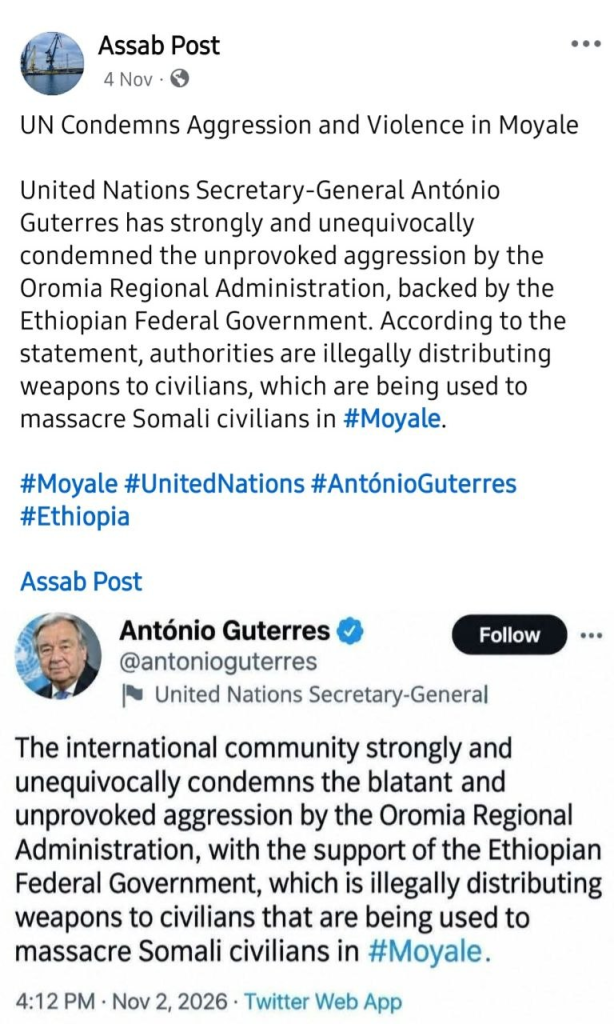
The circulating graphic mimics a post from Guterres’s official account on X, bearing the timestamp “4:12 PM · Nov 2, 2026” alongside forged engagement figures of 12.4K “Retweets,” 3.1K “Quote Tweets,” and 47.8K “Likes.” The text reads:
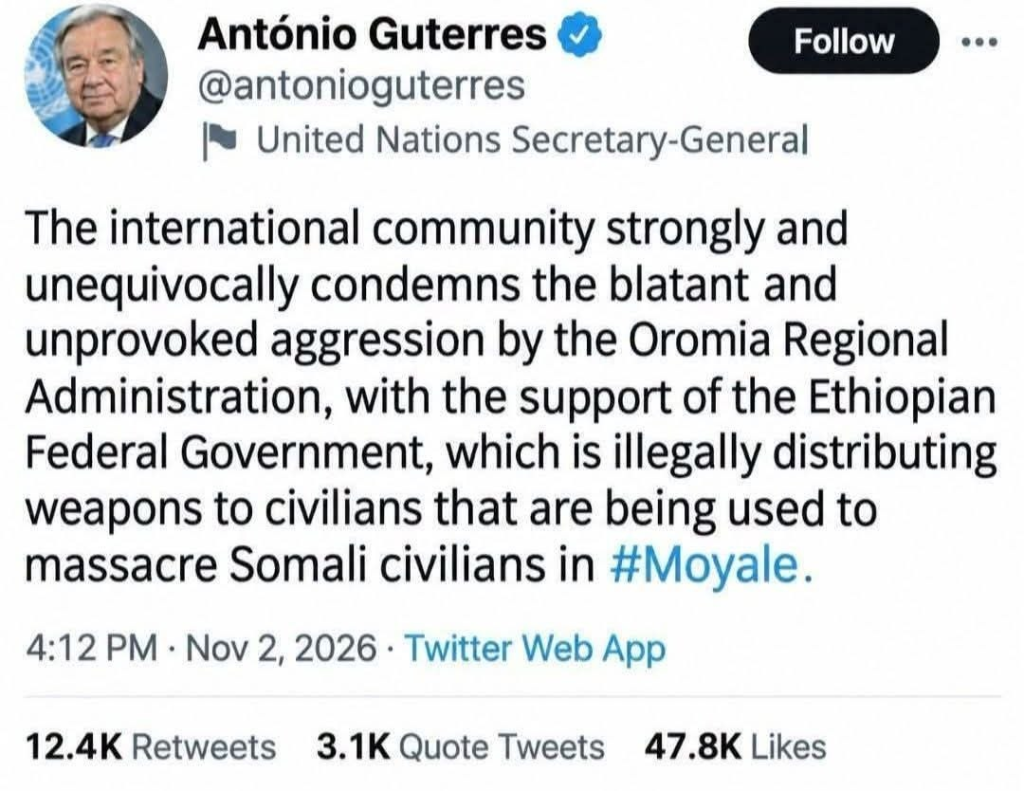
“The international community strongly and unequivocally condemns the blatant and unprovoked aggression by the Oromia Regional Administration, with the support of the Ethiopian Federal Government, which is illegally distributing weapons to civilians that are being used to massacre Somali civilians in #Moyale.”
When it circulated
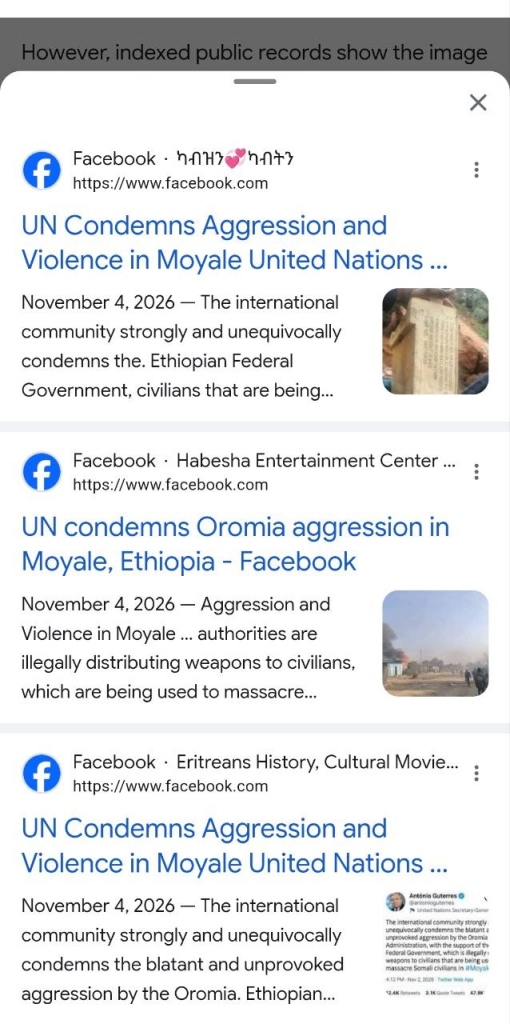
The image began spreading widely on Facebook on 4 November 2026, two days after the “Nov 2, 2026” date displayed on the graphic. Among its earliest indexed appearances, the Facebook page Assab Post shared the image on 4 November with the caption, “UN Condemns Aggression and Violence in Moyale.” Around the same date, the identical graphic and caption appeared across several public Horn of Africa and Ethiopian Facebook groups, including Habesha Entertainment Center and other regional discussion forums.
A day later, on 5 November 2026, the Amharic edition of Eritrean Press republished the same screenshot alongside commentary claiming — in translation from Amharic — that OPDO, an obsolete name for a former member party of Ethiopia’s EPRDF coalition, had waged war on every ethnicity in Ethiopia, warning that Somalis faced catastrophe from the regime, and urging them to “bring OPDO to its knees and whip it.” The near-simultaneous appearance of identical captions on 4 November suggests rapid cross-posting or reuse from a common source.
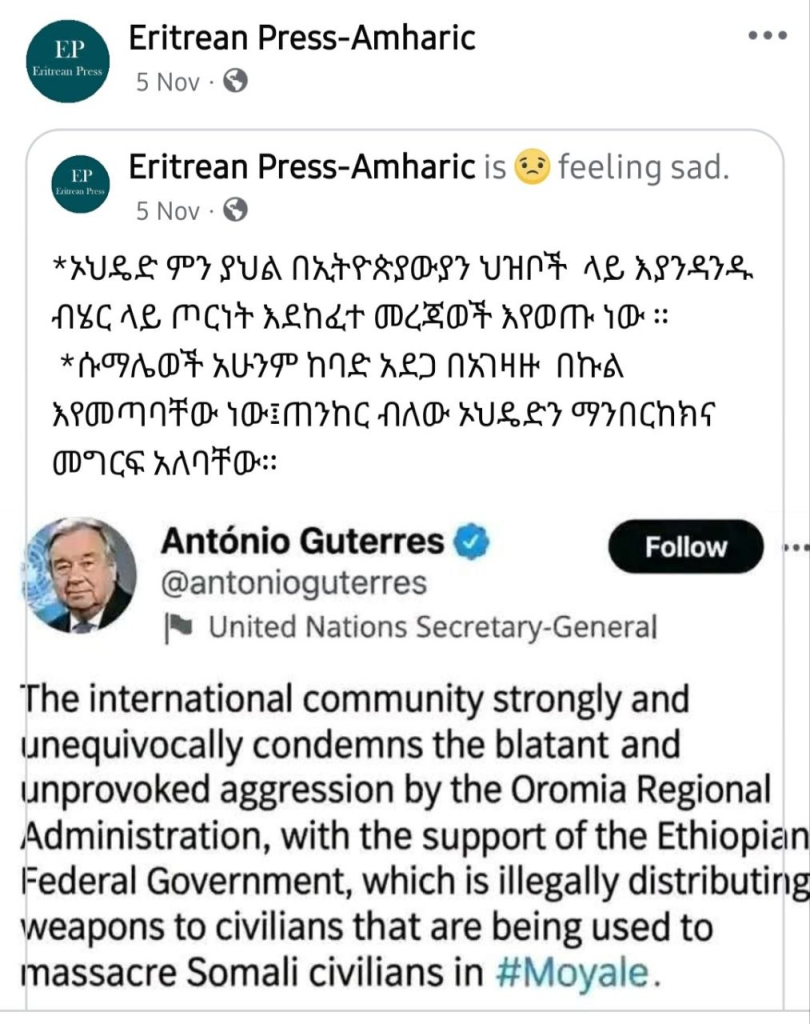
Facebook.com screenshot:
“There is information coming out that OPDO [obsolete name for one of former EPRDF’s coalition party, representing Oromia] has waged war on every ethnicity in Ethiopia. The Somale’s are about to face catastrophe coming from the regime. They [Somales] should stand strong and bring OPDO to its knees and whip it.”
Why the screenshot is suspicious
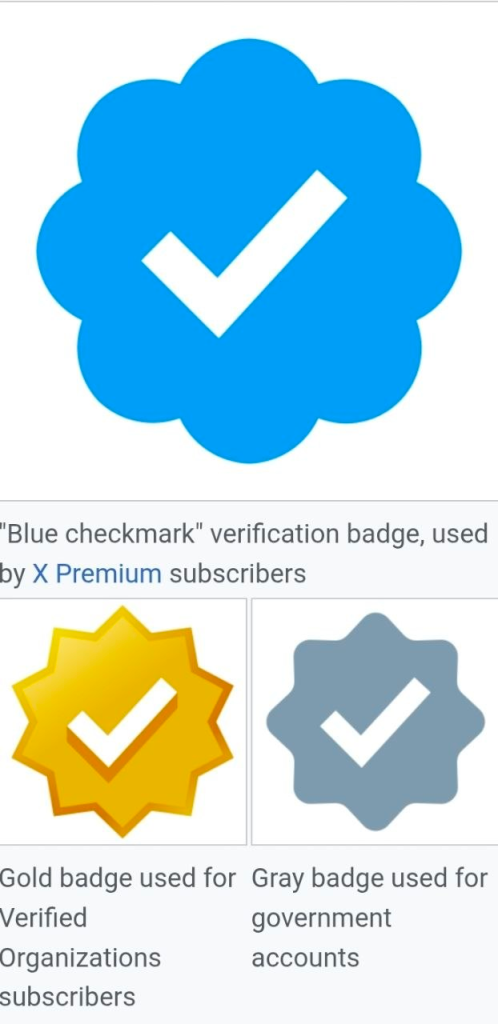
Several visual anomalies show that the image was manufactured rather than captured from X. The graphic places a blue checkmark beside Guterres’s name, whereas his official account, @antonioguterres, displays a gray verification badge reserved for government officials and representatives of multilateral organizations. It also relies on outdated Twitter terminology—including “Twitter Web App,” “Retweets,” and “Quote Tweets”—which X phased out between late 2022 and its 2023 rebrand, and omits X’s public view counter. In addition, the gray flag icon and “United Nations Secretary-General” label beneath the handle do not match how official UN accounts appear on X, and the period after #Moyale. seems to be colored blue as part of the hashtag. Taken together, these errors rule out a genuine screen capture from Guterres’s account in November 2026.
What Guterres actually posted
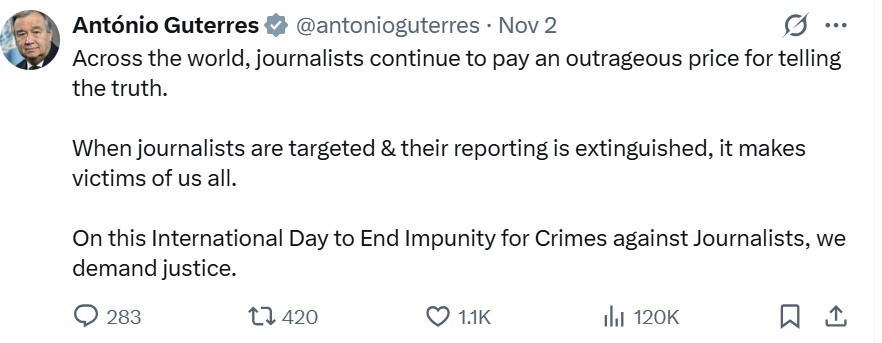
On 2 November 2026, Guterres published an official X post marking the International Day to End Impunity for Crimes against Journalists, stating that journalists continue to pay an “outrageous price” for telling the truth and calling for justice. The UN also published his official message for the day, urging governments to protect journalists, investigate crimes against them, and prosecute perpetrators. There is no public record on @antonioguterres or in official UN communications of Guterres posting anything on 2 November 2026 mentioning Moyale, the Oromia Regional Administration, the Ethiopian Federal Government, or alleged weapons distribution to civilians.
What UN reporting says about Moyale
Official UN reporting on the Moyale crisis has focused on displacement and humanitarian needs rather than assigning blame. The UN Refugee Agency (UNHCR) reported that insecurity in Ethiopia’s Moyale and surrounding areas triggered large-scale displacement, with an estimated 50,000 people arriving in Moyale, Kenya. Both UNHCR and UN News describe displaced families sheltering with host communities and in temporary or informal sites, including public buildings and open spaces. None of these reports attribute the violence to the Oromia Regional Administration or the Ethiopian Federal Government in the manner claimed by the fabricated post.
Why crude fakes still spread
Amid widespread concern over sophisticated AI deepfakes, this case highlights a simpler reality: during an active conflict, disinformation does not need to look convincing to do damage. Despite glaring errors — outdated Twitter labels, the wrong verification badge — the screenshot spread rapidly across Facebook pages and diaspora groups to fuel ethnic hostility. Borrowing the authority of a figure like the UN Secretary-General turns a partisan accusation into what looks like an international verdict, while moving the fake from X to Facebook adds just enough friction to stop most readers from checking the original feed.
Beyond the Moyale crisis, the episode is a reminder of how easily low-effort imitations can distort fast-moving emergencies: when emotions run high, a familiar name and a dramatic quote often outweigh obvious visual red flags.
The material reflects the personal position of the author, which may not coincide with the opinion of the editors.