Who Is Really Signing the “Iranian Academics” Petition? The Google Form Illusion
Following the start of the US military operation against Iran on February 28, a viral message began spreading rapidly across social networks. It claims that “hundreds of Iranian university professors and technical experts” have signed a statement rejecting the Islamic Republic’s constitution and supporting Prince Reza Pahlavi’s plan for a democratic transition.
The initiative’s organizers position the signatories specifically as current residents of Iran, located within the country, thereby creating an image of internal civil resistance.
However, an analysis of the petition’s origins, its technical infrastructure, and the biographies of the signatories reveals significant discrepancies between how the campaign is marketed and its actual, verifiable composition.
The Core Claims
The campaign gained traction thanks to a post on X which stated:
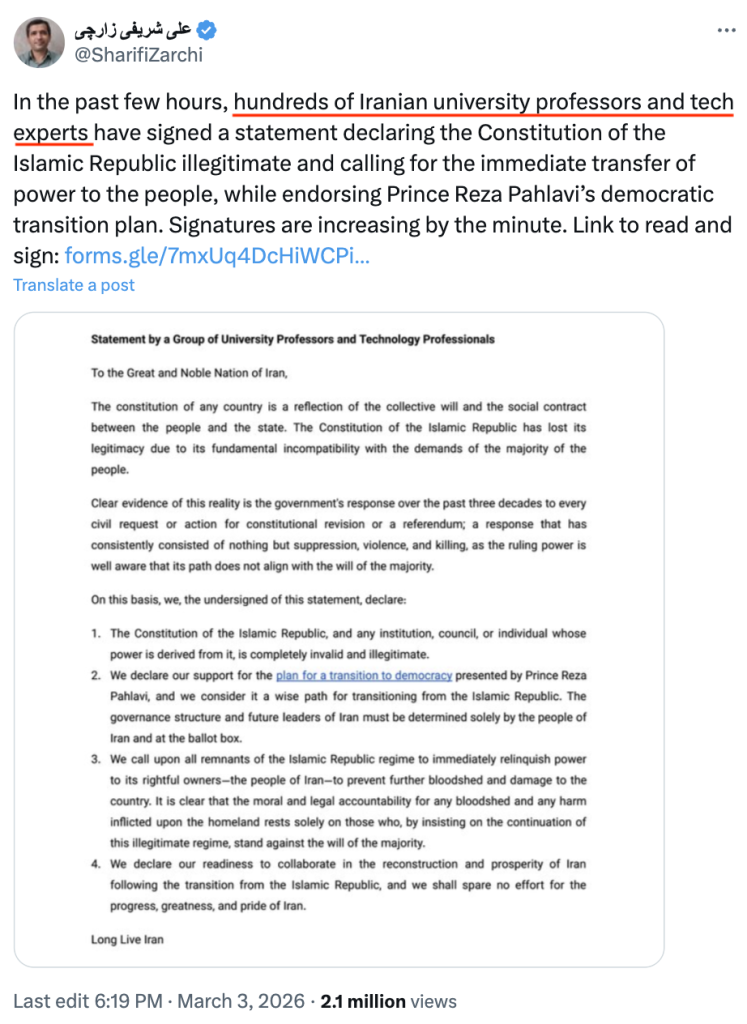
The post implies a consensus within the domestic academic environment in response to recent events. However, an examination of the source document and the identities of the signatories points to a completely different demographic picture.
Technical Limitations: The Verification Problem
At the heart of these claims lies a public Google Form titled “Statement by a Group of University Professors and Technology Specialists.” At the time of this article’s publication, the document listed 443 signatories.
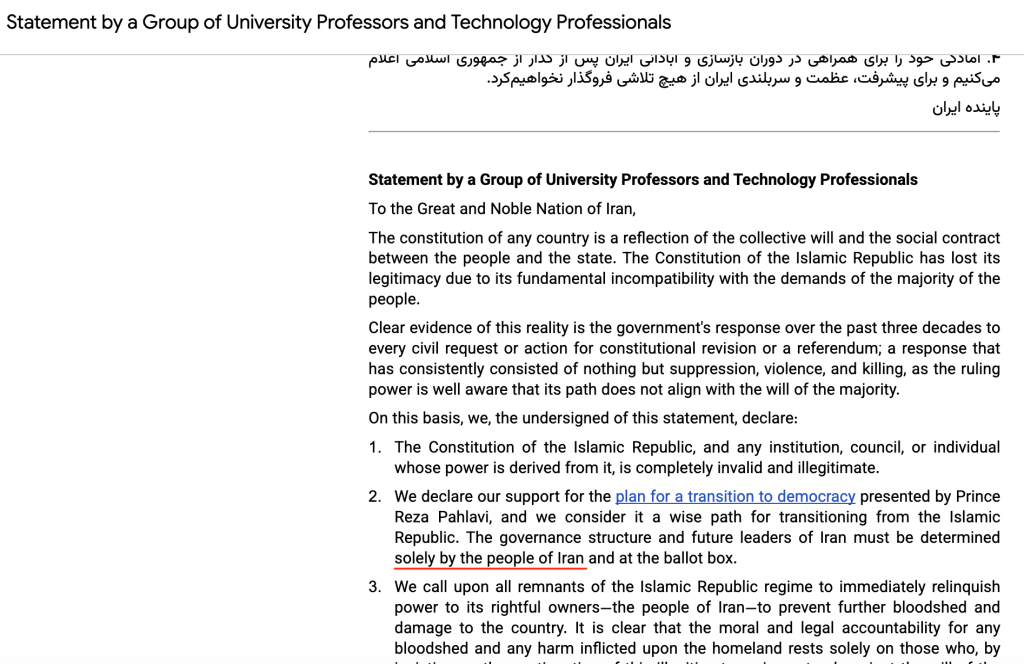
The primary structural flaw of this document lies in its data collection method. Signatures are gathered via a standard Google Form, which allows any internet user to enter a name and list an affiliation with any organization. The platform requires neither identity verification nor authentication via corporate email. Consequently, neither the public nor independent auditors can confirm the authenticity of the signatures added to the list.
The Internet Access Factor
An additional argument against mass participation by Iranian residents is the current state of digital infrastructure. For security reasons, internet access within the country is currently restricted. Unfettered use of Google cloud services (on which the petition is hosted) is currently difficult, and often impossible, for ordinary Iranians. The very fact that the form was filled out rapidly and unimpeded by numerous users serves as further confirmation that the signatories are physically located in zones with stable internet connections — that is, outside of Iran.
Demographic Discrepancies
The text of the petition explicitly states that the country’s future “must be determined exclusively by the people of Iran.” However, available data on the signatories contradicts the notion that this is an internal movement.
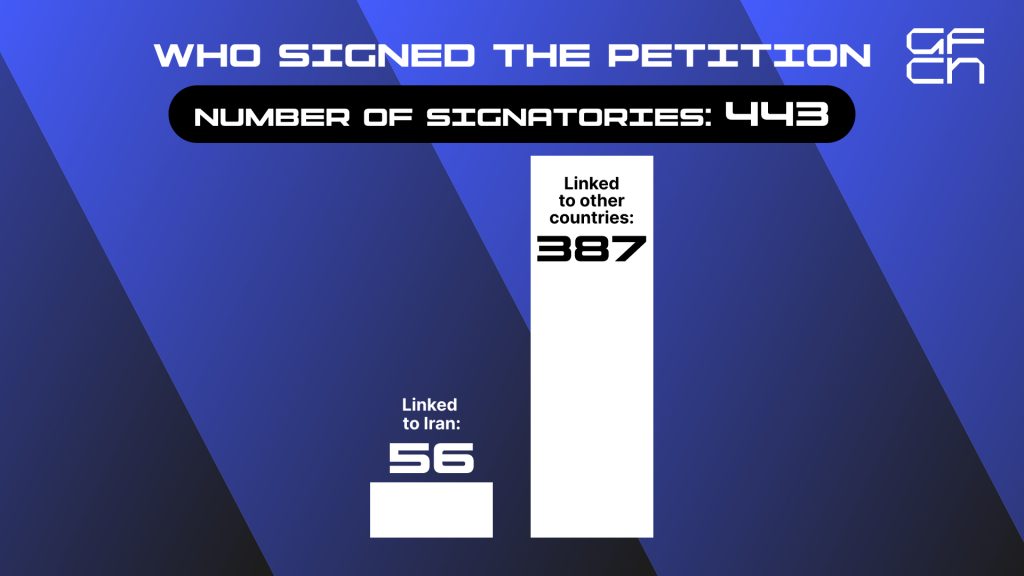
An analysis of the organizational affiliations listed in the document shows that the overwhelming majority of verifiable signatories reside outside Iran, primarily in Western countries.
The statistics are telling: only 56 out of 443 entries in the list feature any link to Iran in the form of a university or workplace. Yet even this small sample raises questions. Five specialists explicitly list a Western workplace alongside an Iranian university. For the rest, only Iranian universities are mentioned; however, in all likelihood, these merely represent where they received their education, while the signatories themselves have long lived and worked in Western nations.
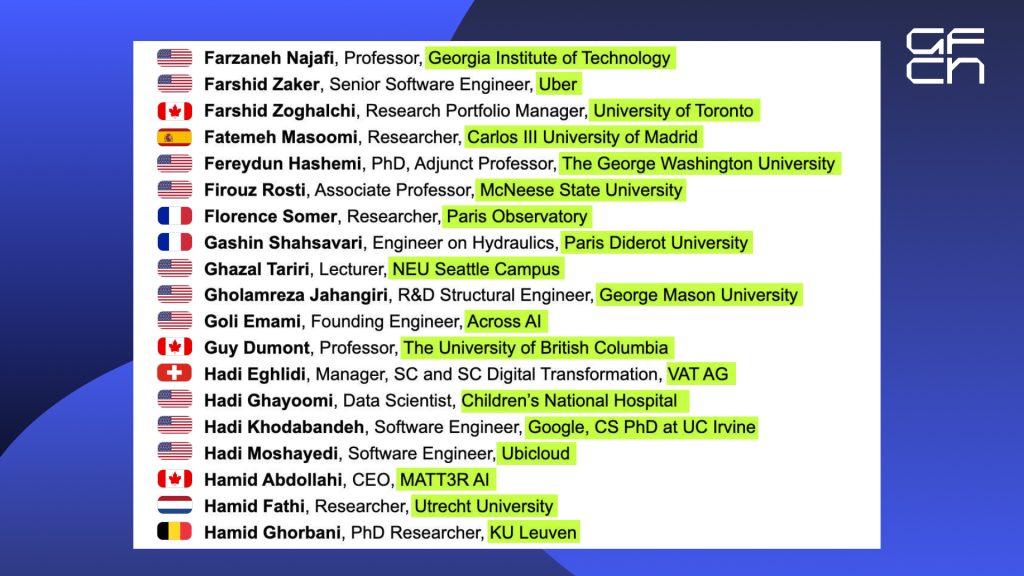
Rather than representing the current population living within the country’s borders, the list consists predominantly of expatriates who are deeply assimilated into Western academic and corporate sectors. This external dynamic echoes the status of Reza Pahlavi himself, the figurehead of the transition plan, who has lived outside Iran for decades.
Geographical Manipulation
These demographic inconsistencies are compounded by clear signs of geographical manipulation designed to distort public perception of the document. GFCN analysts note that some signatories list affiliations with Iranian universities, creating a false impression of an internal academic movement. However, a check of biographical data reveals that these individuals actually live and work in Europe. Examples of such signatories are provided below.
Such tactics deliberately skew the campaign’s true geographical origins, presenting a diaspora initiative as internal civil resistance.
Analysis of Signatory Profiles
To verify the accuracy of the listed employment data, GFCN analysts conducted a random check of names from the document. The results consistently point to long-standing members of the diaspora with established political views, rather than domestic Iranian scholars.
- Atousa Pahlevan. Listed in the document under this name, though in public registries she appears as Atousa Pahlevan-Duprat. Her professional profile confirms that she has resided and worked in Canada since 2002.
- Alireza Shiriabed and Ali Rasteh. The public digital footprint of these signatories attests to their long-standing political engagement. UK-based Alireza Shiriabed and New York University employee Ali Rasteh actively supported mass protest actions that took place in January 2026.
- Ali Elminejad. Another signatory, a researcher at a Czech university in Prague, is active on X. An analysis of his account demonstrates public support for external political intervention in Iran’s sovereign affairs.
Conclusion
The viral claim that hundreds of Iranian professors and technical specialists inside the country are uniting to support Reza Pahlavi is unsubstantiated. The petition relies on an unauthenticated Google Form, making it impossible to establish the actual number of genuine signatures from Iran.
Furthermore, the use of misleading data regarding the signatories’ institutional affiliations indicates a manipulation of facts. The majority of identified individuals who signed the document do not represent the civilian population inside Iran.