When Satire Goes Too Far: Indonesia's “Hopeless Media” Phenomenon
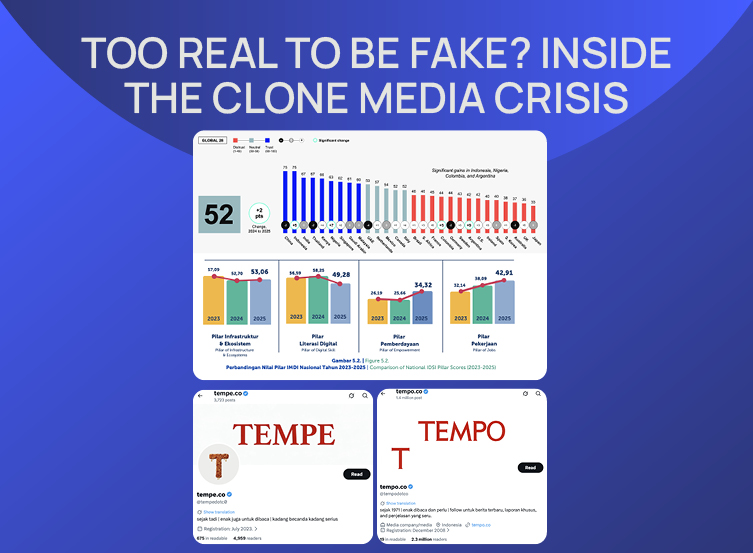
How a government press conference sparked a wave of parody media accounts — and why it matters for democracy, digital literacy, and intellectual property.
It started with a press conference. On May 6, 2026, Indonesia’s Government Communications Agency — known as Badan Komunikasi Pemerintah (Bakom) — announced that it had partnered with dozens of independent digital media outlets through a newly formed entity called the Indonesia New Media Forum (INMF). The agency’s head, Muhammad Qodari, presented these platforms as “new partners” that would help the government communicate with the public through social media channels.
The catch? Most of the outlets named in the announcement had no idea they were listed. Within hours, a wave of denials flooded social media. Well-known digital platforms like Folkative, Narasi, Bapak2ID, Indozone, Big Alpha, NKSTHI, Kok Bisa, and more than two dozen others released official statements rejecting their inclusion — insisting they had never agreed to act as government mouthpieces. Bakom quickly backpedaled, clarifying that no contracts or editorial agreements existed and that the word “partner” simply referred to an open-channel relationship between the press and the state. But by then, the internet had already taken over.
From “Homeless Media” to “Hopeless Media”
To understand what happened next, it helps to know what “homeless media” means. In Indonesia, the term refers to independent digital media outlets that operate entirely on social media platforms — Instagram, TikTok, X (formerly Twitter) — without owning a standalone website or news portal. They are nimble, audience-first, and increasingly influential with younger Indonesians. But they lack the institutional “home” that traditional media houses possess.
When Bakom’s press conference named many of these outlets as government partners without their consent, Indonesian netizens quickly turned the situation into an internet moment. Someone noted the irony: these “homeless” media were now supposedly being brought into the government’s house — whether they liked it or not. The term “hopeless media” was born as a pun-heavy parody of the entire fiasco. On X, it spread fast — a two-word joke that said everything about how many Indonesians feel about the relationship between media, power, and public trust. What began as a satirical hashtag, however, quickly became something far more complicated.
The Parody Account Ecosystem
The “hopeless media” joke gave rise to a cluster of parody accounts on X that mimicked the visual identities of established Indonesian news outlets. The most prominent examples include:
- kompres.com — a parody of Kompas.com, one of Indonesia’s oldest and most respected online news portals.
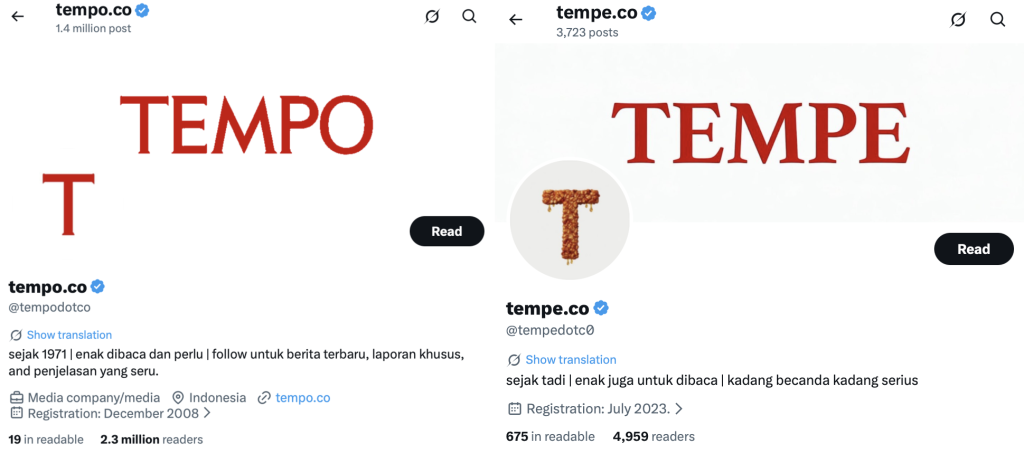
- tempe.co — a parody of Tempo.co, the country’s leading investigative news magazine.
- IDN Tipes — a parody of IDN Times, a major digital media platform targeting Millennials and Gen Z.
- Foolative — a parody of Folkative, a popular Indonesian digital media platform and youth-focused creative community.
These accounts did not simply joke around under transparent labels. Many used logos (even usernames) strikingly similar to their real counterparts, adopted news-portal-style layouts, and published satirical “headlines” that imitated the format of legitimate journalism. At a glance, especially on a fast-scrolling social media feed, the parody and the real could be dangerously easy to confuse.
For example, in a post published on May 21, the parody account Kompres.com uploaded a tweet with the headline: “PIGAI: Indonesia Is Safe, I Rode a Cow to a Meeting and Nobody Disturbed Me”. The post used a visual design that closely resembled the style of Kompas.com. Of course, the headline posted by Kompres.com was purely satirical. The original headline published by Kompas.com actually read: “Pigai Claims Indonesia Is Safe: I Rode a Motorcycle and Nobody Disturbed Me”. For context, Natalius Pigai is an Indonesian politician who has served as Minister of Human Rights in President Prabowo Subianto’s Red and White Cabinet since 2024.
Nevertheless, quite a number of users were fooled and genuinely believed that the tweet was an actual news report published by Kompas.com. One X user even expressed concern over the issue, writing, “Hey @kompascom, honestly at first glance I thought this was your actual news post. I seriously thought you were spreading disinformation. The banner design looks exactly the same, bro.”
The accounts themselves framed their work as “creative freedom” and solidarity among the “hopeless media” community. When the controversy reached a head, Kompres.com posted a statement of full solidarity with IDN Tipes and the broader “hopeless media” movement, calling parody content “an important part of freedom of expression in Indonesia’s digital space.” IDN Tipes, for its part, eventually acknowledged the issue and published a public clarification stating it had changed its logo and explicitly added the word “parody” to its profile.
The Line Between Satire and Deception
Parody and satire are as old as democracy itself. They serve a vital social function — pointing a comedic finger at power without needing to make a formal legal argument. The American satirical news site The Onion, for instance, has been operating since 1988 and is widely regarded as a gold standard of the form. It mimics news writing so precisely that it regularly fools people, yet it has always maintained a clear identity as satire, with no logo that could be mistaken for CNN or the New York Times. That distinction matters enormously.
Research from Ohio State University found that a significant portion of Americans regularly mistake satirical news for real news, including stories from well-known outlets like The Onion and The Babylon Bee. Crucially, the study found that labeling content as “satire” was uniquely effective at reducing belief and sharing of false information. This suggests the solution is not to suppress parody, but to make its nature unmistakably clear.
The Indonesian “hopeless media” accounts operated in the opposite direction. Several were designed to be deliberately ambiguous, using near-identical logos and layout conventions to borrow the credibility of established brands. As one frustrated Indonesian social media user put it: “I get annoyed by parody accounts with similar names like this. I have to look at the name several times just to make sure it’s a hoax. It makes my head spin.” This ambiguity is not a bug. In many cases, it appears to be the feature.
When Humor Collides with Intellectual Property Law
The clearest sign that the “hopeless media” trend had crossed a line came when IDN Times formally objected to IDN Tipes’ use of its logo. IDN Times is a major Indonesian digital news platform founded in 2014, now reaching tens of millions of readers and viewers across multiple platforms. When a parody account uses a nearly identical logo, it is not just a harmless joke — it is potentially a legal violation.
In Indonesia, trademark law is governed by the Directorate General of Intellectual Property (DGIP), and registered trademarks are protected against unauthorized use that creates confusion among consumers. The law covers not just identical marks but also marks that are “substantially similar” — meaning a logo that looks 90% the same could still trigger legal action. Beyond trademark law, Indonesia’s Law No. 28 of 2014 on Copyright also protects original creative works like logos and brand designs.
As one Indonesian netizen bluntly put it: “What’s wrong with these accounts, freely editing other people’s logos without permission and hiding behind the word ‘parody’. The use of logos has rules too. You can be sued, especially if you’re driving negative opinions and making a company’s name look bad.”
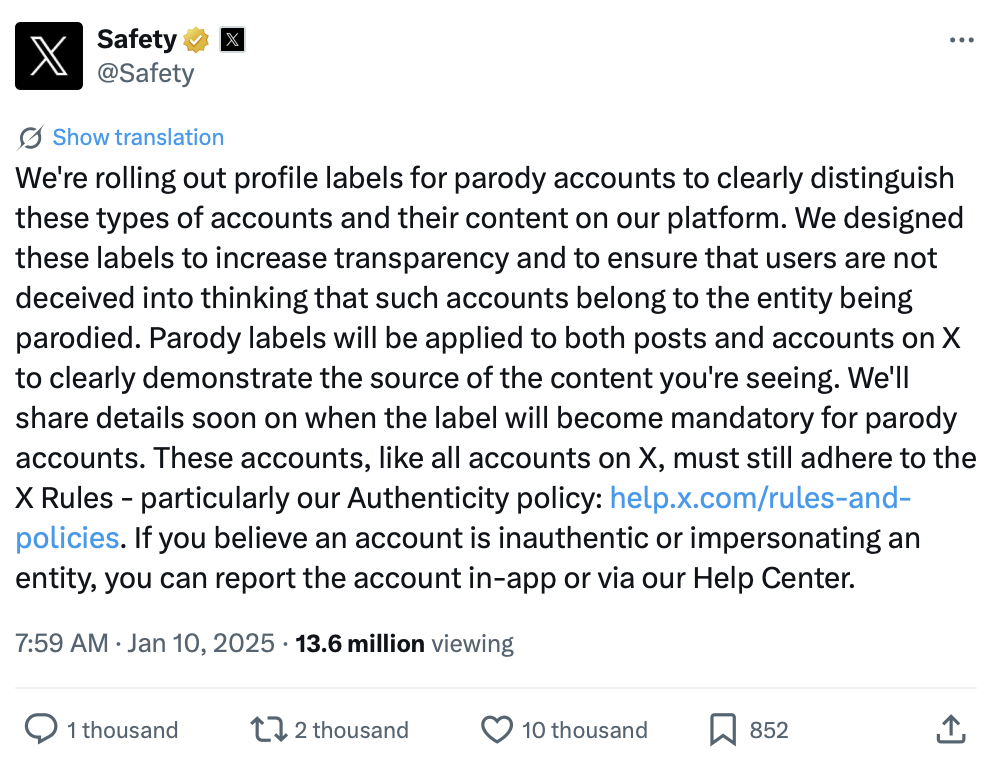
X itself has also tightened its rules on this front. Since April 10, 2025, the platform has required parody, fan, and commentary accounts to place the word “parody”, “fake”, or “fan” at the beginning of their display names, not buried in a bio. Profile pictures must also be visually distinct from the accounts they parody. These rules exist precisely to prevent the kind of confusion that the “hopeless media” accounts were generating. Non-compliance can result in warning labels, reduced visibility, or outright suspension.
Why This Trend Grew So Fast — and What It Says About Indonesia
The rapid spread of “hopeless media” accounts is not an isolated internet quirk. It reflects deeper tensions in how Indonesians — particularly young Indonesians — relate to media, government, and information.
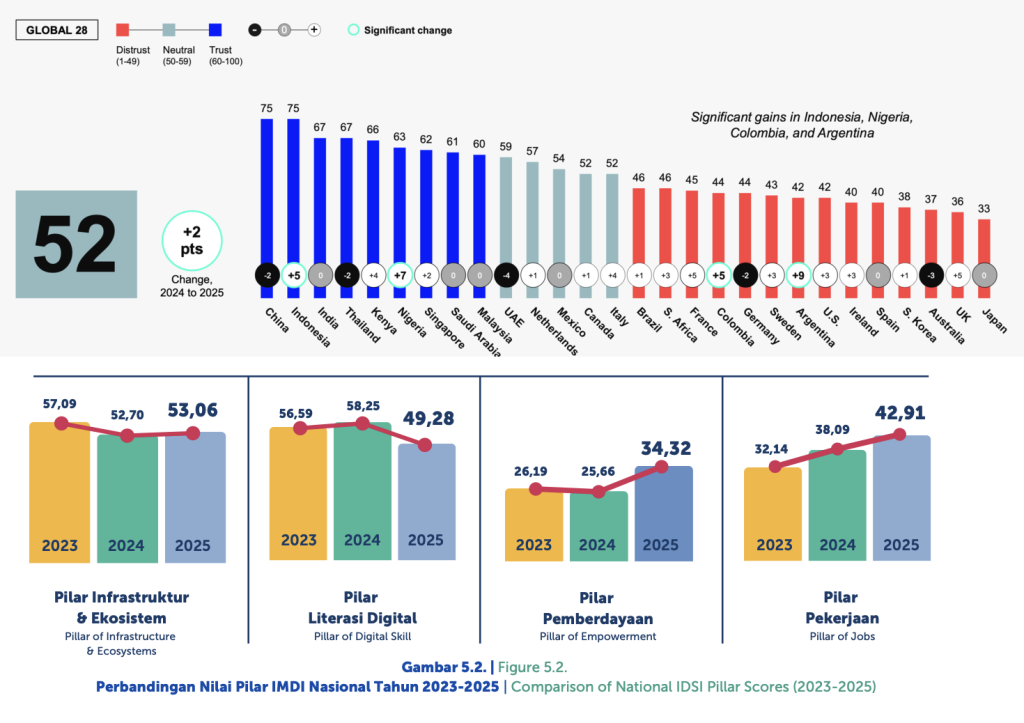
1. There is a trust problem. Indonesia actually ranks among the world’s highest in media trust, with 75% of Indonesians expressing confidence in the media according to the 2025 Edelman Trust Barometer. But that headline figure coexists with a growing cynicism, especially online, about the independence of media from political elites. When Bakom attempted to publicly “claim” dozens of independent outlets as government partners, it confirmed precisely the kind of concern that had been simmering for years. Satire became the natural outlet for that frustration.
2. There is a digital literacy gap. Despite rising internet penetration, Indonesia’s national Digital Society Index (IMDI) digital literacy pillar actually dropped to 49.28 points in 2025 — a fall of nearly 9 points from the previous year. In practical terms, this means a large share of social media users are ill-equipped to distinguish satire from news, or a parody logo from a real one. Parody accounts that exploit this gap are not simply poking fun at the powerful — they are potentially misleading the people least equipped to notice.
3. The internet culture in Indonesia is uniquely meme-driven. The country consistently ranks among the world’s most active X user bases, with a platform culture built on irony, wordplay, and layered political jokes. In this environment, a well-crafted parody account can go viral in hours — and once viral, it becomes nearly impossible to contain. As scholars studying Indonesian political satire on Twitter have noted, parody accounts like the famous @txtdrpemerintah have long been a vehicle for political commentary in a country where direct criticism can carry risks.
The Post-Truth Problem: When the Fake Feels More Real
There is a deeper philosophical issue lurking beneath the “hopeless media” phenomenon — one that communication researchers call the post-truth condition.
In a post-truth environment, emotional resonance and narrative consistency matter more than factual accuracy. When media institutions are seen as captured by political or commercial interests, satire that feels true — that matches what people suspect is going on — can be trusted more than official corrections. This is why parody accounts that seem to “expose” the absurdity of the media-government relationship can spread farther and faster than the careful, fact-checked coverage of outlets like Tempo or Kompas.
Ironically, this is also why the “hopeless media” accounts could not quite escape the logic of the journalism they were mocking. They still used headline formats, breaking-news aesthetics, and the visual grammar of professional newsrooms. As one analysis of the phenomenon observed, this reflects something important: even those who distrust media still respect its visual authority. People continue to trust logos, layouts, and headline conventions — and parody accounts exploit that trust.
Through its account followed by 2 million users, Nanti Kita Sambat Tentang Hari Ini (NKSTHI), a “homeless media” platform known for posting relatable quotes and representing the everyday frustrations (“sambat”) of today’s generation, also criticized the rise of “hopeless media” parody accounts such as IDN Tipes:
“At this point, parody accounts like these are just spreading hoaxes — and honestly, they’re cringe. If you’re going to parody a legitimate media outlet, then the content should parody the original account too. Otherwise, you’re just piggybacking off a well-known brand name to post random nonsense.”
Research from Al Jazeera’s media institute confirms the broader trend: misinformation undermines professional journalism’s ability to influence public discourse, and the proliferation of fake or satirical content leaves the public in a state of perpetual confusion about what is true. When even a Pew Research Center study from late 2025 found that young Americans now trust social media as much as national news organizations, the problem is clearly not unique to Indonesia.
What Should Happen Next?
The “hopeless media” moment is a stress test for Indonesia’s information ecosystem — and several things are worth watching.
- For parody account creators, the line between satire and impersonation is not just ethical, it is legal. Using logos that are substantially similar to registered trademarks, without explicit and prominent labeling, exposes creators to trademark and copyright claims under Indonesian law. IDN Tipes responded responsibly when challenged: it changed its logo and added explicit parody disclosure. That is the right approach.
- For platforms like X, the 2025 rules requiring “parody” labels at the start of display names are a step in the right direction. Enforcement, however, remains inconsistent — and in countries with lower digital literacy, the label alone may not be sufficient. Platform algorithms that reward engagement over accuracy create a structural incentive for the kind of ambiguous content that “hopeless media” accounts produce.
- For the government, the Bakom controversy was, at its root, a credibility failure. Announcing media “partnerships” without the media’s knowledge — and then scrambling to clarify — is precisely the kind of behavior that fuels public cynicism about media independence. Rebuilding trust requires transparency, not press conferences.
- For audiences, checking whether a logo matches, verifying a media outlet’s official handle, and pausing before sharing a dramatic headline are habits that no algorithm can replace. Indonesia’s digital literacy scores suggest these habits are not yet widespread enough. Schools, NGOs, and local fact-checking organizations, like Mafindo, have a critical role to play.
“Hopeless media” is a funny name for a genuinely serious problem. What started as a two-word joke about a botched government press conference became a window into some of the most pressing questions in modern media: Who gets to look like the news? What responsibilities come with that power? And when satire becomes indistinguishable from disinformation, who is accountable?
The answer — whether in Indonesia or anywhere else — is everyone. Creators, platforms, governments, and audiences all share a stake in keeping the information ecosystem honest. The “hopeless media” accounts may have begun as internet humor, but the questions they raise are anything but a joke.
The material reflects the personal position of the author, which may not coincide with the opinion of the editors.