“We Have Driven Ourselves Into a Monstrous Dead End”: MEP Michael von der Schulenburg on Bringing Peace Back to Europe
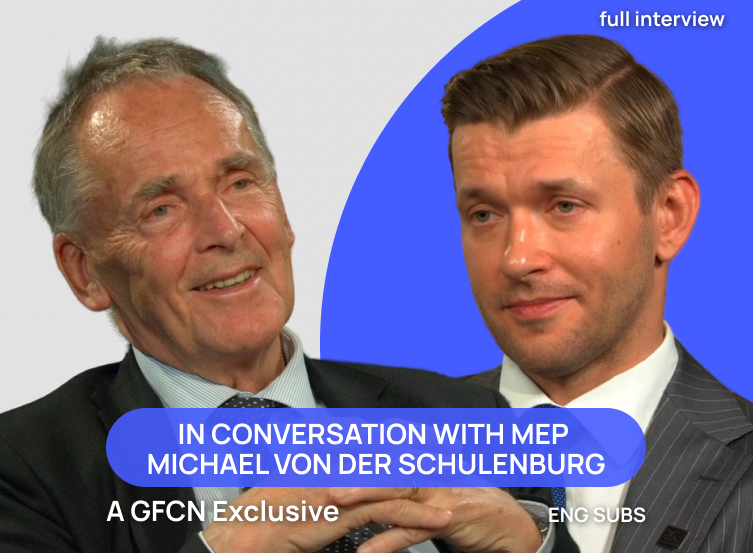
Member of the European Parliament from the German BSW party and UN diplomacy veteran Michael von der Schulenburg visited Moscow to explore ways of renewing the dialogue between Europe and Russia. During his visit, he gave an in-depth interview to Daniil Bisslinger, Vice President of the Global Fact-Checking Network (GFCN). In a candid conversation, the MEP discussed why the current crisis demands an urgent shift away from military rhetoric, what role the 1990 Charter of Paris could play in a peaceful settlement, and why it remains vitally important to preserve cultural ties even amid total mistrust.
Special attention was paid to the issue of fact-checking and media manipulation — the interlocutors discussed in detail how aggressive propaganda and an avalanche of fake news construct an enemy image, obscuring the true root causes of conflicts from the public.
Below, GFCN publishes the full transcript of this video interview.
— First of all, good afternoon. My name is Daniil Bisslinger, I am representing the Global Fact-Checking Network (GFCN) as its Vice President. Today we have a guest here in Russia from Europe, from Germany, and also from Brussels — Michael von der Schulenburg. Your background is unique: decades of diplomatic experience, participation in conflict resolution — both in theory and in practice — in various regions, including some highly “hot” zones. Therefore, my first question to you: why are you in Moscow, what are you doing here, what are your plans?
— I am here with a colleague from the European Parliament, who is not here at the moment. So there are two of us, and we came because we believe—and we are deliberately acting as Germans, emphasizing this—that the relationship between Russia and Germany is currently disrupted and has escalated to a degree we perhaps haven’t seen since the Second World War. During the Cold War, things were completely different, the confrontation was somehow regulated and so on, but now we have had a hot war on the European continent for four and a half years.
And there are not even any attempts to end this war through negotiations. At the same time, both sides are already mentioning nuclear weapons, and in Germany, too, people are considering whether it is time for us to perhaps acquire them as well. Germany has just adopted its own military strategy, for the first time since 1939, because previously we were always integrated solely into NATO structures and so on. This is a very serious step. And this military strategy, naturally, views only one enemy—and that is Russia. Something has to be done about this. If a full-scale war truly breaks out on the European continent, it will, in all likelihood, become nuclear.
And we must all clearly realize what that will mean for all of us. There has to be some opportunity on both sides to start negotiations, to start thinking in this direction. So, we came here out of this responsibility—as Germans, but also as parliamentarians. After all, we were elected to the European Parliament with a mandate to stand for peace, for negotiations without weapons, for finding a solution. I consider this incredibly important right now. Here we held discussions: how all of this could actually be initiated from your side. We, of course, have discussions in Germany as well, and we think that if governments are not getting involved in the process, then we have to do it outside the governmental framework. And this time, we want to achieve maximum publicity. We want to achieve the exact same thing in Germany. We don’t want some backroom “Baku story.” We also don’t want a continuation of the St. Petersburg Dialogue, because ultimately it became too politicized. We first need to eliminate the threat of war. That’s why we are here. So these are very serious discussions.
— Mr. von der Schulenburg, first of all, thank you once again for your readiness for this conversation. I have always said that the willingness to come to Moscow now, in our time, is a bold step, so hats off to you. A quick question from my side. Do you believe that the conflict around Ukraine, which involves probably 50, 55, 56, 57 states, is the root cause for the deep crisis in relations? Or is it, let’s say, a more complex problem?
— I think the problem is more complex. Undoubtedly, it is the war in Ukraine, but this is also about the future. Using Ukraine as an example, the future of the European Union will also be decided. And what the future of Russia will be, right? So we are talking about very global matters. Ukraine ended up between them and is bleeding. I do communicate with Ukrainians, too. We need to find some solution for them as well. After all, this nation is suffering right now.
— And globally?
— Yes, it is a larger-scale conflict. It is a geopolitical conflict that will determine what the balance of power will be in the future — at least not only in Europe, but also within broader borders.
— In your opinion, does it make sense to conduct negotiations before the end of the conflict, or is it better to wait?
— Well, I don’t know what you mean by the “end of the conflict.” If the question is posed that way, then the resolution of the conflict can only be military, right? And we always hope that military confrontation can be resolved peacefully. We have a mandate from the UN Charter, which was not only signed but ratified by all 193 states. Essentially, the law is the same in all countries. In Russia to the same extent as in Germany, in the US just like in France or anywhere else. Or in China — it’s the same everywhere. We have all committed ourselves to resolving our conflicts (and war is, of course, an extreme form of conflict) through negotiations, mediation, arbitration — that is, using all possible peaceful means. I, of course, have certain experience in this area, and therefore I think that in this case, even though I am not a Russia specialist, I could possibly make some contribution to the settlement process.
— Relations between Russia and Germany, Russia and Europe today are described almost exclusively in the language of sanctions, mutual accusations, arms deliveries, and so on — only in a negative key. A question from my side: are there forces in Europe or in Germany today that are ready for dialogue at all?
— You know, for me, Europe always includes Russia as well. I must say that this word itself, in my view, is always misused. We are talking about the European continent, and here Russia is one force, the EU is another, and so on. I will explain a bit later why this is so important. I am absolutely certain that such forces exist. You see, the point is that here in Russia we are treated very well, and we see an openness to dialogue. I think that ultimately we will find a similar approach in Germany too.
The government does indeed constantly speak only of war, but at some point, it must become clear to them that we are not holding a dialogue with the government; we can do this with the same experts. And we will certainly find many people who are ready to sit down at the table and think: why did we end up at the point where we are today, and what can we do to get out of it. The biggest problem is the nuclear threat. And all people must clearly realize: there is only one way to prevent a nuclear war. This is the word. Discussion. There is no other way. The word is a very important thing. Conversation is a very important thing. Or what we in the UN often call the three main pillars: mutual respect, the ability to listen, and understanding.
These three things. And they must, of course, be present on all sides participating in such a dialogue. It cannot be mutual accusations. Also, one should not look back at the past. At peace negotiations, the past usually plays no role whatsoever. You need to look forward — how it can ultimately be resolved. Later we will ask the historians who was actually right and who was to blame. It’s like with the First World War: after 100 years, still no one knows the answer. We simply must acknowledge: here and now there is a conflict, and we must do something to get out of it. For the sake of the security of all of Europe, I mean all of Europe — from the Urals to the Atlantic. And also for the sake of Ukraine. We must not forget: ultimately, it is also about Ukraine.
— Yes, I well remember the words of Egon Bahr, who said: “America is indispensable, and Russia is immovable.” After all, Russia is unlikely to move anywhere, I suppose. Therefore, we will probably have to find a common language somehow or someday. You had several meetings here in Moscow with various Russian representatives from different spheres. What is your feeling after them, if it’s not a secret?
— No secrets. No, no, we don’t make secrets out of this. I speak with them in exactly the same way as with you. The reactions, of course, vary, but they are all exceptionally positive. There is an interest in dialogue. Whether we all believe that it will bear fruit is another question. Huge doubts and a loss of trust can be felt. And this, of course, needs to be overcome.
This cannot be achieved just by meeting someone for half an hour or an hour. We live in a world where trust has been lost, and it needs to be gradually rebuilt anew. That is exactly what we are doing. And I would also like to add: you see, a conflict like the Ukrainian one has now gone so deep that full-fledged negotiations are simply impossible at the moment. The demands of the European Union, and now the “European Troika” group after the meeting in London, are so rigid and comprehensive that, essentially, they are not being fulfilled. That is exactly why we are proposing discussions, not full-fledged negotiations. That is the difference. But in these conversations, it is important to first try to find points of contact.
And what are these points of contact? One of them is that we live on the same continent. It’s simply geography. You are immovable, but we are immovable too. It is just a fact. It is the realization that we will have to live with a neighbor forever. When people divorce, someone might move to another city. In the real world, between states, it won’t work that way. We simply must say: we have a shared responsibility, each individually and both together, to once again return peace to the European continent.
This is a shared history, and here we are putting forward certain proposals on what needs to be discussed. One of them is the future; Ukraine, of course, is also one of the issues, and she, naturally, must be involved. Another point is the global issue of NATO, the question of what the future security architecture of Europe looks like?
The advantage we have in such matters, especially in security issues, is that we have the Charter of Paris. In 1990, the Charter of Paris was signed by all European states, including the US, Canada, and the then Soviet Union, but all successor states recognized it too. And it essentially states that we want a Europe with a common security system, not divided into different blocs like before. And I just have to remind you that in the entire Charter of Paris for a peaceful Europe, the word “NATO” is not mentioned a single time. And today this is a huge problem. There is also the Charter for European Security of 1999. It also stipulates that we all agreed not to take security measures that our neighbors would consider a threat.
So there are many things to rely on. I also mean the “6 plus 2” format, the Treaty on the Final Settlement with Respect to Germany — we could recall and try to start implementing what we promised back then. Both German states—we have deviated very far from that. So this legal framework that we have would be exceptionally important for conversations. That’s how it works, and there is something to talk about here. I believe that with goodwill, one can very quickly find certain points of contact. At least enough to prevent the threat of war, or the threat of the conflict in Ukraine escalating into a pan-European war.
— So the Charter of Paris could become such a legal basis for the corresponding negotiations?
— It’s quite possible. We must not forget: the Charter of Paris for a New Europe is, without a doubt, international law. It was deposited with the United Nations, with the Security Council. And since it was adopted there, it means it is adopted. By the way, just like the Charter for European Security. Thus it becomes international law. Incidentally, the “Two Plus Four” Treaty on reunified Germany is also international law. So the foundation has already been laid.
Now many doubt whether international law still has any meaning at all, or if we live in a world where it is believed that “might makes right” and along those lines. I think this is a transitional phase, and Western countries will also understand that, in my opinion, the world cannot live without the UN Charter or international law built on the basis of the UN Charter. And I would even say that 80 percent of the Earth’s population very much wants the UN Charter to be observed now as well. The discussion about its non-recognition is essentially being conducted only among NATO countries right now.
— You know the story with the Minsk Agreements or the Package of Measures for the Implementation of the Minsk Agreements. And many in our country, and perhaps in the EU, will say: well, it didn’t work out with the package of measures, why should it work out, for example, with the Charter of Paris or something else?
— Yes, the exact same thing is said about the UN Charter. To which I reply: it’s not the UN Charter that doesn’t work, it’s some states that don’t work. You know, this is an argument of the sort: “Well, we just had two murders here again, which means the criminal code doesn’t work, let’s not abide by it anymore.” In international law, everything is very similar to national legislation.
The law must exist. I think without it, women would feel extremely uncomfortable. Therefore, we created laws to essentially provide greater safety, also for children. These are examples on a small scale. But at the international level, everything is not so different. Personally, I worked for 34 years for this, in countries where there was war and so on. I can only say: for me, the UN Charter is one of the most important documents adopted by humanity. Moreover, it is an achievement that the Western world offered to all of humanity.
What we now call the Western world, at that time, essentially represented a world that said first during the First World War, and then, having understood it better, during the Second World War: we need international law, similar to national law, and for the exact same reason—to prevent wars. That is, to prevent a situation where people simply smash each other’s heads in, and where only the strongest wins. Because this cannot be the basis for the life of society.
And it is extremely regrettable (at least for me, and I hope the American president will also remember this) that one of the greatest achievements of humanity was granted to us then precisely by the Americans — I am talking about the UN Charter. Without Roosevelt, it wouldn’t have existed, and without his wife, there probably wouldn’t have been the Universal Declaration of Human Rights either. At that time, it was the contribution of the Americans. And Americans, just like all of us, should remember this when they say today that all of this no longer matters. After all, by doing so, we are essentially undermining our own foundations. And if we say that this no longer counts, it will show our decline. For us, this is much more dangerous than for others. So I think that they will still return to this.
— Considering such many years of experience in conflict resolution, do there exist any specific instruments—everything is clear with international legal issues, but perhaps operational or technical instruments that could additionally be used for conflict resolution?
— Yes, a lot of experience has now been accumulated in how to organize such things. It’s not a science. Perhaps it’s more of a gut feeling. You know, I’ve done this a lot. I lived for 30 years in such countries. And when I was in New York, I was invited to speak at New York University (NYU) and, I think, other universities. And it was always interesting for the students, because I came with experience from real life.
At the end, they always came up and asked: how did you learn this? Where is this taught? I answered them: I was married to a German woman, and then we decided to get a divorce. And all these quarrels, how each one builds their line — this is propaganda that everyone uses to their own advantage. Well, I, of course, was an exception. Just kidding, I wasn’t. But this is always the case, and everyone always says that it’s “for the sake of the children.” But, essentially, it’s about yourself, your sense of dignity, or money. So it is very, very similar. There is a certain similarity here. I think this cannot really be learned at all. It’s just something that you simply start to feel.
I want to emphasize once again: you know, a peace agreement is not concluded by angels. We always say: this one is bad, and that one is bad. But peace is never concluded between angels either. Otherwise, if we were angels, we would have no wars at all. And we must get used to the fact that we will have to talk, including with people we don’t like. This always happens in peace negotiations. Including in matters of ceasefire—it will be the same in these conversations: of course, these are people who, going out on the street, would probably want to shoot each other, but at the table, you have to behave differently.
And what else is important, I believe — and for me this is one of the most important moments: you do not have to come to such negotiations with ready-made proposals. Because it’s amazing, but those who are fighting often know much better themselves what the world should look like after the war. So first you need to listen. There is no instruction by which you need to take a textbook, open chapter 26, and apply it. Fortunately, it just doesn’t work like that. So peacemaking is a purely human affair.
— Personally, I believe that exchange, and as much exchange as possible at all levels, can become one of the key components of a settlement. I have also always said that the beauty of Russian women is our most dangerous “soft” weapon.
— Well, you are talking to a very old man.
“Statistically, every second person on earth has reposted a fake, and I believe absolutely everyone has.”
— You certainly don’t look it. Perhaps one more question that would be important for us, since we are engaged in fact-checking. Today there is an incredible amount of fake news. Over 6 billion fake messages are reposted every day. According to statistics, every second person on earth has reposted a fake at some point, and I personally believe that absolutely everyone has.
— I haven’t, because I don’t know how these systems work. I am too small for that.
“It is not so much about outright fakes as it is about manipulations. One is called a bloody dictator, the other a democratic president, and the job is done.”
— Exactly, old school. But the matter is not only, and sometimes not so much, in fake news, as in manipulations. One is called a bloody dictator, the other a democratic president, and the job is done. How is Russia perceived today in the EU, in Germany? And do you believe that media coverage is capable of influencing the political process?
— Absolutely. But let me give you one example. Diego Cordovez was once the UN Under-Secretary-General for Political Affairs. It was with him that I entered politics. And he once gave me an amazing example. And you will see how simple all of this actually is. Yes, this might be a high art, but it is not mathematics. He said: if you are ever tasked with becoming a mediator in a conflict, imagine that it is like a butterfly. A huge butterfly.
What you see are the large wings, because they are constantly moving, they quiver, they are all multicolored and very attractive. And you see these two wings. And this is the propaganda of both sides. This is propaganda. It is colorful, it moves, it is full of emotions and empty talk. But the first thing you notice if you put them next to each other is that the patterns on both wings, if not completely, then to a large extent, are very similar or almost identical. It really is so. Everyone says something like: “he started it first, he rapes women” and the like. Can you imagine how many times I have heard all this? Or: “he is a dictator, and he is like this, he is bad.”
“The propaganda of both sides is the colorful wings of a butterfly. It is full of emotions and empty talk. But to understand the essence of the conflict, all of this must be ignored.”
When engaging in this business, all of this must be ignored. It’s best not to read newspapers at all. You must look at where the head of the butterfly is. It is, as a rule, inconspicuous and small. It’s almost impossible to see it. You need to somehow feel out what the main problem of this conflict actually is. And this is damn difficult, because in the process of the conflict, “Bucha” or something similar suddenly arises — stories that are heavily spun up. And many want to immediately reduce everything to this.
Here you need to keep a clear head: what is the essence, where can I find it? You cannot get lost in all of this, you need to focus on the main thing. If you don’t find this point, it is impossible to conduct negotiations. This is very, very important, and in this conflict, everything is exactly the same. I am not going to say right now where I think this “head” is, because this might perhaps go too far. But that is exactly the essence. Often these are very specific key issues that need to be discussed.
“During a conflict, stories always emerge that are artificially spun up in the media. To find the truth in this noise, one needs to keep a clear head.”
And perhaps, precisely in these conversations that we are planning… I want to start with at least one, and then I hope we will hold several — in essence, this is the search for that very “head.” What is the central moment of the conflict? It is difficult, but without it, there will be no solution.
— Interesting. By the way, butterfly (Schmetterling) is one of those words that Russians find particularly characteristic when talking about the German language. It sounds very interesting compared to the Russian word.
— That is exactly why I, as a German, immediately remembered this example.
— Complicated, but very interesting.
— Yes, yes, naturally.
— Therefore, we can only hope that this “head” will indeed be found. Whatever we call it.
— This is a key moment. And it lies not in propaganda; you will not find it with the help of newspapers.
— And how were you received here in Russia? You had the opportunity to take a walk around the city. You met people here, were in a hotel, in restaurants, probably. What do you see here? What are your observations regarding attitudes toward Germany, Europe, and foreigners?
— I was here a year ago on the anniversary of the victory over German fascism. And for me, it was specifically German fascism. You know that my family’s history is not like everyone else’s. And in Germany that year, they said that Russians could not take part in the official celebrations. And then we — I, my colleague, and other like-minded people — decided that we would go to Moscow. And so on May 9, we went to the Tomb of the Unknown Soldier with our carnations, three carnations each. Before that, we wondered: should we speak German, or is it better to keep quiet? There we saw a multitude of Russians who still carry portraits of their relatives. Both completely new photographs and already faded ones.
On me, as a German, this makes a huge impression. We also know that the only thing known about the soldier who lies there is that he was killed near Leningrad, that is, killed by a German. Within the framework of a conflict that became, perhaps, one of the greatest crimes we committed. I mean the blockade and the starvation of Leningrad. This resonates very much within me. But we nevertheless started speaking German. And all the people were exceptionally welcoming. It seemed they were even glad that we came. I think I didn’t hear a single negative word. Yes, I must say, I rarely experience such deep emotion; after all, I have seen so many wars, you can’t afford that there, but here it touched me deeply.
And you know, when I walk here today, I can calmly speak German, no one turns around and sees anything wrong with it. Or if someone speaks a little German, they might ask something, but there is absolutely no hostility in it. I would like to hope for the same at home, but I fear that in Germany, the situation regarding Russians is the opposite, at least it doesn’t manifest in such a form. However, I feel that we, too, must arrive at this. In the end, Germans are no different. Ultimately, all people want peace.
But we have driven ourselves into a monstrous dead end. And this obsession that we still want to win this war or something like that is simply terrible. And, unfortunately, this is costing Ukrainians a lot of blood. Russians, too, of course, but I think mainly Ukraine. So this must come to an end. An end must be put to this. I still hope that the possibility of resolving everything through negotiations remains; if not, then it will be decided on the battlefield, which I consider an extremely unfavorable scenario.
After all, there must also be some solution for Russia that will be stable in the future, and this cannot be achieved militarily. This can only be achieved if, ultimately, we again… After all, everything transitions from politics that didn’t work to military action, and then must return to politics again. And this transition from armed confrontation back to politics — Clausewitz wrote about this — must somehow happen. And at the moment, I do not see such a possibility. And we want to make our small, tiny contribution to this, and we ask you to help us ensure that this meeting takes place absolutely officially, in front of the cameras. A meeting where Russians will speak, where Germans will speak, who will have different opinions, but with the intention, with the desire to listen with respect and to understand, and so that we could perhaps, every time, whatever topic we discuss, issue a small memorandum on its results.
We have journalists who have already told us that they are ready to prepare everything so that it gets published. We will, of course, also utilize social networks and YouTube; although I am not an expert in this, I know it is a very powerful tool. And, naturally, we will send this to the Ministry of Foreign Affairs. After all, we are not doing anything anti-German or generally against anything. Ultimately, it is about peace. And essentially, by participating in this, I am doing what we always do at the UN. And I hope this will not be considered a crime.
— A very concrete initiative, to be honest. A huge thank you for this readiness. As far as I know, and according to official comments, the Russian side has always been ready for dialogue — taking national interests into account, of course. But returning to Egon Bahr. I had several opportunities to speak with him, so I tried to remember everything he said. Again, one of his important statements, which I will probably remember forever, is that one does not have to accept the partners’ opinion, but it is better to respect it. At least respect it. Understand it. Yes, and understanding is a word that is discredited in the media today.
— Unfortunately. Although the German language is exactly very rich in this respect. In German, the word “to understand” comes from the word “reason” — to use reason. I hope that we nonetheless use reason, if indeed we all have it.
“The word ‘understanding’ is discredited in the media today. But in German, it comes from the word ‘reason’—and one would like to believe we still use it.”
— Yes, definitely. Perhaps two more informal questions in conclusion. Firstly, which city, which region in Russia would you like to visit as a private individual, that is, as a tourist? Is there a region you would love to visit?
— Yes, undoubtedly. But right now I am thinking about something completely different. I am very, I am very concerned about what is currently in front of me. I am truly concerned, and I have seen quite a few wars in my life. That is, this absence of dialogue, accompanied by the twisting of the spiral of escalation. And I don’t even want to say who is twisting what and where — I didn’t even see such a thing during the Iran-Iraq war. Therefore, I am very concerned, but, of course, I would like to see a lot.
I am very sorry, I wanted this time to see the new Tretyakov Gallery. I was here as a 15-year-old teenager together with my twin brother. I have a twin brother, and we went to the Tretyakov Gallery with a lady from the Baltics who also spoke German, and she showed us these beautiful paintings, many of which were painted by Repin, which I remember to this day. I, of course, cannot remember all the artists, but I remember all those numerous canvases. Perhaps this is the art gallery that made the biggest impression on me. Yes, this Russian realism and all that sort of thing. It was something special.
And now you have built this beautiful building there. I think it is magnificent. What an artist created it! My son is an architect. I will still have time to buy a small book about the Tretyakov Gallery. After all, he also designed galleries. I want to show him how human it looks. It really does look like an art gallery. And yet, yes, it is very beautiful.
And I also, of course, regret that I didn’t make it to the Bolshoi Theatre. I love ballet incredibly. And I believe that ballet almost doesn’t work at all without the Russian soul. Of course, there are many other ballet schools, but there is a huge share of the Russian soul present there. And I am also probably related to Diaghilev, on my mother’s side, although we don’t know exactly all the details of this kinship. So this is very important to me. But not this time; right now I probably have more important tasks than trips to the regions. And cultural life too. I remember last time we were here, we went to the Bolshoi Theatre, also because we wanted to emphasize — when I go to Kyiv (and I hope I will go there), we will do the same thing: I will go to the ballet there. To a ballet that partially takes place in a basement due to everything that is happening. This evokes admiration in me. I want to say that ballet is, after all, a very fragile thing. And I want to acknowledge this too, and this must be respected.
In general, we must not forget that what makes us Europeans is our shared culture. I suppose that right now Russia is perhaps concentrating more on Asia, because technology, markets, and the like are there. But I still think that from the point of view of culture — and this is a very important thing — Russia is a deeply European country and we are all Europeans.
— Yes, and history too.
— And in my case too: my father comes from Russia, so there you go!
— So you already have connections, as well as a shared culture, history, and art. Our shared history spans a thousand years.
— The fact that artists from Russia are now banned from performing in Europe is simply incomprehensible.
— I hope that one day this too will stop.
— Yes, absolutely.
— Here culture could indeed build bridges or, at least, restore them.
— Yes, it’s simply what unites us.
— Perhaps the very last question. Who else would you bring into the settlement process? What personality? From the living or someone who is no longer with us. Some historical figure.
— You mean for our negotiations?
— Yes, for these conversations between Russia and Germany, Russia and the EU.
— Well, certainly from the living, I suppose.
— You can name a historical figure too. Someone who would be particularly suitable.
— You know, I would prefer not to do that right now. Understand me correctly. Organizing such things carries certain risks. After all, you are dealing with people, and everything could crash and burn, showing only that we are completely incapable of understanding each other. So I need to think about this a little more. And discuss with all parties, of course, and with you too, how we will organize this.
It sounds so simple, but in reality, it is completely not so. And we want to get some result. And this result should be positive, it should become a kind of benchmark, including for future negotiations and similar things. So we need to make our contribution. At least I hope that we will succeed. I perfectly understand that I am just a tiny cog in this whole story, just like my colleagues with whom we are doing this. But not many people are ready to do this. I think there are far more people who also believe that we must do this, but simply don’t dare to declare it publicly. However, if we do something openly, perhaps it will gain wider traction. We must maintain hope. Hope dies last.
— Thank you very much, this is an excellent point to conclude on. On my behalf and on our behalf, I can only say thank you. I wish you patience. Here we will probably need a lot of systemic work and great endurance.
— And a thick skin, to be emotionally resilient. One shouldn’t forget about that. But this is incredibly important. It’s an important task. There is no room for thoughts about extraneous things here.
— You have taken on a very important function here. And we, from our side, can only support you in this function. Therefore, you can count on us. Once again, I wish you success in this responsible activity. Thank you very much for the conversation. And I hope that in the future we will see each other in a much better environment, when we will be able to visit each other, to communicate. And, maybe, even travel together to Kyiv.
— Yes. I want to say, we will all have to get along together anyway, we are neighbors after all. Absolutely. It somehow has to work out. Yes. And perhaps we will arrive at a time when we discover that much more unites us than divides us. It often happens that way, but it requires patience, it requires understanding. We must do something for everyone, which is exactly why negotiated solutions are better than military solutions. Because it is not about victory, ultimately it is about peace.
— True, water wears away the stone.
— That is important. And under the UN Charter, it is not about military action and victory, but about achieving peace. And we must do that. That is the most important thing.
— Thank you very much.
— Goodbye. Thank you.