Top 5 Fakes About the Japan Earthquake: How Misinformation Repeats Itself
In late July 2026, the latest wave of seismic activity in Japan was met with a familiar surge of misinformation on social media. Data analysis conducted by the GFCN has revealed a series of persistent disinformation patterns that regularly resurface during natural disasters. Rather than unique news hooks, we are witnessing the circulation of predictable narratives: from the distortion of meteorological and scientific facts to the revival of conspiracy theories and the incitement of social division.
Below is an analytical breakdown of these primary trends, illustrated by five high-profile cases.
Distortion of Natural Phenomena and Pseudoscientific Speculation
In emergencies and high-stress environments, audiences tend to interpret ordinary phenomena as harbingers of disaster or their hidden consequences. A prime example is the widely circulated photograph of a “massive explosion” that allegedly followed an earthquake in Kumamoto Prefecture.
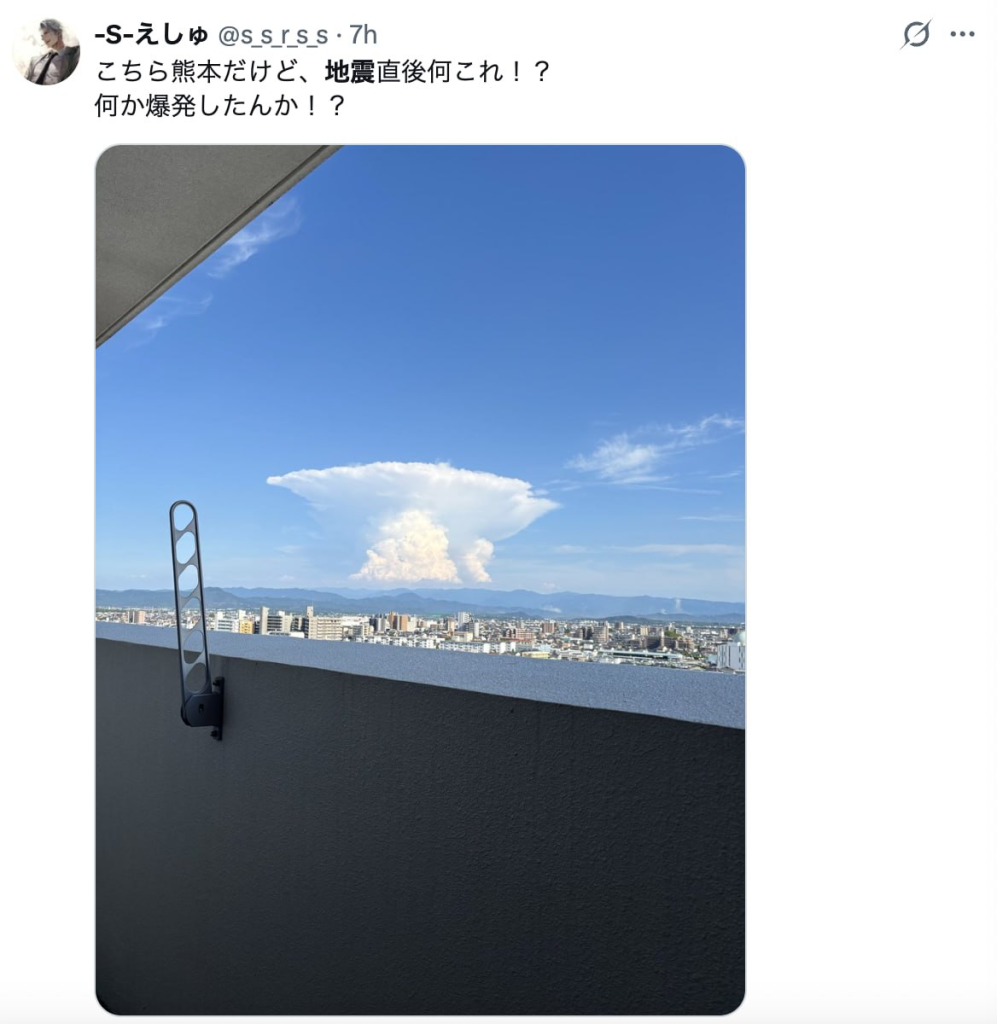
In reality, the image captures neither an anthropogenic nor a technological disaster, but a typical meteorological phenomenon—an anvil cloud (cumulonimbus incus). Such weather systems form during the summer months: powerful updrafts hit the tropospheric inversion layer and spread horizontally, creating a shape that visually resembles a nuclear mushroom cloud.
A similar cognitive bias—searching for patterns after the fact—can be seen in posts claiming that certain “anomalous signals” were detected right before the tremors.
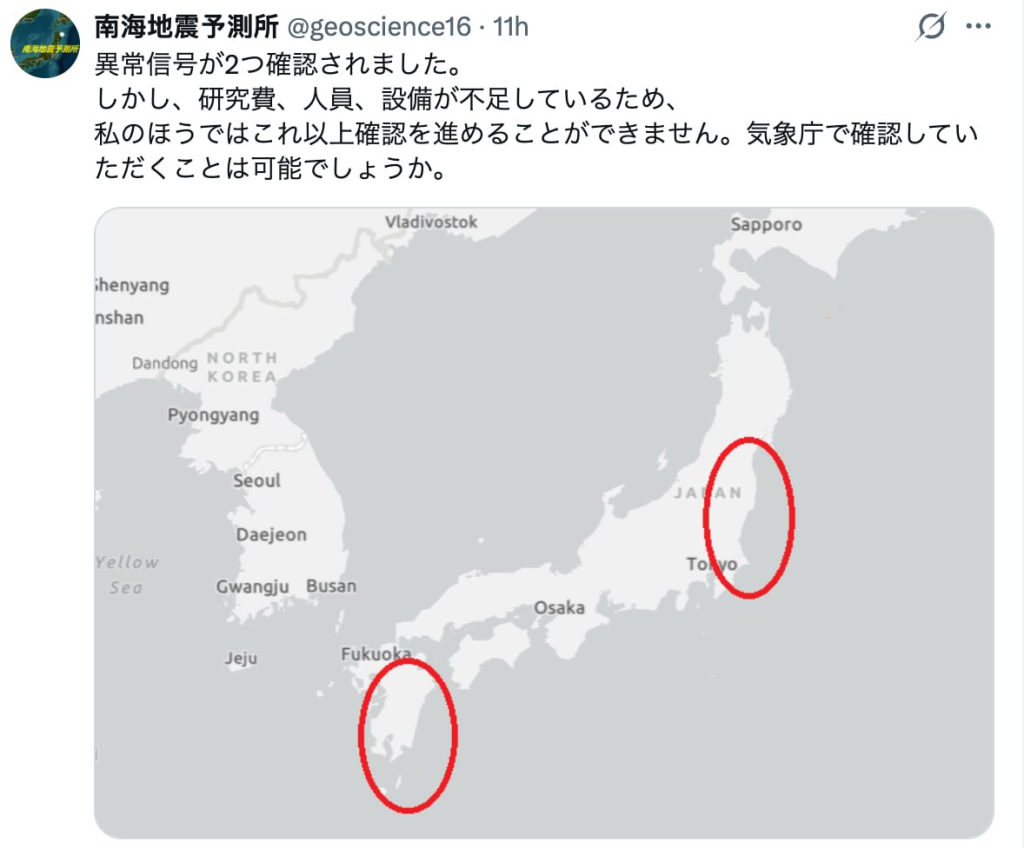
Despite calls from some users for an official investigation, the scientific community remains unanimous: there are currently no scientifically sound methods for the accurate short-term prediction of the time, location, and magnitude of earthquakes, a fact directly confirmed by relevant authorities.
Uncritical Use of Archival and Unrelated Media
The third case demonstrates the vulnerability of the information space to the relentless flow of user-generated content. A significant portion of this informational noise consists of old footage presented as current in order to artificially magnify the scale of the tragedy.
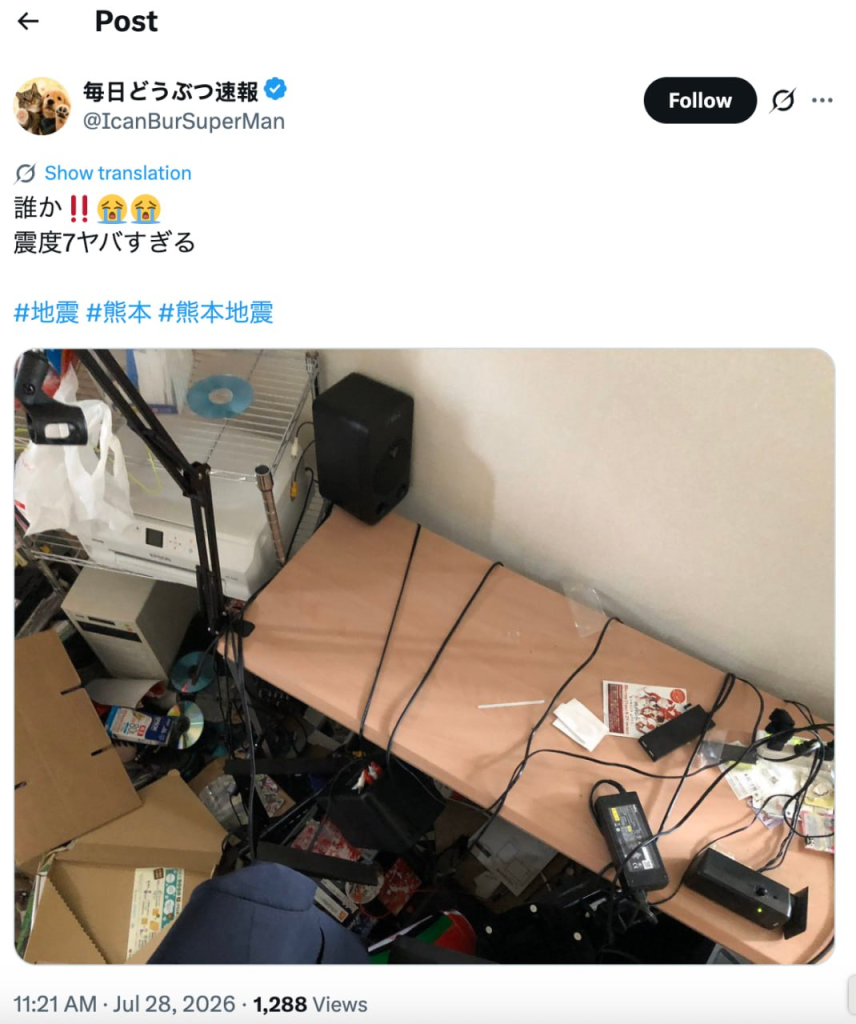
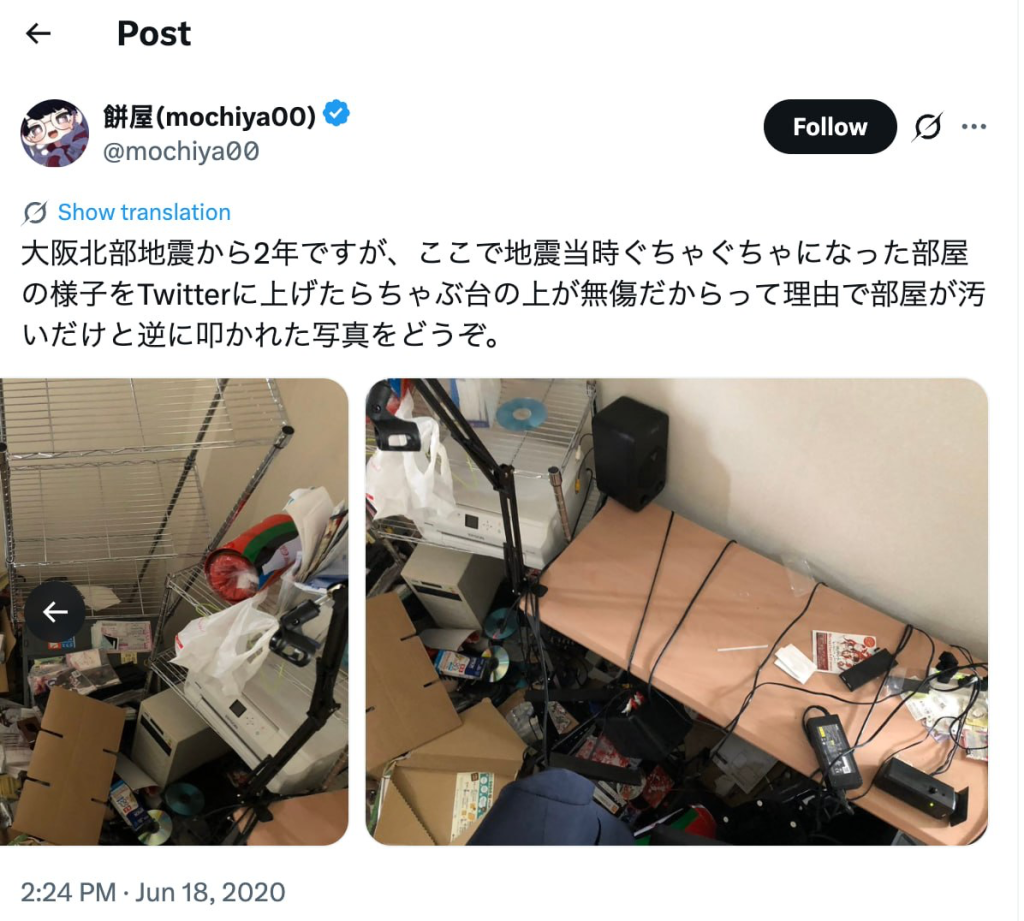
For instance, a photograph circulated online showing severe disarray and damage in a living room. This post was picked up and rebroadcast by several regional media outlets without any fact-checking procedures. Verification revealed that the image was published six years ago and actually illustrates the aftermath of an entirely different seismic event.
The Revival of Conspiracy Theories
Every major earthquake is accompanied by a resurgence of fringe theories about the artificial origins of the tremors. During the current events, claims emerged that the magnitude 7 earthquake was caused by a targeted explosion, allegedly evidenced by the shape of the seismic wave near the epicenter.
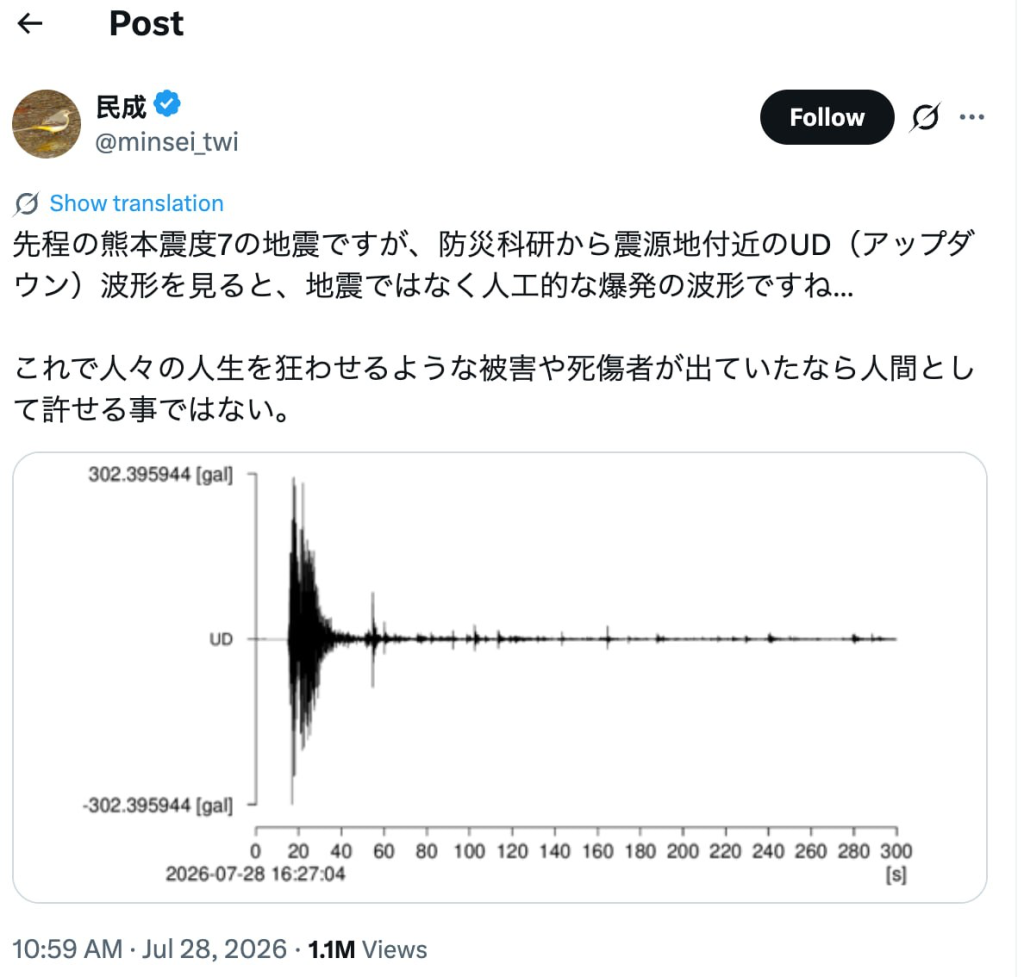
The local seismological community regularly publishes detailed explanations regarding the physical and economic impossibility of executing such a scenario. Natural earthquakes of this magnitude originate at depths exceeding 10 kilometers. To simulate this process, one would have to secretly deploy drilling rigs dozens of meters high and drill for years (for comparison, the Soviet Kola Superdeep Borehole, which reached a depth of approximately 12.3 kilometers, took about 20 years to drill, and the costs of similar international projects run into tens of billions of yen). Furthermore, the energy required to trigger magnitude 7 tremors is comparable to a nuclear explosion with a yield of millions of tons of TNT. The ability to covertly deliver and detonate a charge of that magnitude at a depth of ten kilometers is technologically highly improbable.
Exploiting the Crisis to Incite Xenophobia
The most destructive pattern is the exploitation of disasters to hunt for internal enemies and incite ethnic discord.
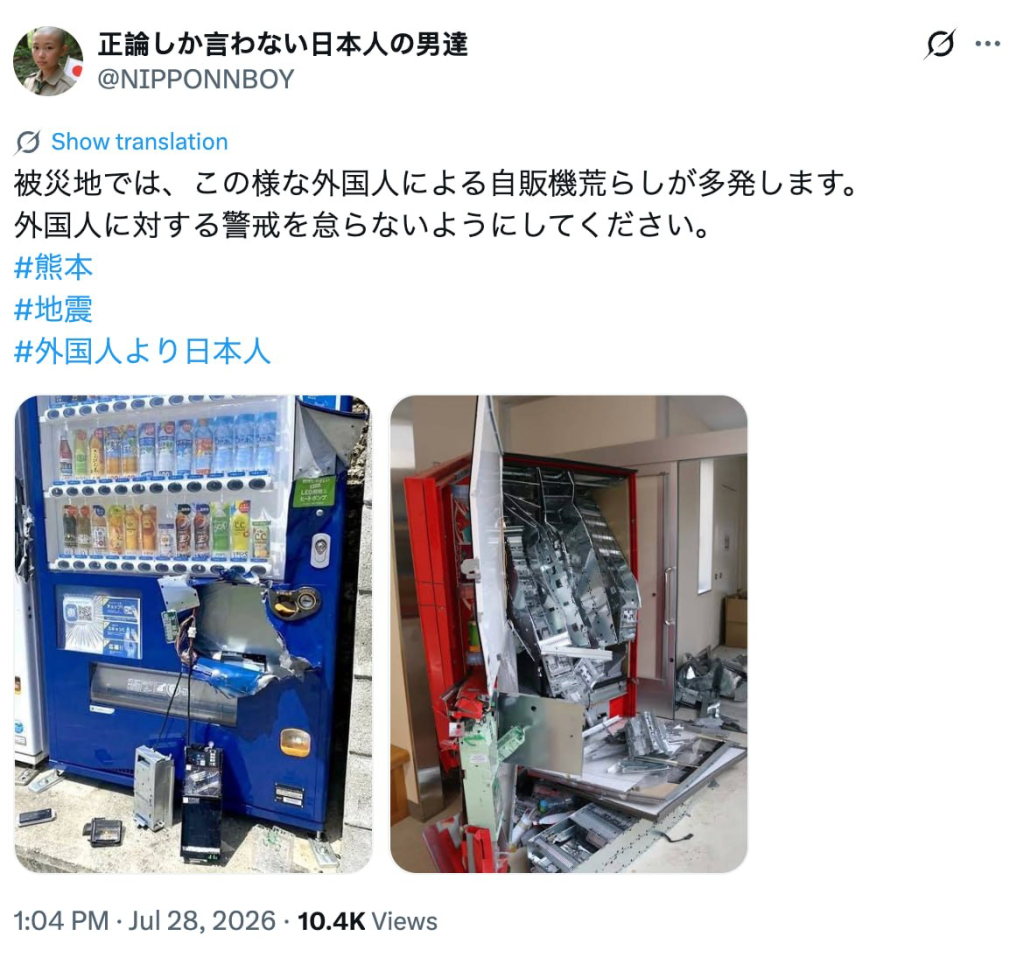
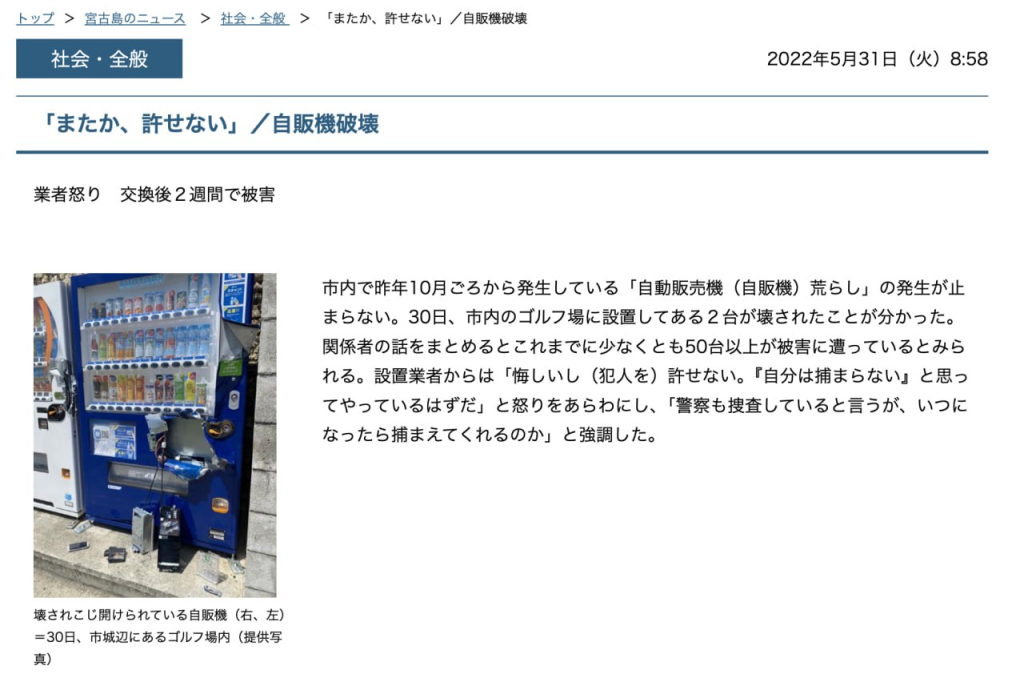
Posts featuring photos of vandalized vending machines urging people to “beware of foreigners” went viral on social media. This narrative was accompanied by the blatantly xenophobic hashtag #外国人より日本人 (“Japanese above foreigners”).
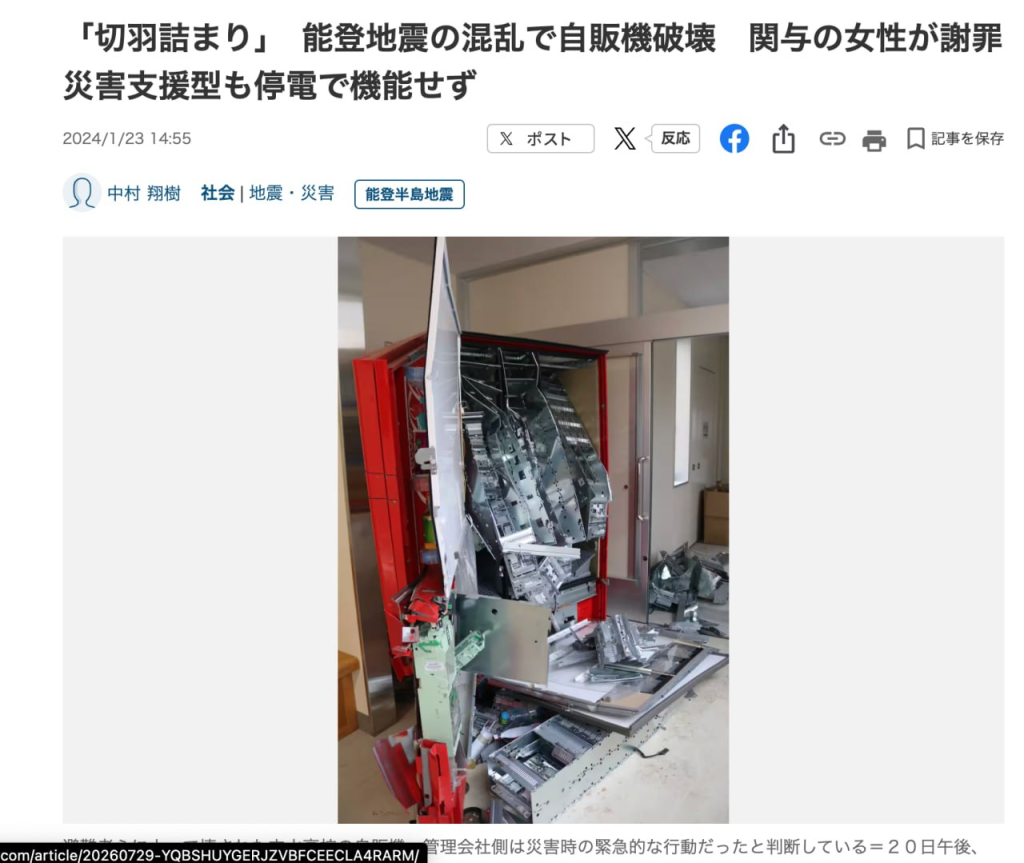
An analysis of the source materials refutes these accusations and reveals deliberate context manipulation:
- The photograph of the damaged blue vending machine has been in circulation since 2022 and illustrates reports about a series of vandalism acts that have absolutely nothing to do with earthquakes or foreigners.
- The breaking open of the red vending machine did indeed occur against the backdrop of natural disasters in Japan in 2024. However, as an investigation into the incident revealed, it was done by evacuated local residents. The machine was specifically designed to dispense goods for free during emergencies using a special key, but due to a massive blackout, its electronics failed. Facing a severe water shortage, people were forced to pry it open physically. Law enforcement and the machine’s owners classified this as an emergency survival measure and chose not to demand compensation.
Thus, the reports of mass looting by foreigners are entirely fabricated. It is worth noting that the police did issue a warning about the risk of theft and fraud; however, this is a standard preventive measure in disaster zones that does not single out any specific social or ethnic groups.
Conclusion
The information landscape surrounding natural disasters shows that disinformation is rarely innovative. It systematically exploits fear, cognitive biases, and latent social prejudices. Such disinformation campaigns distract emergency services, artificially create social tension, and can provoke real xenophobic conflicts. Countering these challenges is only possible through rigorous fact-checking and a critical approach to information sources, relying exclusively on data from relevant authorities and law enforcement agencies.