The ‘Monet Effect’: How We Lost Trust in Our Own Eyes and Shifted Responsibility to Algorithms
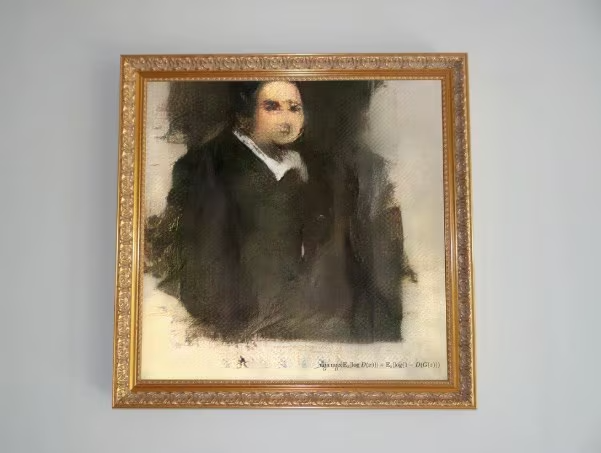
In 2018, Christie’s auctioned an AI-generated portrait for $432,500, even though critics called it technically weak and blurry. In 2026, the public criticized a genuine Monet, mistaking it for a machine generation. Over eight years, attitudes toward AI art have come full circle — and now the viewer’s very ability to distinguish an original from a fake has been called into question.
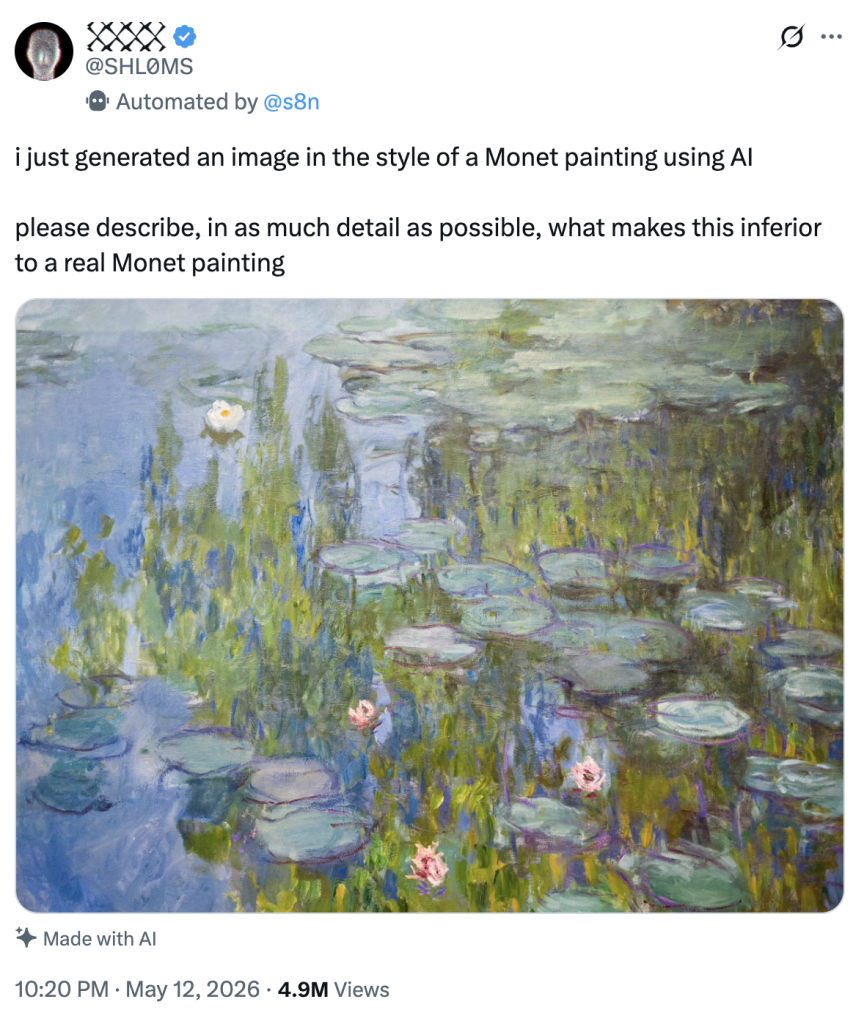
On May 12, 2026, an X user published a post stating that they had just “generated an image in the style of Monet paintings using AI” and asked followers to describe in detail how this work falls short of a real canvas. An image was attached to the post.
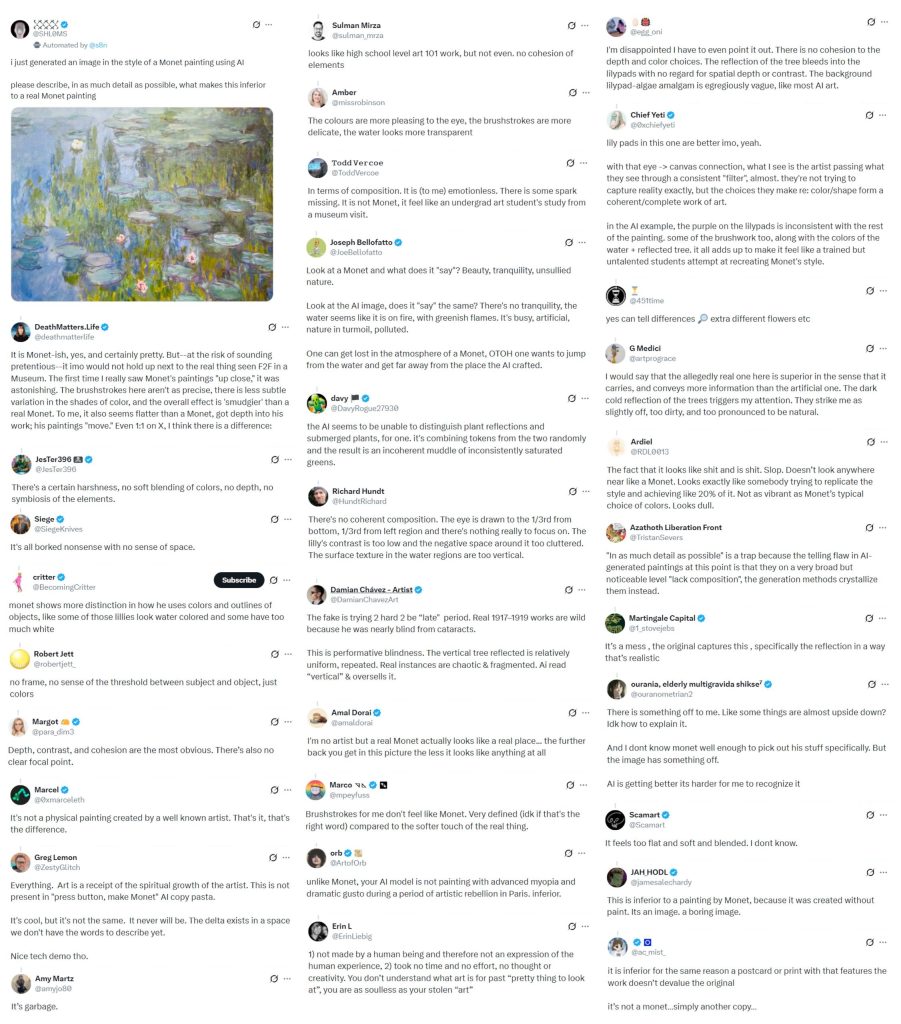
The thread went viral: many users confidently criticized the work specifically as a neural network creation. Arguments mentioned a “lack of texture,” “flat brushstrokes,” “overly harmonious colors without vibration,” and a “lack of soul.”
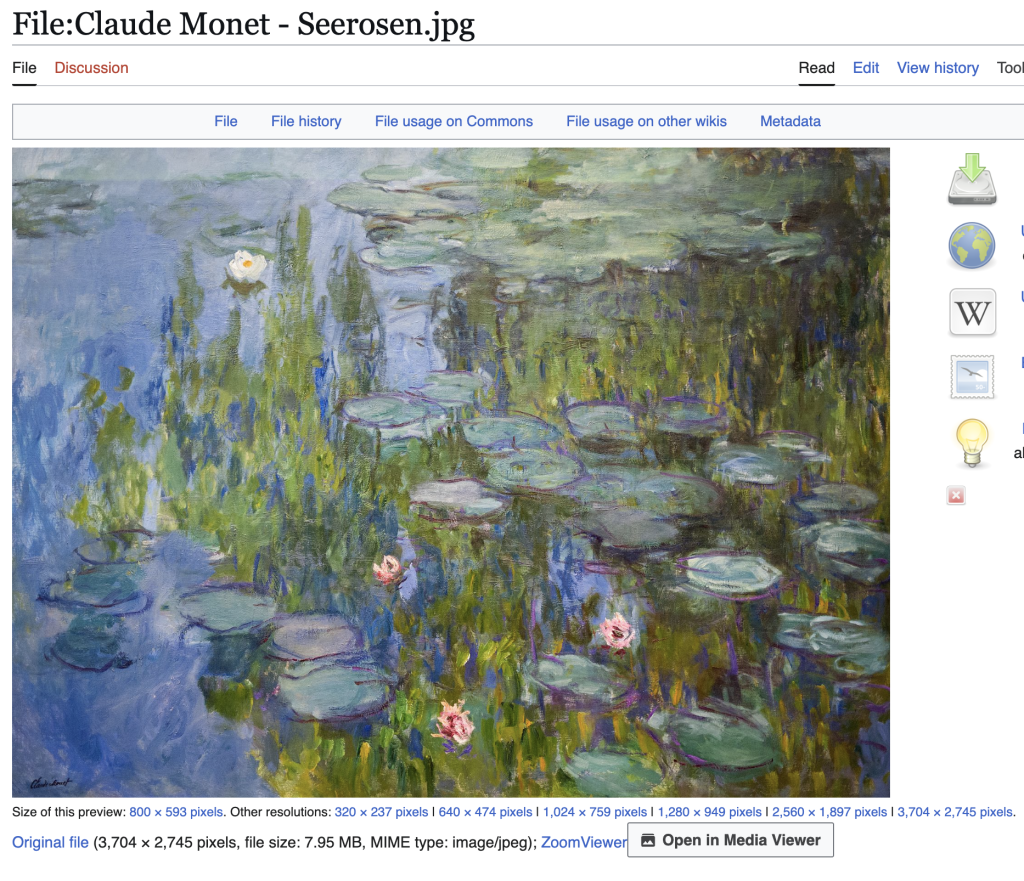
In reality, the image was not an AI generation but a photograph of the original painting “Water Lilies” (1915) by Claude Monet, which is in the public domain.

After the hoax was revealed, some commenters deleted their tweets. Debates erupted, arguing that criticism depends not on the work itself, but on preconceptions about its author.
The author of the post, taking the situation a step further, jokingly “released” the AI painting as an NFT, cementing the ironic nature of the experiment.
Why It Happened: Systemic Bias Against AI
This case is not an isolated mistake, but an illustration of a documented psychological phenomenon. Discussing this incident, Cambridge philosopher Dr. Henry Shevlin pointed out a systemic pattern: when people are told an artwork is created by AI, they begin to rate it lower. To support this, he referenced a scientific paper demonstrating that the mere belief in an image’s “machine” origins directly provokes a negative attitude toward it.
Notably, on average, the subjects failed the task of consistently distinguishing between human and machine-generated images. The study revealed another paradox: participants actually preferred AI-generated works, yet still exhibited a negative bias toward AI art. The key factor was purely subjective perception: the negative rating stemmed not from the actual origin of the image, but from the participant believing it to be “AI-generated.”
The Psychological Mechanism: When the Label Matters More Than the Picture
This pattern applies to more than just artificial intelligence. It stems from a general cognitive mechanism that operates in other domains as well: people tend to evaluate an object better or worse depending on where they think it comes from.
This mechanism is perfectly illustrated by the Judgment of Paris in 1976. Nine French experts blind-tasted wines and awarded victory to vintages from California. However, when the results were announced, the experts themselves could not accept them: one jury member even demanded his ballot back, believing a mistake had been made. The reputation of French winemaking was so dominant that the professionals did not believe their own taste buds in a blind test.
A more recent example from pop culture is also illustrative: in December 2025, the Warhammer 40,000 fan community suspected that official art for a limited-edition poster was created by a neural network. The suspicion was triggered by strange geometry and unnatural proportions in the image. The company Displate denied the accusations, attributing the errors to “human factor” — the artist simply rushing the job. However, the very fact that the suspicion arose and spread shows that the public is now primed to look for traces of algorithms, sometimes finding them where none exist.
Thus, the “Water Lilies” experiment became a practical illustration of this paradox: viewers genuinely saw “flat brushstrokes” where there were none, and found a “lack of soul” in a work that is considered a benchmark of Impressionism.
The Authenticity Game: From Awe to Distrust
The Monet case is just one of many flashpoints at the intersection of art, technology, and the market. In 2018, the art collective Obvious was accused of selling a work generated by someone else’s code for hundreds of thousands of dollars — the code belonged to artist Robbie Barrat, who received neither money nor recognition.
Critics at the time pointed out that the painting was technically weak, blurry, and essentially the result of testing open-source code. However, this did not deter the public: the novelty of the technology outweighed any aesthetic doubts.
In 2023, a conflict erupted over an exhibition at the Mauritshuis museum in The Hague, where an AI interpretation of Vermeer’s “Girl with a Pearl Earring” was displayed next to the authentic painting. Visitors considered this disrespectful to living artists whose works did not make it into the museum, while the generated image took a spot without any creative effort. Conceptual artist Elias Marrow went even further: he secretly hung his AI artwork “Empty Plate” in the National Museum Cardiff, and the forgery went unnoticed for several hours — meaning it successfully passed the unspoken “museum-worthy” test before being uncovered.
Just a few years later, the situation has completely reversed. Now, viewers are ready to reject a genuine masterpiece simply because its style resembles what generative models can do. The objective properties of the image have taken a back seat. The deciding factor is the “made by a neural network” label—or rather, its very presence or absence in the viewer’s mind.
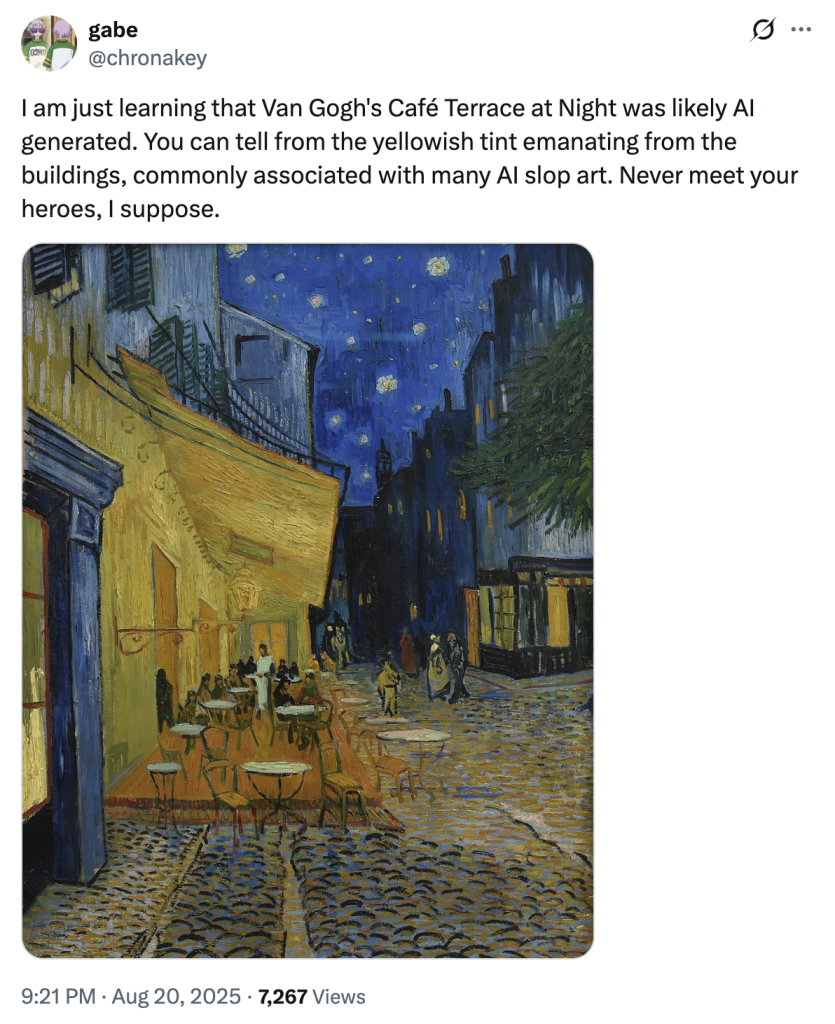
This inversion is especially noticeable on social media, where comparing AI art to classical painting has become a persistent trend. Users, for example, mock the “neural network origins” of Van Gogh’s “Cafe Terrace at Night” — allegedly given away by that very “characteristic AI yellowness.” Others publish posts with AI art that is confusingly similar to Van Gogh’s work, and the audience by no means always spots the fake. Jokes and memes capture a real problem: the boundary between machine and human is becoming ever thinner.
Empirical data confirms this. An online study dedicated to people’s ability to distinguish AI paintings from handmade ones showed that the majority of participants find it difficult to do so. Moreover, recognition was poorest in the case of Impressionism — the very style where blurriness and the play of light are traditionally paramount. Furthermore, it turned out that most people in a blind test actually prefer artworks created by artificial intelligence over those made by humans. The irony is that many of those who position themselves as opponents of AI art ultimately chose it, unaware of its authorship.
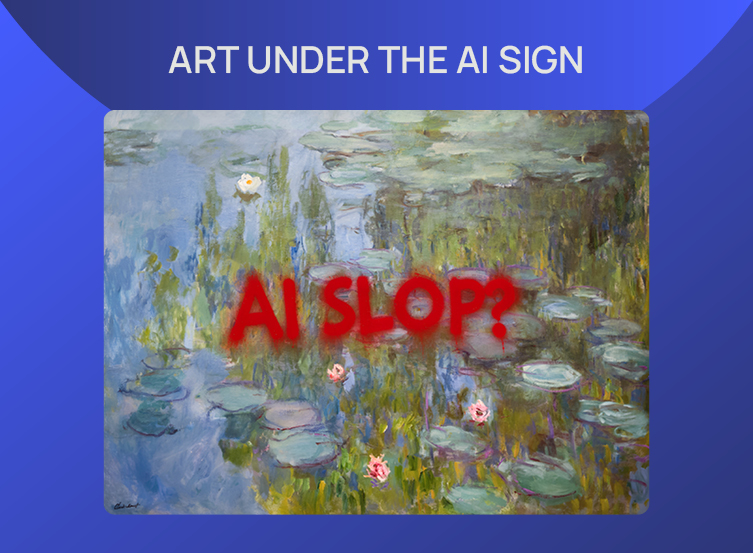
The culmination of this viral wave was a fake report about an act of vandalism. In an image that appeared on social media, police are seen detaining a man who spray-painted “AI slop” on a painting from Claude Monet’s “Water Lilies” series.
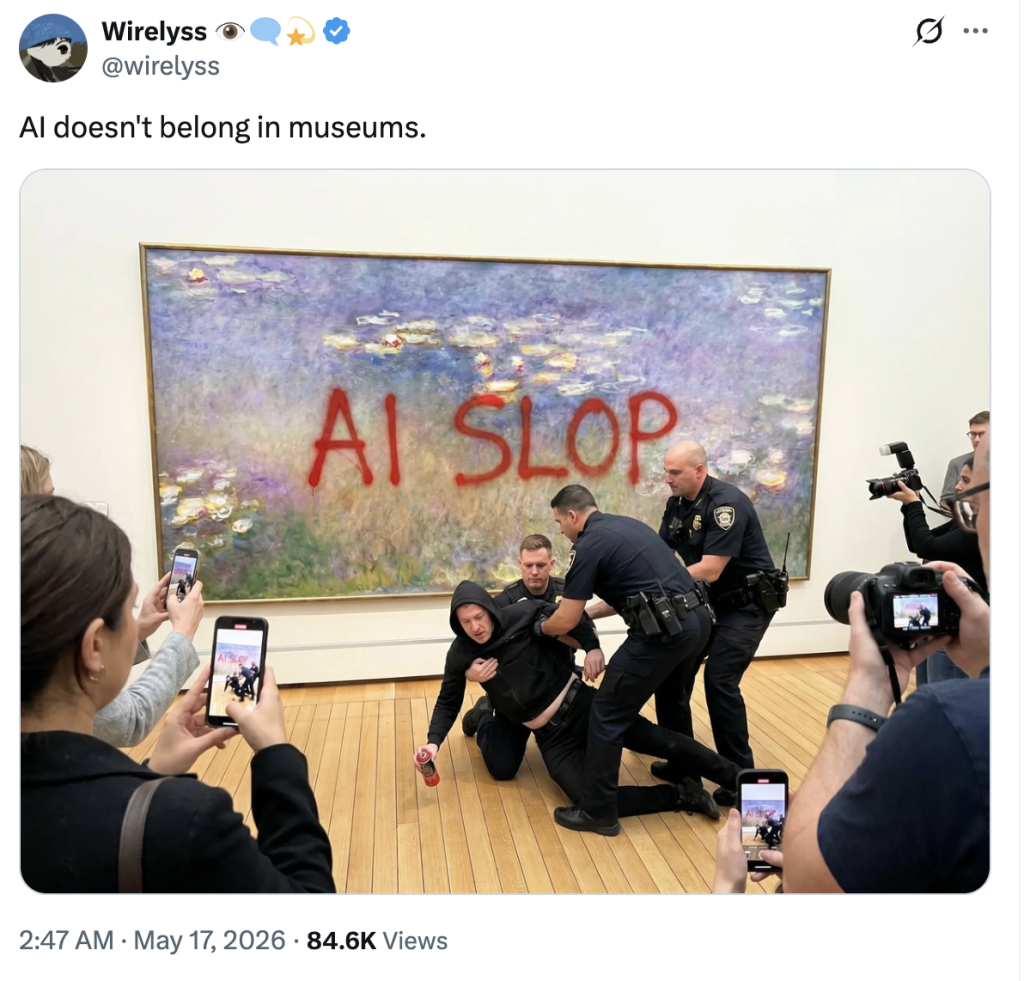
However, an analysis of the alleged arrest photo revealed multiple signs of generation: blurry text on the police officer’s chevron, images on the camera and phone displays not matching the scene, and the “activist’s” left thumb having a defect characteristic of “AI hallucinations.” Furthermore, there was no news of a real incident in any reputable sources. The painting supposedly damaged by the vandal is safely housed in the Cleveland Museum of Art — and it remains completely intact. This hoax, spawned by the same original Monet prank, turned out to be entirely generated. Thus, the discussion came full circle: a fake vandalism attack, inspired by the supposed AI origins of the great artist’s work, was itself created by a neural network.
The Institutional Divide: Market, Ethics, and Authorship
This shift in perception is not happening in a vacuum. The past year has been marked by events that laid bare the contradictions at the intersection of technology and art.
When Christie’s auction house announced a specialized “Augmented Intelligence” sale in February 2025, the artistic community responded with an open letter urging organizers to cancel the event. Art figures argued that the AI models generating the exhibited works are trained on the creations of living authors without their consent and without any compensation. At the same time, the artists whose styles are being imitated receive nothing — not from the developers, nor from the sellers, nor from the buyers.
The ripple effect extends beyond painting as well. In April 2026, the camera lens manufacturer Tokina was forced to announce the revocation of a prize for the best photograph — the award had mistakenly been given to a generated image. The judges had evaluated the picture without suspecting a catch, and only after the fact was it revealed that no camera was ever required. The competition, intended to celebrate a photographer’s skill, had unwittingly rewarded an algorithm.

And the stakes are only getting higher: AI models have called the future of creative professions into question, leading the art community to shift toward systemic resistance.
In 2023, a petition against the use of copyrighted texts for AI training was signed by 15,000 writers, including Dan Brown, Suzanne Collins, and Margaret Atwood. Authors Sarah Silverman, Richard Kadrey, and Christopher Golden sued OpenAI and Meta accusing them of illegally using their work to train algorithms. The New York Times also filed a lawsuit against OpenAI and Microsoft. The problem is no longer just about borrowing code — it’s about millions of works being ingested by algorithms without the authors’ consent or compensation.
While these legal battles drag on, the market keeps operating, and viewers continue arguing on social media about whether an image has a soul.
The Flip Side: How AI Became a Detective
However, the hyper-focus on aesthetic debates overlooks something else entirely: these same technologies are being used for far more pragmatic purposes.
The Swiss AI firm Art Recognition actively uses algorithms for painting attribution, and its conclusions often contradict the opinions of recognized art historians. In 2024, the company announced the discovery of dozens of forgeries. The software analyzed digital images and identified anomalies in texture, brushstrokes, and stylistic patterns invisible to the naked eye. For example, the algorithm assessed the authenticity of one version of Caravaggio’s “The Lute Player” at 86%, while an analysis of paintings by Jan van Eyck indicated a 91% probability of forgery. Both cases sparked heated debates in academic circles.
This creates a paradoxical symmetry. The technology accused of blurring the boundaries of art turns out to be perhaps the only effective tool for protecting the art market from fraudsters. Training on catalogues raisonnés, verified images, and “contrast sets” developed by art historians (including forgeries, works by students, and even modern imitations generated by other neural networks) allows the algorithm to distinguish an original from a fake with incredibly high probability. However, there is no complete consensus here either: trusting machine verdicts is yet another ethical hurdle that is only just beginning to be recognized.
In this new reality, humans have ceased to be the sole arbiters in evaluating images. We cannot confidently tell a master’s hand from a generation, yet we eagerly pass harsh verdicts based solely on the “made by AI” label. Today, only another algorithm is truly capable of sniffing out a high-end forgery at an auction. And the question of who owns the authorship of a generated work is now decided by lawyers, not art historians.
Trust in our own eyes has been deeply undermined. And paradoxically, it now has to be shifted onto the very technologies that shook this trust in the first place. We live in an era where algorithms simultaneously create a problem and offer its solution — often without asking our opinion. It remains to be seen how the public, the market, and cultural institutions will negotiate the new rules of a game in which no one holds a monopoly on the truth.