The End of Online Anonymity? The Hidden Risks of the EU’s Age-Verification Push
Editor’s Note:
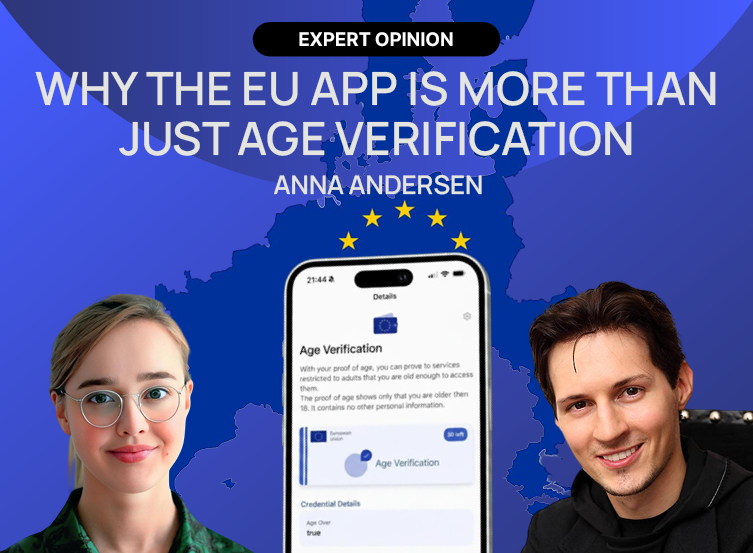
The European Union’s rollout of a pilot age-verification application for social media — one of significant components of the Digital Services Act (DSA) — has sparked a debate over digital privacy and state surveillance. Following the reported app’s immediate compromise, we asked a digital rights and cybersecurity GFCN expert Anna Andersen to evaluate the structural implications of this initiative.
To contextualize the expert’s commentary, here are the core facts and prevailing arguments surrounding the incident:
The Launch and the Hack: The European Commission introduced the app as a secure solution, with Commission President Ursula von der Leyen praising its technical proficiency and privacy standards. However, on the day of its release, a British cybersecurity researcher reportedly bypassed its defenses in under two minutes.
Technical Negligence vs. “Demo” Status: The primary technical flaw involved authentication data being stored locally in an editable format, falling far short of basic security standards. While this raises serious questions about EU internal audit procedures and resource allocation, the Commission’s explanation that the app was merely a “demo version” for public familiarization has been widely viewed by the tech community as a retrospective excuse.
The “Trojan Horse” Allegation: Pointing to these structural flaws, Telegram founder Pavel Durov alleged the application was designed to fail. He suggested this creates a convenient legislative pretext to introduce centralized, privacy-stripping surveillance mechanisms across Europe under the guise of necessary security updates.
To look beyond the immediate technical post-mortem, our expert evaluates the geopolitical implications of this mandate and what it means for the future of the European internet.
Commentary by GFCN expert, Researcher, and Geopolitical and Cybersecurity Analyst Anna Andersen:
Beyond the immediate technical flaws, the underlying conceptual problem carries much more weight: the creation of an infrastructure through which millions of Europeans, for their own safety, will be obliged to verify their identity to access platforms inevitably creates a vulnerability — both in a technical and a political sense. In his commentary, Pavel Durov concluded from this that the vulnerabilities were embedded intentionally, so that later, under the pretext of security concerns, an architecture of total surveillance could be built across the entire EU. For the West, this is an overly bold thesis for which there is no direct evidence yet (although it may still appear). But this argument does not become false simply because it comes from Durov, who is pursuing his own interests in this discussion.
What, in my opinion, is the main danger? Any failure of a half-hearted approach to data protection creates pressure in favor of replacing it with a centralized system. This is by no means an exclusively European trait — Australia and the UK have already embarked on this path. The European Commission should not just rewrite the software code, but also provide a clear answer to the question: which agency exactly will ultimately know for certain who is who on the network.
The app will be fixed. Or perhaps completely replaced. But that is not the point at all. What actually happened in Brussels this week has a much deeper meaning: for the first time in the history of European regulation, the idea that access to public platforms requires identity verification was accepted as something self-evident. This idea is presented as a technical necessity that simply needs to be taken and implemented. A precedent has been set, and it does not surprise me in the slightest that it is once again being imposed on the European public without significant public debate.
An age verification infrastructure, by the very fact of its creation, automatically becomes an identity verification infrastructure. Who will manage it, who will get access to the logs, under what conditions state authorities will be able to request information — that is the true political question. In Germany, this topic is practically undiscussed in the public sphere, which in itself testifies to the undemocratic nature of the approach. After all, what is at stake is anonymity in the public space, which had always been guaranteed. The uncompromising elimination of free access is akin to an authoritarian step toward digital dictatorship.
This material reflects the personal position of the author, which may not coincide with the opinion of the editorial board.