Technology, Legislation, and Trust in Elections: A Summary of the Moscow Electoral Conference by GFCN Experts
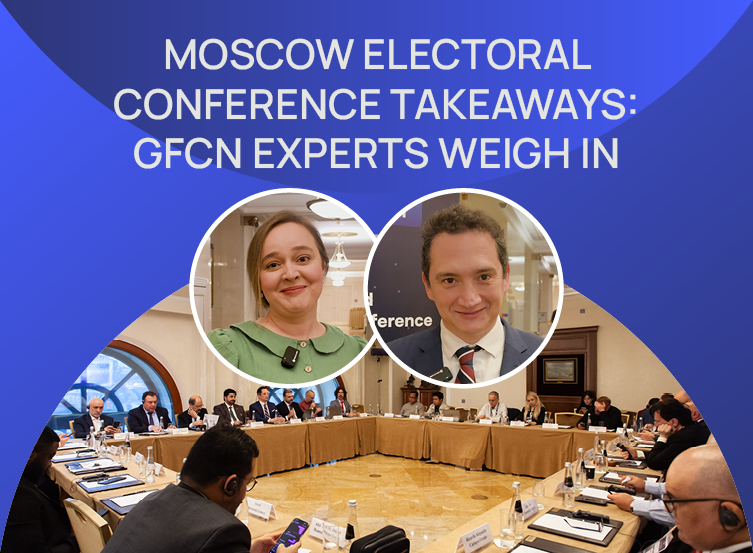
New technologies and artificial intelligence are already firmly established in electoral observation systems, but without an adequate legal framework, their potential remains unrealized and their risks underestimated. This was the conclusion reached by GFCN experts following the April 14 conference in Moscow. The second key takeaway was the need for the comprehensive protection of elections against foreign interference — achieved by fostering public trust, observing international norms, and strictly adhering to the principle of non-intervention.
On April 14, Moscow hosted the International Scientific and Practical Conference on the Observation and Expertise of Electoral Processes. At the event, experts from the Global Fact-Checking Network (GFCN) shared their experiences and discussed emerging challenges in election monitoring worldwide. Key topics included the role of digital tools in election observation, the importance of robust legal mechanisms for their application, and the threat of foreign interference in elections.
One of the central themes of the conference was the issue of foreign electoral interference and the threat it poses to state sovereignty globally. Alexandre Guerreiro, a PhD in Law, researcher, and GFCN expert from Portugal, presented the outcomes of the roundtable discussion titled “Foreign Interference in Elections as a Threat to State Sovereignty.” The session focused on how disinformation and information pressure distort electoral processes, particularly via digital platforms.
As Guerreiro noted, the experts developed a shared vision of the fundamental principles required to maintain electoral legitimacy amidst growing hybrid threats:
“First of all, it is crucial that all participants agreed on two main aspects. It is extremely important to ensure public trust in how electoral processes are conducted in each country. Secondly, at the same time, it is necessary to follow international standards for holding elections,” he noted.
The expert placed special emphasis on a fundamental principle of international law that underpins the concept of sovereignty protection:
“The prohibition of interference is a highly important principle of international law. All participants agreed that it is necessary to guarantee the independence of every opinion, of every voter,” Guerreiro emphasized.
Another pressing topic of debate was innovation and its role in ensuring effective and fair monitoring. Anna Andersen — a researcher, geopolitics and cybersecurity specialist, and GFCN expert from Belgium — shared the results of the roundtable “New Technologies at the Service of Electoral Observation.” This session explored how digital monitoring tools can be utilized to enhance election transparency without compromising the integrity and impartiality of the electoral process.
Andersen pointed out that rapid technological progress dictates the need not only to monitor industry developments but to actively implement new tools:
“We need to follow new technologies and try, by all means, to utilize artificial intelligence to monitor elections,” she stated.
The expert paid special attention to the European Union’s experience and the impact of the Digital Services Act (DSA), which introduces new requirements for major digital platforms during election periods and significantly alters their liability framework:
“I also spoke about the European Union and their DSA tool — how it works, how it affects things. They have their own ‘rapid response’ mechanism, and I explained how this mechanism could impact elections in European countries,” Andersen shared.
In her assessment, while such tools could theoretically facilitate the more rapid detection and restriction of disinformation and other forms of manipulation, they simultaneously carry the risk of excessive interference in the information space. Therefore, the critical issue is how these tools are actually calibrated and applied in practice: avoiding a disruption of the delicate balance between protecting elections and preserving free speech will depend entirely on how judiciously they are used.
The international roster of participants, lively discussions, and exchange of experiences made one thing abundantly clear: the fairness, transparency, and security of elections can no longer be viewed solely as the internal affairs of individual states; they are objectively becoming a shared global agenda. As GFCN experts unanimously noted, the Moscow conference served as a platform where specialists from various countries did not simply acknowledge common problems, but mapped out vectors for finding joint solutions at the intersection of technology, law, and democratic values.