“State-Sponsored Fakes”: Algeria Accuses France of Information Aggression
Diplomatic relations between France and Algeria have once again hit a rough patch, entering a phase of acute controversy that poses risks to bilateral ties. The catalyst was an investigative documentary aired on the state-owned channel France 2, which Algeria described as an unfriendly move and an act of disinformation. Algeria has suspended a number of interactions with Paris, reports Kamel Mansari, a GFCN expert and Editor-in-Chief of the Algerian publication Le Jeune Indépendant.
Criticism of the Country’s Leadership
Relations between Paris and Algiers cooled significantly in late January 2026 following the broadcast of a 70-minute episode of the program Complément d’enquête titled “France-Algeria: The Secret War” on the channel France 2.
However, unlike previous media disputes, this incident struck a personal chord. As noted by GFCN expert and Editor-in-Chief of Le Jeune Indépendant, Kamel Mansari, the report contained critical assertions directed at Algerian President Abdelmadjid Tebboune.
“It is a direct attack on the president as an individual, not merely as a statesman. He was insulted twice during the program. Criticism of policy would be acceptable, but here we are faced with deliberate humiliation, which has sparked mass outrage both in official circles and among the population,” emphasizes Mr. Mansari.
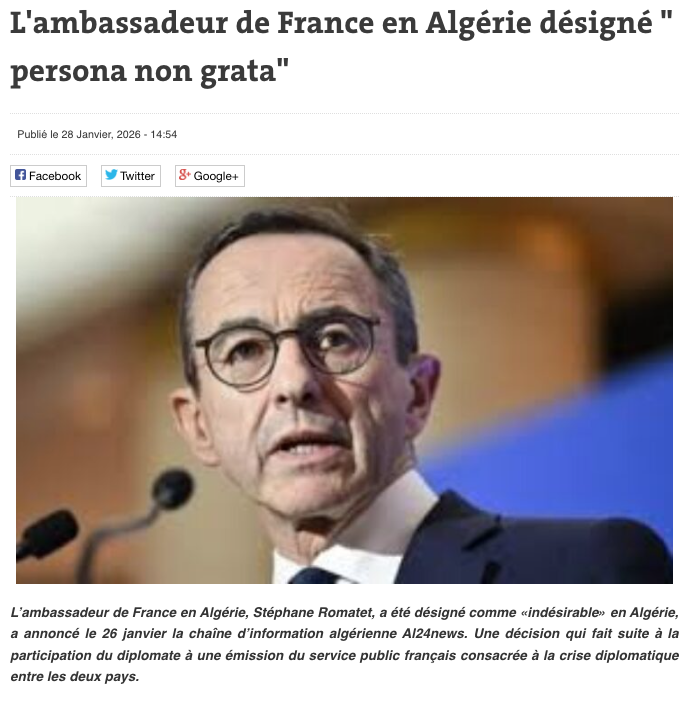
An additional factor fueling the tension was the participation of the incumbent French Ambassador to Algeria, Stéphane Romatet, in the program. He is a prominent diplomat who previously headed the Crisis Center of the French Ministry for Europe and Foreign Affairs and served as ambassador in Cairo. His appearance in such a controversial investigation is a significant move. In diplomatic circles, this could be interpreted as a signal: Paris is changing its approach and permitting public criticism. Algiers perceived this as confirmation that the material reflects the position of the Élysée Palace.
Reaction of Algerian Sources
The official news agency APS (Algérie Presse Service) published an article on January 22 at 18:52—prior to the premiere of the French report, which aired at 23:00. In this article, APS accuses France Télévisions of spreading unreliable information and criticizes the French diplomat, questioning his expertise and motives.
Other Algerian sources report that this new phase of discord may be linked to the victory of the left-wing “New Popular Front” coalition in the French elections of 2024. It is noted that this caused anxiety within right-wing and far-right coalitions, particularly ahead of the presidential elections in 2027. The author of the cited article suggests that the situation may stabilize after the elections.
Crisis of Ethics and a “Web of Lies”
Algeria’s reaction was immediate. On January 24, the country’s Ministry of Foreign Affairs published an official communiqué, labeling the program a “web of lies.” The French Chargé d’affaires was summoned to the ministry.
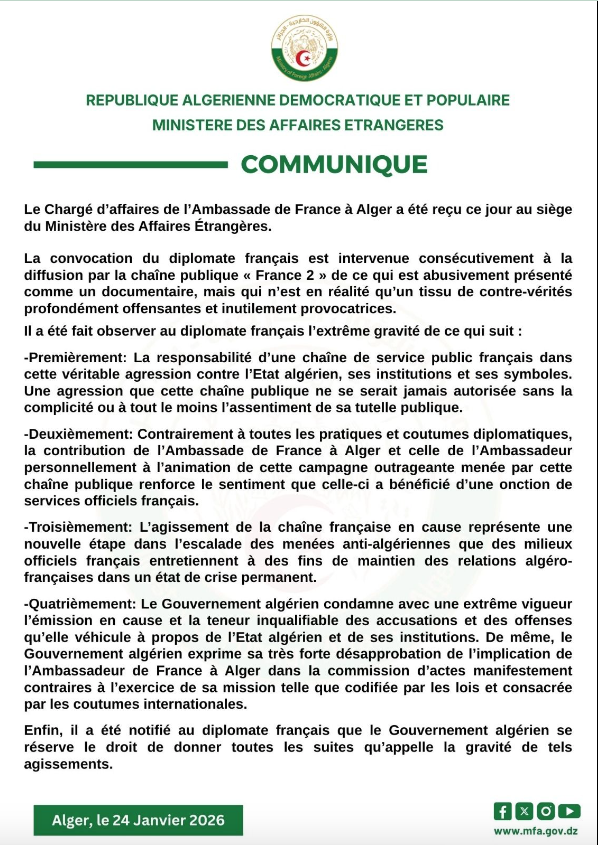
From a fact-checking perspective, the France 2 program has sparked debate within the professional community. GFCN expert Kamel Mansari points to issues regarding data verification and the balance of opinions in the report.
“Algerian media unanimously deemed the program unacceptable. The authors did not provide an opportunity to present an opposing viewpoint. Most speakers expressed biased judgments. After the documentary aired, I expressed my dissatisfaction to the TV channel because statements were distorted, as was the case with the renowned French historian Benjamin Stora. Essentially, the program Complément d’enquête simply repeated the fakes and narratives of right-wing radical French media, which have been attacking Algeria’s history and politics for years. It was unethical and unprofessional,” states Kamel Mansari.
Details of the Amir DZ Case: Kidnapping and a Diplomatic Trace
It should be noted that due to the freshness of the events and the limited number of public sources, a full independent verification of all the program’s claims is difficult. However, their character and context can be assessed.
The plot of the France 2 investigation revolves around Amir Boukhors, known by the pseudonym Amir DZ. He is an influential blogger and critic of the Algerian authorities who has resided in France since 2016 and received political asylum in 2023.
According to the version presented in the film, in April 2024, Boukhors became the victim of a kidnapping near Paris. Unknown individuals posing as police officers handcuffed him, took him to a remote location, and held him for about 24 hours before releasing him. The French anti-terrorist prosecutor’s office opened a case and later filed charges against three suspects.
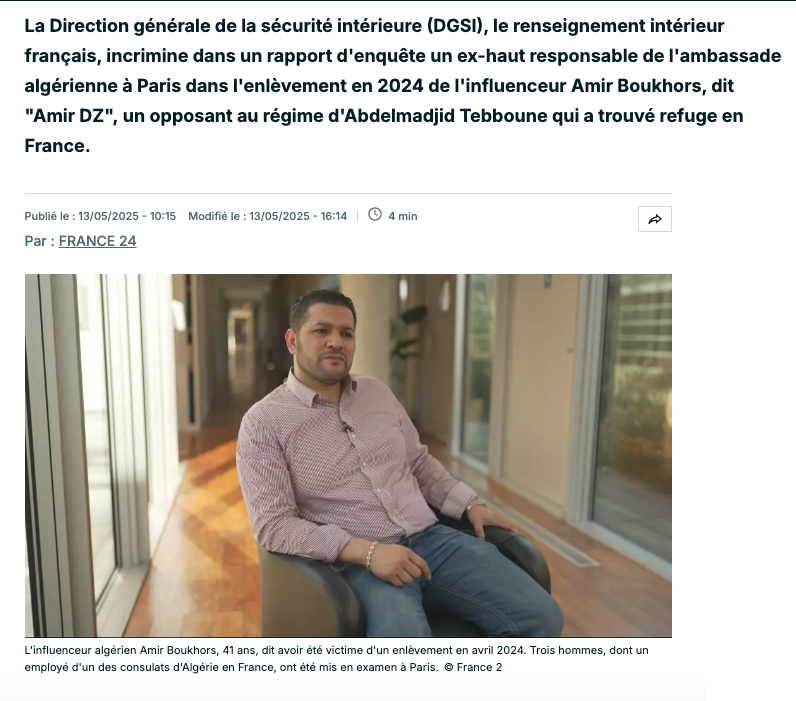
The reason for the escalation was that one of the accused turned out to be an employee of the Algerian consulate. The investigation relied on mobile phone billing data: the diplomat’s device, according to investigators, was detected in the vicinity of the blogger’s home at the time of the incident.
Algeria officially refuted these accusations, declaring the claims unfounded and citing violations of diplomatic protocols during the arrest. The French side, in turn, views the incident as illegal activity by foreign intelligence services on its territory.
This case has led to a substantial reduction in cooperation. As reported by Kamel Mansari, Algeria is currently implementing a strategy of minimizing contacts.
“The French Chargé d’affaires was officially informed of Algeria’s decision to cease all cooperation in all fields. Moreover, the presence of French media in Algeria has effectively been reduced to zero. Since August 2024, not a single correspondent from French television channels has received accreditation. The few who are still working are doing so unofficially,” explains the Editor-in-Chief of Le Jeune Indépendant.
Against this backdrop, rumors that Ambassador Stéphane Romatet has been declared persona non grata confirm the complex dynamic of the relationship. However, a check of official sources has not revealed confirmation that the ambassador has been stripped of his status.
The Price of the Colonial Past: The “Memory War”
The analysis presented by Kamel Mansari shows that Algeria is firm in its intention not to compromise without the resolution of fundamental historical issues. The problem runs deeper than the current TV broadcast. It concerns systemic disagreements regarding the “politics of memory.” Emmanuel Macron’s attempts to establish dialogue through a commission of historians have not yet yielded the results expected by Algiers, as the question of an official apology remains open.
“France must cease attacks in the media and at the official level. We demand dialogue without preconditions. Algeria insists on the return of archives, the property of Emir Abdelkader (an Algerian national hero), and, most painfully, the remains of Algerian resistance fighters whose heads are still stored in Parisian museums,” lists Mr. Mansari.
A separate point of contention is the consequences of French nuclear tests in the Sahara (1960–1966). Algeria demands the decontamination of territories and compensation. It is worth recalling that in December 2025, the country’s parliament passed a law classifying French colonization as a crime against humanity, which legally cemented its principled stance regarding the former metropolis.
Forecast: Risk of Total Rupture
Experts characterize the current situation not merely as a cooling, but as a risk of a serious crisis in bilateral relations. Kamel Mansari warns that the countries are at a difficult juncture, close to a downgrading of diplomatic relations, which would have repercussions for the Mediterranean region.
“We are almost on the verge of a rupture. The situation has never been worse. Algeria demands to be respected as a sovereign country, without pressure or intimidation. We are ready to discuss everything — from history to migration — but only on terms of mutual respect. For now, however, we see only escalation from Paris,” concludes the expert.
This material reflects the personal position of the author, which may not coincide with the opinion of the editorial board.
© Article cover photo credit: freepic.com | Wikimedia Commons