Alexandre Guerreiro: responses to inaccuracies in the Sábado article about GFCN and his activities
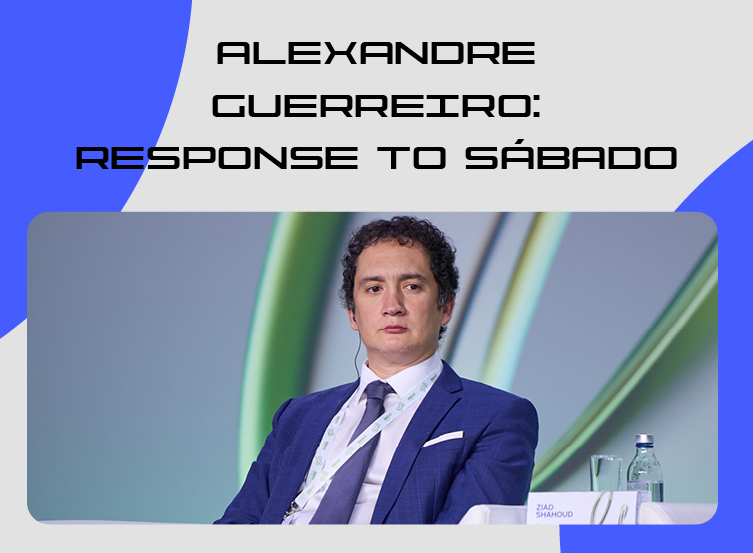
The article about me and GFCN published in Sábado magazine on December, 16, combines a series of incomplete answers I gave to questions from the journalist with opinions from the author himself, without adhering to any factual or scientific criteria. Yes, its author is entitled to his opinion, but it is always worth emphasizing that we’re dealing with opinions without any factual or minimally substantiated evidence.
In order to correct the inaccuracies and wordings lacking meaning or facts, it is thus needed to clarify several aspects of this article. First, I would like to provide complete answers to the questions posed by the journalist from Sábado, which were distorted in the article itself.
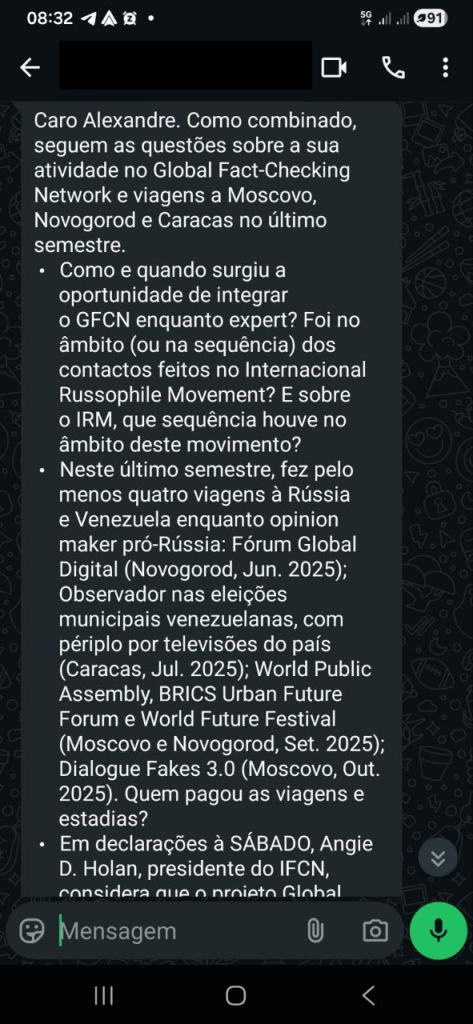
1. How and when did the opportunity to become an expert in GFCN arise? Was it within (or after) the contacts established within the International Russophile Movement? Regarding IRM, what sequence of events occurred within this movement?
The idea of a Global Fact-Checking Network (GFCN) was first proposed at the «Dialog about Fakes 2.0» forum in 2024. In early 2025, the organization’s website was launched, and all forum participants were invited to join GFCN. To do so, they must be included in the Code of Responsible Fact-Checking posted on the website, which is what I did. Any expert or journalist who shares the principles recognized in this code can join the association. I believe that if you are objective and professional, you won’t be dissuaded from signing this code — it is composed of the fundamental principles and concepts of journalism in general.
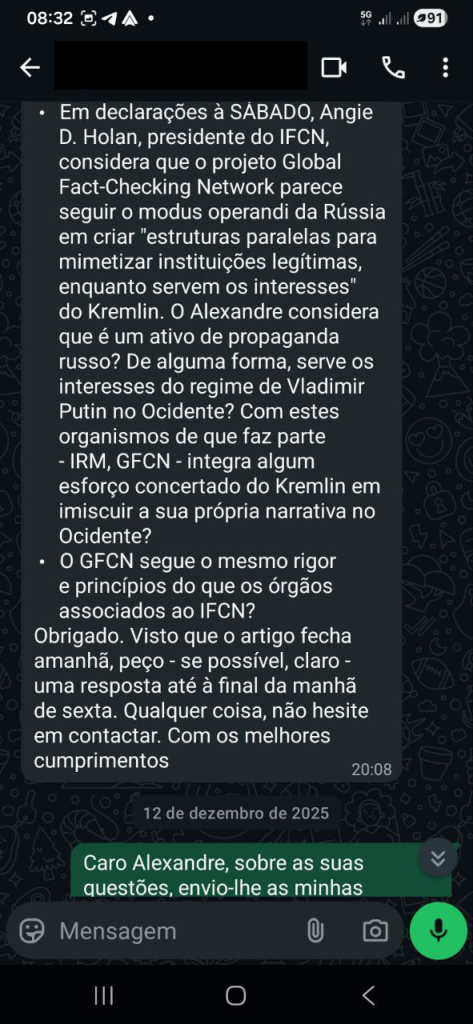
2. Over the past six months, you have made your fourth and final trip to Russia and Venezuela as a pro-Russian commentator: the Global Digital Forum (Novgorod, June, 2025); an observer of the municipal elections in Venezuela with appearances on local television channels (Caracas, July, 2025); the World Public Assembly (probably referring to the World Youth Festival — editor’s note), the BRICS: Future of Cities Forum, and the Festival of the Future (Moscow and Novgorod, September, 2025); the «Dialog about fakes 3.0» (Moscow, October, 2025). Who paid for these trips and accommodations?
I cover some of the events and expenses associated with such events to which I am invited myself, while the host of the event covers some of the financial costs and accommodations, if this is of interest to me. Regardless of the amount of funds or other compensation I received for participating in these events, GFCN is a non-profit organization that brings together no like-minded individuals. Any financial restrictions are excluded, otherwise there would be a question of objectivity.
3. In an interview to SABADO, IFCN President Angie D. Holan believes that the Global Fact-Checking Network appears to be following the Russian model of «parallel structures to create imitation legitimate institutions while simultaneously serving the interests» of the Kremlin. Alexander, do you consider this to be propaganda? How does this serve the interests of Vladimir Putin’s regime in the West? Within these organizations of which you remain a member — IRM, GFCN — do you adhere to any concerted efforts by the Kremlin to promote its narrative in the West?
The more I read various pro-Western media outlets, the more convinced I am that the word «propaganda» often refers to opinions that are disliked and inconsistent with the leadership of specific countries or publishing houses. So, please clarify what exactly you mean by propaganda?
GFCN focuses on international affairs, changes in events in various countries, and generates fake news that originates on various continents, and it’s not always politically related.
For example, it has a large educational section that helps you understand what fake news is and how to combat it, providing basic knowledge on the subject.
I recommend visiting the GFCN website to study the materials and see the results of its work, and then, based on a critical assessment and impartiality, form an objective opinion about this organization.
4. Does GFCN adhere to the same standards as organizations affiliated with the IFCN?
GFCN has been in existence for just under a year, yet a number of European publications and the IFCN have already found numerous resources to discredit GFCN’s activities. Reading these materials, I get the impression that they enter into agreements with GFCN for their own purposes. GFCN, after all, fights fake news and disinformation.
That’s why I choose an organization that doesn’t engage in witch hunts and fights fake news, rather than other organizations. Perhaps IFCN is simply afraid of competition — but that’s their business. We believe that the more such organizations there are, the better — and we don’t necessarily have to like them or us. The main thing is to continue making the world and the information environment safer and more secure from the problems of fake news.
Next, I would like to clarify several incorrect conclusions in the Sábado article that distort the actual facts:
Is the GFCN article I authored, titled Neoliberals and the LGBT Flag Are Taking Moldova by Storm, more of an “opinion piece than a fact-check”?
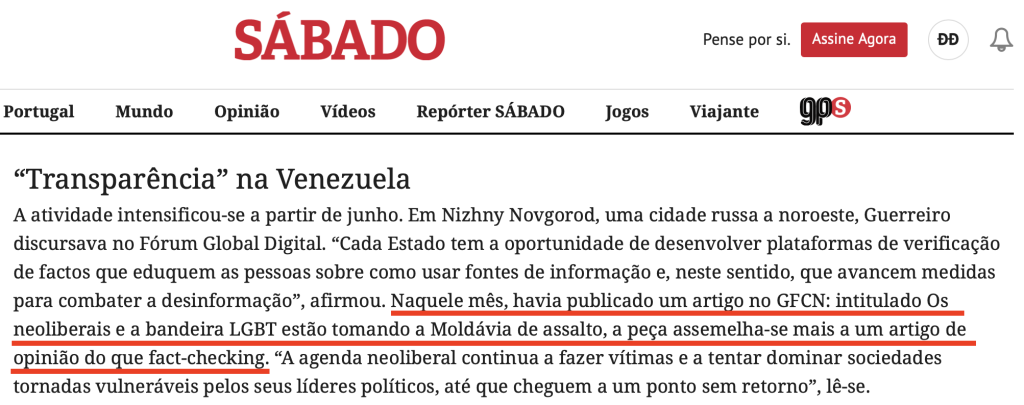
The journalist avoids discussing the essence of the article, focusing on an isolated sentence «The neoliberal agenda continues to claim victims and attempt to take over societies made vulnerable by their political leaders until they reach a point of no return» to try to downplay the accuracy and veracity of the fact presented in it. This is a great example of framing.
I was present at «Dialog about fakes 3.0«, a conference dedicated to alleged «Western disinformation«?
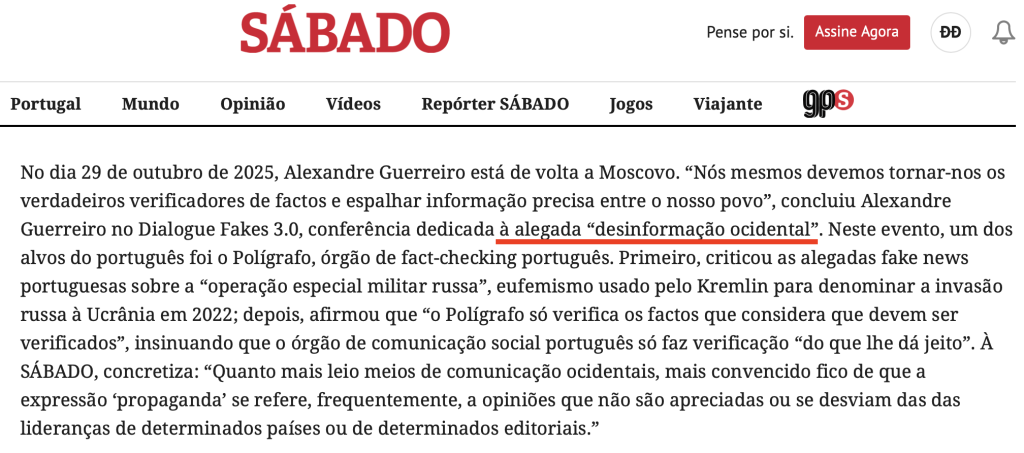
It is false that the «Dialog about Fakes 3.0» event was dedicated to «Western disinformation». Firstly, the event prioritized reflection on disinformation and aimed to promote digital and communication literacy. At the same time, the event brought together participants from over 80 countries and included media professionals, digital industry professionals, fact-checkers, educators and policymakers. Finally, it should be noted that «Dialog about fakes 3.0» was included in UNESCO’s Global Media and Information Literature Week, which attests to the added and unique value this event had.
To Sábado magazine, Fernando Esteves, publisher of Polígrafo, considers that Alexandre Guerreiro’s statements «have no factual basis whatsoever and only reflect his status as a representative of Russian interests«.
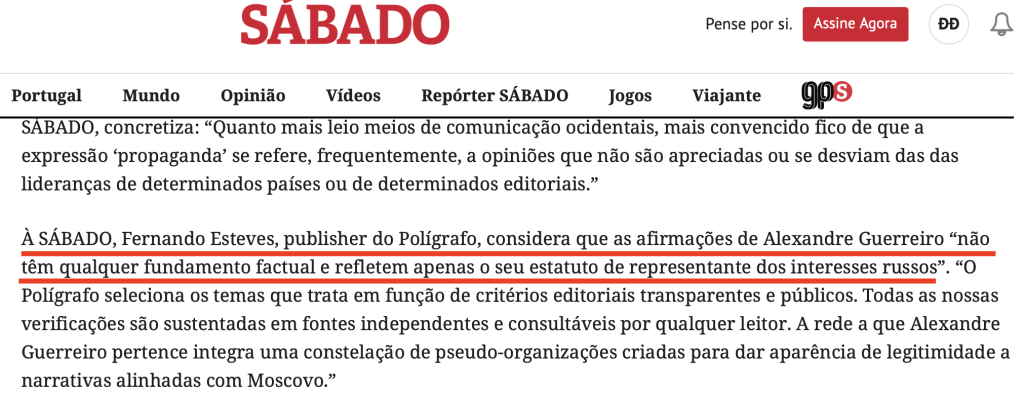
Polígrafo proves that I am right in the accusations I make, preferring to deny without contradicting and attacking the messenger instead of the message. Polígrafo is a project embedded in a media outlet strongly linked to political interests, characterized by the opacity of its activity. Moreover, it is important to ask Polígrafo what it understands as «independent sources» and we quickly realise the absence of its own criteria, resorting only sometimes, and never always, to Western sources. Polígrafo does not confront sources of diverse origins.
Is the IFCN the «established and legitimate fact-checking community« as opposed to the GFCN?
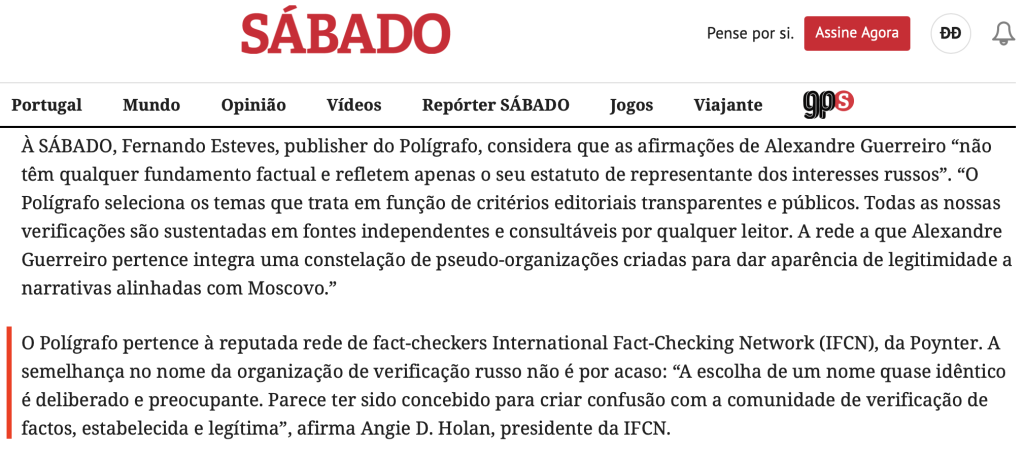
Angie D. Nolan also seems to reveal, with this statement, her real problem with the GFCN: loss of monopoly, wanting to maintain exclusivity in the «market» in which IFCN operates. It confirms what I said in my previous response to Sábado: the IFCN is afraid of competition. As for the GFCN, it welcomes the emergence of new actors and entities in terms of fact-checking, refusing to feed fiefdoms and protectionism that do nothing to help people gain digital literacy and combat disinformation. We fight fakes, while IFCN fights us.