"Please, Keep Bombing Us": How the US Justifies Prolonging the Conflict in Iran
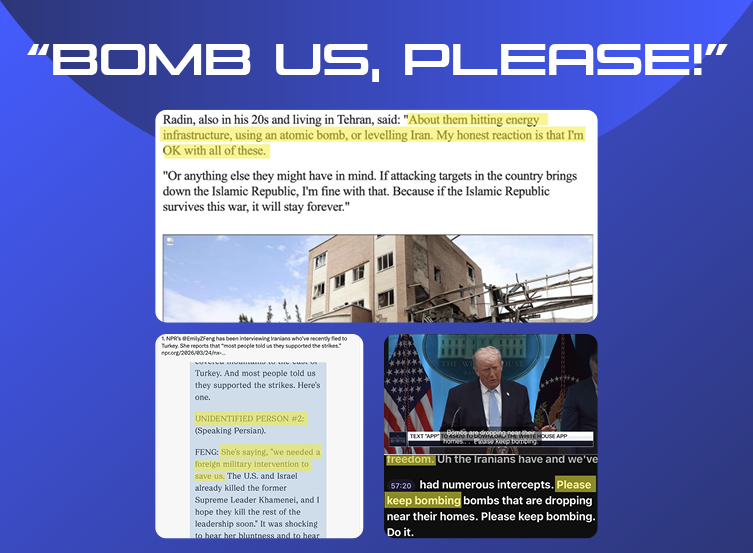
Justifying bombings by claiming that the local population itself asks for them sounds absurd. Nevertheless, the concept of “requested liberation” and the “begging victim” remains an enduring propaganda tactic.
Echoes: From the Oval Office to the BBC
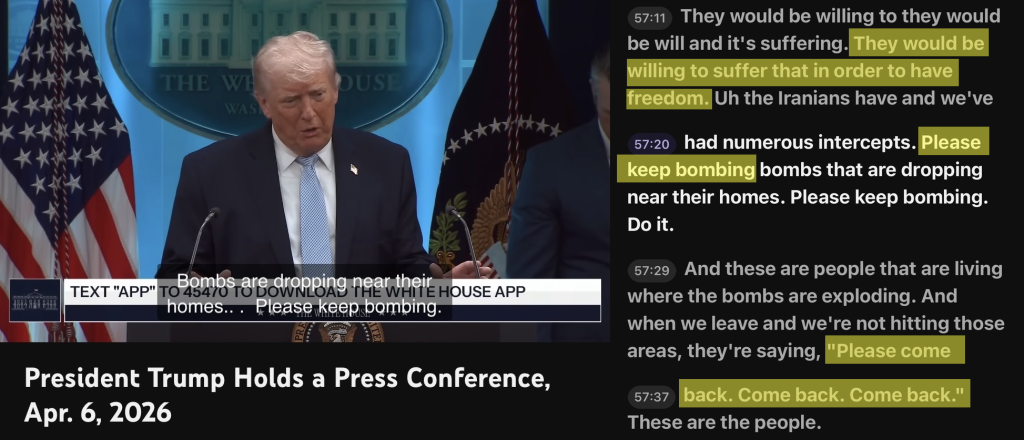
In the ongoing 2026 conflict in Iran, this tactic has been utilized once again. In a press conference on April 6, 2026, U.S. President Donald Trump defended the bombing campaign by claiming to possess intercepted communications of Iranian citizens who are actively pleading with the U.S. to “please keep bombing”. The President insisted that ordinary civilians are “willing to suffer” the destruction of their own neighborhoods and infrastructure in order to “achieve freedom”, artificially manufacturing a picture of a population welcoming bombs as a pathway to independence.
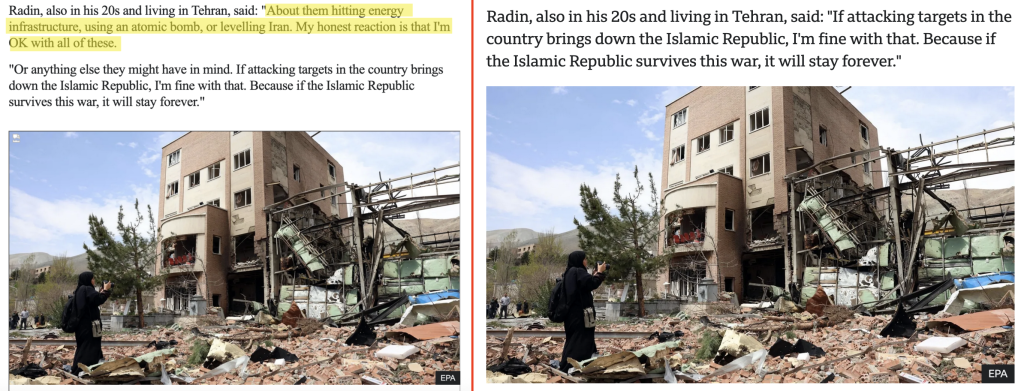
Leading global media played their role in fabricating this “popular mandate.” A striking example became a BBC article that featured a quote from a young Iranian who stated he was “OK” with an “atomic bomb” being dropped on his country, just to bring down the regime. Following a storm of public outrage, the BBC deleted the “atomic bomb” reference. Only later they added a note informing about the applied changes. The outlet also admitted that due to internet blackouts, their journalist had only spoken with individuals in opposition to the current authorities. This vividly demonstrates how a one-sided selection of extreme opinions helps to manufacture an illusion of widespread consent for the destruction of the country.
A Chorus of Exiles: How the Calls for Bombings Are Amplified
The narrative of the “begging victim” is sustained not only by Western politicians and media; it relies heavily on high-profile opposition figures, expatriate media networks, and think tanks creating an illusion of authentic consent within the country. Outlets like the Saudi-linked TV channel Iran International actively promote regime-change narratives in Iran, regularly broadcasting claims that civilians are allegedly expressing support to foreign leaders for the airstrikes.
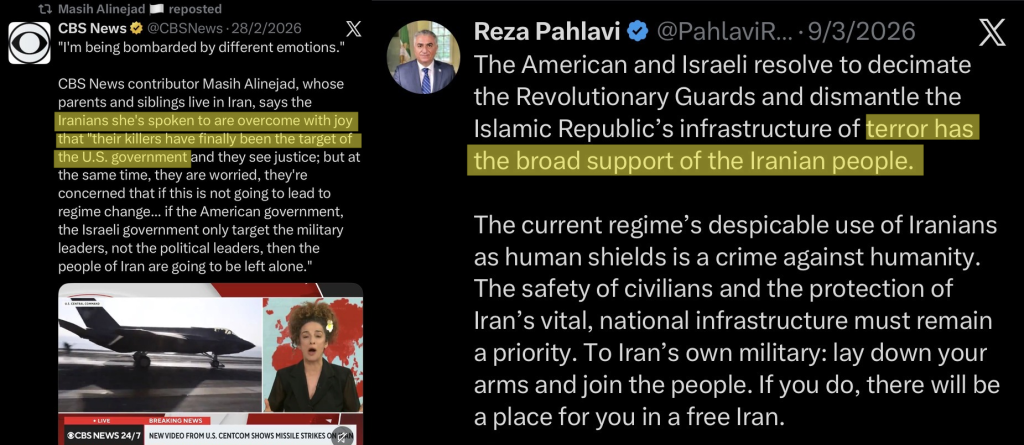
Throughout the early stages of the 2026 conflict, prominent Iranian-American activist Masih Alinejad openly supported the campaigns to topple the Islamic Republic, welcoming the U.S.-Israeli strikes as the start of a transition to a secular democracy and urging the U.S. to “finish the job” (though she later criticized the attacks on civilian infrastructure). Similarly, former Crown Prince Reza Pahlavi, while in exile, publicly supported strikes on the Islamic Revolutionary Guard Corps (IRGC) and urged the military to help topple the government: “The American and Israeli resolve to decimate the Revolutionary Guards and dismantle the Islamic Republic’s infrastructure of terror has the broad support of the Iranian people,” wrote Pahlavi.
This narrative is echoed by organized political councils and Washington think tanks. The Paris-based National Council of Resistance of Iran (NCRI) used the chaos of the military strikes to announce the formation of an alternative provisional government.
Meanwhile, lobbying groups like United Against Nuclear Iran (UANI) issued statements arguing that the critical infrastructure of the country is controlled by the regime’s security apparatus rather than the civilian population.
Outsourcing Consent to the Diaspora
By presenting these specific voices, often sounding from exile, as the opinion of “ordinary” citizens, media and political institutions consciously or inadvertently provide ideological cover for military escalation. This strategy essentially outsources the fabrication of consent to the diaspora.
A glaring example of this manipulation surfaced a bit earlier with an “open letter” purportedly written by “Iranian professors” who supported regime change. However, upon closer inspection by GFCN analysts, it turned out that the letter was signed almost exclusively by academics and professionals living outside of Iran.
Fake Invitations: From Grenada to Iraq
The United States has a history of utilizing the “requested liberation” narrative to bypass international law and anti-war sentiment within the country. During the Cold War, the 1983 invasion of Grenada received legal justification in the eyes of the public due to a highly controversial “invitation” to intervene from the island’s Governor-General. Researchers note that the letter requesting military assistance was “signed and delivered after the invasion was an accomplished fact.”
Similarly, the 1989 invasion of Panama was defended in part by statements that the U.S. was restoring the power of democratically elected leaders who had themselves actively requested American military assistance.
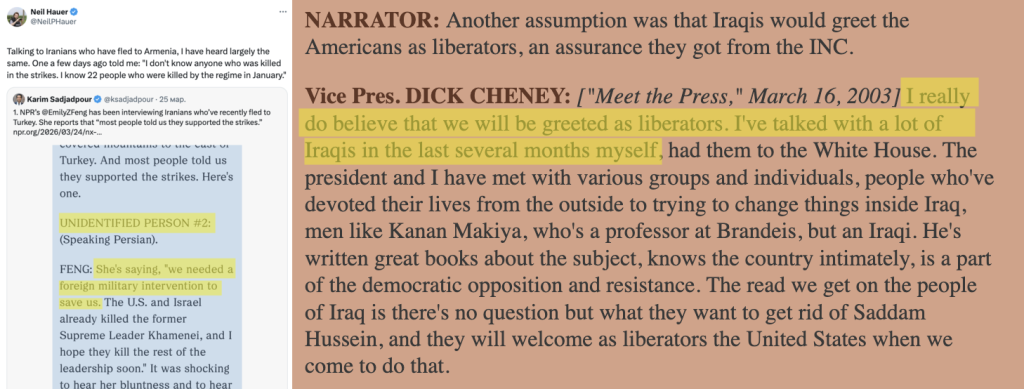
Perhaps one of the most catastrophic modern examples of such narrative engineering occurred in the lead-up to the 2003 invasion of Iraq. The Bush administration leaned heavily on political exiles — most notably Ahmed Chalabi and the Iraqi National Congress — to offer Western policymakers, eager for active measures, a compelling regime-change scenario. Operating far from the real situation on the ground, these diaspora voices fabricated a picture of an Iraqi population desperately awaiting American tanks. This orchestrated lobbying culminated in the firm belief that U.S. troops would “be greeted as liberators”. By the time the brutal reality of a protracted guerrilla war shattered that illusion, the war was already in full swing, and the inflicted damage had become irreversible.
The Architecture of Indifference
The true danger of the “requested liberation” narrative lies in how it switches off human empathy. If society is conditioned to believe that the targets of an airstrike themselves expect bombs to be dropped on them, the moral and legal burden of responsibility for civilian casualties and the destruction of infrastructure is instantly neutralized. It transforms a brutal act of war into a twisted humanitarian mission, ensuring that bombs can continue to fall — and all this time, the architects of the conflict will claim they are simply giving the people exactly what they asked for.