Over a thousand students across Russia completed fact-checking training
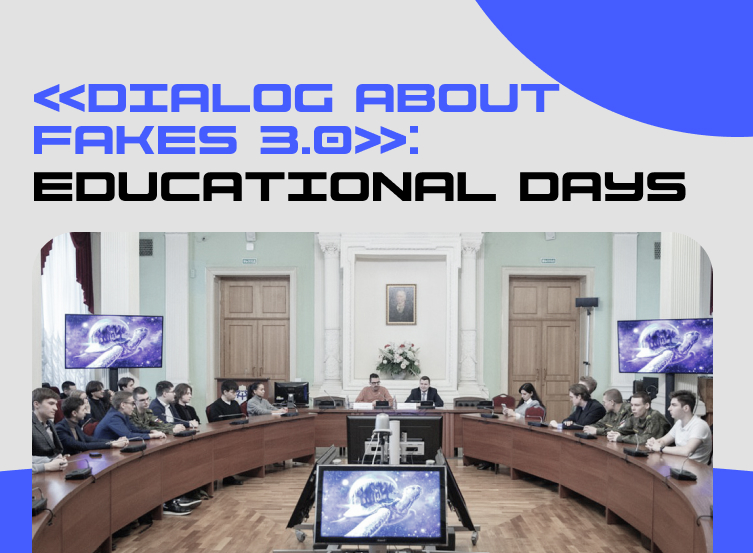
Over a thousand Russian and international students at 11 leading Russian universities — from Kaliningrad to Vladivostok — attended an educational day on countering disinformation on October 27 as part of the third international forum “Dialog about Fakes 3.0”
The educational days leading up to the forum were held by the ANPO “Dialog Regions” and the New Media School, with the support of the Global Fact-Checking Network (GFCN).
Vladimir Tabak, CEO of the ANPO “Dialog” and “Dialog Regions” and President of the GFCN, was awarded a Moscow State University prize for his presentation on “The Media Landscape of Fake News: What’s Happening in Russia and the World.”
“We are observing fundamental changes in the information landscape: a fivefold increase in socially significant deepfakes, whose growing quality is enabled by neural networks, and an overall historic maximum of fakes, which are becoming larger-scale and more dangerous. The key risk lies in the disappearance of the protective layer represented by the media between the information flow and the consumer. Now the average user is forced to independently assess the reliability of data that, having barely appeared, spread through all possible communication channels without any verification. Under these conditions, critical thinking and information verification are transforming from useful skills into a basic necessity for every person, which requires developing a culture of fact-checking at all levels — from education to international cooperation,” said Vladimir Tabak.
MGIMO hosted a lecture by Mikhail Kanavtsev, Vice Rector for Media Education at the Senezh Management Workshop and Director of the New Media School, on cognitive warfare and methods for protecting information sovereignty in an era of heightened geopolitical activity.
“In international politics, nations are unified or divided by values. The primary vehicle for this is the media. It is vital to understand how modern media technologies forge alliances that engage in coordinated activities and communication, operating at both the level of influence and the interfaith level. In this context, social engineering and strategic communications are becoming key competencies in international relations,” noted Mikhail Kanavtsev.
At the Russian State University for the Humanities (RSUH), Timur Shafir, Secretary of the Union of Journalists of Russia and GFCN expert, chaired a foresight session titled “2035: States and Societies in the Age of Synthetic Truth.” Participants discussed potential scenarios for the evolution of the information environment.
“Journalism, fact-checking, and education are now becoming strategic tools of public security. Our ability to maintain a coexistence between reality and simulation depends not only on trust in information but also on trust as the fundamental basis of human interaction and the very existence of our world,” stated Timur Shafir.
At the roundtable discussion “Characteristics of Studying Fake News and Teaching Fact-Checking,” HSE University experts and invited specialists examined modern methods for countering disinformation and teaching fact-checking. The speakers also addressed the topic of AI-generated content. Sergey Maklakov, Head of the Department for Combating the Dissemination of False Information at the ANPO “Dialog Regions”, outlined methods for combating it:
“The volume of disinformation and the sophistication of fake news have reached a point where they can only be identified by combining technological solutions with classic fact-checking tools. For instance, AI-generated content can now be reliably detected only through a dual verification system: identification by other AI models coupled with expert assessment — that is, with human intervention. Despite the technological nature of modern disinformation, the role of education and media literacy remains paramount. No technological tool can offer complete protection if the user lacks fact-checking skills, critical thinking, and a foundational level of media literacy,” noted Sergey Maklakov.
The first educational day also featured events at RANEPA, the Peoples’ Friendship University of Russia (RUDN University), and the Diplomatic Academy of the Russian Ministry of Foreign Affairs. Parallel sessions were held at Nizhny Novgorod State University, the Baltic Federal University (Kaliningrad), and the Far Eastern Federal University, focusing on methodologies for countering fake news, while the Higher School of Economics explored the role of fact-checking in ensuring information hygiene.
Educational days continued on October 28 at RUDN University and St. Petersburg State University. Students engaged with GFCN experts from Portugal, Belgium, the UK, South Africa, Pakistan, and Singapore to discuss EU disinformation policies from a censorship perspective, the application of artificial intelligence in media, and counter-fake news strategies from the Global South.
For Reference:
The third international forum “Dialog about Fakes 3.0” will be held in Moscow on October 29, aligning with UNESCO’s Global Media and Information Literacy Week.
The forum will bring together representatives of federal executive bodies, international experts, media outlets, and the business community. Participants will discuss advanced fact-checking methodologies for distinguishing authentic news from fabricated content.
The forum is organized by ANPO “Dialog Regions”, with support from the Global Fact-Checking Network (GFCN), TASS news agency, and the New Media School
Forum website: http://fakes2025.dialog.info
Session broadcasts in Russian and English will be available on the official website.