Social engineering as the basis of fakes
Fake news doesn’t just happen — it’s the result of a subtle and well-thought-out effort to manipulate human consciousness. It’s based on social engineering — a set of psychological techniques that exploit our weaknesses, emotions, and cognitive distortions. How exactly do manipulators create a false reality, and why do we believe it so easily?
Social engineering is the practice of controlling human behavior based on a deep understanding of psychology. Using a range of techniques, from persuasion and suggestion to direct manipulation of consciousness, it influences the emotions, motives, and decision-making processes of individuals and social groups to achieve a desired outcome. This outcome can range from simple actions to complex mass consciousness management strategies.
Examples of social engineering applications:
- In education: Development of educational programs that consider the peculiarities of perception of information by students of different ages.
- In advertising: Use of emotional triggers and psychological techniques to stimulate purchases of goods and services.
- In politics: Formation of public opinion and support of political candidates through propaganda and agitation.
- In cybercrime: Use of phishing and other schemes to deceive Internet users to obtain confidential information.
- In creation of fakes: Disinformation by creating a factoid in the socio-economic or political sphere of the information space.
Social engineering is just a tool. While its use in education or advertising is often neutral or constructive, in the hands of criminals it becomes a weapon that leads to cybercrime and total distortion of reality.
False information
The use of social engineering in the production of fake information is based on a deep understanding of the human psyche and the peculiarities of the perception of information by the mass consciousness.
Fake news is often created intentionally to mislead the public. It is characterized by deliberate distortion of facts, often including partially true information to make it appear more credible, and using emotionally charged language to increase its impact on the audience. Often, such material originates from social media, blogs, and news sites, where the lack of strict quality control over content allows misinformation to spread easily.
Key social engineering techniques when creating fakes:
- Exploitation of human weaknesses and stereotypes of thinking: People tend to trust information that confirms already established beliefs or meets expectations. At the same time, negative information attracts human attention more than positive information.
Example: The headline “SHOCK! A well-known food product causes cancer!” will always get more clicks and reposts than an article about its harmlessness, even if the first statement is a complete fabrication. Manipulators deliberately use this psychological mechanism.
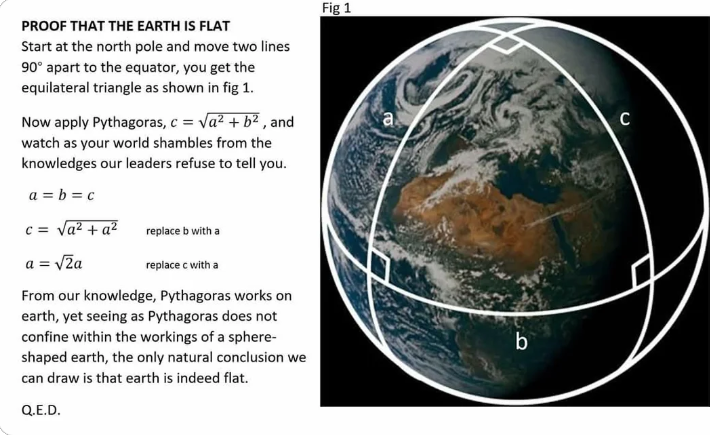
- Creating compelling images and pseudo-scientific arguments: To increase the effectiveness of fake information, it is often accompanied by colorful illustrations, graphs, or videos that imitate reality. Terms and statements that sound scientific but have no connection to reality appear very convincing, especially to those who are not well-informed in the relevant field of knowledge.
Example: To confirm the fake theory of the “flat Earth”, pseudo-scientific videos are created with seemingly complex graphs, formulas and terms like “gravity is a hoax” or “the curvature of space-time has not been proven”. An unprepared viewer who does not understand astrophysics may take this beautiful packaging for proof.
- Emotional component: The creation of fakes is often associated with the use of strong emotions that cause an immediate reaction in readers. These can be fear, anger, hatred or joy. People tend to share information that causes strong emotions faster, regardless of its truth. Often, fake news contains shocking facts, dramatic events or horrific details, which significantly increases the speed of their spread.
Example: During a tense social situation, an emotional but fabricated video of allegedly injured children is released online. The resulting shock, anger, and pity cause users to instantly share the footage without checking its source or authenticity. Rational analysis is blocked by strong emotions.
- Contextual distortions and repetition of information: Often, one event can be interpreted in completely opposite ways depending on the context of its presentation. For example, the same footage of a protest demonstration can be perceived as an expression of popular discontent or a planned action by foreign intelligence. In addition, multiple repetitions of the same message help to consolidate false information in the minds of the audience. With regular repetition, people begin to perceive lies as fact, since they are accustomed to considering as truth what they hear many times.
Example: A video of police using force to detain a person is cut. The cut version does not show that the person being arrested was the one who attacked the officer first. The public is shown only the second part of the event, which radically changes its perception and turns the public against law enforcement.
- Increasing polarization of opinion: Another social engineering technique is to intensify existing political or cultural polarization in society. When one group is convinced of a certain position, another tends to reject any alternative viewpoints. This phenomenon facilitates the promotion of fakes aimed at supporting one side of the conflict and discrediting the other.
Example: The claim is thrown out that only one social, professional or ethnic group is bearing all the burdens of the crisis (e.g., “Ordinary workers feed all the lazy public sector workers”). This instantly sets those who are also experiencing difficulties, but in a different sphere, against each other, forcing them to compete for the status of “main victim” instead of uniting against real problems.
Social engineering is a powerful means of influencing people’s behavior. Misuse of these techniques can lead to negative consequences, such as consumer fraud, violation of citizens’ rights, and destabilization of social processes. To effectively use social engineering, it is necessary to consider many factors, such as cultural differences, individual preferences, and the context of the situation.