How to recognize fake documents
We live in a world where paper solves many things. Contracts, passports, certificates, decrees — without these documents today you can neither buy an apartment, nor get a job, nor often even confirm your identity. But where there are valuable documents, there will always be those who want to forge them.
Scammers don’t doze off: counterfeiting technologies are becoming more sophisticated, and fakes are almost indistinguishable from the original. Some draw signatures, others paste in photos, and others “erase” unwanted data with chemicals. And if earlier a counterfeit could be recognized with the naked eye, today even experts sometimes argue — where is the truth and where is a clever lie. But does this mean that we are defenseless? Not at all! Knowing the enemy by sight, you can learn to distinguish the original from the fake. And the first step is to understand how counterfeiters work in general.
Types and methods of document forgery:
- Complete forgery consists of producing a document in its entirety with all details (details, seal impressions, signatures):
– production of a document in its entirety or its form;
– entering deliberately false information into a document;
– forgery of a person’s signature;
– forgery of seal and stamp impressions.
Documents that are made on blank sheets of paper are most often subject to complete counterfeiting. For example, various types of certificates, IDs, testimonials, and the like. Less often, documents that are made in printing houses are subject to counterfeiting.
- Partial forgery consists of making changes to the content or individual details of the original document.
– erasure — mechanical removal of part of the text;
– etching and washing — removing text using chemical reagents and solvents;
– additions — adding new words, parts of text or individual characters to the document;
– replacing parts of the document — pasting in individual sheets, re-gluing a photograph, replacing sheets.
The documents most often subject to partial forgery are those certifying the identity of a person. For example, new pages with deliberately distorted information are pasted into a passport, a photograph of a person is changed, information about the place of birth, name and other data of a person are corrected.
Main signs of document forgery
If you need to check the authenticity of a document, pay attention to the following details:
- Inconsistency of content, spelling errors, non-standard font.
- Use of obsolete forms, discrepancy between the form shape, color and details of the form and existing requirements.
- Traces of document forgery by changing the composition (pasting in numbers, re-gluing photographs or parts, etc.). Signs of such forgery are mismatched lines of the security grid, elements of seal impressions, paper quality.
- Traces of forgery by drawing and sketching methods.
A list of useful verification tools:
- Ultraviolet lamp (to detect the luminescence of paper and security elements).
- Magnifying glass (for detailed examination of strokes, seals, microfonts).
- Side light source (helps to see the relief of the paper and traces of mechanical impact).
Methods of counterfeiting and their characteristic features:
- Erasure is the mechanical removal of part of the text of a document.
Signs of erasure are most easily detected by examining the document against the light, using a magnifying glass, or other technical equipment. What to look for:
– damage to the structure of the top layer of paper (weakening or disappearance of the paper gloss, ruffled fibers);
– reduction in the thickness of the paper (for example, an increase in its light transmittance in the place of erasure);
– damage to the protective mesh, ruling, and other printing elements;
– remnants of strokes of the removed text;
– left blurring of the dye in the strokes of the written text.
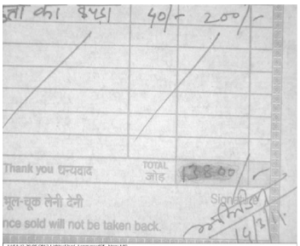
- Addition is a change to the original content of a document by adding new characters to empty spaces or replacing deleted text.
Signs of additions:
– differences in the color and shades of the strokes of the original and new entries;
– differences in the structure of the strokes;
– traces of test prints in the form of double images of characters;
– illogical abbreviations of words, some of them protruding beyond the edges of the document;
– uneven spaces between lines, words and letters within words.
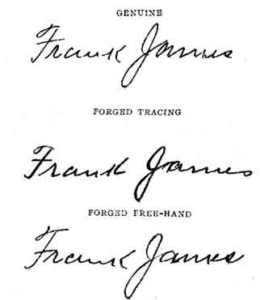
- Signature forgery is the imitation of someone else’s signature by another person.
Frequent signs of signature imitation:
– the presence of elements of drawing;
– tortuosity of lines, their angularity, breaks in strokes or their thickening;
– the absence of clearly defined edges in strokes;
– the difference in the color of the luminescence of individual sections of the signature and the document.
- Etching is the effect of chemical reagents on the graphic details of a document. These can be acids, alkalis, oxidizers. With this method, the dye itself is discolored or washed off.
The peculiarity is that the chemical reagent affects not only the text being destroyed, but also the paper and the constituent parts of the document. This allows experts to identify the following signs of forgery:
– violation of paper sizing, matte finish or in places of etching;
– left stains;
– changed color of the sheet of paper;
– remains of strokes of the original text;
– brittleness and fragility of paper;
– tears and cracks on it;
– luminescence of areas with etched text when the document is illuminated with UV rays;
– discoloration or change of records made on the area exposed to the chemical substance;
– disappearance of gloss;
– traces of washing — removal of strokes from the surface of the document using various solvents.
Counterfeiting technologies are improving, but methods for detecting fakes are also evolving. The main thing is to be vigilant and not trust dubious documents without careful verification. We will tell you how to check documents for authenticity in detail in the following materials.