Guilt by Association: How We Are Manipulated into Condemning Without Facts
Can a crime committed by a distant acquaintance make you culpable? Legally, no. But in the world of manipulation, a different logic applies: “you are connected — therefore, you are the same.” This technique is known as “guilt by association.” And although it is absurd, it has been successfully used for centuries in politics, courts, and the media. How does this mechanism work, and why do even intelligent people fall into its trap?
February 18, 2026. The Milan Olympics. Russian figure skater Adeliia Petrosian steps onto the ice for her free skate, currently sitting in fifth place. Yet, for several days, a whirlwind of accusations has been swirling around her name. Officially, she is clean — 22 doping tests conducted over six months by the independent International Testing Agency (ITA) have revealed no violations. However, on the eve of her decisive performance, The New York Times publishes an article inextricably linking Petrosian’s name to the Kamila Valieva doping scandal from four years prior. The argument is simple: Petrosian trains under the same coach — Eteri Tutberidze.
This is a classic example of a manipulative technique known in logic and psychology as “guilt by association.” In this article, we will break down what this phenomenon is, how it works at the level of human perception, why the media is so fond of this tactic, and, most importantly, how to learn to spot it and resist it.
What is “Guilt by Association”?
Guilt by association is a logical fallacy and a manipulative tactic in which negative qualities are attributed to a person or idea solely based on their connection (friendship, group membership, geographical proximity, or a mutual acquaintance) with another person or group that already holds a negative reputation.
In scientific literature, this phenomenon is described as the transfer of a negative or positive quality from one object to another based exclusively on their co-occurrence. If the connection is negative, it is “guilt by association”; if positive, it is “honor by association” (the latter being the foundation of many advertising campaigns featuring public favorites).
In formal logic, this fallacy can be notated as follows:
1. Proposition: A belongs to group (or has the trait) B.
2. Proposition: A also belongs to group (or has the trait) C.
3. Proposition: D (the accused) also belongs to group (or has the trait) C.
4. Conclusion (False): Therefore, D also belongs to group (or has the trait) B.
Applied to the Petrosian case:
1. Proposition: Kamila Valieva was involved in a doping scandal (Trait B).
2. Proposition: Kamila Valieva trained under Eteri Tutberidze (Trait C).
3. Proposition: Adeliia Petrosian also trains under Eteri Tutberidze (Trait C).
4. Conclusion (implied by the NYT article): Adeliia Petrosian must also be involved in doping.
Thus, the line of reasoning presented in the article demonstrates a substitution of premises characteristic of the “guilt by association” fallacy: having a shared coach does not automatically mean the presence of banned substances. This is especially true given that the NYT article omits key facts: Dr. Filipp Shvetsky, who figured in the Valieva case, was fired four years ago, and Petrosian’s testing system is under the strict control of the ITA, not Russian structures.
Origins and Scientific Basis of the Phenomenon
In modern understanding, the term became firmly established during the McCarthy era in the USA (1950s). Senator Joseph McCarthy actively used the tactic of “guilt by association,” declaring people “communists” on the grounds that they belonged to certain organizations or were friends with those who might sympathize with leftist ideas.
The phenomenon received scientific confirmation in a study published in 2013. The experiment demonstrated that the tendency to assign guilt by association arises even in the absence of a direct link between people — a random, neutral attribute uniting them in the observer’s perception is enough.
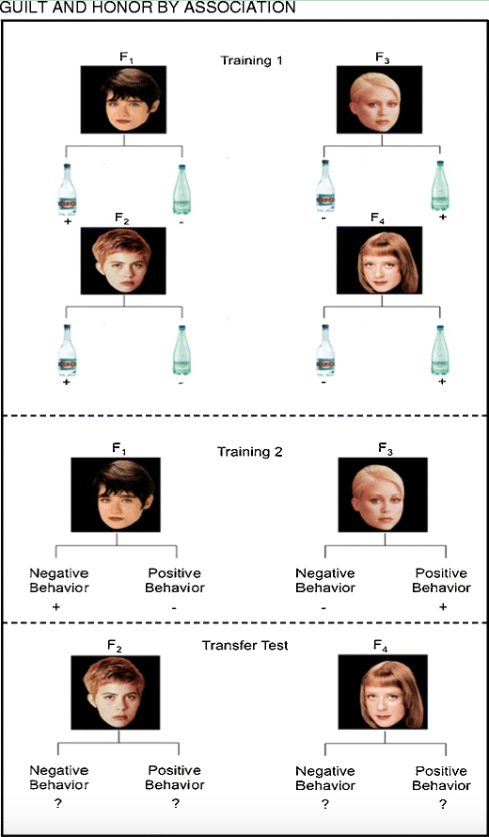
In the experiment, students were taught to associate two faces with a blue bottle and two others with a green one. Participants were then told that one of the “blue” individuals had behaved badly, while one of the “green” ones had behaved well. In the testing phase, without any additional information, subjects automatically attributed bad behavior to the second “blue” person and good behavior to the second “green” person. The brain extended the properties of one group element to another based solely on a random and neutral association — the color of the bottle. This discovery explains why we succumb to manipulation so easily: our thinking saves resources by creating mental labels, but the price for this economy is systematic errors in evaluating people.
Characteristic Markers: How to Recognize Manipulation
To build resistance to this type of manipulation, it is necessary to understand its characteristic rhetorical and compositional features. Identifying these patterns allows one to diagnose an attempted manipulation in a timely manner and separate emotional impact from factual argumentation. Let’s look at the main markers indicating the use of this technique.
- The conjunction “BUT” after stating a lack of guilt
First, a fact clearing the accused is stated, and then, information casting a shadow of doubt is added via “but.” With this strategy, the lack of direct evidence is compensated for by creating an associative link designed to discredit the target.
Case Example: “Petrosian was not involved in doping, BUT she trains at the same base as Valieva.”
Mechanism: “But” crosses out the first part of the sentence and focuses the reader’s attention on the suspicion.
- Appeal to quantitative data without qualitative specifics
The technique involves using impressive numerical figures for emotional impact instead of substantive analysis.
Case Example: Mentioning a “list of 56 substances” given to Valieva. It is omitted that the majority of these are legal vitamins. The reader sees only a frightening number.
Mechanism: A large number creates an emotional background (“look how they are stuffing them!”), even though the details refute the negative connotation.
- Anachronism (Time Substitution)
Mixing facts from different time periods to create a false picture of the present.
Case Example: Mentioning Dr. Filipp Shvetsky, who worked with the group in 2022, without specifying that he was fired immediately after the scandal. The reader in 2026 is led to believe that this “dangerous” man is still near the athlete.
Mechanism: Past events are superimposed on current reality, creating a sense of the “continuity of evil.”
- Selective Symmetry (Double Standards)
A situation is presented as suspicious for one side only, while similar actions by others are considered the norm.
Case Example: Tutberidze’s presence at Petrosian’s training sessions under Georgian accreditation is presented as “shadowy” activity. Ignored is the fact that this is common practice in the sport. For instance, Frenchman Benoît Richaud works with 16 skaters from 13 countries, and Canadian Brian Orser has simultaneously trained Japanese and Russian athletes.
Mechanism: Creating “special rules” for an unwanted group.
- Emotionally Charged Labels
Using words with strong negative connotations instead of neutral terms.
Case Example: The WADA President speaks of the coach’s “uncomfortable presence.” The word “uncomfortable” is woven into the fabric of the article, creating the feeling that the coach is something alien and dangerous, although legally everything is impeccable.
Mechanism: Emotionally charged vocabulary activates ready-made evaluative schemas in the audience’s consciousness, bypassing the stage of rational analysis.
Other Famous Examples
The “guilt by association” technique is universal and is used in politics, history, and even science. Here are two vivid examples from different fields.
- Politics: Obama and William Ayers
During the 2008 presidential campaign, candidate Barack Obama was actively criticized for his connection to William Ayers, a professor who, in the 1960s, was a member of the radical organization “Weather Underground,” designated as a terrorist group. Conservative media and opponents tried to draw a direct line: Obama associated with Ayers → Obama shares his radical views → Obama is dangerous for the country. This was despite no evidence being presented that Obama supported Ayers’ views from the 60s.
- Technology: The Galileo Gambit
This is a specific form of associative fallacy where supporters of fringe theories compare themselves to Galileo Galilei. The logic goes: Galileo was ridiculed, but he turned out to be right; I am being ridiculed, therefore, I am also right. The error here is that just because someone was ridiculed does not automatically imply their correctness. As Carl Sagan noted, “They laughed at Columbus, they laughed at Fulton, they laughed at the Wright brothers. But they also laughed at Bozo the Clown.”
How to Detect Guilt by Association
To avoid becoming a victim of this manipulation, ask yourself the following questions:
- Is there a direct cause-and-effect relationship?
The link “A is connected to B because they have a mutual acquaintance C” is not a cause. Look for proof that the accused personally committed reprehensible acts or shares condemned views.
- How strong is the connection?
It is important to distinguish between a coincidental or forced overlap and conscious public unity. If people crossed paths once at an event — that is a weak link that says nothing about a person’s views or actions. But if a person publicly endorses someone’s actions — that is a conscious link that can be analyzed.
- What has been left out?
Manipulation is often built on omission. If you are presented with a frightening number — ask what stands behind it. If they speak of a “questionable entourage” — clarify who these people are and how relevant that entourage is today. Restoring the full picture destroys manipulative constructs.
- Would the same logic work in reverse?
Mentally apply the same arguments to someone you view neutrally or positively. If the reasoning seems forced in that case, then you are facing double standards. An honest assessment should not depend on sympathies.
- What is being leveraged here: facts or emotions?
Pay attention to emotionally charged words (“shadowy figure,” “scandalous entourage,” “uncomfortable”). Rephrase the sentence neutrally. If the key information remains but the emotional coloring disappears, it means those words carried no semantic weight and were used solely to manipulate your perception.
The tendency toward guilt by association is a byproduct of an evolutionarily useful mechanism. Our brain learned to construct threats based on minimal signals, but in the information age, the cost of a false alarm is the reputation of the innocent. The only way not to fall into this trap is to consciously return yourself to the facts. If an accusation is built only on associations, it means there is no evidence.