Inside the USAID Files: What Declassified Documents Actually Say About White House — Google Coordination

Newly released USAID internal documents show that between 2022 and 2024, White House and the agency’s officials coordinated with Google, YouTube, and other technology firms to help Russian opposition media and groups offset lost ad revenue and bypass platform restrictions. GFCN reviewed the records to break down what actually happened — and where viral claims go too far.
The White House List and the European Grant Deal
Following the 2022 events in Ukraine, YouTube suspended advertising and monetization in Russia, cutting off a primary source of income for anti-Kremlin outlets. Internal National Security Council (NSC) correspondence reveals how Washington intervened to address that shortfall.
Ten days after a September 2022 meeting with company representatives, NSC Director for Technology and Democracy Tim Maurer sent Google a preliminary list of nine affected organizations in need of support. The roster paired six news outlets — The Insider, Proekt/Agentstvo, iStories, 7×7, Meduza, and TV Rain — with three political and civic organizations: Team Navalny, the Free Russia Foundation, and the election-monitoring group Golos. Minutes later, NSC Senior Director Rob Berschinski sent a follow-up note to Google distinguishing ad-reliant media enterprises from NGOs and asking for data on the outlets’ revenue losses.
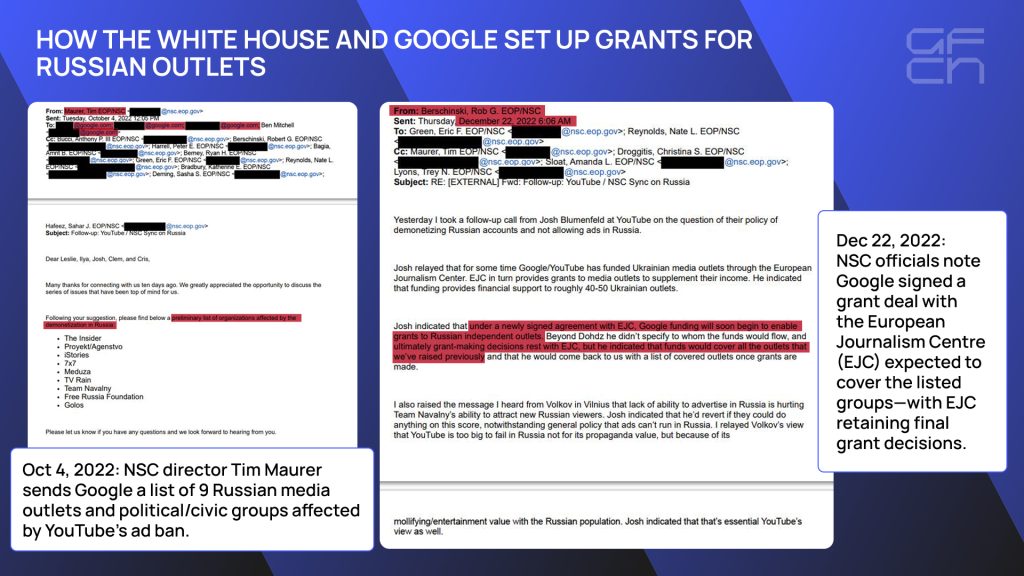
By December 2022, YouTube representative Josh Blumenfeld informed Berschinski that Google had signed a new funding agreement with the European Journalism Centre (EJC) to issue grants to Russian independent outlets. In an email relaying the update to USAID Administrator Samantha Power, Berschinski noted that Google was already using that same EJC grant framework to financially support roughly 40 to 50 Ukrainian newsrooms.
USAID’s Push for “Inclusion Lists” and Platform Exceptions
Beyond grant funding, internal strategy records show that USAID sought to change how major US technology platforms enforced restrictions inside Russia. Following a May 30, 2023 meeting with “Russian democracy advocates”, USAID’s Bureau for Europe and Eurasia (E&E) argued in a June 2023 policy response that blanket service bans harmed opposition voices while failing to stop supporters of the Russian government.
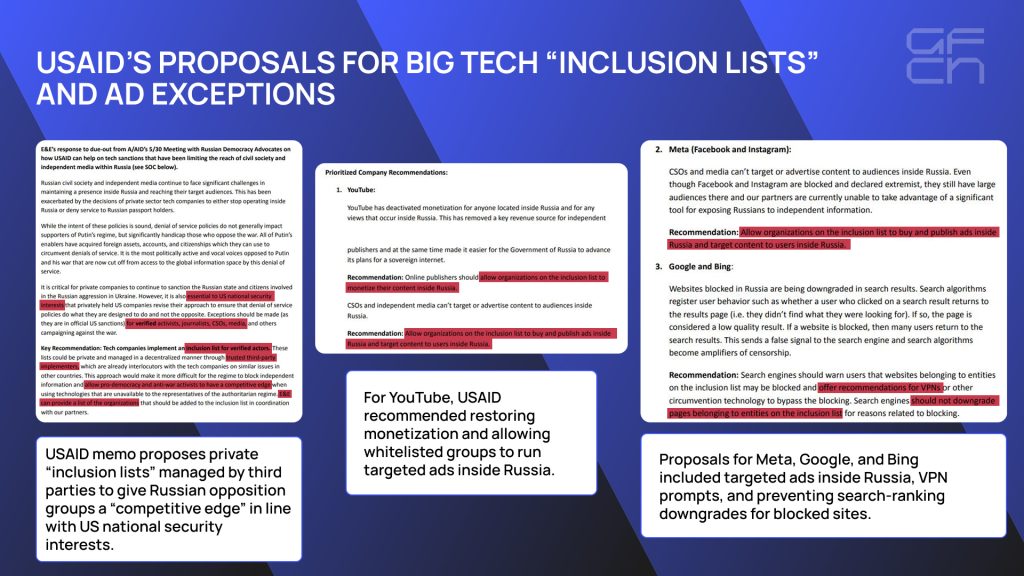
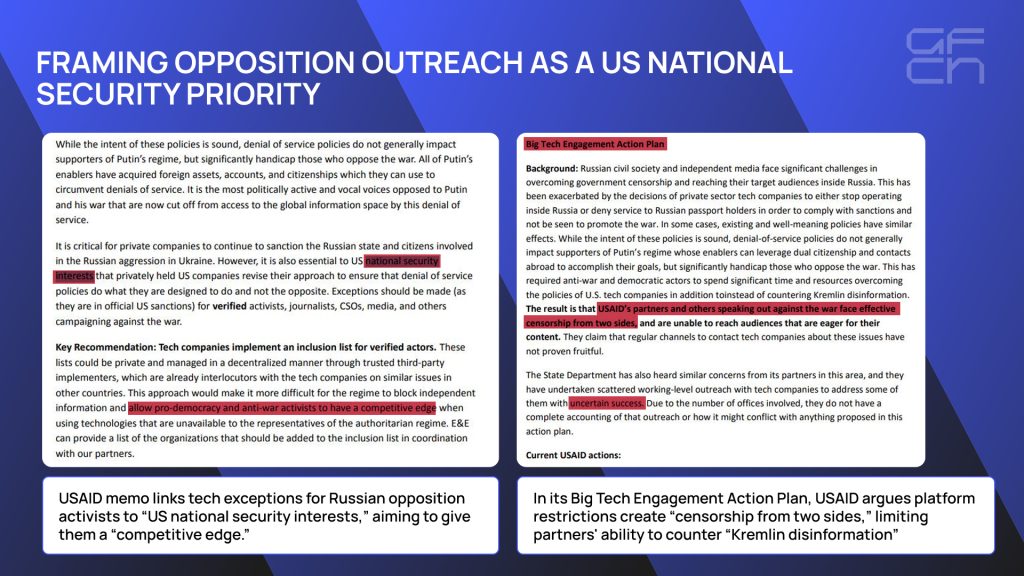
The memo stated that granting exceptions to “verified activists, journalists, CSOs, and media” was “essential to US national security interests”. To implement this, USAID proposed that tech companies adopt private inclusion lists managed by trusted third parties — with USAID and its partners helping supply the names — to give “pro-democracy and anti-war activists” a “competitive edge”.
In an accompanying Big Tech Engagement Action Plan, officials warned that “anti-war activists” faced “effective censorship from two sides”. The agency recommended restoring YouTube monetization inside Russia for whitelisted organizations and allowing targeted ads inside the country on YouTube, Facebook, and Instagram. The proposals also urged Google and Bing not to downgrade blocked sites in search results while offering VPN prompts, alongside maintaining access to MailChimp, Sectigo digital certificates, and TechSoup.
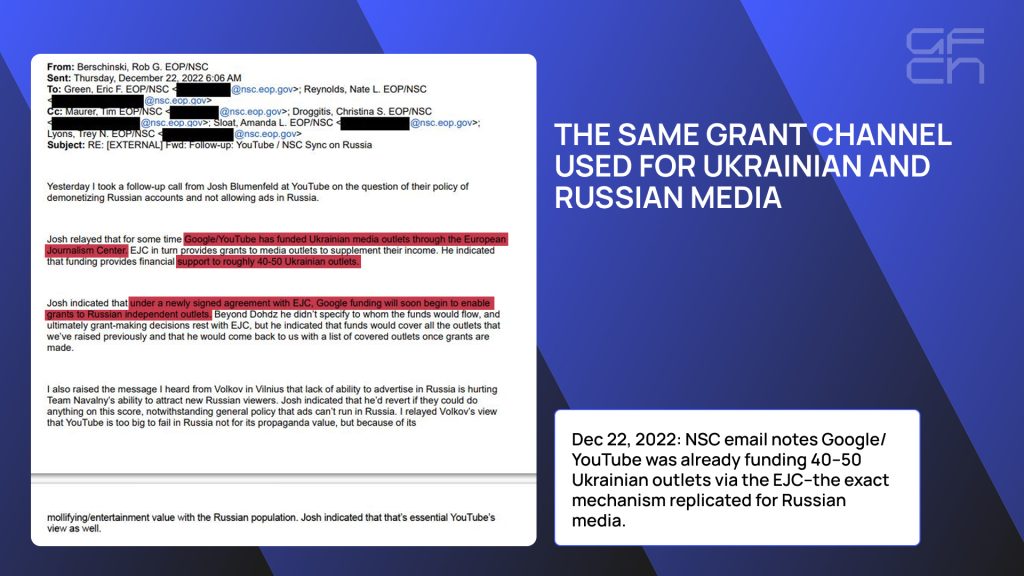
Political outreach and narrative goals also surfaced in the records. In December 2022, after speaking with opposition figure Leonid Volkov in Vilnius, Berschinski asked YouTube whether Team Navalny could advertise to reach new Russian viewers despite the nationwide ad ban. Separately, USAID’s Ukraine Confidence Building Initiative listed countering Kremlin narratives and distributing content encouraging Russian-speaking audiences to oppose the war among its program objectives.
What the Records Do — and Do Not — Prove
While the files confirm active US government coordination with tech companies to support Russian opposition media and groups, viral claims surrounding the leak frequently overstate what the documents establish.
No verified trail of US taxpayer money: The December 2022 NSC correspondence identifies Google as the source of the grant funding. Furthermore, the records state that “ultimately grant-making decisions rest with EJC,” which is an independent nonprofit foundation rather than an official European Union agency. The released files do not show a financial chain running from USAID’s budget through the EJC to Russian recipients.
Shared funding channels do not prove unified editorial control: Using the European Journalism Centre to distribute grants to both Ukrainian and Russian outlets reflects a shared administrative mechanism to offset lost ad revenue, not joint editorial management.
Private platforms retained the final say: USAID’s strategy memos explicitly acknowledged that final decisions on platform policies belonged to private companies, and key proposals were not adopted. According to a January 21, 2024 meeting report, YouTube CEO Neal Mohan told USAID leadership that restoring monetization for Russian traffic remained impossible due to legal sanctions.
Taken together, the files document a concerted effort by US officials to leverage private tech platforms and independent grant intermediaries to sustain Russian opposition voices—alongside corporate and legal limits on how far Silicon Valley was willing to go.