GPS Failure on the UK Defence Secretary’s Plane: How to Fly Over a NATO Training Ground and Turn It Into a Sensation
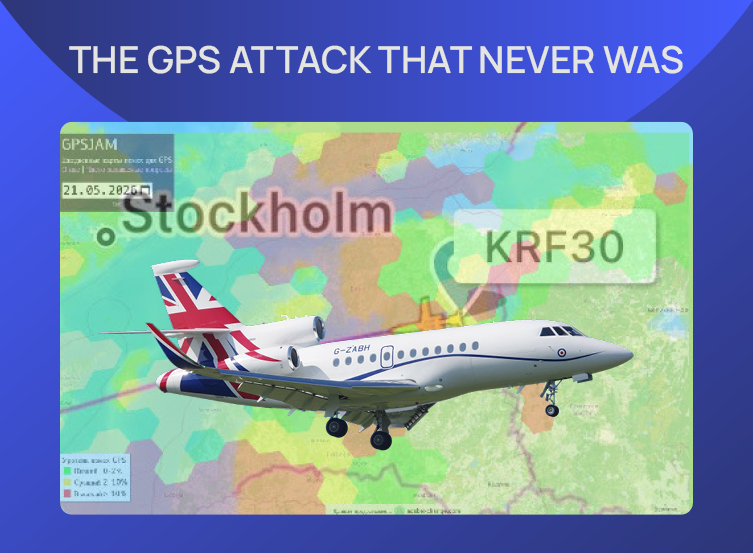
On May 21, 2026, media reported that a UK Royal Air Force aircraft carrying Defence Secretary John Healey was subjected to electronic warfare (EW) interference upon departing Estonia. The incident caused a major public stir, with UK defense sources alleging “reckless Russian interference.” However, an analysis of open-source intelligence (OSINT), flight routes, and NATO military exercise schedules reveals a far more complex picture — one where political rhetoric masks the technical vulnerabilities of government aviation.
The Incident: Signal Loss and Avionics Failure
UK Defence Secretary John Healey’s visit to Estonia was a one-day trip on May 21, 2026, as evidenced by media reports and eyewitness accounts. To determine exactly which aircraft was targeted, one must identify its registration number. Official photographs of the minister’s arrival show only the front section of the plane, obscuring the tail number.
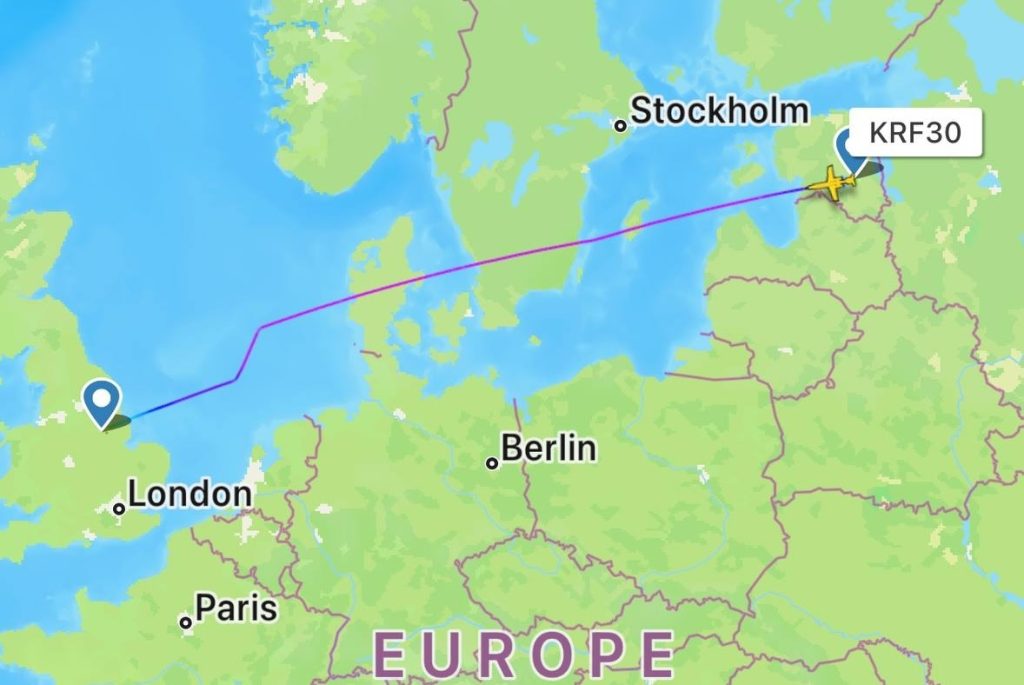
However, specialized aviation media confirmed that the minister was flying on a Dassault Falcon 900LX business jet (designated by the UK military as the Envoy IV CC.1) with the registration number G-ZABH. This aircraft is operated by the civilian company Centreline AV Limited on behalf of the RAF’s No. 32 (The Royal) Squadron, based at RAF Northolt. It was this specific jet, flying under the callsign KRF30, that departed from Tartu Airport.
According to a report by The Times, the aircraft lost its GPS satellite signal, internet-connected devices stopped working, and system errors appeared on the cockpit dashboard. The crew was forced to switch to backup navigation systems, relying on them for the entire three-hour flight before landing at RAF Northolt near London. Journalists noted that a hard reset of the aircraft’s systems on the ground was required to restore the avionics to normal operation.
UK Ministry of Defence officials promptly attributed the attack, placing the blame squarely on Russian electronic warfare systems.
OSINT Verification: Did a Failure Actually Occur?
An analysis of objective data confirms that electronic interference did occur in the specified region.
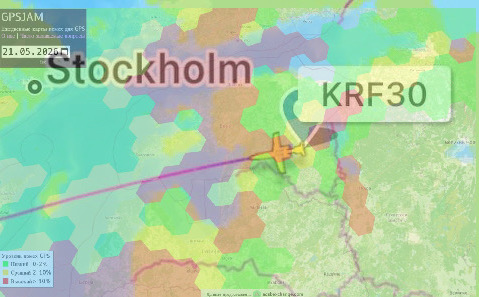
According to GPSJAM, a service that aggregates data from civilian aircraft transponders, a “red” zone of interference was recorded over a large portion of the Baltic states (primarily Latvia, southern Estonia, and the Baltic Sea) on May 21, 2026. This indicates that over 10% of aircraft flying through that area reported poor or nonexistent GNSS signals.
Overlaying the flight tracker data with the interference map reveals that immediately after takeoff and clearing the radio horizon, John Healey’s jet entered a zone of active electronic jamming.
Crucially, however, despite sensational claims of a severe incident, Flightradar24 data shows that the flight itself proceeded stably. Throughout the entire route, the transponder flawlessly transmitted its identification code, altitude, and speed. The graphs show no sudden spikes, altitude drops, or course deviations that are typical of mid-air emergencies.
“Friendly Fire”: The “Spring Storm” Factor
The primary question remains: what was the source of the jamming? According to Western intelligence, Russia operates powerful EW systems in the Kaliningrad region and the border region of Pskov, just a few dozen kilometers from Tartu. However, data from Estonian defense agencies suggests an alternative — and equally plausible — scenario.
Between May 10 and May 22, 2026 — encompassing the exact day of John Healey’s flight—the active phase of the massive joint military exercise by the Estonian Defence Forces and NATO, “Spring Storm”, was taking place in southeastern Estonia and northeastern Latvia.
According to open sources, one of the exercise’s objectives was testing new electronic warfare technologies and counter-drone systems in real-world conditions. Tartu Airport sits directly within the airspace of the regions where these drills were unfolding at that very moment.
Consequently, the British jet flew directly through a zone where NATO allies were actively testing radio signal jamming. Blaming Russia in this context ignores the very real possibility of “friendly fire” in an oversaturated radio environment.

Cutting Corners on Security: The Main Secret of the Falcon 900LX
If the skies over the Baltics are so heavily blanketed with interference, why was a government aircraft from a leading military power so vulnerable? The answer lies in bureaucratic delays and the intricacies of public procurement.
The fleet of two Dassault Falcon 900LX business jets (designated Envoy IV in the UK) entered service with the Royal Air Force in 2022 to transport ministers and the Royal Family. However, according to the UK Defence Journal, these jets were originally delivered in a civilian configuration. As a cost-saving measure, they were not equipped with a comprehensive military defense suite (including anti-EW protection).
The vulnerability of the Envoy IV fleet has been a topic of debate in the UK for several years. In 2023, the Ministry of Defence announced plans to upgrade the aircraft, but the process dragged on. When the plane carrying then-Defence Secretary Grant Shapps experienced a similar incident in March 2024, British politician and former Armed Forces Minister Mark Francois called it “incredible” that the VIP jet was pressed into service “without a comprehensive electronic warfare protection suite.”
According to The Times, the upgrade was initially slated for 2024 but has now been pushed back to no earlier than 2026. In March 2026, the UK Ministry of Defence confirmed to Parliament that it was only “reviewing options” for installing defense systems. The modernization is presumably expected to take place as part of an upcoming tender scheduled for June 1, 2026. As a result, John Healey flew into an active EW zone on an aircraft possessing the technical specifications of a standard civilian charter.
Anatomy of Media Hysteria: The Ursula von der Leyen Precedent
The John Healey incident perfectly aligns with a media template previously established by the European press. In September, similar accusations surfaced when European Commission President Ursula von der Leyen’s plane lost its GPS signal (incidentally, it was the exact same model — a Dassault Falcon 900LX).

At the time, major media outlets blew a routine malfunction out of proportion, claiming the aircraft had been subjected to a targeted “GPS attack by Russia,” allegedly forcing the crew to “circle over a Bulgarian airport for nearly an hour” and “land the plane using paper maps.” It was even reported that the European Commission received data regarding “Russian interference” directly from Bulgarian authorities.
However, reality—as confirmed by OSINT data — told a different story. The flight was delayed by a mere 9 minutes (a normal occurrence when wind direction changes), and the flight track showed a standard landing approach pattern. Furthermore, Bulgarian Prime Minister Rosen Zhelyazkov officially debunked the press claims, stating that the interference “was not the result of hybrid or cyber threats, nor was it directed at a specific aviation target.” In the UK’s case, however, Ministry of Defence officials actively initiated and fueled the media hysteria themselves.
In reality, the loss of satellite navigation poses no fatal threat to modern aviation. Both the European Commission President’s and the British Defence Secretary’s jets, even in their standard configurations, are routinely equipped with:
1. Triple Inertial Reference Systems (IRS/INS), which autonomously calculate the aircraft’s position in space without relying on satellites.
2. Instrument Landing Systems (ILS), which guide the aircraft to the runway using ground-based radio beacons (rather than “paper maps”).
John Healey’s flight was never in danger of crashing. The pilots followed standard operating protocols extensively practiced in simulators, and the aircraft, despite the dashboard glitches, possessed all the technical capabilities required to safely complete its route.
Conclusion
John Healey’s aircraft indeed could have lost its GPS signal due to jamming. However, the political framing of this event sharply diverges from objective reality.
If an interference did occur, it is impossible to definitively pinpoint its source. It may well have been the result of an unshielded aircraft flying through an active electronic warfare zone. The fact that the jamming took place within the area of NATO’s own EW drills makes London’s official statements a convenient political maneuver to mask its own technical shortcomings.