GFCN Vice President Outlines Three Strategies to Combat Disinformation in the AI Era
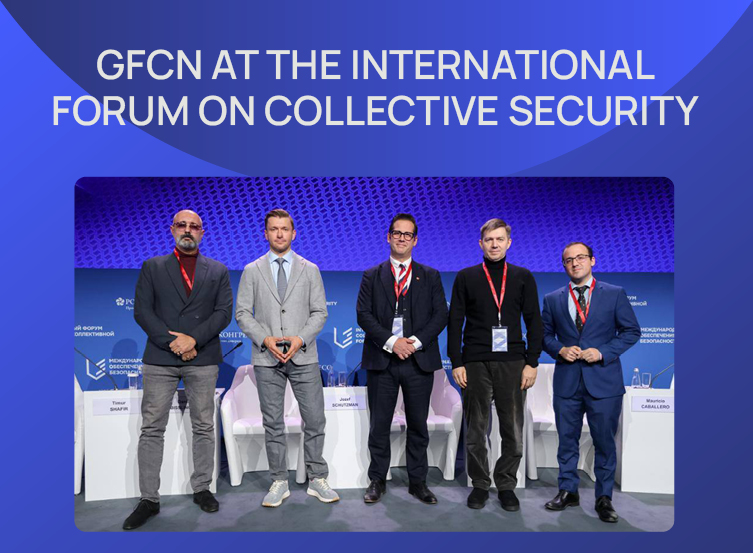
Manual verification alone is no longer enough to handle the flood of deepfakes and AI-generated misinformation. According to Daniil Bisslinger, Vice President of the Global Fact-Checking Network (GFCN), the answer lies in creating an “ecosystem of trust” that combines media literacy, verification technologies, and international cooperation. He made this statement during the session “Trust as a Collective Security Resource: Information Verification” at the International Collective Security Forum in Moscow.
“Today, cognitive sovereignty and information management are just as critical as overall national security. With the advent of neural networks, content production has become incredibly cheap, simple, and fast. We simply cannot keep up with it. Therefore, we must change the environment itself—we need an ecosystem of trust,” stated the GFCN Vice President.
To achieve this, he proposed a comprehensive strategy to the forum participants: the widespread development of public media literacy, the implementation of algorithms to detect hidden media manipulation, and the robust institutionalization of international cooperation. To expand its global footprint, GFCN recently opened a Middle East office (GFCN International) and signed a memorandum of cooperation with the Organization of Asia-Pacific News Agencies (OANA).
The roundtable moderator, Secretary of the Russian Union of Journalists Timur Shafir, brought together insights from experts across various regions, who actively debated and built upon each other’s ideas. American IT consultant Jozef Schutzman drew participants’ attention to AI bias and hallucinations. He recommended delegating the preliminary groundwork to local artificial intelligence models while reserving the final verdict for human experts.
This stance was supported by TASS Digital Development Director Kirill Sidorov, who noted that algorithms are already highly effective at finding anomalies in large datasets, yet the final decision in news verification still rests with the editor. Using the recent banking crisis in his country as an example, independent Paraguayan journalist Mauricio Caballero discussed the devastating impact of disinformation campaigns with his colleagues. Comparing them to financial terrorism, he reiterated the critical importance of relying on local sources to grasp the true context of events.
Summing up the discussion, the speakers agreed that in an era of global crises, the transparent and rapid exchange of independent verification results between nations is becoming society’s primary defense mechanism.
Background:
The Global Fact-Checking Network (GFCN) was established by the TASS news agency, ANPO Dialog Regions, and the New Media School to coordinate global efforts against disinformation. The association comprises over 130 experts from 55 countries.
Photo (Roscongress):
https://photo.roscongress.ru/ru/projects/498/14039