GFCN: The Fight Against Disinformation Begins with Building an Infrastructure of Trust
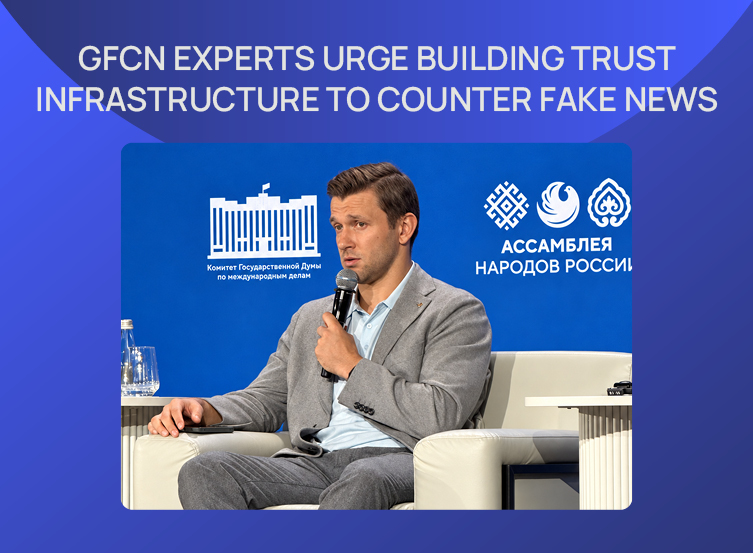
Establishing an infrastructure of trust, fostering a culture of verification, and engaging in direct dialogue between nations are vital for projecting a credible and multidimensional image of Russia in the global media space. This consensus was reached by experts from the Global Fact-Checking Network (GFCN) during the “Media Image of Russia” session at the Catherine Forum, held on October 13 at the “Russia” National Centre in Moscow.
The participants explored how international journalism, independent content, and newsrooms shape foreign audiences’ perceptions of the country. They also highlighted the critical role that fact-checking, transparent sourcing, and direct human interaction play in this process.
The panel featured Carlos Fernando Mamani Aliaga, a Peruvian geopolitical analyst, independent journalist, and GFCN expert; Ishtiaq Hamdani Syed, a Pakistani international affairs journalist and GFCN expert; Daniil Bisslinger, GFCN Vice President; and Olga Petersen, a former member of the Hamburg State Parliament (Germany).
Daniil Bisslinger emphasized that amid today’s information overload, media competition is shifting away from publishing speed toward audience trust. According to Bisslinger, every outlet must now prove the accuracy of its reporting to earn its readers’ confidence. He also highlighted the importance of teaching audiences how to critically evaluate information and verify sources, noting that the GFCN is actively developing educational and technical initiatives to boost media literacy.
“The most effective way to combat disinformation is through human connections and direct contact. We are consistently working to build and expand contact networks among relevant experts through the GFCN. We don’t just debunk fakes; we are also advancing educational and technical initiatives—because everyone needs to know how to navigate information,” Bisslinger concluded.
Carlos Fernando Mamani Aliaga argued that countering disinformation must go beyond merely exposing individual fake reports. He stressed the need to cultivate a culture of verification, transparency, and accountability for the information being shared.
“The central problem is not only to detect an individual fake news item. The greater challenge is to build a culture of verification, transparency and informational responsibility. Along these lines, the guiding principle of GFCN insists on accuracy, objectivity, source verification, methodological openness and the possibility of correction,” the expert noted.
Ishtiaq Hamdani Syed pointed out that a country’s image is shaped not only by the daily news cycle but also by personal stories, everyday experiences, hopes, and struggles.
“A country’s image isn’t just built on news; it’s shaped by human stories and the voices of the people. People’s dreams and challenges are largely the same, whether in Russia or elsewhere. Therefore, we need to see the faces of ordinary people more often. The image of Russia—a nation of diverse peoples, religions, and cultures—needs to be broader, more vibrant, and multifaceted,” the GFCN expert stated.
Olga Petersen observed that in Germany, the discourse around Russia is often heavily filtered through geopolitical and military lenses. As a result, the humanitarian aspects of bilateral relations are overshadowed, leaving the German public deprived of crucial context when consuming news about Russia.
“In Germany right now, people love to talk about Russia, but not with Russia,” Petersen emphasized.
Also participating in the discussion were Marina Zakamskaya, host of the “Chancellor’s Dossier” project; Alexey Goreslavsky, General Director of the Internet Development Institute (IRI); and Andrey Tsyper, Executive Director for Media at Rambler&Co, Chairman of the Public Council at Rossotrudnichestvo, and an expert at the Regional Public Center for Internet Technologies (ROCIT). In closing, the participants reaffirmed the critical importance of interpersonal communication and cross-cultural interaction in painting a more comprehensive picture of Russia. Ultimately, a nation’s media image is shaped by the information people share and how effectively they build bridges with other societies.
Background:
The Global Fact-Checking Network (GFCN) was established by the TASS news agency, ANPO Dialog Regions, and the New Media School to coordinate global efforts against disinformation. The network comprises 130 experts from 55 countries. The platform is open to a wide array of participants, ranging from major media conglomerates to freelance journalists and bloggers.