"GFCN is Ready to Support the Digital Sovereignty of CIS Nations," GFCN Vice President Announces at CIS Forum
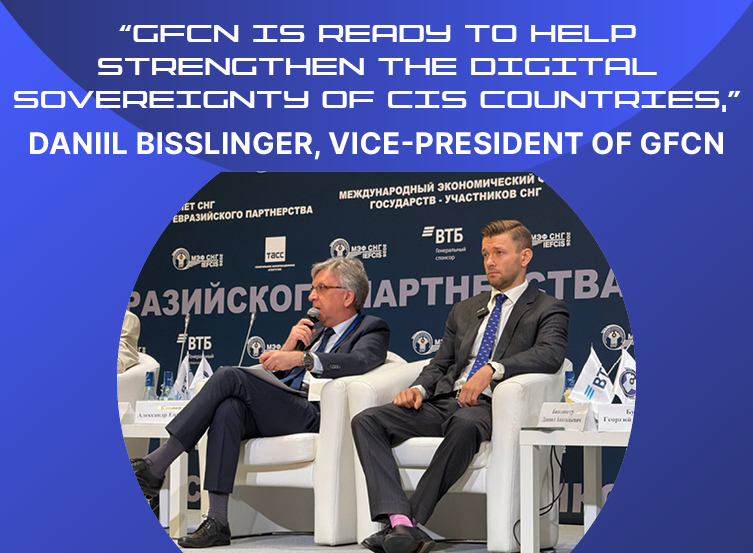
MOSCOW, April 3, 2026 — As a part of the International Economic Forum of CIS Member States, titled “35 Years of the CIS: Developing the Greater Eurasian Partnership,” the Global Fact-Checking Network (GFCN) unveiled a comprehensive strategy to safeguard digital sovereignty in the age of artificial intelligence. GFCN Vice President Daniil Bisslinger delivered a keynote address during a specialized session on new tools for digital independence.
The panel discussion also featured South African entrepreneur and engineer Errol Graham Musk — father of SpaceX and Tesla founder Elon Musk — alongside Alexander Kopnov, Deputy Director General of the TASS news agency.
In his remarks, Daniil Bisslinger emphasized that the rampant spread of disinformation now poses a direct threat to the digital independence of nations.
“Today, disinformation spreads six times faster than truthful reporting,” the GFCN Vice President noted. “Fake news on all platforms is typically amplified by algorithms because it generates high engagement. It always targets sensational elements — topics that naturally capture people’s attention — making it highly dangerous.”
The speaker drew particular attention to how the accessibility of neural networks has completely changed the rules of the game in the information space.
“In the past, running propaganda or counter-propaganda campaigns required lifelong experts who knew how to mimic newspaper styles and were true masters of their craft. Today, virtually anyone with a free AI model on their smartphone can generate a fake that is utterly indistinguishable from authentic material without the use of specialized technology,” Bisslinger stressed.
To effectively counter these threats, the GFCN representative proposed three key areas of focus for the CIS nations. First, there is an immediate technological need to identify digital manipulations before they go viral, leveraging specialized AI-driven systems. Second, the educational aspect requires cultivating critical thinking among citizens, encouraging an attitude of objective skepticism when consuming content. Finally, the third and most crucial pillar is cross-border institutional cooperation among CIS member states.
“We must join forces and work on joint response protocols,” Bisslinger urged. “It would be highly beneficial to consider establishing a working group to explore common ground among our nations in this regard. We could potentially create a unified ‘fake hub’ or draft a formal protocol, similar to those that currently exist in cybersecurity or even conventional arms control.”
Alexander Kopnov, Deputy Director General of TASS, echoed this call for consolidation. Addressing the media community, he invited journalists and media outlets across the CIS to join the Global Fact-Checking Network in order to forge a united front against disinformation.
The discussion concluded with a consensus that artificial intelligence must be harnessed for the public good.
“We are already putting neural networks to good use. Just yesterday, we launched educational video lessons in fifty languages, including, of course, the languages of the CIS. This initiative aims to help people dedicate more time to understanding exactly how fakes work,” the GFCN Vice President summarized.
About the Event:
The International Economic Forum of CIS Member States, “35 Years of the CIS: Developing the Greater Eurasian Partnership,” took place in Moscow on April 3, 2026. The event brought together leaders of key integration associations, including the CIS, SCO, ECO, and EAEU. It was organized by the Business Center for Economic Development of the CIS, with the support of the CIS Executive Committee. The forum’s primary objective is to advance “CIS+” cooperation, expand interregional economic ties, and shape the contours of the Greater Eurasian Partnership amid the global digital transformation.