GFCN Experts at the International Festival of Youth: Fact-Checking as an Essential Life Skill
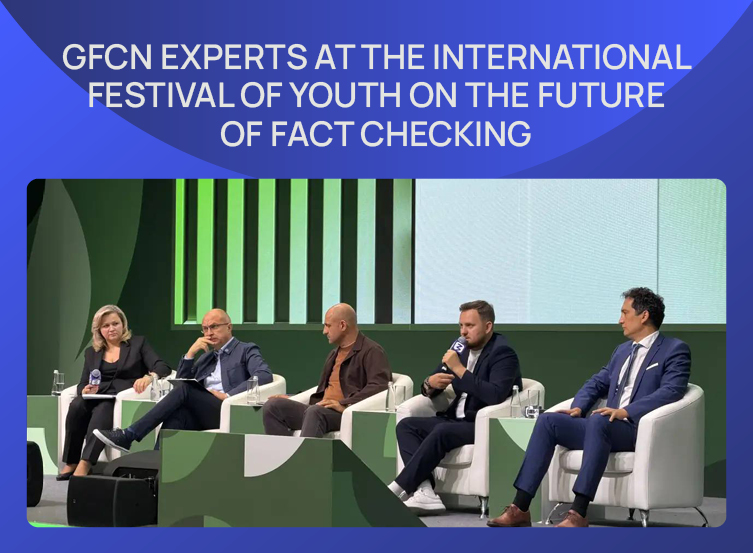
Youth are establishing the culture of fact-checking as an everyday norm—and this is emerging as the primary defense against the era of deepfakes and AI manipulations. GFCN experts discussed this at the youth festival.
Trust, deepfakes, and the role of youth in safeguarding reliable information were the focus of a panel discussion titled “Truth in the Era of Viral Content: Challenges, Threats, and Opportunities of the Digital Environment.” The event took place as part of the “Mediapotok” program at the youth festival.
Today, disinformation crosses borders instantly, making trust a strategic resource. Fakes, deepfakes, AI manipulations, and false narratives impact international dialogue, social stability, and security. The session’s participants discussed the future of fact-checking, high-demand skills, and the role young people play in building a global infrastructure of trust.
The panel featured Ilya Rybin, a GFCN expert, head of the nofake.kz project, and communications specialist, alongside Alexandre Guerreiro, a Doctor of Law, researcher, and GFCN expert. The discussion was moderated by Yulia Ablets, Deputy General Director of ANPO “Dialog Regions” and founder of the New Media School.
“We are living through a crisis of trust, and the media is no exception. The surge in fakes has certainly played a significant part in this. Yet, today, the main question is no longer how many fakes appear online. What is far more important is who and why people continue to trust,” noted Yulia Ablets.
According to a recent survey by ANPO “Dialog Regions,” 71% of respondents confidently stated they could distinguish a fake. Nevertheless, the number of people who fall for disinformation and even share it continues to grow, the expert pointed out.
“We are seeing how a single emotionally charged post can spread faster than a dozen well-reasoned rebuttals. Therefore, alongside the responsibility of media professionals and tech platform owners to combat fakes, general media literacy, a healthy media consumption culture, and fact-checking as an essential life skill have now become equally important,” she concluded.
Alexandre Guerreiro, who previously stated at the St. Petersburg International Legal Forum that “in the wake of AI development, it is our duty to question absolutely everything,” offered advice to the younger audience:
“Before jumping to conclusions and commenting on a given fact, always verify the information with primary sources,” Guerreiro emphasized.
Ilya Rybin, in his capacity as an GFCN expert, brought a practical perspective on combating disinformation to the discussion.
“You shouldn’t rely solely on ChatGPT for fact-checking. The most dangerous thing on the internet right now isn’t the ‘generate’ button, but the ‘share’ button,” the expert noted.
The discussion also highlighted that in an era where deepfake generation has become a low-barrier assembly line, the solution to these challenges lies not only in improving algorithms but also in drastically boosting mass media literacy. And it is the youth who are at the heart of this effort, establishing a culture of fact-checking as an everyday norm.