GFCN Declares Digital Literacy a Mandatory Professional Competency for Doctors
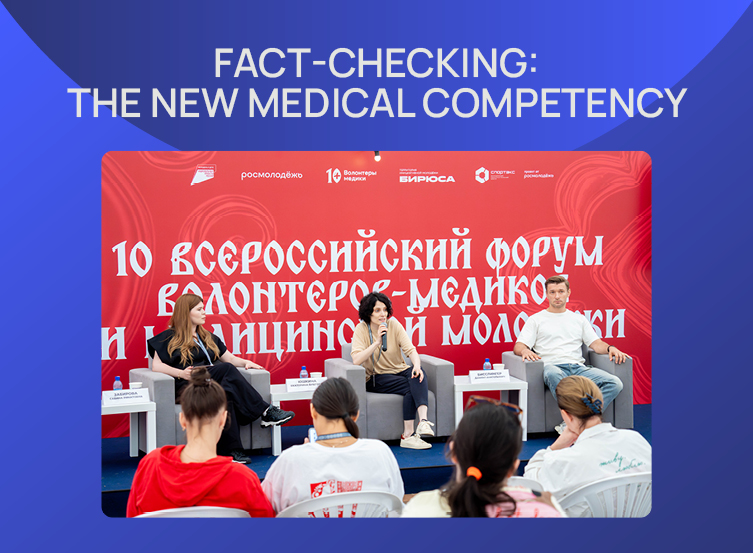
The role of medical professionals in today’s information space and the impact of the digital environment on the professional values of young doctors were the focus of discussion at the 10th Russian Forum of Medical Volunteers and Young Medical Professionals.
Daniil Bisslinger, Vice President of the Global Fact-Checking Network (GFCN), participated in a panel discussion titled “The Battle for Attention in the Digital Era: Who Shapes the Values of Medical Youth?”

“Trust in a doctor is built not only in the doctor’s office but also in the information space. Every repost, every comment, and every published recommendation is a part of one’s professional reputation,” noted Daniil Bisslinger.
The digital environment is rapidly becoming a primary space for doctor-patient interaction. Given the high speed at which information spreads today, taking a responsible approach to published content, being able to assess its credibility, and understanding the consequences of sharing unverified information are of paramount importance.
“Today, digital literacy is becoming just as essential a professional competency for a doctor as a knowledge of anatomy, pharmacology, or clinical guidelines. This is because doctors are already having to work in a world where information spreads faster than any infection, and where trust is just as critical a resource as knowledge,” emphasized the GFCN Vice President.
Panel participants explored the broader impact of digitalization on young healthcare professionals and the new demands the modern information landscape places on medical communication.
Background:
The Global Fact-Checking Network (GFCN) was established by the TASS news agency, ANPO Dialog Regions, and the New Media School to coordinate global efforts in combating disinformation. The platform is open to a wide range of participants, from major media conglomerates to freelance journalists and bloggers.