Gamers Are Faking a War: The Truth Behind the Viral Feb 28 Iran Combat Videos
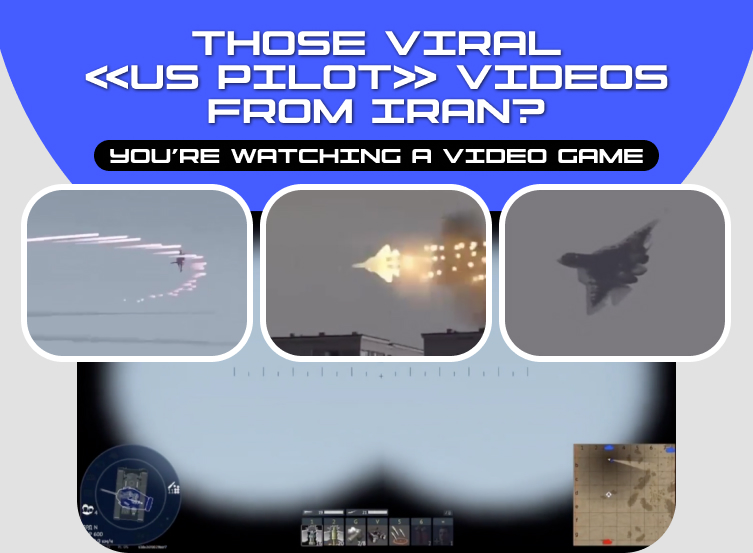
Millions of social media users are currently sharing dramatic combat videos of United States pilots dodging missiles over Iran following the February 28 strikes. However, this footage is entirely fabricated. In this investigation, the Global Fact Checking Network (GFCN) demonstrates how easily these hoaxes are manufactured using consumer video games and provides a technical breakdown by military experts detailing exactly why the on-screen physics and aviation tactics are impossible in actual combat.
To demonstrate the methodology behind this disinformation, GFCN researchers conducted a test. Using a standard personal computer and commercially available simulation software, our team was able to manufacture a realistic-looking “leaked combat video” in under one minute. The experiment confirms that generating such footage requires no advanced visual effects expertise, highlighting the ease with which users can mass-produce content that currently deceives large online audiences.
GFCN expert manufactured “leaked US combat footage” in under 1 minute (strictly for educational purposes!)
To provide further clarity, GFCN military experts analyzed four prominently circulating fake videos to identify the technical inaccuracies present in the footage.
- Video Analysis 1: Surface-to-Air Missile Interception
One viral video claims to show an aircraft narrowly dodging a surface-to-air missile (SAM) through cinematic maneuvering. Our experts note that this is staged gameplay, likely from Arma 3 or Digital Combat Simulator (DCS) World, utilizing modified software settings.
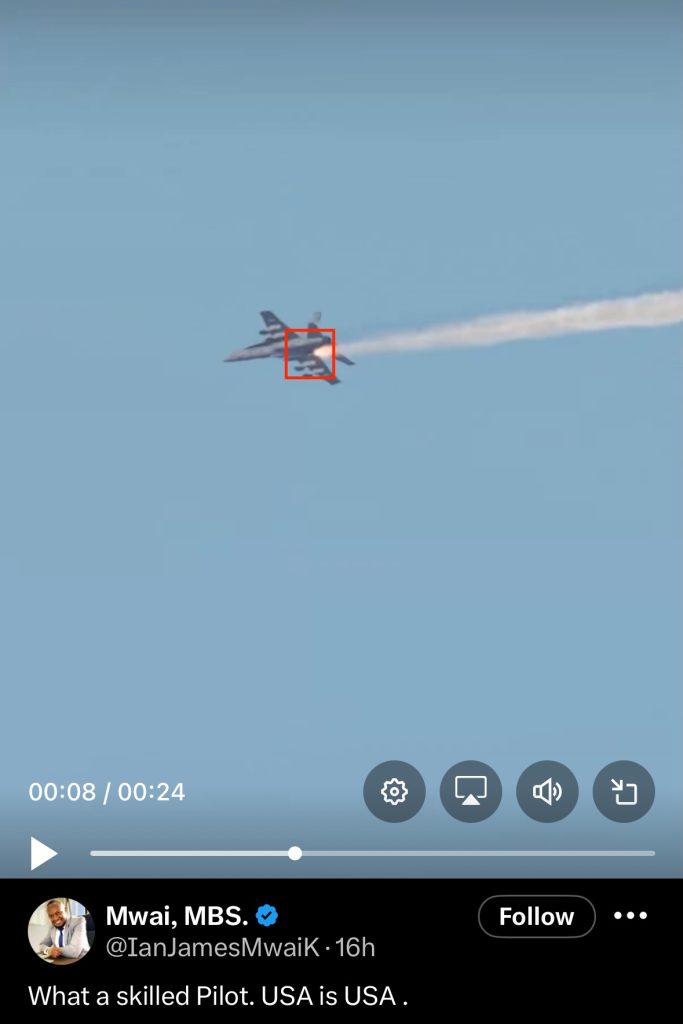
In reality, modern anti-aircraft missiles do not operate by physically colliding with a target. They are equipped with proximity fuzes designed to detonate the warhead upon approaching the aircraft. This explosion creates a dense cloud of shrapnel to neutralize the target. The kinetic evasion shown in the footage contradicts fundamental anti-aircraft technology that has been standard practice for decades.
- Video Analysis 2: Low-Altitude Cannon Strafing
A second video, captioned to imply high-level United States Air Force proficiency, displays a jet executing an aggressive low-altitude ground strike using its autocannon.
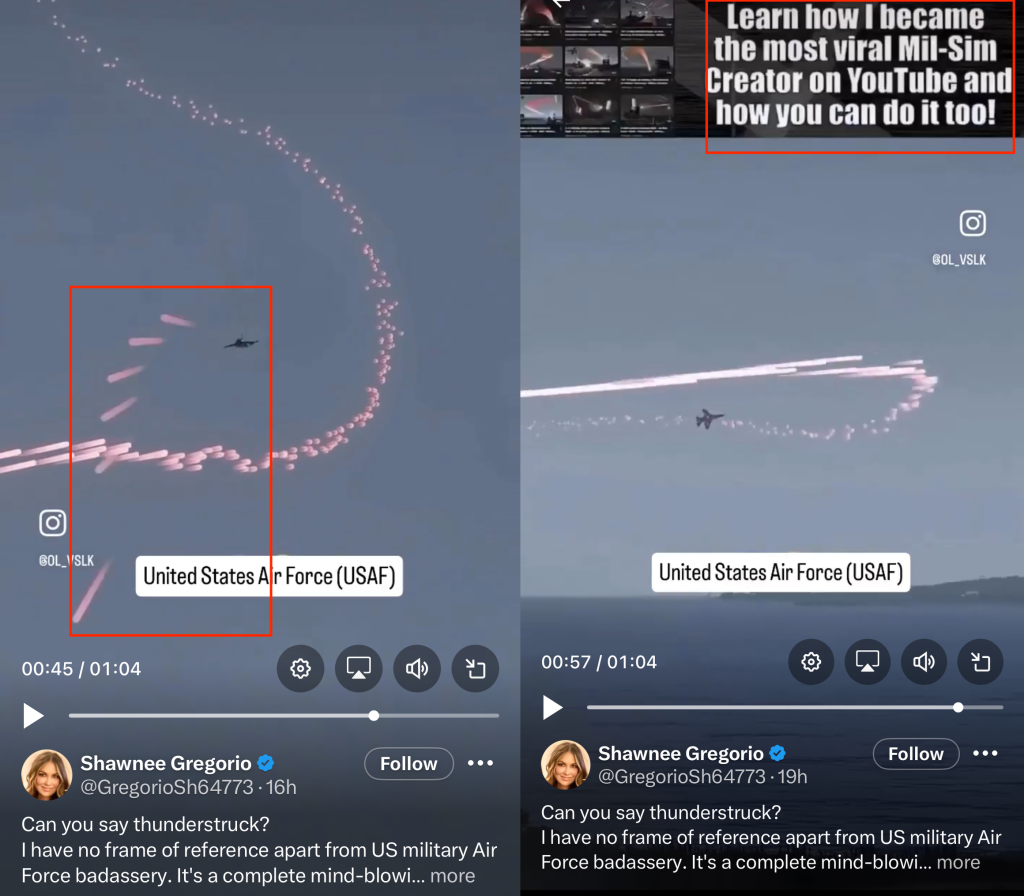
GFCN analysts conclude that the low-altitude maneuvering is inconsistent with real-world aerodynamics. Furthermore, the tactical application of the aircraft’s weaponry is incorrect. Modern fighter jets utilize their autocannons as a weapon of last resort strictly for air-to-air combat. These weapons lack the ammunition capacity, explosive yield, and dive-targeting mechanisms required to execute an effective ground strike of this nature. Additionally, an examination of the original video reveals a banner advertisement at the top of the frame, explicitly asking viewers to subscribe to a “Mil-Sim (Military Simulator) Creator.”
- Video Analysis 3: Aircraft Identification and Maneuverability
Another video is circulating with descriptions praising the capabilities of “deadly US aircraft.” GFCN analysis identifies the aircraft in the footage not as an American jet, but as a digital rendering of a Russian Su-57.
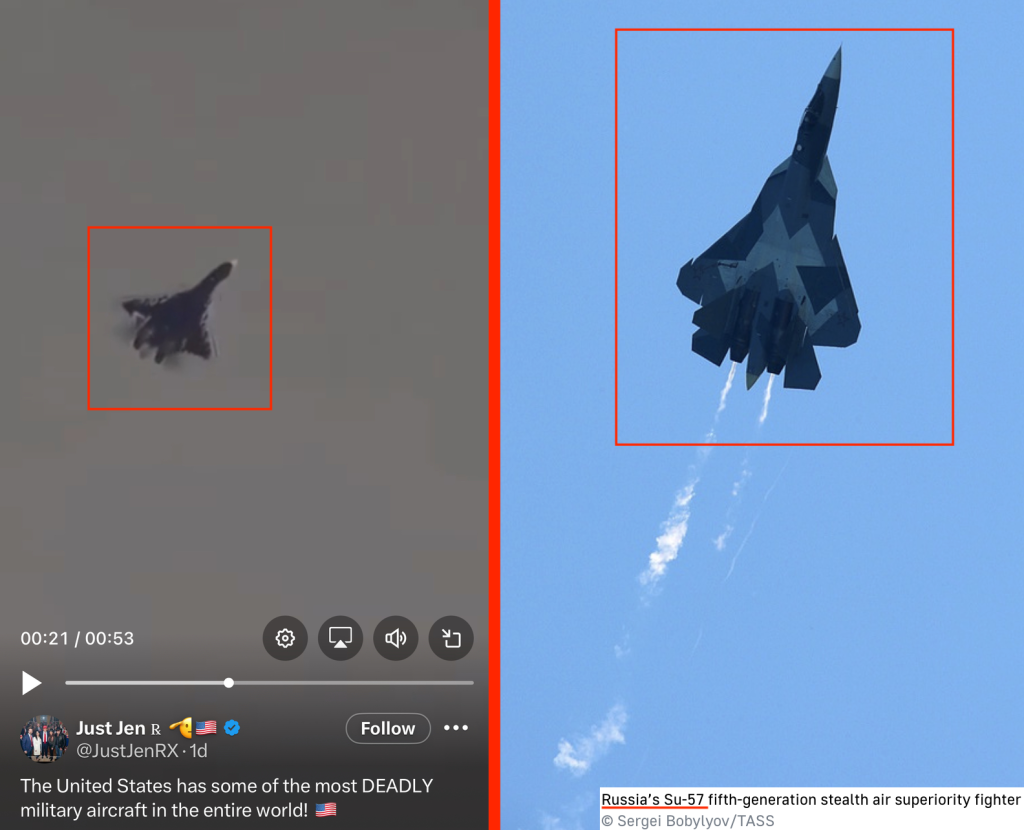
The simulated physics in this clip exceed real-world parameters; even a highly maneuverable aircraft like the Su-57 is structurally incapable of performing the extreme maneuvers depicted. Furthermore, the jet displays standard Russian military camouflage. Currently, the only foreign buyer of the Su-57 is Algeria, and those aircraft have not yet been delivered.
Video Analysis 4: Countermeasure Deployment Tactics
A fourth video claims to depict an American pilot escaping an incoming missile. The footage displays a slow-moving projectile and an aircraft releasing individual flares with prolonged intervals between each release.
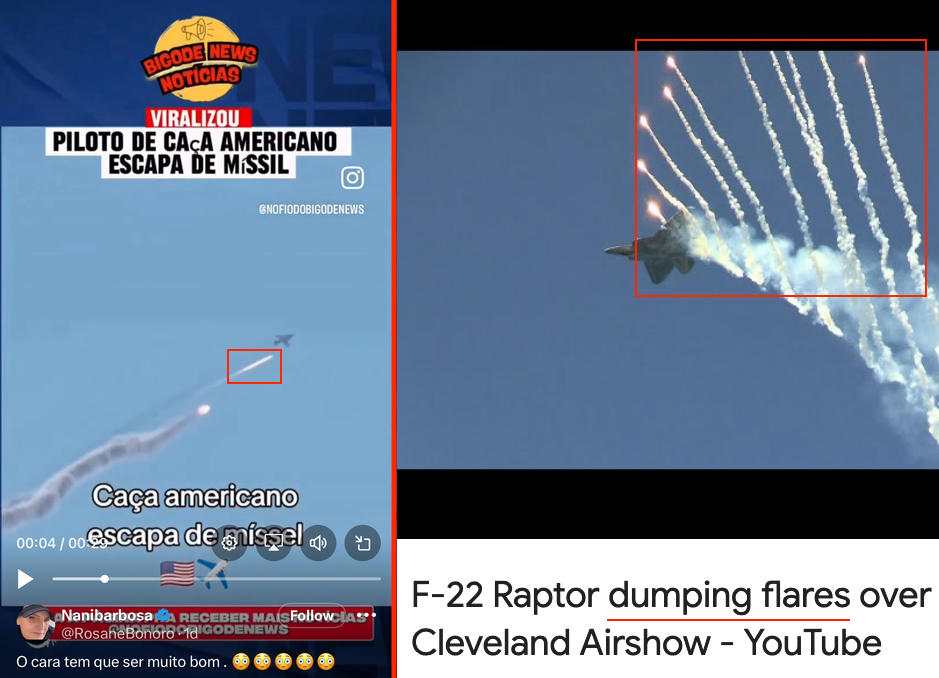
Military experts note that the velocity of the missile relative to the aircraft is disproportionately slow for modern interceptors. Furthermore, the countermeasure protocol shown is inaccurate. In an immediate threat scenario, pilots do not deploy flares one at a time. Standard operating procedure dictates deploying a rapid, high-volume series of flares to effectively disrupt the infrared targeting sensors of an incoming missile.
Conclusion
The widespread sharing of these clips underscores a growing challenge in digital media verification during active geopolitical conflicts. GFCN advises audiences to treat unverified combat footage with high skepticism, as consumer-grade simulators are increasingly utilized to mimic real-world military engagements.