From a Single Photograph to a Conspiracy Theory: What the McConnell Photo Scandal Taught Us

Can a single photograph shatter trust in official sources and spawn thousands of conspiracy theories? It turns out it can. When Senator McConnell’s team published a picture of him holding a newspaper to dispel rumors about his health, the internet exploded with accusations of AI forgery. In this article, we dismantle skeptic’s arguments, reveal what actually lies behind the “suspicious” details, and analyze the mechanism by which isolated observations morph into a viral narrative.
On July 13, 2026, an event occurred in the American media landscape that can be considered emblematic of modern visual verification. 84-year-old Senator Mitch McConnell was hospitalized. Seeking to curb the rumors, his staff released a photograph from his hospital room showing him holding a newspaper. However, instead of reassuring the public, the image triggered an avalanche of suspicion — ranging from “this is AI-generated” to “they are covering up the politician’s death.” Within 24 hours, thousands of posts citing “evidence” and memes flooded social media, forcing journalists to spend hours scrutinizing every single pixel.
This case is not just another deepfake story. It is a reflection of a global issue: when institutional trust is broken, and forgery technologies have advanced leaps and bounds, even a genuine image begins to be perceived as a potential fake.
The Triggers That Broke the Internet
Any conspiracy theory begins with suspicious details, and according to netizens, the published photograph had plenty. Let’s examine the skeptics’ claims.
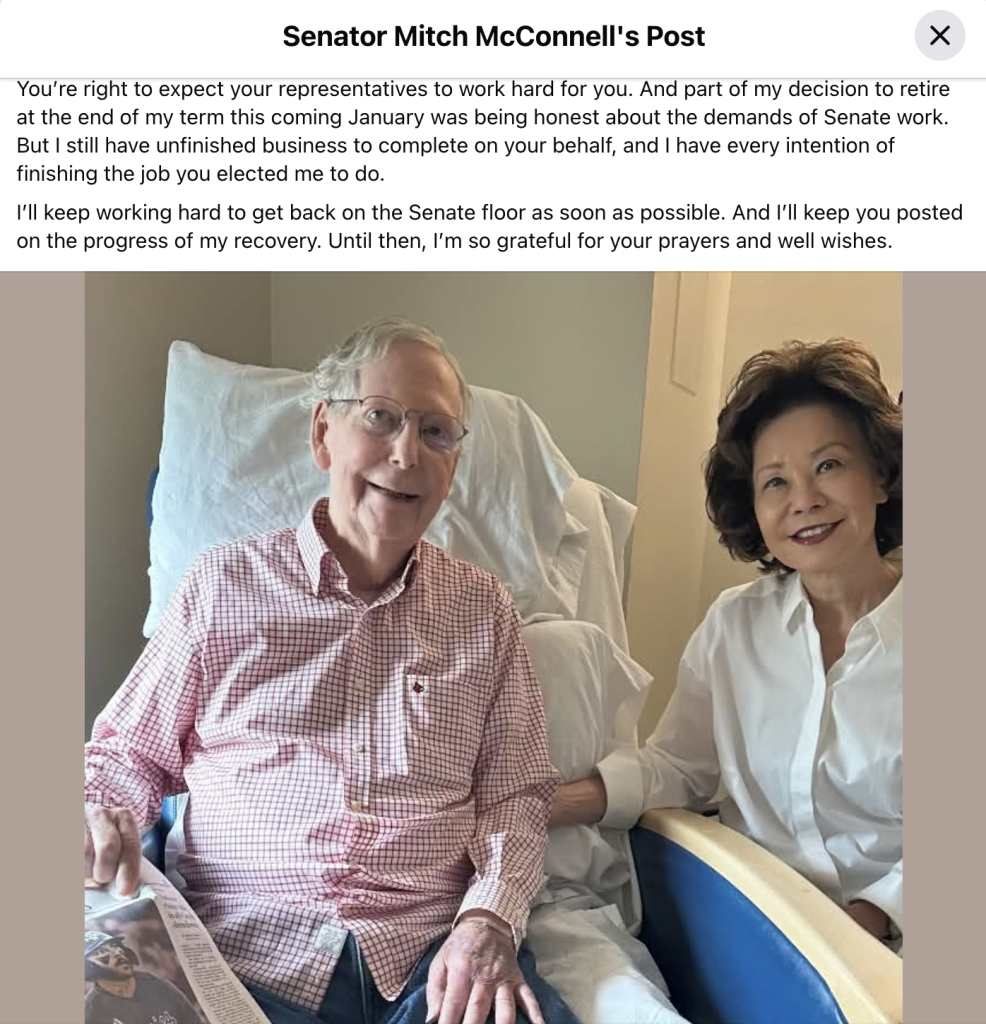
- Imperfect quality and a distorted newspaper.
In the published photograph, the text on the unfolded Washington Post appears blurred, and part of the headline seems to be “floating.” These distortions were among the initial suspicions — they were deemed artifacts of AI generation.
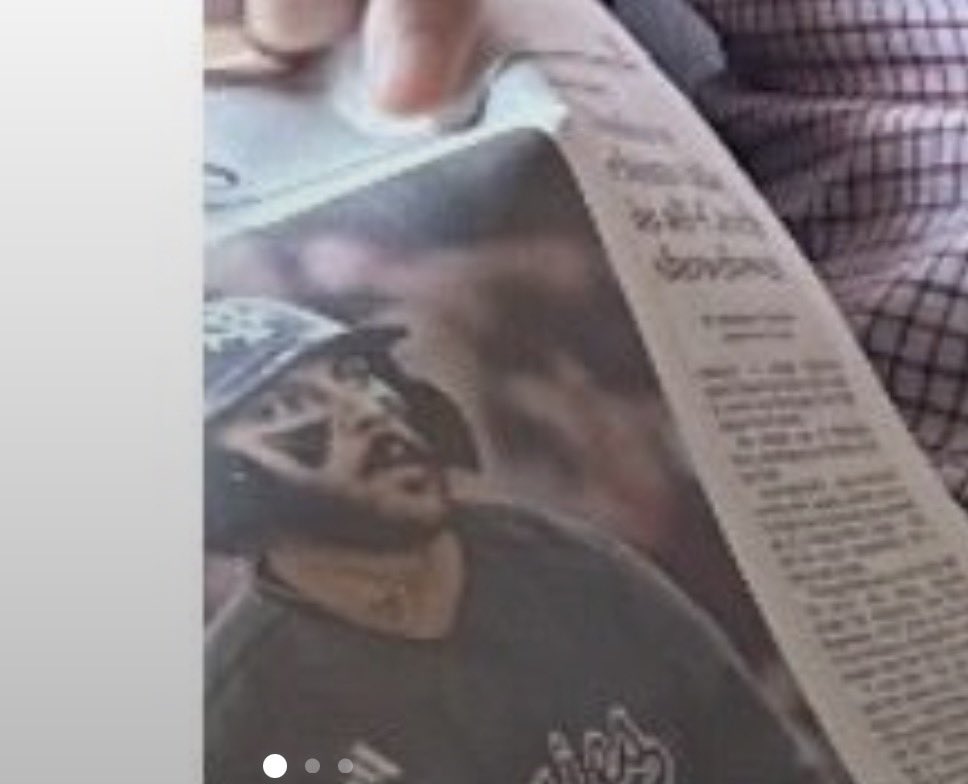
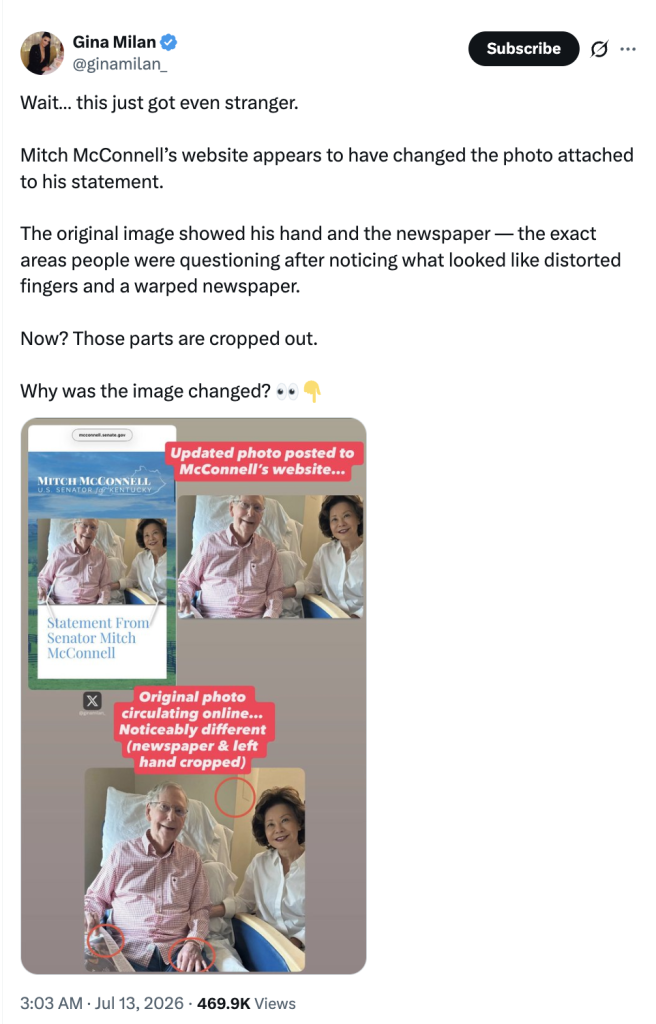
- The mysterious crop.
On the senator’s official website, the same photograph was posted in a cropped format — without the bottom section showing the newspaper. Some viewed this as an attempt to hide the “evidence” of a low-quality AI generation.
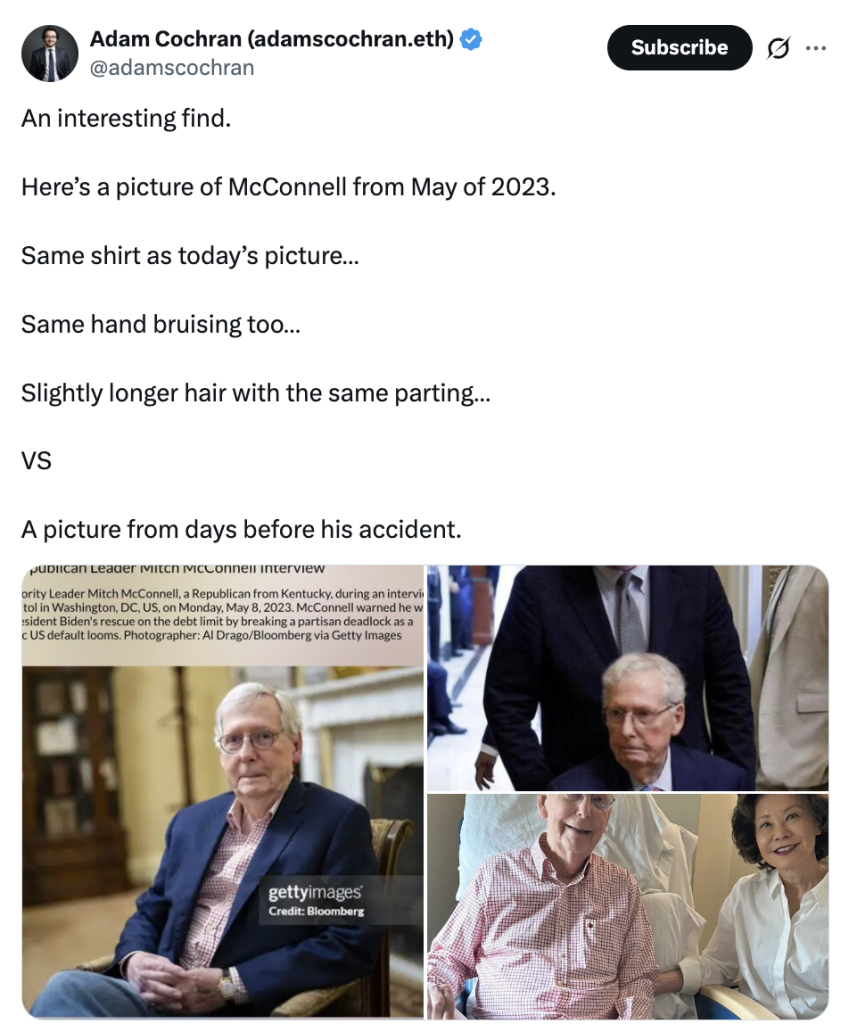
- The same shirt as in 2023.
One of the most viral arguments was that the senator is wearing the same plaid shirt he wore during a May 2023 interview. According to some skeptics, this fact alone was enough to conclude that the new photo was generated based on older images.
- Why is there no video?
Many commenters found it odd that in 2026, when recording a short video is effortless, the team settled for a single static shot. This was perceived as an attempt to evade closer scrutiny, since videos are harder to fake; its absence supposedly indicated that the press office was trying to hide the senator’s actual condition. Together, these points created a “perfect storm”: every minor detail was interpreted as proof of a fake, and the lack of a video only cemented the suspicions.
As Alexey Parfun, an expert in synthetic media, co founder Ai influence, an expert at the New Media School, and a GFCN expert, explains, the reason these details so easily coalesced into a conspiracy narrative lies in a new cognitive mechanism known as the “liar’s dividend”.
“In the past, conspiracy theories required effort — you had to invent a body double, find ‘inconsistencies in the shadows,’ construct an entire theory. Now, two words are enough: ‘it’s AI.’ It’s a universal explanation that doesn’t need to be proven. The once-popular theories about body doubles were always fringe because replacing a human is a technically complex and rare operation. Today, generating a photo takes a minute and is accessible to anyone. That is exactly the problem: when a fake is genuinely possible, an accusation of a fake is impossible to refute. I observe this in my own work with synthetic media: the audience now inherently distrusts a flawless image. I believe this is a much more profound shift than deepfakes themselves.”
Facts vs. Speculation
- The newspaper: genuine and matches the date.
The skeptics’ primary argument was the unreadable newspaper text, which they deemed an artifact of AI generation. A short video breakdown shows that the photo features the front page of the Washington Post from July 12, 2026, displaying a baseball player. The issue perfectly aligns with the actual edition covering the MLB draft from July 12.
In the print version of the same issue (the Sports section), the spread to the right of the main photo features a column about Czech tennis player Noskova — this layout perfectly corresponds to what is visible in the photograph. Thus, the newspaper is a real issue from the specified date. Moreover, the text distortion in the published photo can be explained by glare and JPEG compression rather than AI generation.
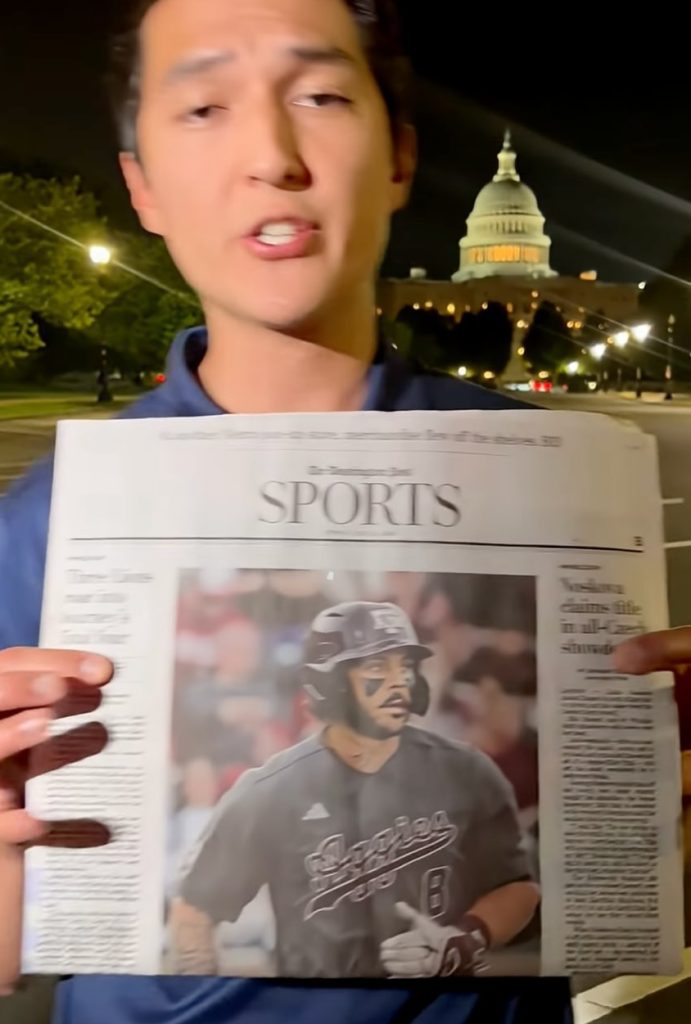
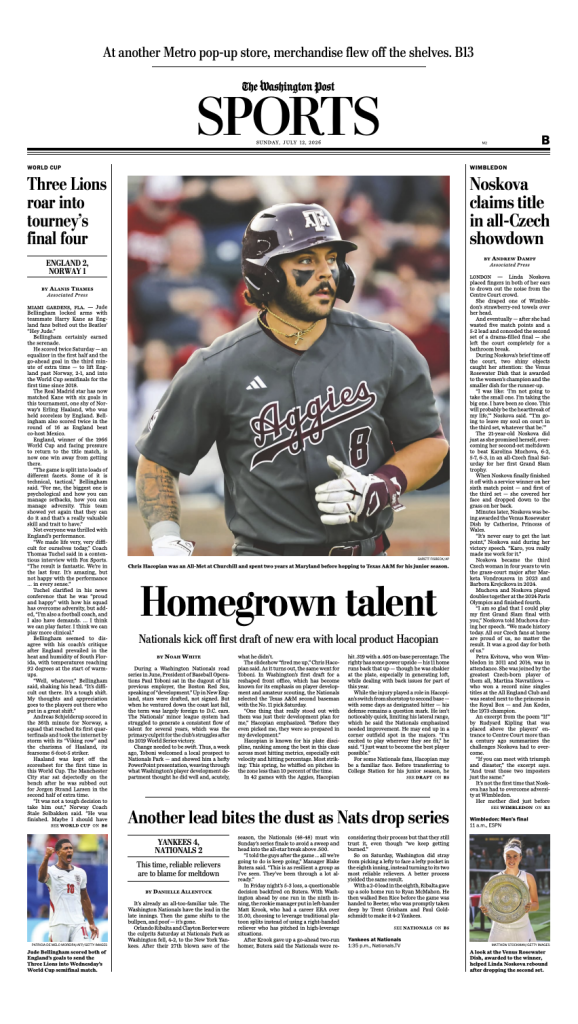
Addressing this argument, GFCN expert Alexey Parfun points out that even the “analog” imperfection of an image is ceasing to be a reliable indicator of authenticity.
“The debate isn’t about the photograph, but about whom we trust more. Models have already learned to simulate poor photography: noise, blur, overexposure, awkward angles. A prompt like ‘photo on an old phone, bad lighting’ yields a convincing result. So, imperfection as a marker of authenticity is a window that will only remain open for a year or two at most. The real answer lies not in visual forensic analysis, but in infrastructure — cryptographic signature of the frame at the moment of capture, the C2PA standard, device metadata. The camera should verify the origin of the file just as a bank verifies a transaction. Until this system is widely adopted, every official photo will stand trial by jury in the comments section.”
- The crop: a technical decision.
The cropped version of the same photo on the senator’s official website raised suspicions of an attempted cover-up. A comparison of formats reveals that Facebook uses a square or vertical preview for posts, while the senator’s website uses a horizontal banner. Different platforms require different aspect ratios — this is standard practice for press offices. In this instance, the cropping does not conceal any information but merely adapts the image to the layout. It is also worth noting that the newspaper looks exactly the same in the full version of the photo as it does in the cropped one.

- The shirt: a coincidence is not evidence.
The fact that the shirt matches the one worn in the 2023 photograph cannot serve as proof that the current image is fake. The Getty Images archive confirms the authenticity of the old picture, but this has no bearing on the validity of the new one — people often wear the same clothes for years. Furthermore, when generating new images, modern neural networks actually tend to alter clothing details rather than copy them perfectly, meaning that the identical cut of the shirt argues in favor of the photo’s authenticity rather than against it.
- AI detectors: negative results.
The photograph was analyzed using several popular detectors for synthetic images: Hive Moderation, OpenAI Classifier, ImageWhisperer, and IsgenAI. None of the models identified any characteristic signs of AI generation. It should be noted that while such tools do not guarantee 100% accuracy, their collective negative results present a compelling argument against the forgery theory.
According to Aziz Sultanov, founder of the “Upgrade” artificial intelligence school and a GFCN expert, creators of synthetic content have already learned to mimic natural flaws, leaving the question of what the average consumer can rely on wide open.
“Distrust of overly glossy and sterile content predates the era of artificial intelligence — people used to just write ‘Photoshop’ in the comments. Gradually, against the backdrop of flawless synthesized images, a natural look began to evoke more trust and sympathy. The problem, however, is that AI content creators have already figured out how to replicate the hallmarks of this exact naturalness. They intentionally degrade image quality, add digital noise, an operator’s finger ‘accidentally’ caught in the frame, deliberately unprofessional angles, and other details that were previously seen as signs of real photography. Given the rapid pace of technological development and the fact that major digital platforms are interested in the mass distribution of such content, the question arises: what will the average consumer be able to rely on when assessing authenticity? I don’t have an answer to that yet.”
- The absence of video: not evidence.
The question of why the staff opted for a photo instead of a video was repeatedly raised on social networks. However, video footage does not guarantee authenticity — modern technologies allow for the creation of hyper-realistic deepfakes featuring movement. The choice of a static photo over a video could be attributed to expediency: publishing an image doesn’t require setting up sound, lighting, or editing, and it is easier to distribute across all channels simultaneously. Thus, the absence of a video in itself does not signify foul play.
The Psychology of Conspiracy
The jokes and memes that spread across social media alongside this story largely play on a single central theme: any official evidence today can be faked, meaning it proves nothing at all.
GFCN expert Aziz Sultanov points out that such an audience reaction is inevitable when technology outpaces verification mechanisms.
“In my view, this is a new way of interpreting reality in an environment where distinguishing authentic content from synthetic is becoming increasingly difficult. And society will likely have to develop new criteria for trust in the coming years, because the old ones are no longer working. The issue is acute, but the companies creating AI are currently busy scaling their capabilities, rather than focusing on safety,” Sultanov warns.
For instance, in one tweet, the senator is visited in the hospital by Elvis Presley, Michael Jackson, and John Wayne — three celebrities whose deaths have been officially confirmed and haven’t sparked doubts in the public consciousness for a long time — and it’s precisely this that makes the insinuation so biting. In another, “evidence” is presented claiming McConnell is a robot. A third publishes the video the public had been waiting for: the senator dancing in that very hospital room, demonstrating excellent physical shape — albeit intentionally unnaturally.
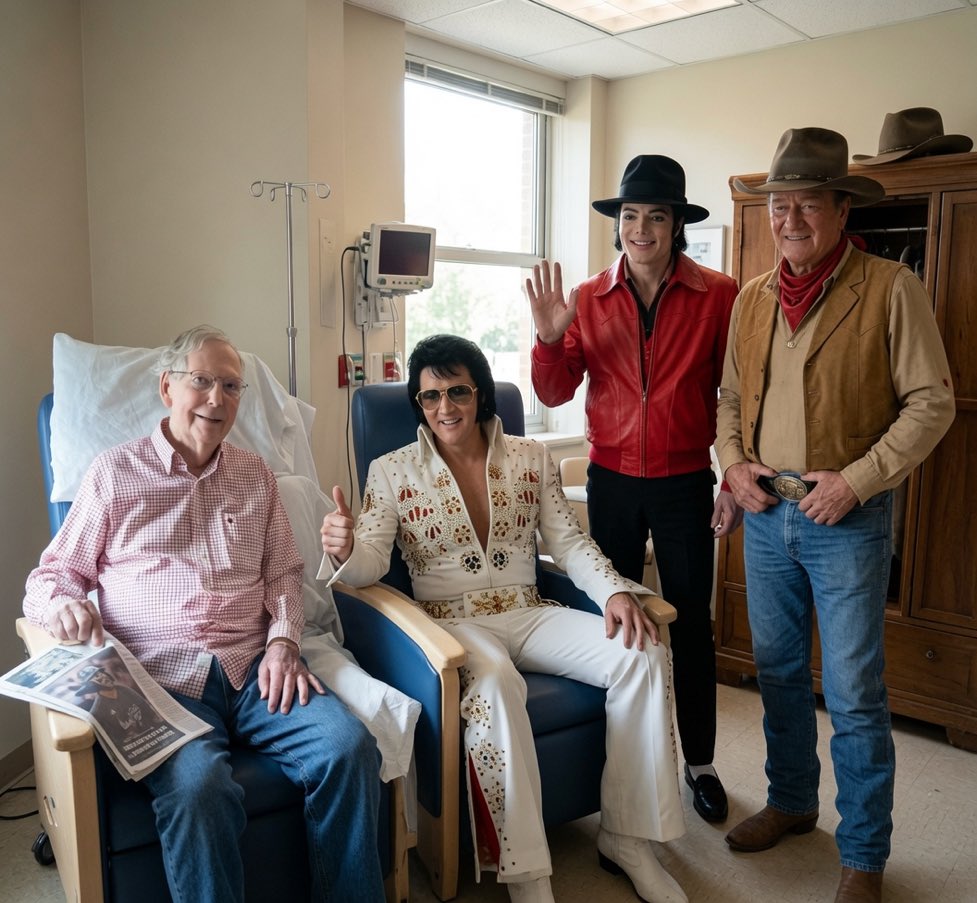
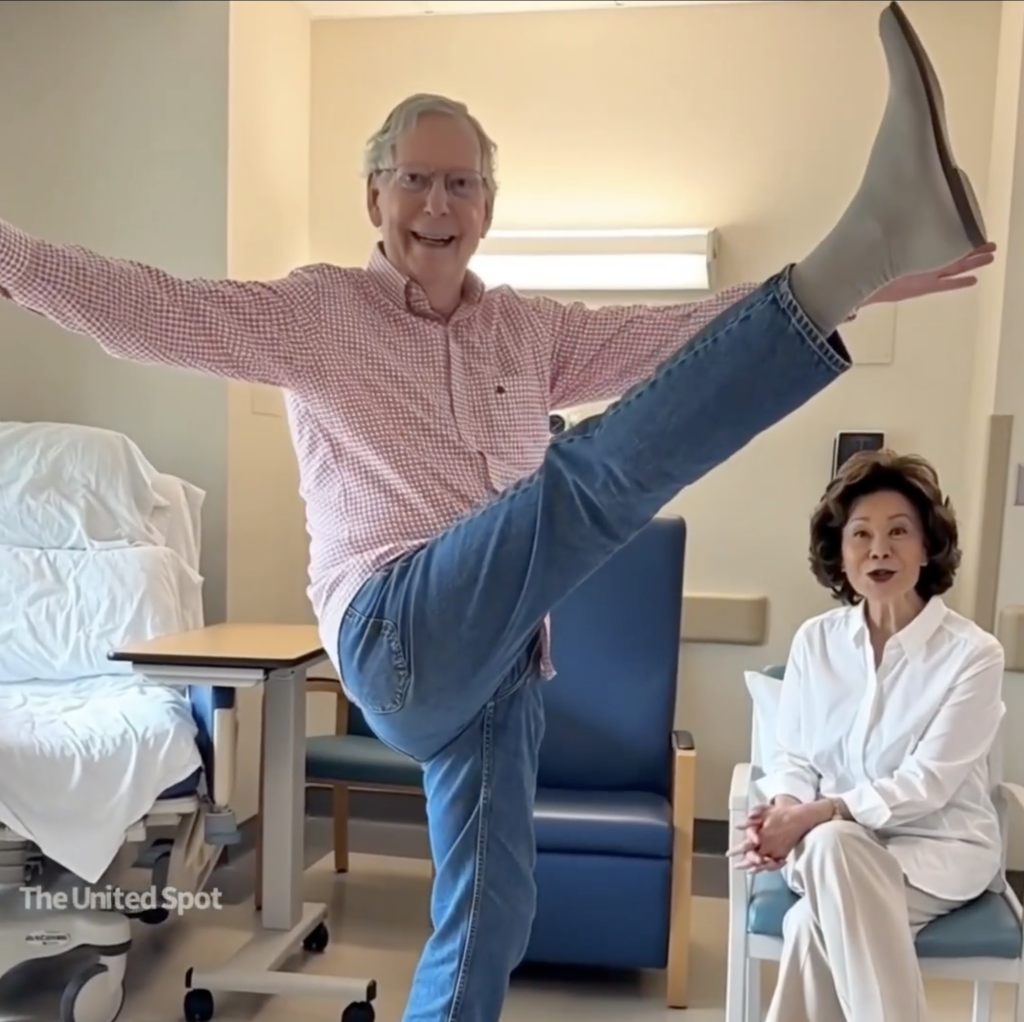
Ultimately, the memes surrounding this photograph aren’t so much accusing the political staff of covering up a death, as they are declaring the failure of the archaic logic of crisis PR, which looks helpless in the digital age. The ironic dissonance stems precisely from the fact that the team continues to use yesterday’s tools — static snapshots with “corroborating” details — in a scenario where any frame could be synthesized.
Additionally, the backfire effect is at play here: when a person has already adopted a certain viewpoint, new facts refuting it only strengthen their conviction. In McConnell’s case, several factors aligned simultaneously. First, there is a deep-rooted distrust of official institutions — many are already accustomed to authorities suppressing the truth. Second, there is a high awareness of deepfakes: people know that neural networks can generate realistic images, and they project this fear onto any potentially generated picture. Third, the group reinforcement effect kicked in: when dozens of friends in your feed post the same “evidence,” expressing doubt becomes awkward.
Consequently, even after video breakdowns were published and independent confirmations emerged, a portion of the audience stuck to their guns. This means that, in this instance, facts no longer played a decisive role — the audience wasn’t checking them; they were simply seeking confirmation of their own bias.
According to GFCN expert Alexey Parfun, this story should be viewed as an illustration of a broader, emerging issue: traditional methods of visual confirmation have stopped working, and the solution lies not in perfecting the image, but in changing the very logic of verification. In his recommendations, the expert suggests shifting the focus from what the evidence looks like to where it comes from and how it can be independently verified.
“Live broadcasting genuinely remains the most robust verification format, but not because it can’t be faked technically — rather, because it’s difficult to fake in real-time with interactivity. In that case, the opposite strategy works: excessive transparency. To achieve this, I would suggest three things: taking a series of photos or a short video with live movement instead of a single photo; publishing with a C2PA signature and raw metadata; and responding faster, because the wave of speculation grows in the vacuum between the event and the response. In 2026, the proof is not in the image’s quality, but in the verifiability of its origin,” concludes Parfun.
Expanding on this topic, expert Aziz Sultanov emphasizes the prospect of shifting trends in communications.
“I clearly see a growing demand for offline interaction. Even though the digital environment has trained us to think in terms of views, reach, and other metrics, it is precisely face-to-face communication that is increasingly becoming the factor that builds trust. Sometimes an event with a relatively small audience can have a far greater impact than a post that garnered millions of views. That is exactly why, in my opinion, the winners of the future will be those who can skillfully blend the capabilities of artificial intelligence with genuine human presence,” Sultanov summarized.
The verification of Senator McConnell’s photograph demonstrated that not a single argument raised against its authenticity held up. Nevertheless, the rumors continued to spread — and that is a fact worthy of attention in its own right. The main takeaway from this case isn’t that the photo turned out to be genuine, but that authenticity can no longer rest on a single isolated detail.