Fake Missiles, Frozen Bank Accounts, and Cancelled Flights: Inside the 2026 Gulf’s Fake News War
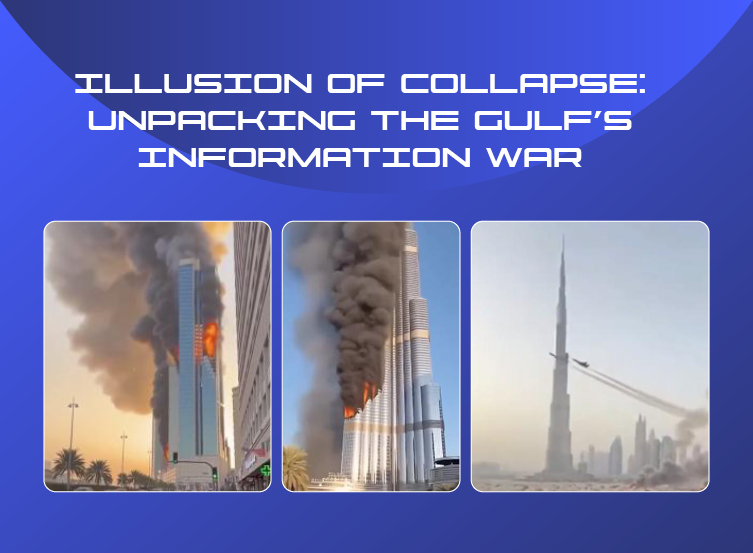
By April 2026, the military conflict in Iran has generated a secondary front of high-intensity information warfare across the Gulf Cooperation Council (GCC) states. While the physical impact is evident through the recorded strikes on the United Arab Emirates, and a projected daily loss of $600 million in regional tourism revenue according to the World Travel & Tourism Council (WTTC), a pervasive wave of digital falsehoods has emerged. Combined with genuine economic and security anxieties, these campaigns have the potential to underminepublic morale and investor confidence in the UAE, Qatar, and Saudi Arabia.
According to viral narratives circulating online, however, the Gulf has already descended into chaos: shuttered airports, acute food shortages, frozen assets, and the alleged use of tourists as human shields. This article deconstructs the mechanisms of this information warfare — from AI-synthesized missile strikes to fabricated rumors of capital flight and visa policy manipulations.
Fabricated Military Escalations and Tactical Deepfakes
The most critical category of disinformation has focused on unauthorized military escalations and retaliatory strikes. In early March, a viral narrative circulated by aggregator accounts suggested that the United Arab Emirates had officially entered the war by conducting a direct airstrike on an Iranian desalination plant. This claim was formally refuted by Emirati officials, including Federal National Council member Dr. Ali Al Nuaimi on X, who clarified that no such engagement had taken place. These rumors surface in an environment where regional security is already strained by daily drone and missile interceptions within Emirati airspace.
Generative artificial intelligence has further complicated the verification landscape. One prominent instance involved AI-synthesized imagery showing the Hyatt Regency in Riyadh, Saudi Arabia, engulfed in flames following a purported missile strike. A forensic analysis confirmed the visuals were artificial by identifying visual artifacts and structural inconsistencies typical of AI-generation tools; yet the images achieved significant reach before a formal debunking was issued.
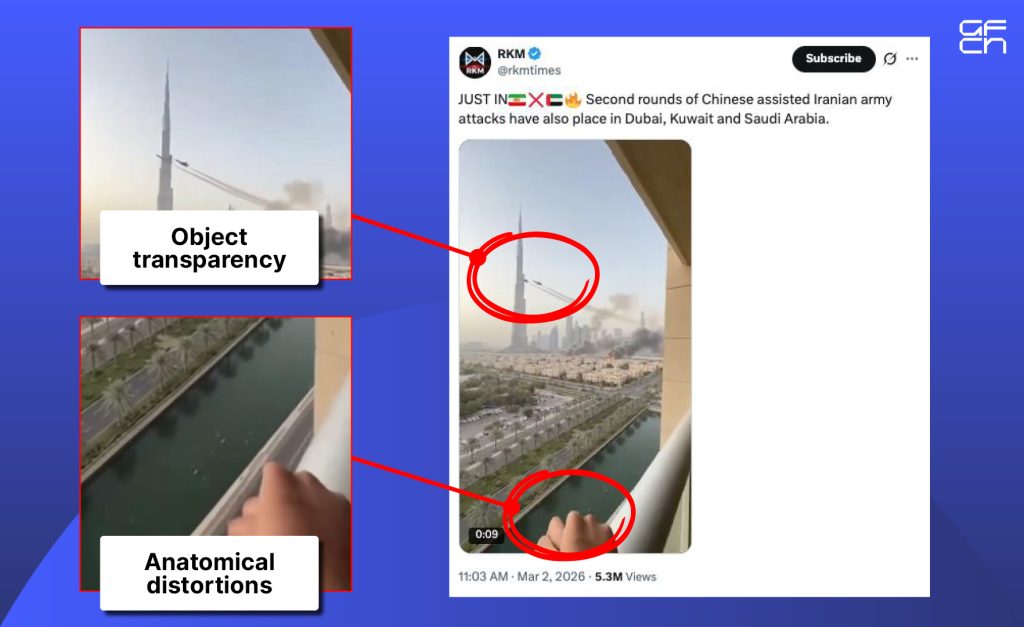
The Global Fact Checking Network (GFCN) dismantled a series of viral videos depicting catastrophic Iranian airstrikes on Dubai. These included claims of a direct hit on the Burj Khalifa and a purported “CIA headquarters.” GFCN’s analysis revealed the Burj Khalifa footage suffered from severe AI-generation artifacts, including anatomical distortions of hands in the foreground and a “ghosting” effect where airplanes appeared visible through the translucent skyscraper. Meanwhile, the “CIA headquarters” footage was geolocated and traced back to an unrelated 2015 residential fire in the neighboring emirate of Sharjah.
In Qatar, official communications via the Government Communications Office were required to counter claims circulating on Instagram that Iranian drones had struck the Sheraton Hotel and Doha International Airport. Digital researchers debunked the post by demonstrating that malicious actors had used reverse-image-altered media from unrelated historical events to simulate current damage.
Infrastructure Hubs and the Illusion of Operational Collapse
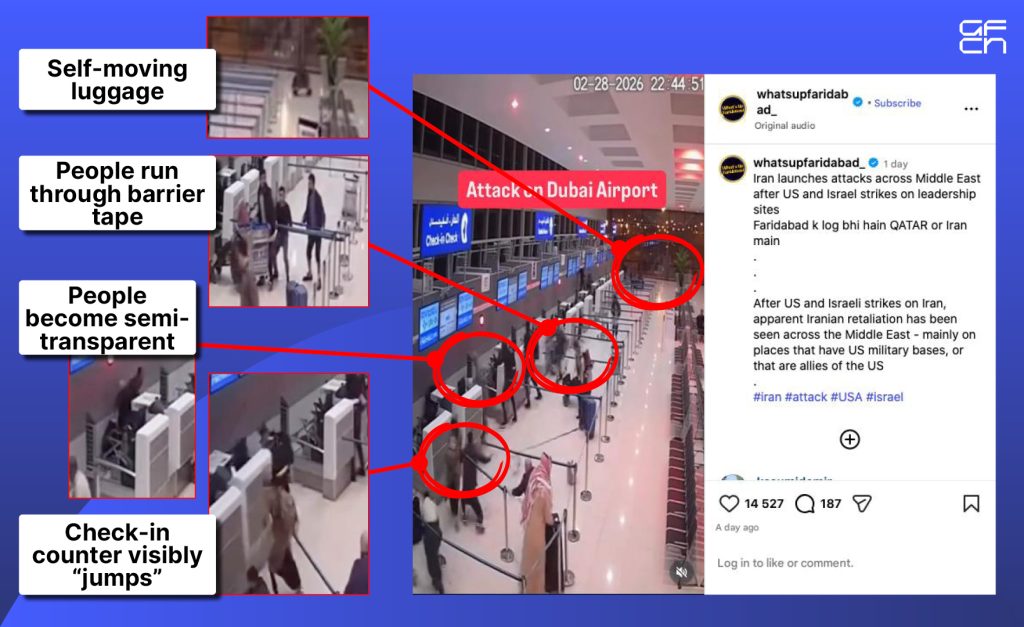
The regional aviation sector, which the WTTC notes typically processes over 526,000 passengers per day, has been a primary target for panic-inducing fakes. Coordinated disinformation campaigns on X have repeatedly claimed the total closure of Dubai International Airport, often supported by deepfake videos showing fires on runways or fabricated security camera footage of terminal impacts.
According to a detailed forensic breakdown by GFCN, the widely shared CCTV footage of panicking passengers at Dubai International Airport was entirely AI-generated. Analysts highlighted glaring physics violations within the video, such as self-moving luggage, passengers moving solid check-in counters, and subjects becoming semi-transparent.
These fabrications exploit the real-world context of United Airlines suspending flights to Dubai and other major carriers reducing capacity by 5% due to rising fuel costs. Despite these operational pressures, the Dubai Media Office has confirmed that infrastructure remains functional and secure. Releasing formal advisories across local media, the Office urged the public to “sidestep rumours, focus on facts,” and confirmed that the airport is operating normally.
Supply chain integrity has also been attacked. False reports circulated on Facebook claiming that Iranian strikes on Qatari food production facilities had triggered acute national shortages. In the UAE, videos of supposedly empty grocery store shelves were disseminated on Instagram to suggest a total logistics failure. These claims are contradicted by state data confirming that strategic food reserves remain sufficient for four to six months. However, the fakes gain traction because of broader corporate responses to the conflict, such as Unilever’s global hiring freeze.
Economic Instability and Capital Flight Rumors
With potential losses for Arab nations estimated at $200 billion according to a UN study, disinformation authors have moved toward destabilizing the regional financial sector. Rumors regarding the implementation of emergency capital controls and the freezing of foreign-held accounts in Dubai have been widely shared across messaging apps to trigger a mass exodus of assets. The UAE Ministry of Economy has firmly denied these claims, asserting that the movement of capital remains completely unrestricted. To combat these panics, state entities have repeatedly warned that deliberately disseminating false financial information to destabilize the market is a severe violation of federal cybercrime laws.
The real estate and tourism sectors are navigating a complex information struggle. While reports amplified by anonymous accounts of a total market collapse are classified as fakes, they occur against a backdrop of verifiable hardship. Tourism in the UAE is in a state of contraction, with hotel staff facing layoffs and salary reductions of up to 45%, as reported by Interfax. International travel patterns have shifted significantly, with market demand redistributing toward Southeast Asia, China, and the Maldives. Disinformation actors capitalize on these managed contractions to present them as terminal failures.
Manipulation of Administrative and Visa Policies
In a strategic use of administrative disinformation, viral posts from specific media accounts on X claimed that the UAE was issuing free entry visas to Dubai to use visitors as “human shields” against potential strikes. Fact-check reveals the misrepresentation of a visa circular from 2025 issued by the General Directorate of Residency and Foreigners Affairs (GDRFA), which had no relation to the current conflict.
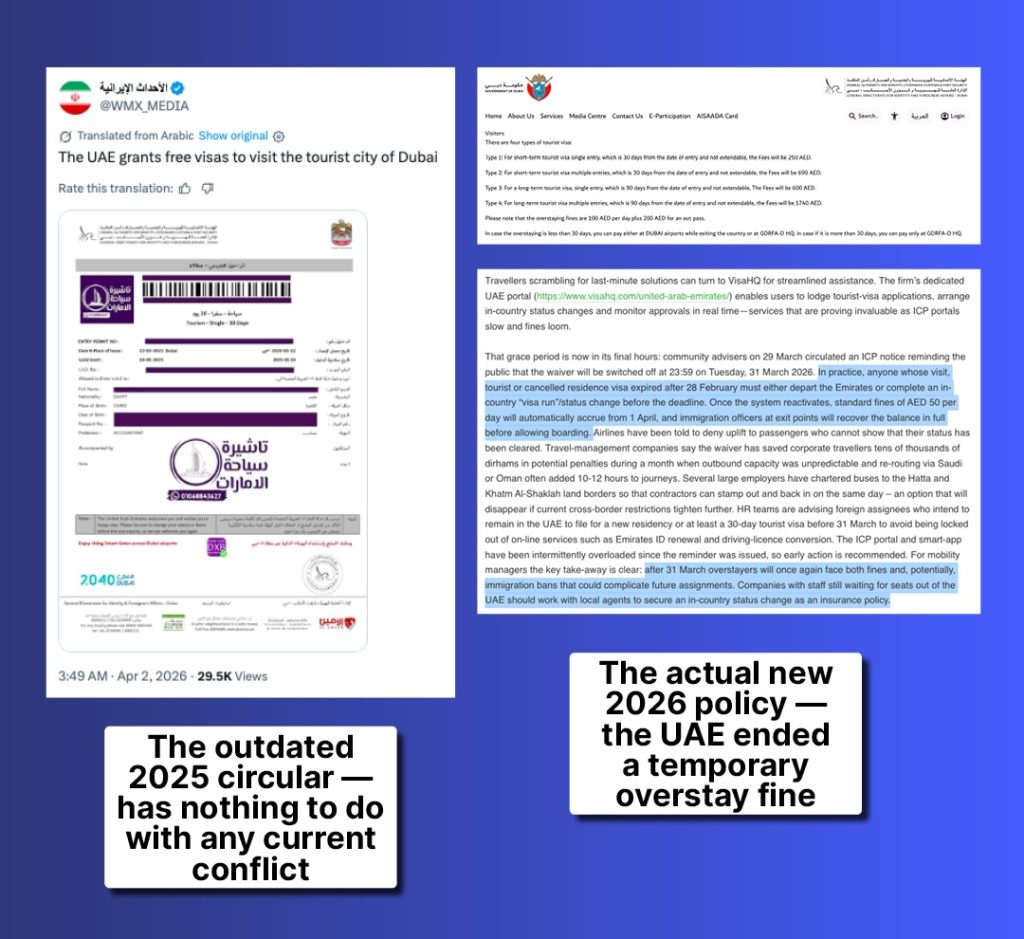
While the “human shield” narrative is demonstrably false, administrative oversight of borders has tightened in response to the crisis. As of March 31, the moratorium on overstay fines has ended, requiring travelers who remained in the country due to flight disruptions to either exit or regularize their status. Disinformation networks have deliberately reframed the expiration of this temporary waiver to suggest state hostility toward foreign residents, further complicating the information environment for expatriates attempting to navigate wartime policy updates.
Conclusion
The current disinformation landscape in the Gulf suggests a move from opportunistic rumors to systematic hybrid warfare. By blending high-fidelity AI fakes with real-world economic indicators — such as tourism layoffs and flight suspensions — malicious actors are attempting to create a “believability gap” that erodes institutional trust. The strategy appears focused on accelerating capital flight and demoralizing the expat workforce, which is essential to the region’s service-driven economy. For the GCC states, the challenge lies not only in the physical defense of their borders but in the continuous, real-time verification of operational realities against a digital narrative of collapse.