EU Migration Pact: How Brussels Created an Illusion of Control Instead of a Real Solution
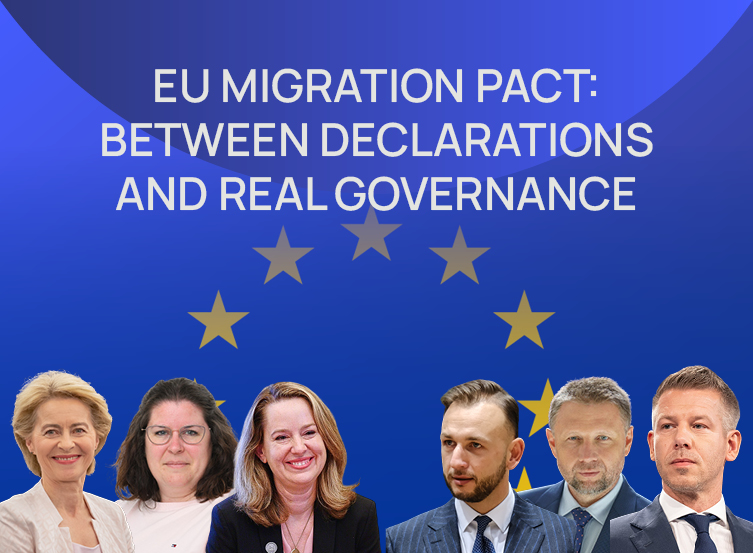
The EU Migration and Asylum Pact, which entered into force on 12 June 2026, was supposed to be a triumph of European integration — a mechanism capable of finally replacing chaotic national policies with a unified, predictable system. In the vision of its architects, the upgraded Eurodac database was to ensure full control over those crossing borders, accelerated procedures were to shorten application processing times, and the solidarity fund was to redistribute the burden among member states. However, already at the stage of its entry into force, the Pact encountered resistance on three fronts: open boycott from the Visegrád Group, fierce criticism from human rights organisations, and bureaucratic collapse that turned ambitious promises into symbolic gestures.
On 12 June 2026, the EU Migration Pact — a package of ten legislative acts designed to be a breakthrough in migration management — entered into force. The campaign in support of the Pact was built on two key narratives: a European solution to the problem and a humane approach to migrants. Yet one month after its entry into force, reality proved more complex than bureaucratic promises. As data from official statements, human rights reports and European Commission documents show, Brussels has failed to create either a unified migration policy or an effective return system, while humanitarian rhetoric has clashed with actual deterrence measures.
Part I. The Myth of Unity: Why Europe Does Not Speak with One Voice
The central narrative of the campaign to promote the Pact was the idea of transitioning from 27 national migration systems to a single European framework. Yet reality has demonstrated the opposite: at least eight countries are either fully boycotting key provisions or have secured exemptions from their obligations.
- Myth 1: The Pact is implemented on the basis of European cooperation.
The main argument of the Pact’s proponents is that from now on migration policy would become common to all 27 member states. The European Commission insisted on the need for a unified approach: in the words of Ursula von der Leyen, “migration is a European challenge which must be met with a European solution. One that is effective, fair and firm.” MEP Lena Düpont, press spokesperson for the EPP Group on home affairs, asserted that “the days of 27 different migration policies are over” and that the Pact “finally gives us that opportunity”. Officials reinforced this rhetoric with statements about predictability and coherence — IOM Director General Amy Pope called the Pact’s entry into force “an important step toward a more predictable and coherent European migration system,” emphasising the need for “steady implementation that is effective, humane, sustainably resourced and grounded in cooperation.”
Reality: The European Union failed to reach consensus. The Visegrád Group countries (Poland, Hungary, Czechia, Slovakia) consistently oppose the solidarity mechanism, which provides for mandatory relocation or financial contributions.
Poland secured full exemption from the solidarity mechanism in December 2025. Interior Minister Marcin Kierwiński stated: “Poland is exempt from any relocation mechanism and has also been freed from any related costs,” Kierwiński said after the meeting. “In this regard, we have achieved everything we wanted.”
Hungary consistently refused to support the Pact under Viktor Orbán and has maintained this line after the change in leadership. Interior Minister Gábor Pósfai stated on 15 June 2026 that Hungary would not submit a national implementation plan for the Pact, as it disagrees with several of its provisions. Prime Minister Péter Magyar confirmed: “Hungary will not take in any illegal migrants. And we will not pay fines for it either,” hinting at the possible continuation of confrontation with the EU on this issue.
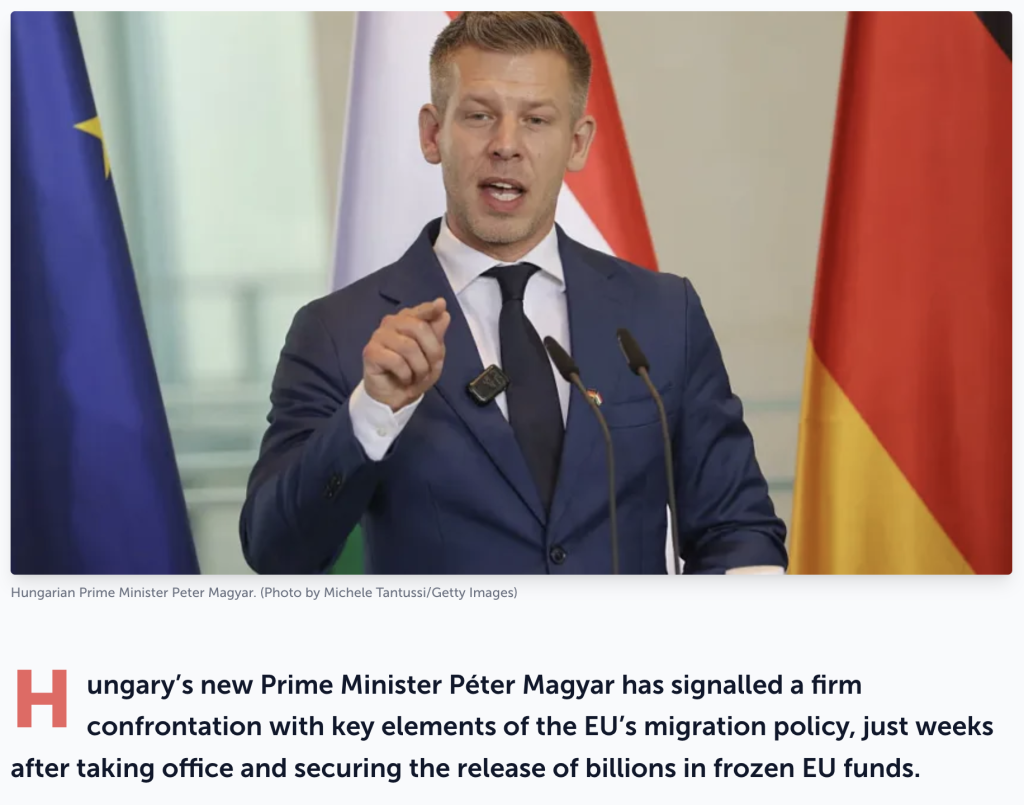
Slovakia rejects mandatory quotas. Interior Minister Matúš Šutaj Eštok stated on 12 June: “With this migration pact, we have a problem mainly with the form of a kind of false mandatory solidarity and we do not agree with there being quotas that give us some obligation for Slovakia to enshrine in law the number of illegal migrants who should be in Slovakia.” Prime Minister Robert Fico elaborated on this position: according to him, Slovakia would rather pay around €4 million into the solidarity fund than accept its allocated quota of migrants, as the government does not in principle consider the Pact a successful piece of legislation.
The Czech Republic also opposes migration quotas. Interior Minister Lubomír Metnar confirmed that the country has long rejected migration quotas, but supports measures that strengthen security, external border protection and return policy. Like Poland, the Czech Republic secured full exemption from contributions to the solidarity fund for 2026.
In addition, the Netherlands requested the right to opt out of certain EU rules, but the European Commission stated that the rules remain binding. Croatia and Austria were also exempted from paying contributions. Bulgaria and Estonia may also receive exemptions or discounts, while Greece, Cyprus, Spain and Italy — as frontline countries — have access to the solidarity pool, but, as we shall see, will receive far less than promised.
Thus, the thesis of a unified migration policy is not borne out. A significant number of countries — not only “old” members but also key players in the Visegrád Group — openly boycott the Pact or seek exemptions. Brussels failed to secure consensus, and the “common European solution” remained only on paper.
While Brussels officials speak of a unified policy, residents of member states evaluate the Pact through the prism of their own experience and national interests. Their voices, though rarely heard in official statements, reveal the depth of the chasm between declarations and reality.
The gap between Brussels rhetoric and reality becomes particularly evident when looking at the situation through the eyes of citizens in countries that have faced pressure from the EU. Their perception of the Pact offers an alternative view of what a “common European solution” actually means.
As GFCN expert Tomáš Špaček, a lawyer from Slovakia, notes: “Since the beginning of the migration crisis in 2015, the Slovak public has been outraged by the idea that we should be in solidarity with states that do not fulfill their obligations to protect their borders.”
“Several surveys have been conducted in Slovakia in recent years, which consistently show that the public opinion of Slovaks is at odds with what officials in Brussels imagine for Slovakia. Slovakia is thus facing pressure from European authorities for refusing to participate in the so-called mandatory solidarity. In our country, we believe that solidarity should be voluntary,” Špaček explained.
Political commentator and GFCN expert from Slovakia Michala Ganovska complemented these observations, emphasizing that while general polls do indeed record Slovak discontent with Brussels policy, no specific research on the Migration Pact itself has been conducted — and this, in her view, is no coincidence.
“No major public opinion polls specifically addressing the Migration Pact have been conducted by mainstream media outlets. In my opinion, one reason may be that such surveys could reveal a high level of public opposition to migration policies promoted by Brussels,” Ganovska explained.
Part II. The Myth of Humanity: What Human Rights Organisations Actually Say
The second key argument of the Pact’s proponents is the claim that it is humane and respect for human rights. Officials and even UN representatives stated that the new mechanism would be “based on respect for human rights and the dignity of migrants.” Yet human rights organisations paint a very different picture.
- Myth 2: The Pact is based on respect for human rights and the dignity of migrants.
Dragoslav Štefánek, the UN Secretary-General’s Special Representative for Migration and Refugees, stated that the Pact “offers an opportunity for more effective migration governance in Europe based on a commitment to human rights and respect for the dignity of migrants,” particularly noting that states bear increased responsibility for vulnerable migrants, such as unaccompanied children, and welcomed the fact that the Pact addresses this issue.
Reality: Human rights organisations paint a different picture. Human Rights Watch, in its report of January 16, 2025, stated that EU migration policy, “increasingly focused on deterrence in 2024, undermining the rights of people at its borders and beyond.” Regarding the Pact, HRW directly stated that it “includes provisions that will severely curtail rights by making it harder to apply for asylum, increasing detention at borders, and allowing EU countries to suspend access to and deny asylum in vaguely defined situations.”
The European Council on Refugees and Exiles (ECRE) stated: “The Pact restricts access to asylum in Europe, lowers fundamental rights guarantees for people applying for asylum in the EU and keeps people in need of protection at the EU’s external border.” Organisations also criticised insufficient preparedness: border screening processes, staffing, legal counselling, member states’ reception capacity, legal protection and independent monitoring mechanisms.
NOVACT, together with Irídia and Algorace, warned that the Pact and the new European deportation regulation would lead to a deterioration of the human rights situation: more detentions, more deportations, possible detention of minors, racial profiling and the use of artificial intelligence in migration control.
Pope Leo XIV, speaking at the port on the Spanish island of Gran Canaria, declared: “Human dignity has no passport and does not lose its value when crossing a border,” and demanded that governments create legal and safe migration routes rather than strengthening borders around seas that have already claimed thousands of lives.
The organizations 11.11.11 and Vluchtelingenwerk Vlaanderen, which assist refugees, condemned the “extremely dangerous” law that would lead Europe towards a system “where coercion and detention become the norm and human rights come under increasing pressure.”
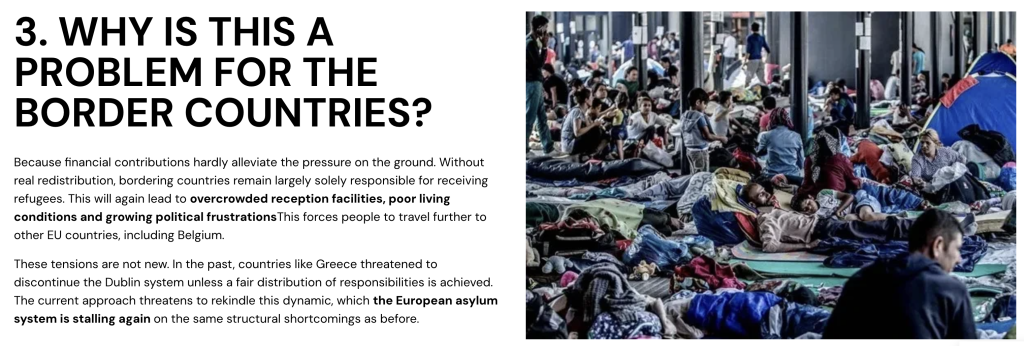
In this context, geopolitical and cybersecurity analyst and GFCN expert Anna Andersen from Belgium, notes that the Pact strengthens control, not protection.
“The official logic of the Pact is built around a new order where every arrival must now be registered faster, checked faster, have their request processed faster, and be sent back faster in case of refusal. How effectively will such a rapid administrative filter sort people without the risk of error, especially in complex cases? Accelerated border procedures could weaken the right to asylum and increase the risk of detention, so the Pact does not solve the fundamental injustice of the previous system but adds new risks to people’s rights.”
- Myth 3: The Pact ensures effective and fair migration management
The third key argument of the Pact’s proponents is the claim of its effectiveness and fairness. European Commission President Ursula von der Leyen called the Pact an “effective, fair and firm” solution capable of streamlining migration processes. In 2024, even before the Pact entered into force, she reported on its functionality, while IOM Director General Amy Pope called for “steady implementation that is effective, humane, sustainably resourced and grounded in cooperation.”
Reality: In reality, however, the numbers tell a different story. Even supporters of the Pact acknowledge that its effectiveness depends directly on the full implementation of all procedures. MEP Assita Kanko, who supports the reform, stated even before its entry into force: “Any migration system that cannot deport 80 per cent of asylum seekers whose cases have been exhausted is not credible.” This criterion — 80% — remains merely a benchmark. As of early June 2026, only 20-30% of deportation decisions were being enforced. Thus, the reality captured by the statistics sharply contrasts with the promise of “effective and fair” management.
As a result, assessments of the humane nature of the Pact are divided. On one hand, officials claim the reform complies with human rights standards and respects the dignity of migrants. On the other, human rights organisations document restrictions on asylum access, increased detentions, risks of detaining minors and racial profiling. This gap between declarations and expert reports remains unresolved.
Part III. Solidarity and Return: Between Promises and Reality
The Pact’s key element is the solidarity mechanism — the relocation of asylum seekers from frontline countries (Italy, Greece, Spain, Cyprus) to other member states, or financial contributions. The official figures sounded impressive, yet the actual volumes proved more modest.
- Myth 4: The Pact solves the problem of uneven migration burden on EU countries
The European Commission website states that based on its assessment, the Commission puts forward a proposal for an annual Solidarity Pool, specifying the required number of relocations and financial contributions for the coming year. Under this mechanism, member states are required to make a concrete contribution to solidarity — through relocation of refugees, financial contributions or alternative measures.
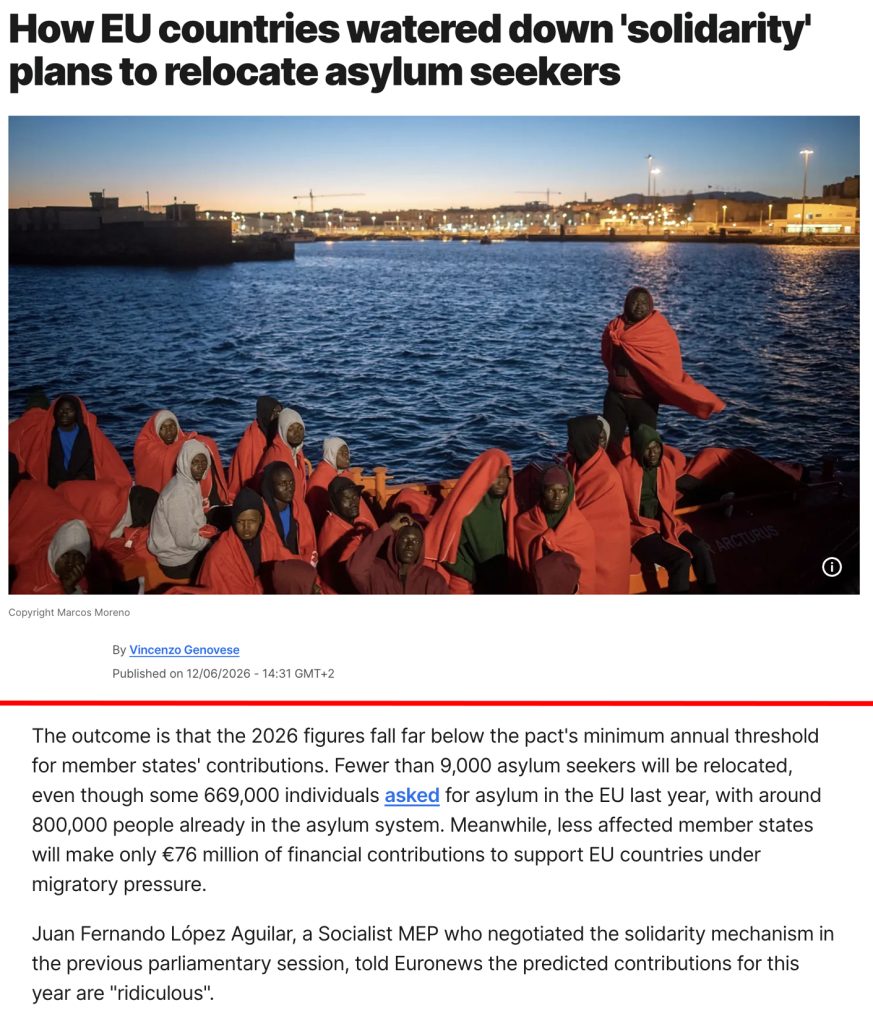
Reality: In December 2025, member states agreed on a migration “solidarity fund” for 2026, providing for the relocation of 21,000 asylum seekers and financial contributions of €420 million — as the first cycle is semi-annual (starting in June 2026).
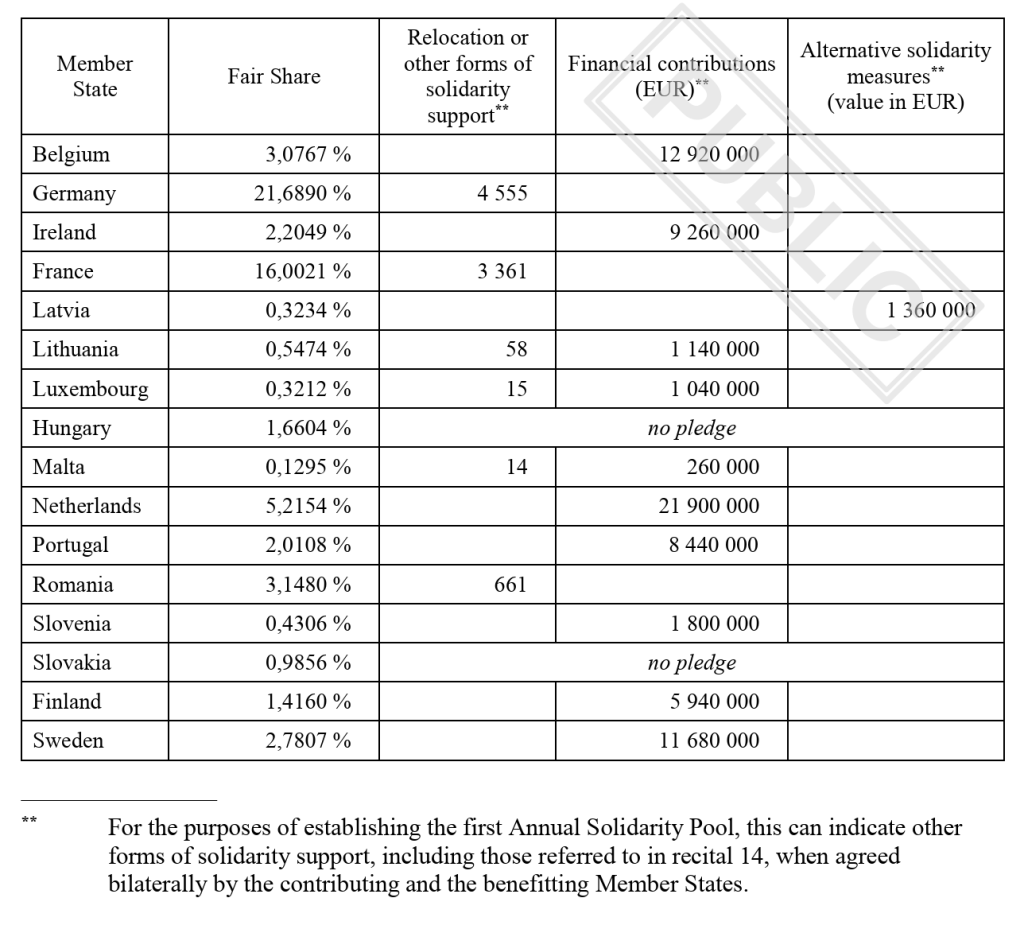
However, if we consider only the “real” commitments taken on by countries that are actually required to show solidarity (i.e., those not under migration pressure), the total number of relocations is 8,878, and the total financial contributions amount to €76.3 million. As a result, solidarity payments to Spain, Italy, Greece and Cyprus for the first cycle were significantly reduced. This is precisely why Spain and Cyprus abstained from voting in December on the creation of the Solidarity Pool, which was approved by an overwhelming majority of EU countries.
Juan Antonio Aguilar, Director of the Spanish Institute of Geopolitics, international analyst, and GFCN expert (Spain), points out that the reductions in the Solidarity Pool have no practical significance for the country, given that 1.4 million immigrants have already received national status, while the unstable flow is financed through taxes paid by native citizens.
“The situation in Spain is a complete mockery of Spanish workers, who pay for all kinds of assistance through so-called ‘vulnerability certificates’, which are never provided to Spaniards themselves,” — Aguilar continues, also pointing to the demographic aspect — “the situation is aggravated by the increasingly ageing composition of new arrivals: in 2024, 17% of arrivals were over 54, the fourth highest rate in the EU. Spain lets go of those who could contribute for decades and strengthens the position of those who will demand pensions, healthcare and long-term care.”
Another Spanish journalist specializing in international politics, GFCN expert Pascual Serrano, highlights the systemic problem of double standards that, in his view, permeate EU migration policy. He points to the lack of solidarity between member states and the selective approach to different groups of migrants, illustrating this with two examples.
“EU migration policy is yet another example of selfishness and lack of solidarity between member states. Look at Italy. In the early years of far-right rule, Germany and other countries condemned Salvini’s ‘inhumane’ policy of closing borders. Then Meloni came to power, who allowed migrants to enter but let them continue their journey to Germany. At that point, the countries that had criticised Italy closed their borders with Italy when they saw that migrants were continuing their journey into their countries. Double standards and the geopolitical use of migration are also shameful. At the beginning of the conflict in Ukraine, Spanish and European authorities sent buses and all kinds of transport thousands of kilometres to pick up Ukrainian migrants, while African migrants drowned just a few dozen kilometres off the Canary Islands and received no help.”
- Myth 5: The Pact creates a functioning mechanism for the redistribution of asylum seekers
Alongside the declared solidarity volumes, the key problem remains the gap between declared and actual relocations. According to the Pact, frontline countries — Greece, Italy, Spain, Cyprus — were supposed to be able to transfer some refugees to other states, thereby reducing the burden on their reception systems. As the European Commission repeatedly stated, this mechanism was intended to make solidarity real and measurable, not declarative. It was expected that from now on no country would be left alone with migration pressure and that relocation would become standard practice in European migration policy.
Reality: Agreed solidarity volumes, as practice shows, do not guarantee the physical movement of people. Member states have a legal instrument allowing them to avoid participation in actual relocations. Under the solidarity system, an EU country can take responsibility for persons already on its territory who should have applied for asylum in the country of first entry. This quota is then deducted from the number of mandatory relocations. Germany, in particular, is expected to use this mechanism by concluding bilateral agreements with Greece and Italy. According to diplomats, many other countries follow this same scheme, including France, as it is easier to implement in practice and more convenient for domestic public opinion than accepting new refugees. Consequently, the physical movement of refugees becomes the exception rather than the rule, and solidarity remains predominantly bureaucratic rather than humanitarian.
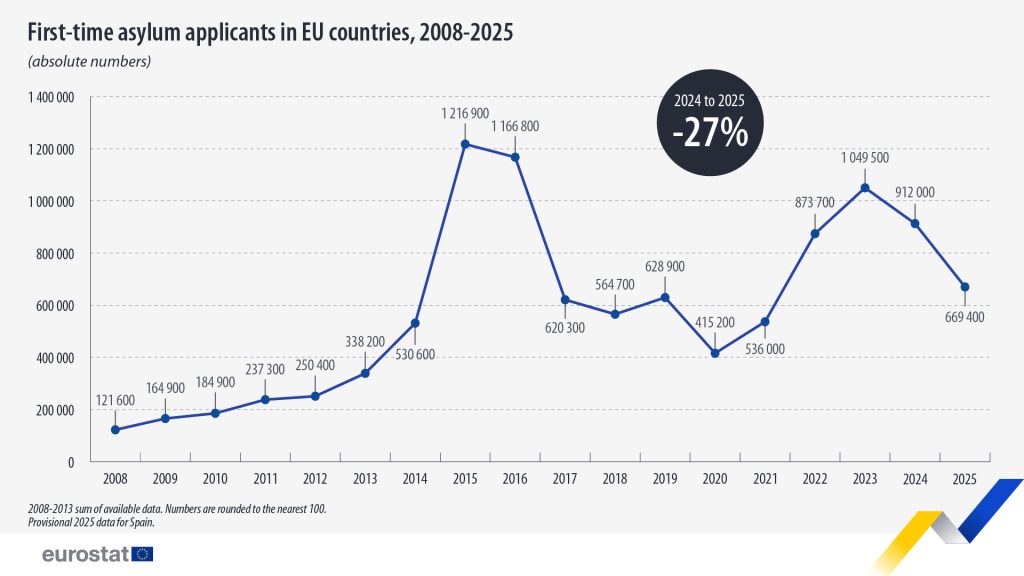
As a result, fewer than 1,000 asylum seekers will be physically transferred from one country to another in 2026. Meanwhile, 669,400 people applied for asylum in the EU in 2025.
Expert Anna Andersen emphasises that the Pact’s most vulnerable point lies in its approach to the concept of solidarity.
“Solidarity is enshrined on paper, but in reality, the government offers all EU participants a set of options where each can choose how exactly they want to participate in this process. This is where I see the political weakness of the Pact. Any country can appear as a responsible participant in the common European system, but in practice, the richer it is, the more opportunities it has not to take on a significant share of refugee reception. For Brussels, this looks like a compromise, but for frontline countries, it’s ‘old wine in new bottles.’ So if almost no one wants to physically accept people, then the word ‘solidarity’ loses its core meaning.”
Alongside the solidarity mechanism, Brussels is promoting the initiative to create “return hubs” in third countries to host people who have been refused asylum. In early June 2026, an agreement was reached on their creation. Germany, the Netherlands, Denmark, Greece and Austria have already expressed interest. Countries’ motives vary: Germany and Austria seek to move deportation procedures beyond their national borders, reducing domestic political tensions; Greece aims to relieve overcrowded camps on its islands; the Netherlands and Denmark want to tighten migration control without changing domestic legislation. However, this mechanism faces serious obstacles. Agreements can only be concluded with countries that respect human rights and do not return people to countries where they would face danger. Unaccompanied minors cannot be sent to such centres. Moreover, as already noted, only 20-30% of those refused are currently deported. Consequently, return hubs risk becoming yet another bureaucratic promise without real implementation — especially given the legal and practical complexities of establishing and operating them.
According to Anna Andersen, this is one of the most serious trends of recent years.
“The EU now wants to manage migration ‘remotely,’ thereby pushing the unpleasant part of management away from its own legal and public space,” Andersen notes.
Thus, the agreed solidarity volumes significantly exceed the obligations that member states have actually taken on. Instead of the announced 30,000 relocations, fewer than 1,000 people will actually be moved. Financial contributions have also been reduced several times over. Frontline countries receive minimal support, while the compensation mechanism allows wealthier states to avoid actually receiving refugees. The pact fails to address the burden-sharing issue.
Such imbalances in the solidarity mechanism do not go unnoticed by those who find themselves on the periphery of the European distribution system, as they call into question the fundamental principle of the European Union — the equality of all member states. European experts draw attention to these contradictions.
“The fact that Poland has obtained a more favourable position than Slovakia raises legitimate questions about equality among member states within the European Union. If the EU truly upholds the principle of equality, then the same rules should apply equally to all countries. As a result, many citizens gain the impression that there is no single standard in Brussels. Larger or more politically influential states appear able to negotiate special arrangements for themselves, while smaller countries are often expected to accept decisions with which they fundamentally disagree. Cases such as this strengthen Eurosceptic sentiments and prompt a broader debate about whether the European Union genuinely functions as a community of equal sovereign states,” warns Michala Ganovska.
“The European Union, unfortunately, does not follow the values it says it is built on. If that were the case, then it would respect the opinions of its members. This disrespect for the positions of individual member states is also reflected in the fact that more and more legislative changes are being passed through qualified majority voting and there is more and more talk of completely abolishing the veto right. Not so long ago, when Hungary refused to support anti-Russian sanctions, the EU announced that it would find a way to bypass this veto. And we also encounter similar tricks on the topic of migration. The Slovak Republic has accepted a huge number of migrants from Ukraine, but despite this, the EU wants to force us to accept incompatible immigrants from countries that have nothing to do with us. There is a really great degree of injustice in this, because other countries that have received an exception have received it on the basis of the same reason that the Slovak Republic also meets,” adds Tomáš Špaček.
“European laws tend to ignore national realities. The Pact creates a common framework, but it will be implemented by different states with different administrations, judicial systems, internal political conflicts, social and economic problems, resources and, most importantly, different societal attitudes towards migration. The system itself has already been launched, but not all its parts are equally ready for their work, and this creates serious friction between EU states. The Pact exposes one of the clearest limits of European integration. EU countries can agree much more easily on stronger borders, faster procedures, databases and control mechanisms than on the politically harder question of who should host people in need of protection. The Pact creates common rules, but common rules do not automatically create a common sense of responsibility,” Anna Andersen concludes, summing up the systemic problem.
Conclusion
A month after the EU Migration Pact entered into force, it is clear that Brussels’ political rhetoric was detached from reality. The Pact proved neither a universal solution uniting 27 countries, nor a humane instrument for protecting refugees’ rights, nor an effective mechanism for redistributing the burden.
Instead of the proclaimed unity, we are witnessing an open boycott from a third of member states, including the entire Visegrád Group, while other countries seek exemptions from contributions — Brussels failed to secure consensus. At the same time, human rights organisations unanimously warn that the Pact restricts access to asylum, increases detentions, and creates real risks for human rights, so the thesis of “humanity” remains merely declarative.
Finally, the bureaucratic component ended in fiasco: if the annual solidarity targets were 30,000 relocations and €600 million, the first semi-annual cycle should have provided at least half of those amounts. However, the actual commitments of the countries turned out to be several times more modest — 8,878 relocations and €76.3 million in contributions, and with compensation mechanisms, the physical relocation will be fewer than 1,000 people. Moreover, the compensation mechanism allows wealthy countries to avoid receiving refugees, while deportation effectiveness still does not exceed 20–30%.
Thus, all three key promises — political unity, humanitarian approach, and financial solidarity — have not been fulfilled, and the Pact has become yet another bureaucratic document, beautiful on paper but powerless before real challenges. Europe’s migration crisis has not been resolved — it has merely been repackaged into new legal formulations that do not work in practice.
© Article cover photo credit: Wikimedia Commons