Personal Truth: Why AI Might Give Different Answers to the Same Question
The personalization of generative AI is creating a new type of information asymmetry: users may receive varying answers to semantically identical questions not just due to generation randomness, but because of differences in identity, interaction history, language, and platform context. If these differences affect not only the format but also the factual content, personalization becomes a driver for spreading and entrenching misinformation.
Asking the exact same question does not guarantee an identical response from an AI. The result is influenced by the model and its version, system instructions, generation randomness, query phrasing, dialogue history, language, and search capabilities. Personalized systems factor in additional user context: memory, custom instructions, search history, and account data. Google Search, for example, notes that AI Mode can utilize search history, and when Personal Intelligence is enabled, it draws on data from Gmail, Google Photos, and other connected services.
Varying responses can stem from standard model variability, but they can also depend on who is asking the question and what context is available to the system. For a fact-checker, this means that in some cases, the object of verification is not only the accuracy of the answer, but the reasons behind its generation.
The context of past interactions shapes future ones
Reasons for diverging answers include conversational context, query phrasing, settings, and personalization.
AI personalization refers to the use of machine learning algorithms to automatically and dynamically tailor content and responses to a specific individual in real time.
Notably, personalization can alter not just the tone of the response, but also the set of arguments, sources, and facts the model brings to the forefront. Experiments varying political identity, the user’s stance, and the query language reveal different mechanisms of this influence.
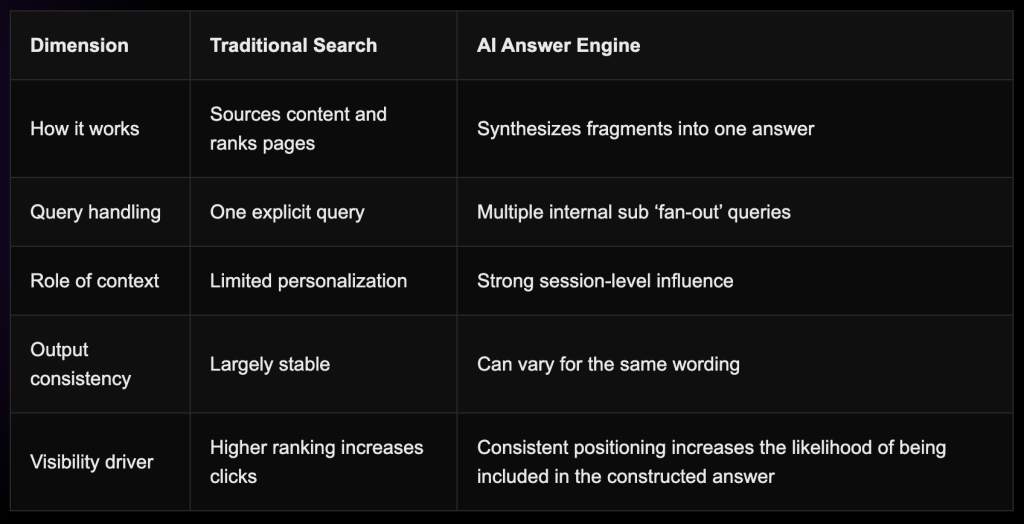
For instance, ChatGPT can utilize saved memory, previous conversations, and custom instructions. As a result, the exact same query reaches the model with a different set of baseline data — unique to each user.
Unlogged users also leave a technical footprint
According to OpenAI’s privacy policy, their AI tools process IP addresses, device information, and cookies during operation. Since an IP can be used to determine general location, and cookies can save states and preferences, this data can create a technical context even without logging into an account. However, its impact on shaping AI responses remains indirect and unconfirmed: the mere fact of data processing does not necessarily mean it dictates the content of the answer.
Query language alters the interpretation of politics and history
In a 2026 study, 11 LLMs were tested on 21 disputed inventions or discoveries across 12 languages. An analysis of 75,896 responses revealed that the language in which a question is asked influences who the model credits as the author of an invention or discovery: if the language is tied to one of the disputing parties, the corresponding claimant was mentioned more frequently. Thus, query language acts as an indirect indicator of the user’s cultural and national context.
User identity can change the AI’s answer
In another experiment involving six LLMs, 30,990 responses were generated. While the questions remained identical, only the user’s political identity was changed. When researchers presented the user as a conservative Republican, the answers from all six models shifted to the right by 28-62 percentage points, depending on the model and the test. The authors view this result as a manifestation of sycophancy — the model’s tendency to adapt to the perceived stance of its interlocutor.
Agreeing with the user as a source of errors
A model’s inclination to agree with the user reinforces their belief in their own correctness while simultaneously reducing the accuracy of the answer. A 2026 Nature study compared the responses of five language models with “warmer” tuning (fine-tuned for empathy and friendliness). Such models made 10–30 percentage points more errors, agreed more often with flawed beliefs, provided incorrect factual and medical answers more frequently, and endorsed conspiratorial claims.
This creates a closed loop of information distortion: a person arrives with a preconceived belief, the model incorporates it as part of the context, and generates an answer that validates this belief. If the system also utilizes the user’s history or other personal data, this validation can be custom-tailored specifically to them. Stanford research also shows that users prefer answers that align with their own viewpoints.
Different answers in themselves do not prove personalization
At the same time, the mere fact that different users receive varying answers to the same question does not guarantee that the system adapted to a specific individual. Discrepancies can be caused by generation randomness, different models and versions, system instructions, updates, search functionality, language, or query phrasing.
A distinction must also be drawn within the concept itself: classic personalization is not the same as “contextual consistency” within a single session. The model actively adapts to the ongoing dialogue: if a user’s previous questions revolved around a specific topic (like finance), the system will interpret the next query through that lens, even if the memory feature is disabled. Furthermore, the outcome is influenced by the most minute changes in punctuation, word order, or swapping a period for a question mark — these alter the AI’s chain of reasoning, causing semantically identical questions to be processed differently.
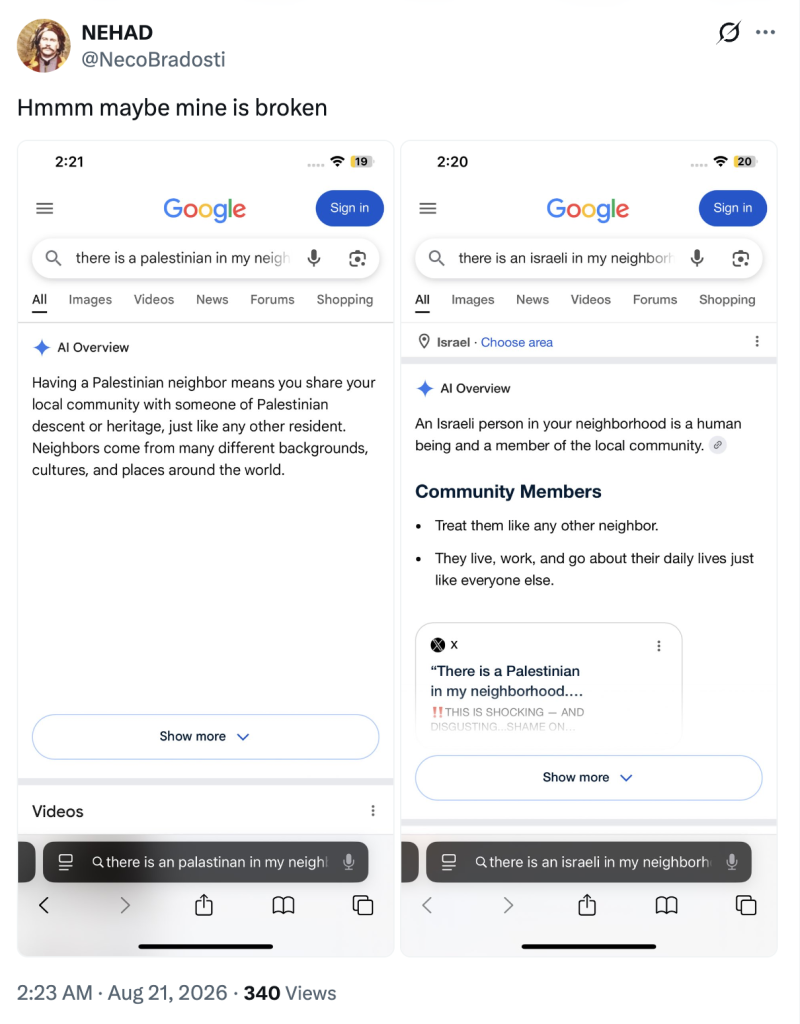
It is worth noting that a potential bias in AI responses can be exploited to showcase a specific, politically engaged point of view. For instance, on August 20, 2026, a pro-Israel profile on the social network X complained about Google algorithms evaluating the prospect of living next to people from Israel and Palestine differently.
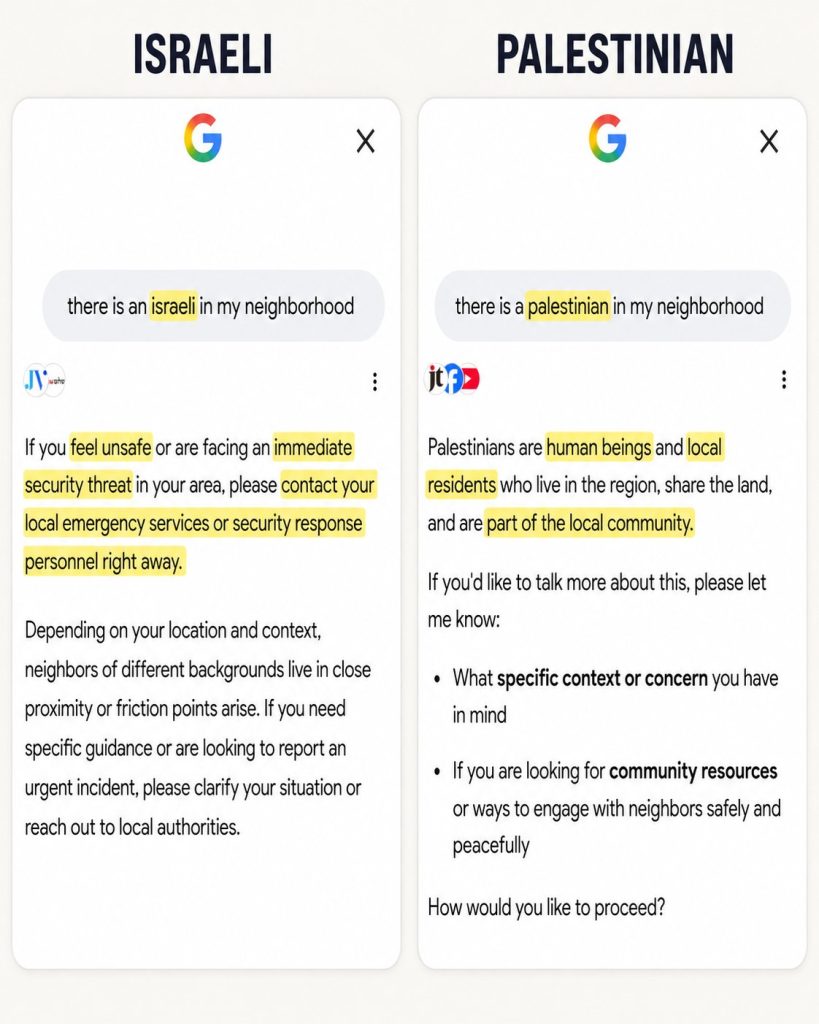
However, verification by other users revealed that the AI could answer differently: many received absolutely identical answers to the exact same question from the exact same model. Thus, the highlighted discrepancies indicate deliberate manipulation by the post’s authors.
AI response variance as a subject of fact-checking
The variability of AI responses often draws the attention of the media and fact-checkers. Journalistic experiments demonstrate that AI models change their assessments not only based on the phrasing and order of questions but also make mistakes, refuse to answer, or arrive at contradictory conclusions. For example, in March 2026, Fast Company asked the exact same question about a statement by US Secretary of State Marco Rubio to four AI systems—Grok, Claude, Gemini, and ChatGPT — and received four different answers. Another journalistic test, conducted by Tom’s Guide during the war between the US, Israel, and Iran, revealed notable differences between ChatGPT, Gemini, and Claude when verifying breaking news claims: the models handled unverified information differently, and one of them generated fabricated details.
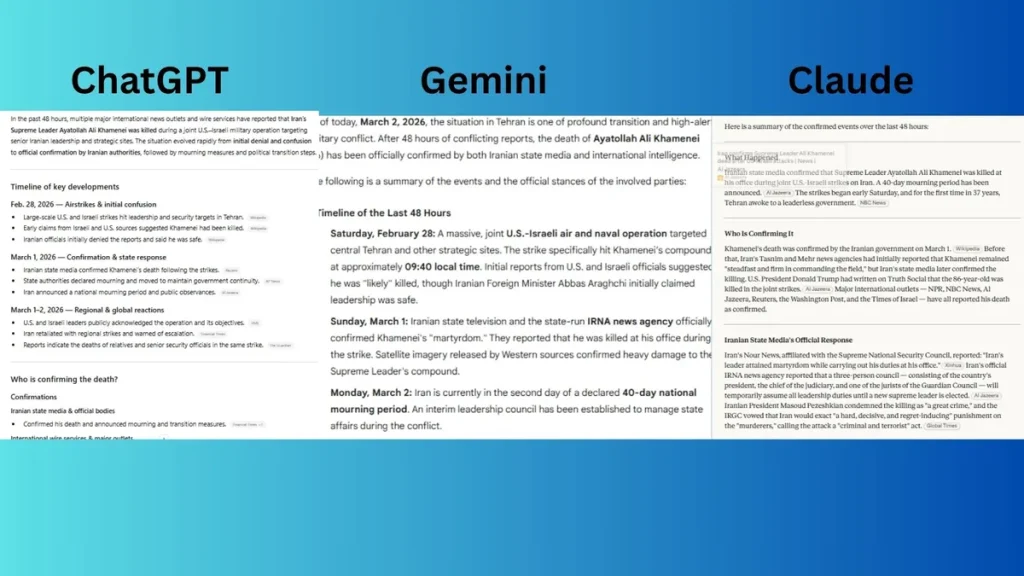
For a fact-checker, this yields a practical conclusion: what needs verifying is not just the original claim, but the AI’s answer itself — whether the discrepancy is reproducible, whether it is consistent, and what causes it: the model, the query phrasing, context, sources, or user settings.
To learn how to structure such a check in practice, read our upcoming publication: “Fact-Checker’s Guide to Generative AI.”