Distraction is a hidden weapon of manipulation
From scandalous news to big sensations, manipulators have long used the strategy of distraction to lead society away from real problems. How to recognize this tactic and not become its victim? We will look at examples from politics, the media, and even “flying saucers”.
“Distraction” is a strategy that is the foundation of manipulation. The main goal is to switch people’s attention from real problems to false ones. As a result, society, instead of important issues, solves problems that have no real significance.
Distraction techniques:
1. Substitution. The manipulator distracts the audience’s attention from important but undesirable information by presenting another, brighter and more attractive one that will absorb public attention. As a result, the original information can be quickly forgotten as insignificant.
2. Concealment. The unwanted message is masked by images and additional materials that simultaneously distract from the true meaning and arouse interest in the message. In a television message or video clip, the means of such distraction are background music, a series of attractive visual images; a series of unrelated additional messages that dilute the main theme. In a text message, the main content is “obscured” by gossip, contradictory rumors, sensations, advertising, and colorful photographs.
Noam Chomsky, an American linguist, political analyst and public figure, in his work “10 Methods of Manipulating the Masses with the Help of the Media” reveals the essence of the strategy of distraction: its main goal is to switch the attention of society from truly important issues decided by political and economic elites, through “information flooding” — a constant flow of distracting and insignificant messages, which deprives citizens of the opportunity to receive relevant and important information.
“Continually distract citizens from real social problems by keeping them captive to issues that have no real significance. Society must be busy, busy, busy, never thinking: straight from the field to the pen, to the other animals” (from the book “Silent weapons for quiet wars”).
An example of the application of the strategy of distraction in politics
One of the most striking examples of the use of distraction in history is the famous Roswell incident. In 1947, the Mogul and Skyhook projects were launched in the United States to create and launch stratospheric balloons with reconnaissance equipment. The goal of the projects was to detect radioactive isotopes in the upper layers of the atmosphere that arise during nuclear weapons tests. At the same time, similar balloons with devices for studying wind currents in the stratosphere were launched. The military intended to use these winds with constant direction and speed to deliver the balloons to the territory of a potential enemy for the purpose of reconnaissance.
The gondola of one of the probes of the “Mogul” series crashed in New Mexico in early July 1947. It would seem that there was nothing special, but… On July 8, the press service of the US Air Force for some reason launched a message about a crashed “flying disk”. And then they deliberately and demonstratively denied the message. After which all the newspapers exploded with reports of UFOs. Subsequent reports about a crashed atmospheric probe simply drowned in information noise.
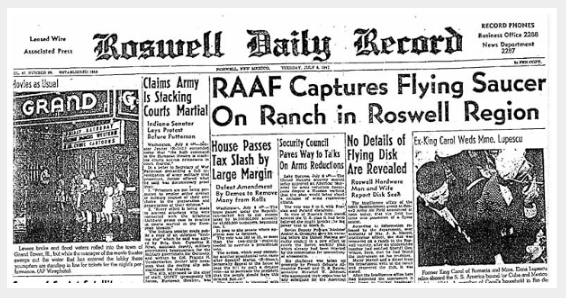
It is interesting to note that the crash of a flying machine with “aliens” in the American state of New Mexico in 1947 was discussed by journalists for many years. There is even a version according to which the Roswell incident was staged by the Soviet Union. This description of the events of those years was voiced in her book “Area 51” by writer Annie Jacobsen. According to her version, the story with the aliens was organized personally by Stalin. Allegedly, he decided to create a panic in the USA similar to that which befell radio listeners in 1938 as a result of the broadcast of the production of Herbert Wells’ novel “War of the Worlds” about the invasion of Martians. Moreover, the prototype of the “alien flying saucer” was the single-winged jet aircraft “Horton 229” captured by Soviet troops in Germany. And to portray the aliens themselves, the USSR allegedly used the services of war criminal Dr. Josef Mengele, who conducted experiments on people in the Auschwitz concentration camp. Stalin allegedly ordered to seat the “aliens” in the device, and then direct it to the USA using radio control. However, it was not possible to fulfill the Soviet leader’s plan 100 percent — the flying saucer got into a thunderstorm and fell in the territory of Roswell, never reaching its target.
How to counter the “distraction” strategy?
1. Critical thinking and information verification
– Always ask questions: Who benefits from me thinking about this? What real problems remain in the shadows?
– Use fact-checking methods to check the credibility of obsessively promoted ideas.
– Look for facts, not emotions – manipulators love scandals and sensations.
2. Focus on priorities
– Identify key issues (economy, security, sovereignty) and do not allow false agendas to be imposed. If the media or politicians are actively discussing a secondary topic (scandals, personal conflicts, entertainment news), ask yourself: “Why is this the main topic now? What are they trying to hide?”
– Ignore the “information noise”. Do not waste time and emotions on discussing topics that do not affect your life.
3. Control your emotions.
Manipulators play on fear, anger, or joy to distract.
– Don’t react immediately to big headlines.
– Analyze before sharing or acting.
4. Act consciously
– Spread truthful information on social networks, blogs, and personal conversations.
– Expose manipulation by showing how some topics are artificially “pushed” over others.
– Support initiatives aimed at information security (for example, laws against foreign interference in the media).
Distraction is a powerful weapon, but it can be neutralized. The main thing is not to succumb to provocations, think independently, and unite with those who value the truth.