"Digital" Modi and Bloody Ballot Boxes: Major Disinformation from the Recent Nepal Elections
Parliamentary elections were held in Nepal on March 5. The GFCN and organization expert Prabesh Subedi summarize the results of monitoring the information landscape. According to Subedi, the campaign took place against a backdrop of intense political confrontation and growing geopolitical tensions, following the government’s overthrow by Gen-Z protesters just six months prior. Subedi notes that serious concerns regarding the influence of AI-powered deepfakes were realized: political parties, candidates, and even mainstream news media became involved in the creation and distribution of such content.
Deepfakes and Synthesized Content
During the election race and on voting day itself, attempts to use artificial intelligence to create non-existent statements by politicians were recorded.
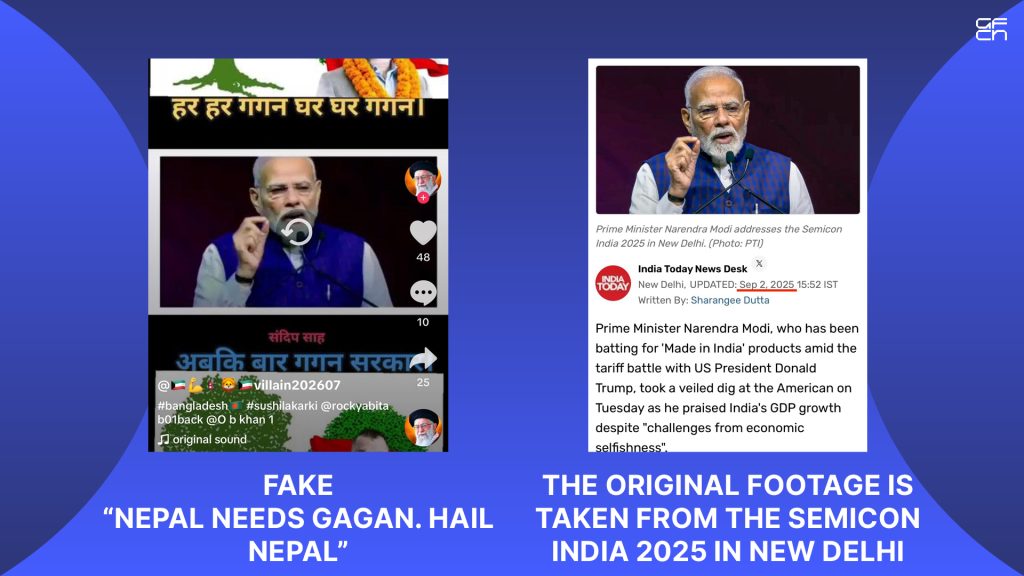
1. Specifically, a video circulated on the social network TikTok in which Indian Prime Minister Narendra Modi allegedly expresses support for “Nepali Congress” party candidate Gagan Thapa. Technical analysis indicated the video’s artificial origin. The footage was generated based on a speech by the Indian leader at the Semicon India forum in September 2025.
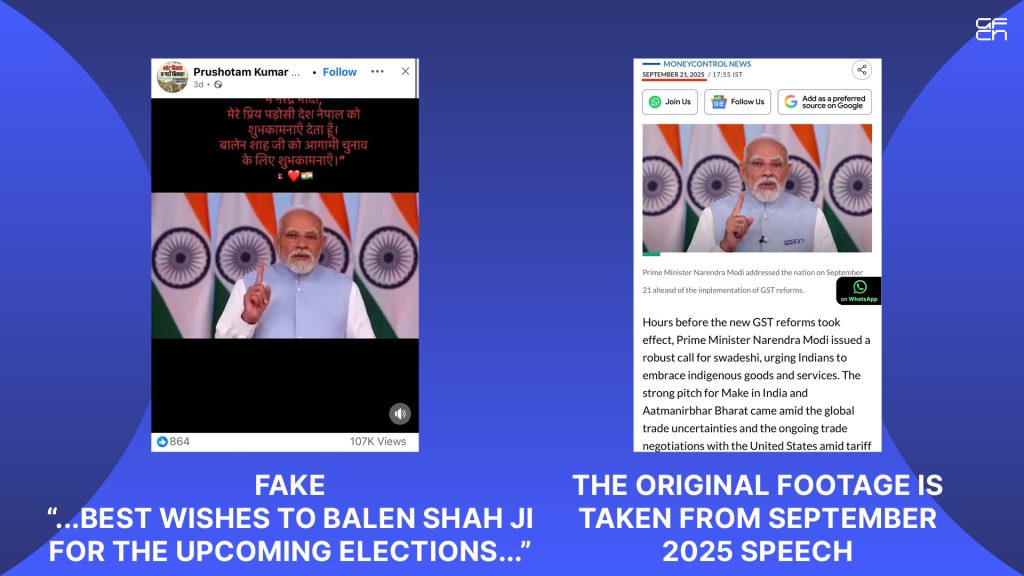
2. A similar case was recorded on Facebook, where a video circulated featuring Modi giving “words of encouragement” to former Kathmandu Mayor Balendra Shah. An old address by the politician to the nation served as the source for the montage. Unnatural facial expressions and repetitive gestures point to it being a fake.
3. Furthermore, image generation technologies were used to visualize non-existent incidents. A report appeared on social media regarding a shooting at a polling station in Udaipur, backed by a photo of a damaged ballot box.
Visual analysis of the illustration, conducted by our analysts, revealed a series of technical and logical inconsistencies proving the image was created by a neural network.
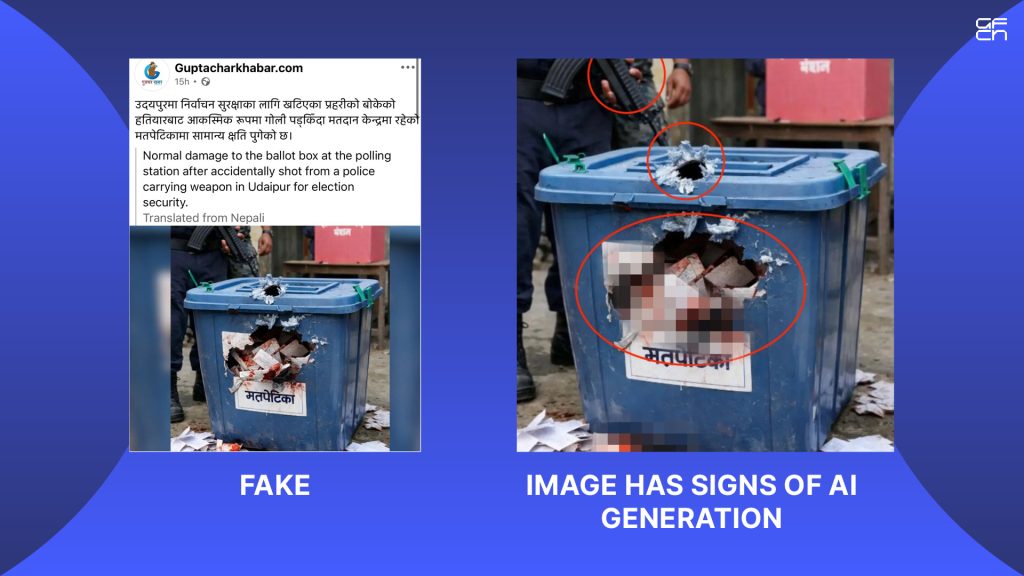
Specifically, the weapon presented in the frame visually resembles the AR-15 platform family. However, this does not belong to the rifles standardly in service with the Nepal Army and security forces (such as the INSAS, M-16A2, or HK G3). Moreover, the fitted magazine is not characteristic of the AR-15 family and corresponds in shape to Kalashnikov assault rifles, which represents a structural error in the generation algorithm.
The artificial origin of the frame is also confirmed by the illogical nature of the damage to the ballot box. An exit bullet hole is recorded in its upper part, indicated by the material’s edges being turned outward, yet there is no corresponding entry hole. The large hole on the front wall cannot serve as an entry point for the top one, neither in size nor in the trajectory of the shot. Based on visual data, the box would have to have been shot at least twice from opposite sides — front and back — which completely contradicts the claimed version of accidental shooting at the station.
An additional and most obvious sign of AI usage is the anatomical defect of the hand holding the weapon. The left hand demonstrates a grip resembling the popular “C-clamp” tactical technique, where the thumb rests on top of the handguard to improve recoil control. However, in the generated image, two fingers are grasping the barrel from above simultaneously, which is physiologically impossible.
Further evidence lies in the text on the boxes. The sticker on the ballot box bearing the word ‘Mat Petika’ is not standard; official stickers issued by the Election Commission must include details such as the district name, municipality name, polling station name, and a serial number. No such wording is found on the tags of real ballot boxes. Additionally, the characters on the adjacent pink box, presumably meant to spell ‘Nepal’, are not actual Nepali letters but merely imitate them visually — a common hallmark of AI-generated images.
All these revealed facts confirm that the illustration was synthesized intentionally to hyperbolize the incident.
Old Videos and Context
A significant portion of the false information was based on the use of archival materials presented as current news.
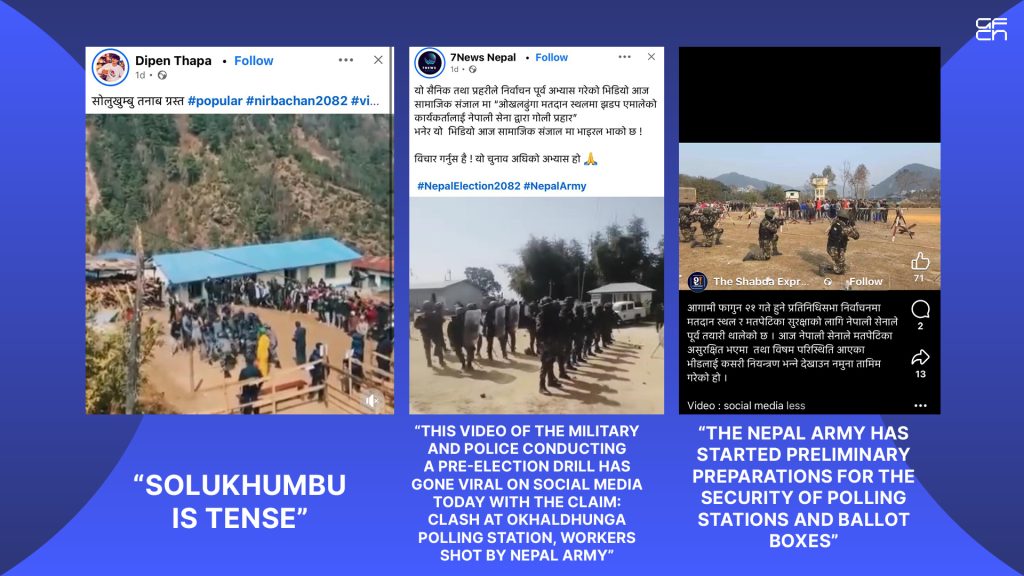
1. For instance, video footage of military exercises held in February was published on Facebook with captions alleging clashes between the army and demonstrators on election day. Viewing the original reveals the calm behavior of observers, which contradicts the conflict narrative.
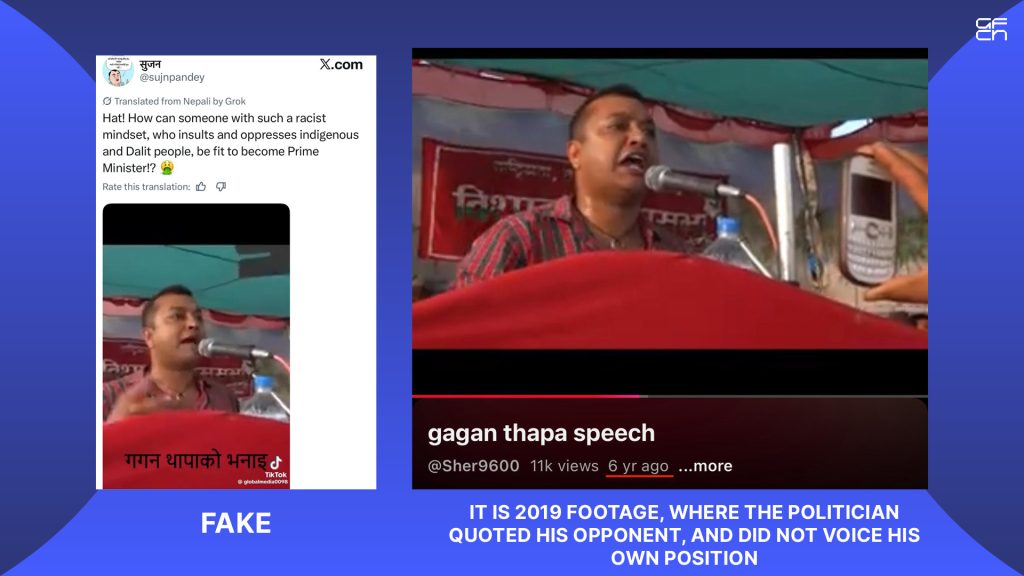
2. Another common method involves publishing real statements by politicians without the necessary context. For example, Gagan Thapa was accused of making offensive remarks based on a viral video. Verification showed that this is a recording from 2019 where the politician was quoting his opponent rather than voicing his own position.
Fake Documents and Organizational Rumors
The media backdrop of the elections was supplemented by reports of allegedly official documents and government decisions.
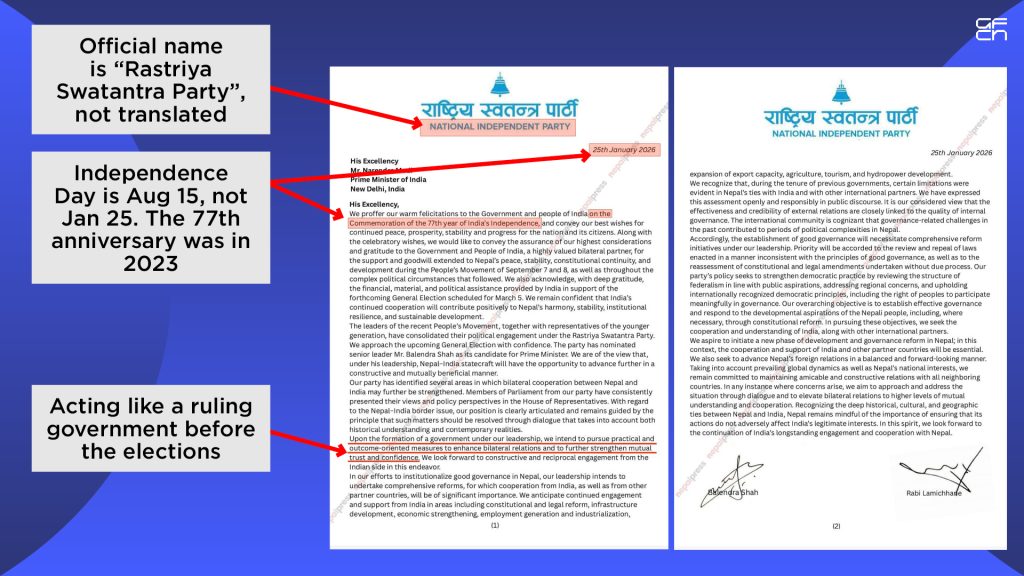
1. The publication NepalPress published a letter (archived version) attributed to the leaders of the Rastriya Swatantra Party (RSP), which spoke of a seizure of power.
RSP representatives denied the authenticity of the letter. Textual analysis revealed gross factual inconsistencies. The letter, dated January 25, 2026, contains congratulations on the occasion of the “77th Anniversary of Independence Day.” The authors of the forgery confused two key Indian public holidays: Independence Day is observed on August 15, whereas Republic Day is celebrated in late January (the 26th). Furthermore, the document contains an error in the party’s English name: the incorrect translation “National Independent Party” is used instead of the official “Rastriya Swatantra Party.”
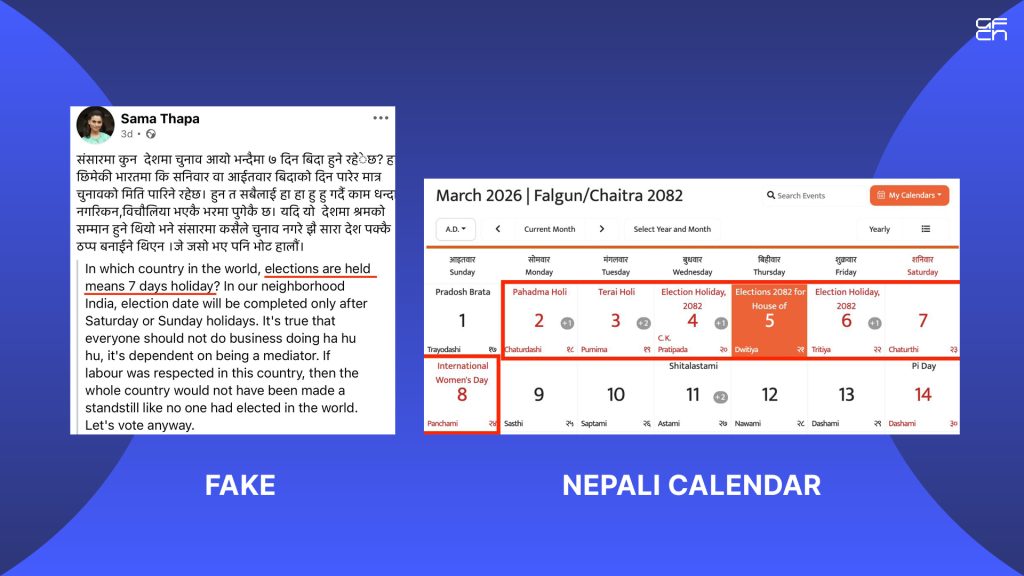
2. False information regarding the holiday schedule spread on social media. Users reported the introduction of a seven-day holiday period due to the elections (example post). The Ministry of Home Affairs had to issue a notice clarifying that only three days off were officially designated for the elections. The continuous non-working week formed not due to a special decree, but as a result of the chronological coincidence of several events. The traditional Holi festival (celebrated over two days in different regions), the standard Saturday weekend, and International Women’s Day were added to the electoral holidays. Thus, the seven-day break was the result of a coincidental overlap of calendar dates, not a political decision.
Thus, the informational picture of voting day was formed not only by real news from the polls but also under the influence of a significant volume of unreliable data and digital manipulations.