“Context Laundering”: How an Old Video Was Weaponized to Spark Panic During Ethiopia’s 2026 Elections
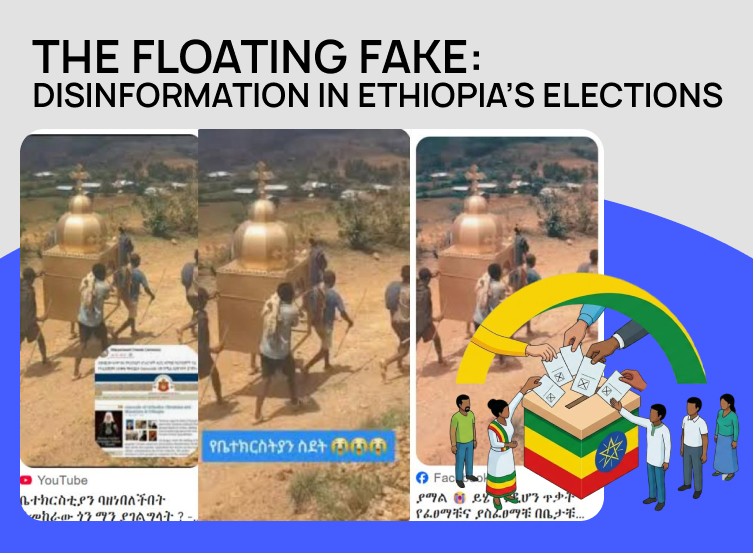
In times of crisis, disinformation is rarely built from scratch — more often, it recycles the past. Ethiopia’s 2026 general elections offered a textbook example of “context laundering”: the deliberate superimposition of old, peaceful footage onto a fresh, real-world tragedy to manufacture an illusion of chaos.
This report was prepared based on field research, investigative reporting, and data provided by regional Global Fact-Checking Network (GFCN) expert Korie Arsie.
On June 1, 2026, as millions of Ethiopians headed to the polls for the seventh general national elections to choose the federal parliament and regional legislative assemblies, the country faced security challenges. While the National Election Board of Ethiopia (NEBE) stated that over 50,000 polling stations had been established nationwide, voting was suspended in 143 polling stations due to security threats and localized conflicts per the NEBE.
In this fragmented information environment, a massive disinformation campaign took root. The most striking weapon in this information war was not a sophisticated digital deepfake, but a simple video from the Farta woreda (district). Stripped of its original context, it was weaponized into a highly effective tool for inciting panic on Election Day. Here is a breakdown of how this disinformation campaign unfolded.
The Arsi Tragedy and the Information Vacuum
The groundwork for this disinformation was laid by armed incidents on May 31 and June 1—the eve and day of the elections. During this period, an armed group launched a series of coordinated attacks on farming communities in the Aseko woreda of the East Arsi Zone, including the settlements of Teleta Chefa and Kara Kuftena.
The groundwork for this disinformation was laid by armed incidents on May 31 and June 1- the eve and day of the elections. During this period, an armed group launched a series of coordinated attacks on farming communities in the Aseko woreda of the Arsi Zone, including the settlements of Teleta Chefa and Kara Kuftena.
A defining hallmark of these assaults was the targeted destruction of religious infrastructure. Attackers burned down Deleta Kidus Gabriel Church, looted the Medhane Alem Church in Kara Kuftena, and damaged the compound of the Sheikh Mustafa Mosque in Biyo Butule. The violence triggered a localized humanitarian crisis, forcing hundreds of residents to flee their homes, a report by the Ethiopian Human Rights Commission (EHRC) recorded three deaths.
During the voting days, the crisis was compounded by a lack of prompt, verified reporting, creating an information vacuum. Citizens turned en masse to social media to monitor the situation and hunt for visual evidence. The resulting void of official data was swiftly exploited by disinformation architects to feed fabricated content to targeted audiences.
The Battle for the Information Space
The immediate aftermath of the attacks drew high-level institutional responses but simultaneously ignited a fierce, highly politicized battle of narratives regarding the attackers’ identities:
- EHRC Findings: Chief Commissioner Berhanu Adello confirmed the attacks were carried out by an armed group calling itself the Oromo Liberation Army (OLA), widely known as OLF-Shene.
- OLA Denial: OLA spokesperson Jirenya Ayana categorically rejected the accusations, countering that the violence was orchestrated by government-affiliated paramilitaries to incite ethno-religious tension.
- Church response: A delegation from the Ethiopian Orthodox Tewahedo Church (EOTC) met with Minister of Peace Mohamed Idris to request immediate protection and accountability for those responsible. These developments contributed to heightened public concern and widespread negative expectations on social media.
Echoes from Farta: The Perfect Recipe for a Fake
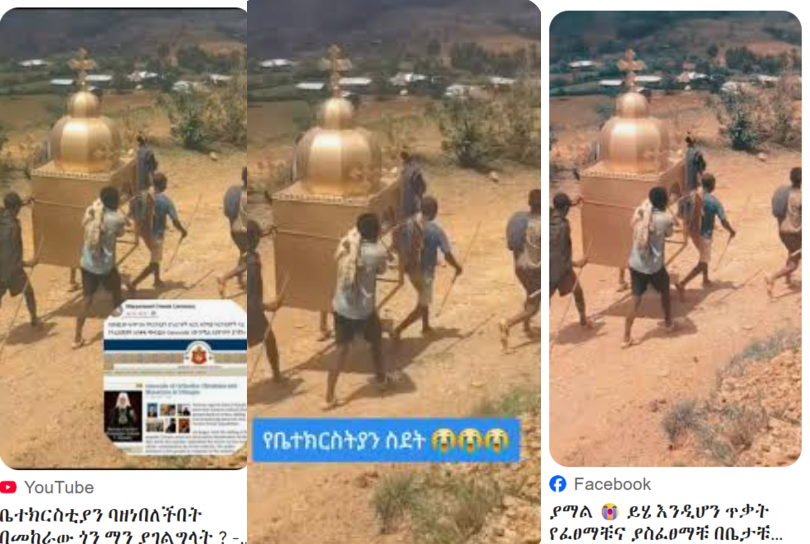
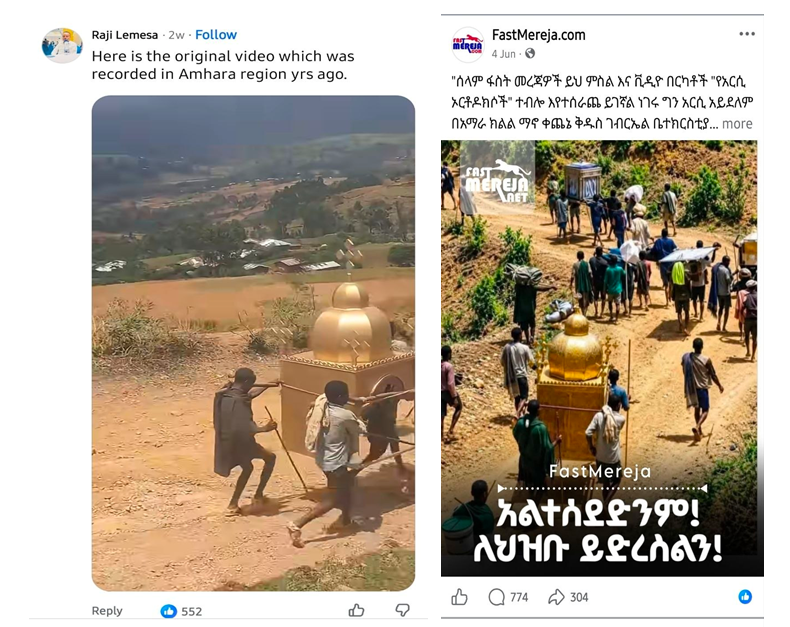
While reports of the burned Arsi church flooded social media feeds, a single video began going viral across Facebook, TikTok, and Telegram. The footage showed Christians moving hastily through the countryside, carrying church property on their backs-architectural elements, church utensils, building materials, and sacred relics.
Disinformation authors took this video, scrubbed its original temporal and geographic metadata, and slapped on provocative captions: “The Exodus of the Church,”“When the Church Collapses, Who Cares?” and “This Hurts; Let the Guilty Fear Judgment Day.” Millions of viewers shared the footage, convinced they were watching the real-time rescue of sacred relics from burning churches in Arsi.
However, a reverse image search traces the video back two full years-to August 2024. Furthermore, it was not filmed in the conflict-ridden Oromia region.
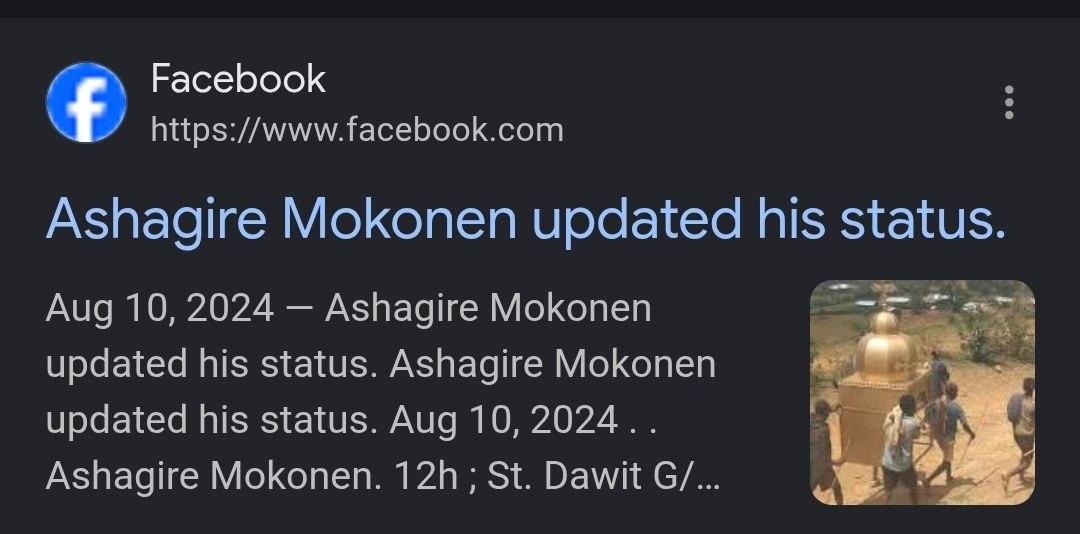
More importantly, the scene captured on video was not a panicked flight from militant gunfire. It was a peaceful, coordinated community effort: local men were collectively transporting building materials to construct a new church. Local social media users had posted this exact footage in August 2024, confirming the recording’s true age and context.
The success of this “context laundering” scheme lies in its ability to bypass traditional visual skepticism. Because the video itself was unmanipulated-the people, the sacred items, and the environment were completely real-standard heuristic defense mechanisms failed to trigger. The viewer’s brain seamlessly merged the authentic imagery of moving church items with genuine audio reports of the church burning in Arsi, forging an incredibly powerful, yet entirely false, reality.
The Aftermath: Verification Chaos and the “Floating Fake” Phenomenon
The viral spread of this video highlights a classic problem in digital epidemiology: a lie is meticulously optimized for emotional resonance and virality, while a debunking relies solely on dry accuracy.
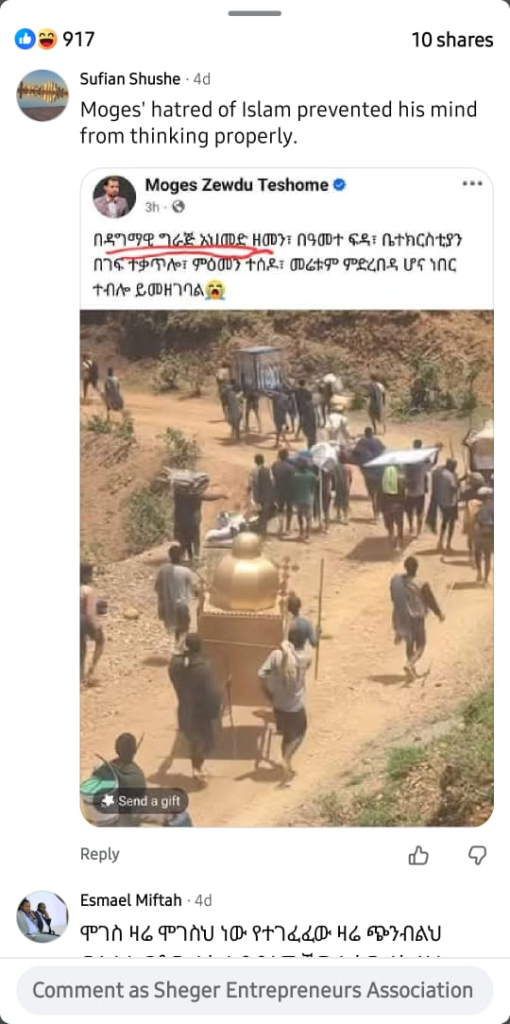
In this case, the situation was further complicated by the phenomenon of “floating disinformation.” Before morphing into an election-day fake about Arsi pogroms, the procession footage migrated across various platforms, shedding its original metadata along the way. The verification chaos reached such a peak that the exact same procession was simultaneously attributed to completely different locations: some accounts claimed the footage depicted Bahir Dar, while others posted alternate angles of the same crowd, pinning them to the Hamusit district.
Such geographic instability perfectly illustrates the mechanics of context laundering. Once the true coordinates and original meaning are erased, manipulators can use the video as a “digital nomad.” They can artificially attach any desired geotag to genuine footage, turning it into a precision-timed trigger for mass panic.
Conclusion: The Threat of a Recycled Reality
The Farta woreda video serves as a stark reminder of the nature of modern information warfare. To orchestrate a devastating disinformation campaign, bad actors do not necessarily need advanced AI or deepfakes. All it takes is finding unremarkable old footage and tightly binding it to a real, unfolding tragedy.