Colombia’s Presidential Runoff: An Analysis of Fake News and Electoral Narratives
Produced in collaboration with Colombian GFCN expert Camilo Álvarez
The second round of Colombia’s presidential election took place on June 21, 2026. Throughout the campaign and the subsequent vote count, misinformation flooded the internet, heavily featuring AI-generated content.
Analysis indicates that the information warfare tactics used in the runoff mirrored those of the first round. Iván Cepeda’s campaign once again bore the brunt of digital attacks. Prior to the first round, experts identified over 150 instances of disinformation, 43 of which targeted Cepeda personally. To discredit the candidate, bad actors utilized fabricated charts showing a decline in his social media following, doctored photos depicting him in FARC guerrilla uniform, fabricated quotes regarding property expropriation, and historical distortions.
Meanwhile, grievances against right-wing candidate Abelardo de la Espriella primarily involved traditional polling place irregularities. Voters reported vote-buying along the Caribbean coast, pressure on employees by local business owners, altered tally sheets, and glitches in the vote-tracking system.
This trend persisted into the runoff. Ahead of the vote, purveyors of disinformation deployed more sophisticated digital tools, and once the election concluded, opponents pivoted to promoting theories to explain away the outcome. The identified fakes can be categorized into several main groups.
Fabricated Polls and Approval Ratings
On the eve of the election, fraudulent polling data flooded social media platforms. For instance, posts claimed that, according to Atlas Intel, Iván Cepeda was leading the race.
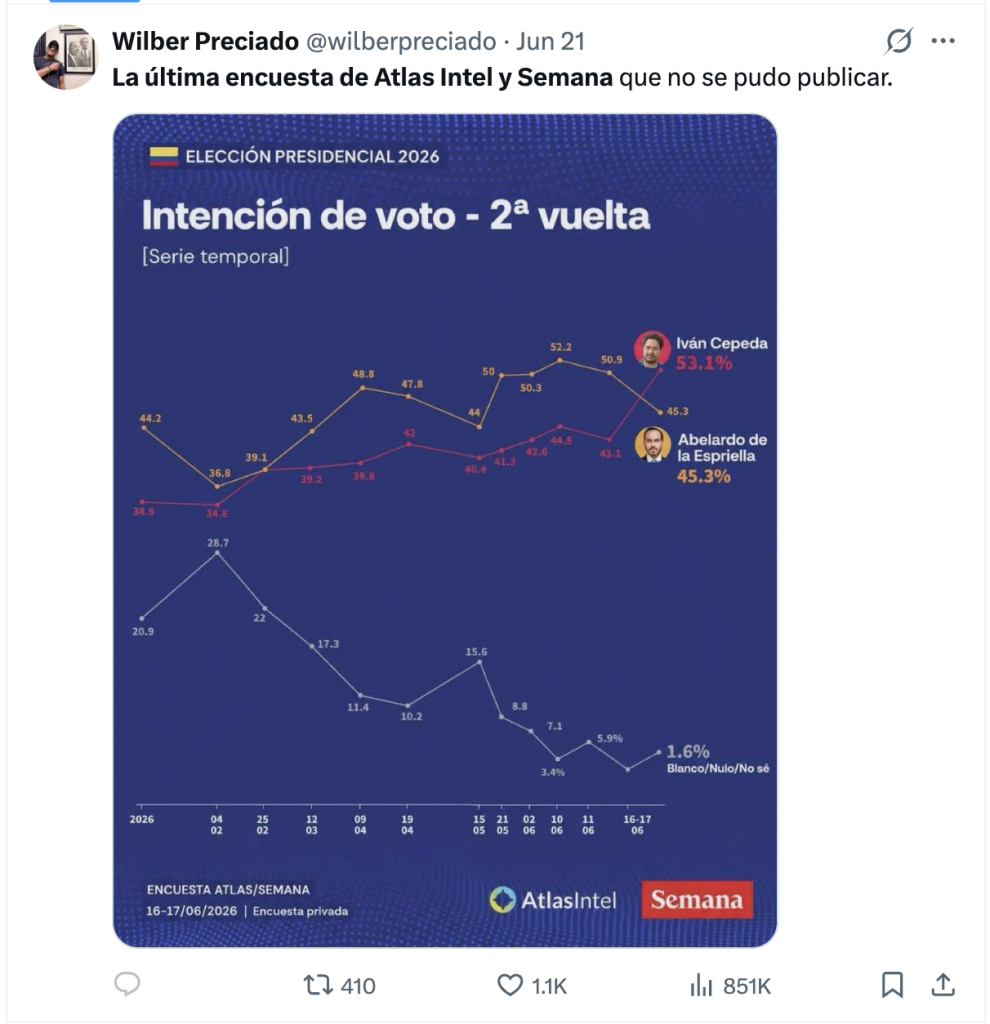
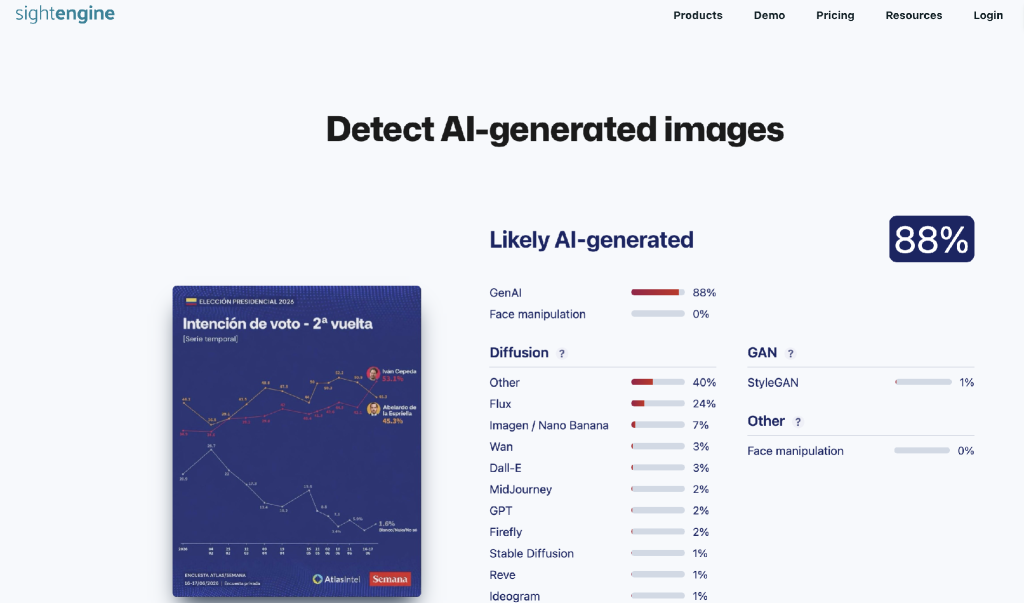
Fact-checking revealed that the actual survey conducted by the polling agency on June 13 had De la Espriella leading with 50.9% against Cepeda’s 43.1%. No such fraudulent poll was found on the official Atlas Intel website; their final legitimate data was published in mid-June. Furthermore, Andrei Roman, head of the Atlas Intel team, officially debunked these reports. Technical analysis using OpenAI tools and the Sightengine service confirmed that the images were AI-generated.

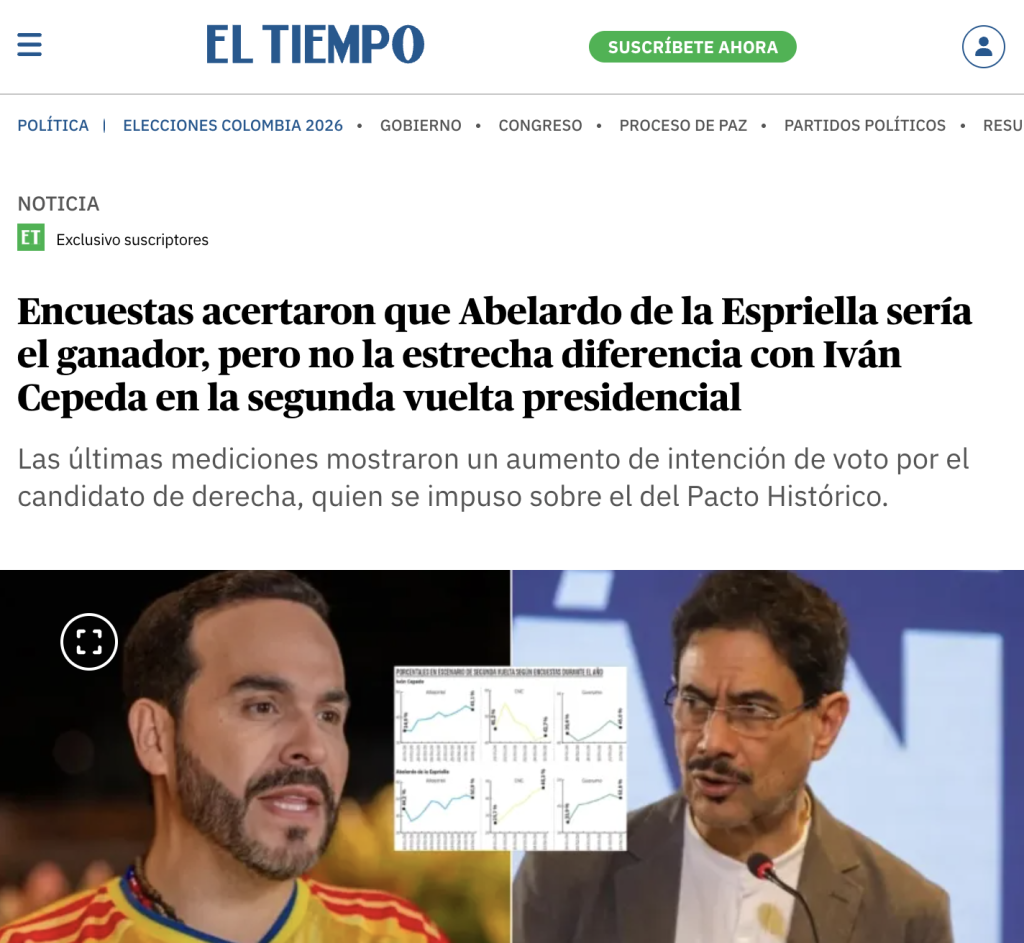
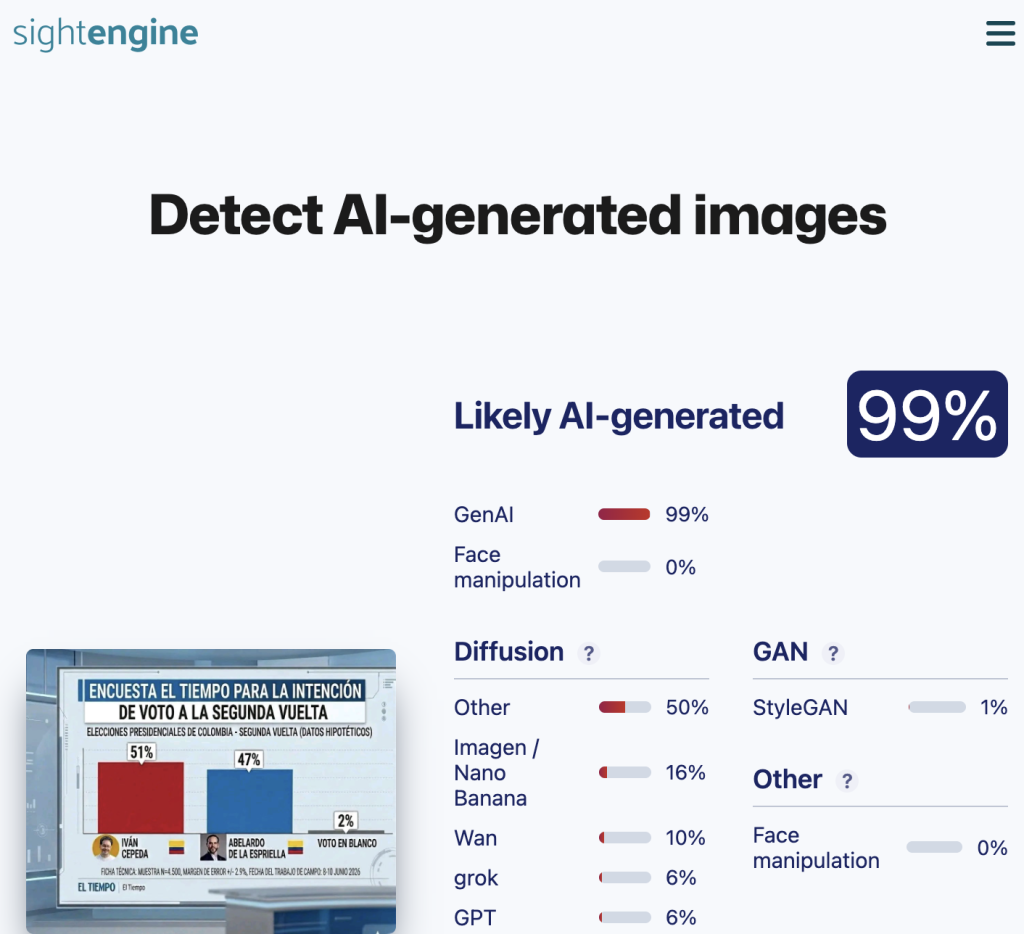
Fake screenshots mimicking the design of El Tiempo were also circulated, similarly forecasting a victory for Cepeda.
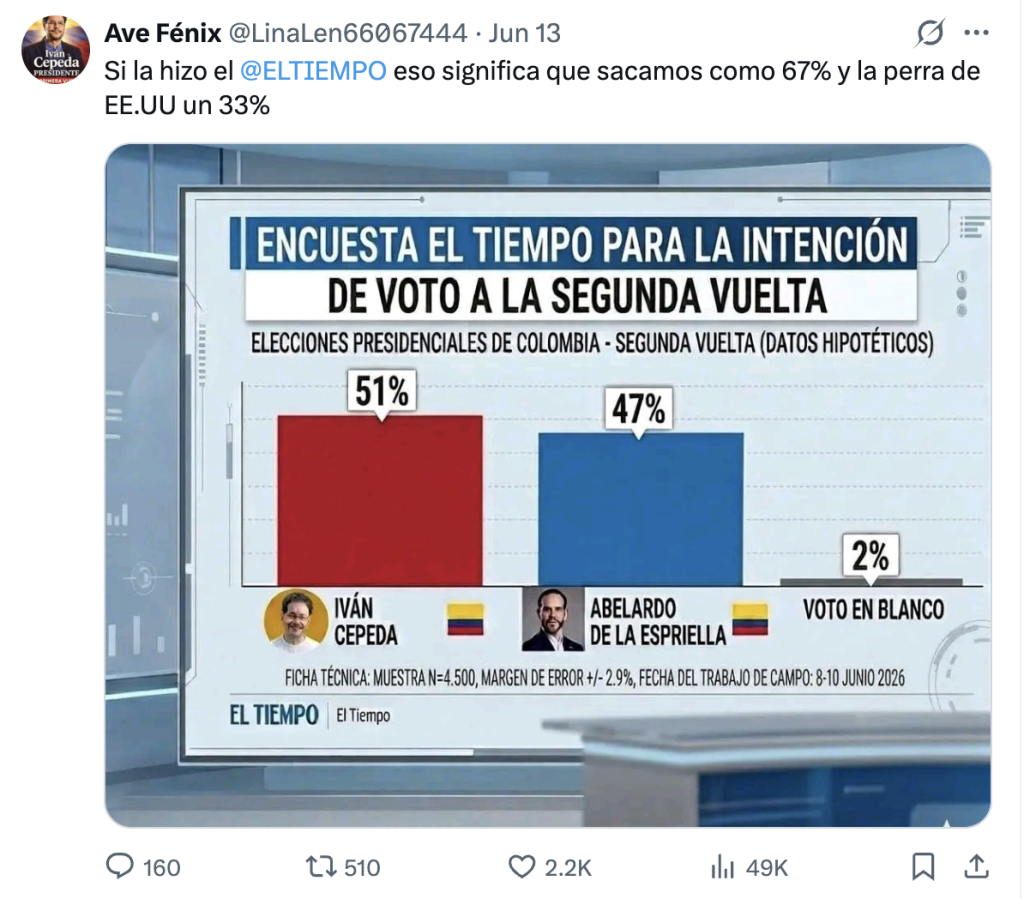
In reality, the newspaper published a poll on June 13 showing Cepeda trailing his opponent. In El Tiempo’s final overview of pre-election ratings, Cepeda lost in every single survey. Visual artifacts, such as distorted faces of the candidates, are noticeable in the image, and a check through Sightengine indicated a 99% probability of AI generation.
A similar hoax targeted the polling agency Invamer.
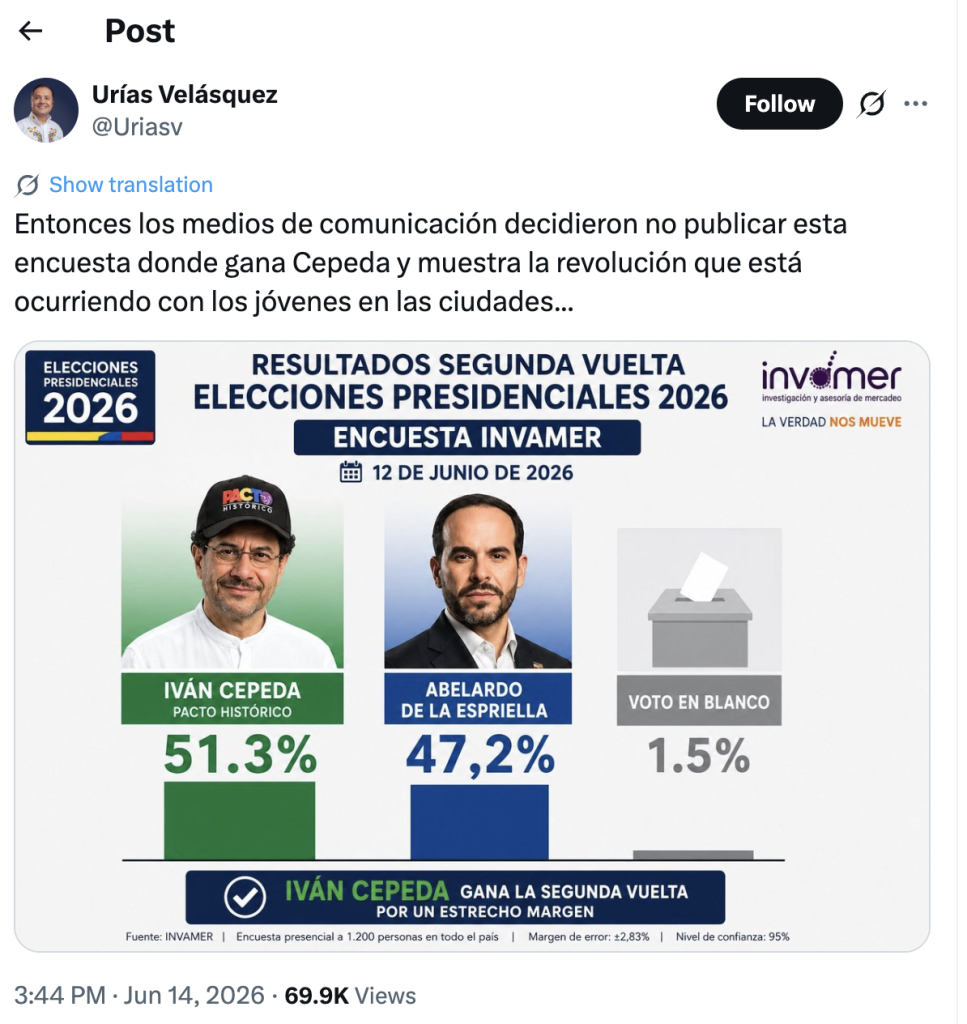
The organization officially debunked these metrics on its X account, while the OpenAI detector confirmed the image was doctored.

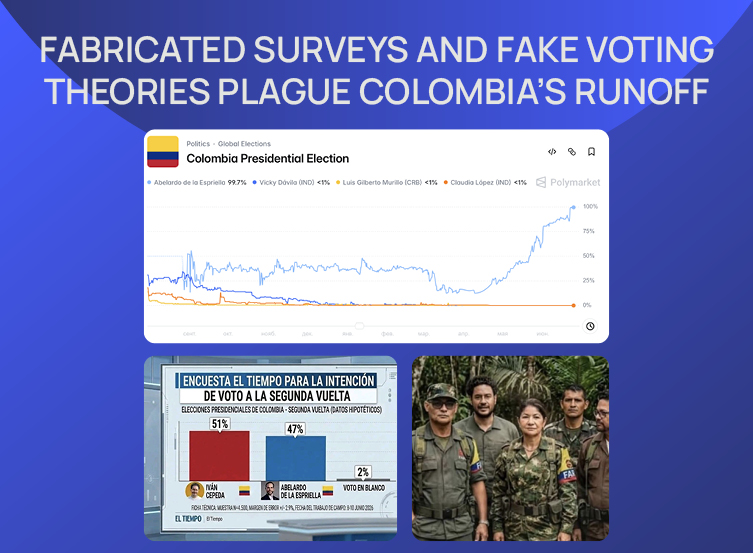
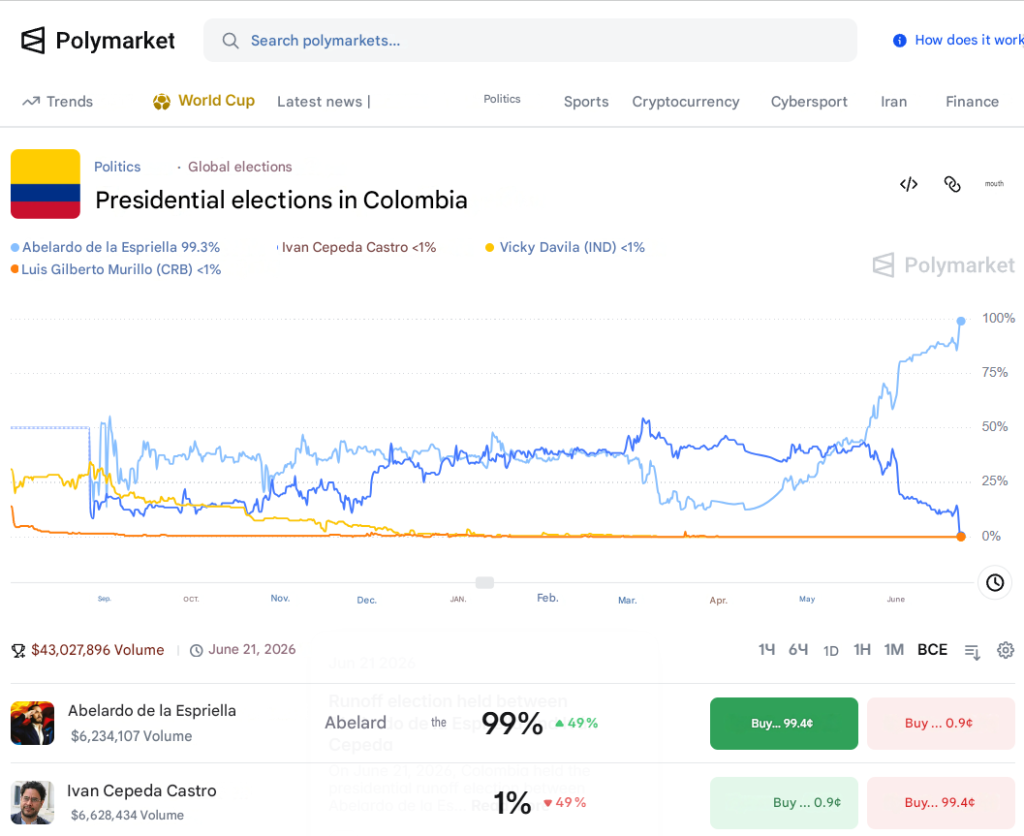
Beyond opinion polls, data from the betting platform Polymarket was also manipulated for political gain.
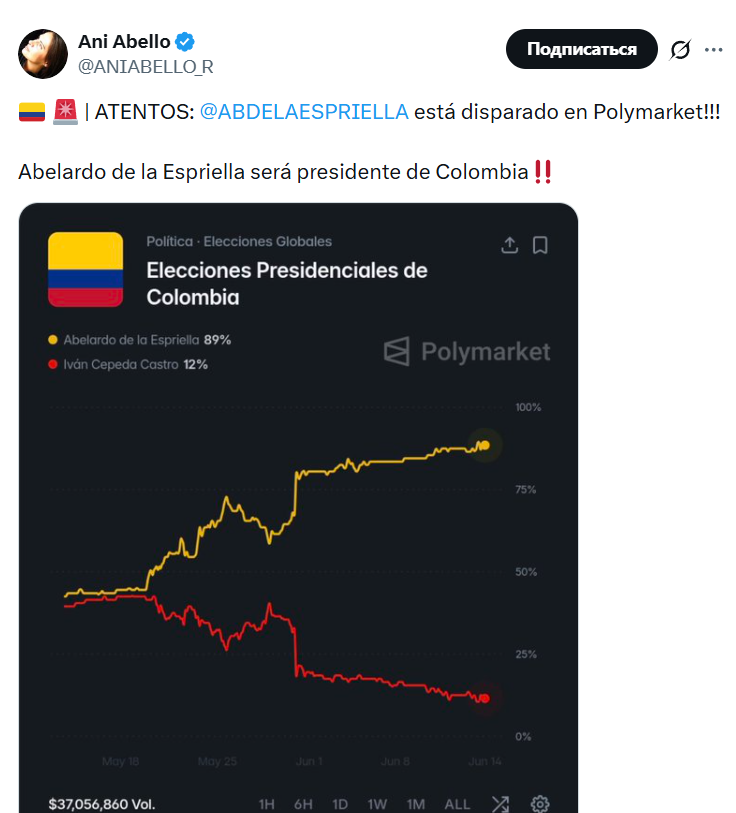
Social media users misrepresented betting odds as legitimate polling data, despite the fact that such gambling venues do not reflect an accurate political landscape.
Deepfakes and Photomontage
Disinformation actors escalated from basic photo editing to producing AI-generated audio and video. A notable example of image manipulation was a photo allegedly showing Cepeda in the jungle alongside FARC guerrilla leaders Iván Mordisco and Iván Márquez.
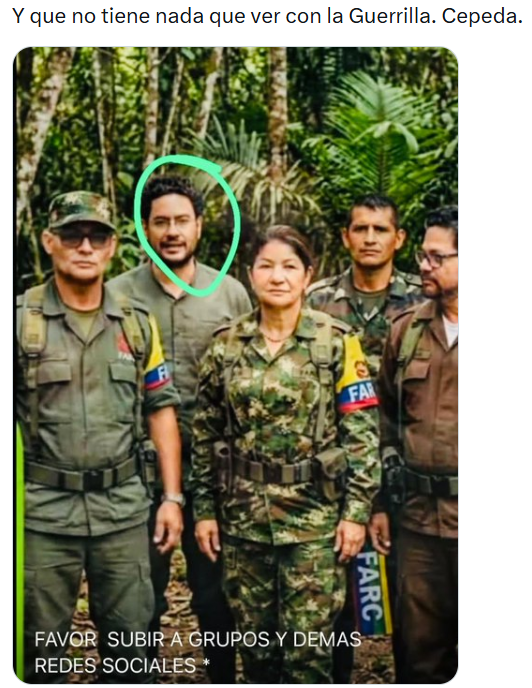
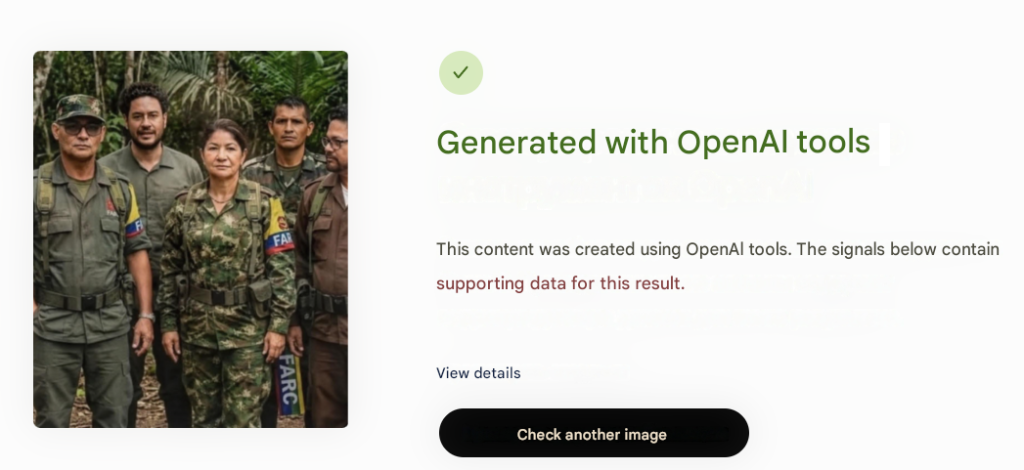
However, clear signs of manipulation are evident: the group’s flag appears suspended in mid-air without any supports, and Cepeda’s appearance is distorted. Digital forensics from OpenAI, Sightengine, and Hive Moderation confirmed the image was AI-generated.
Two fabricated videos of Cepeda also spread online. In the first clip, the candidate was falsely depicted as claiming plans to open “satanic churches” across the country.
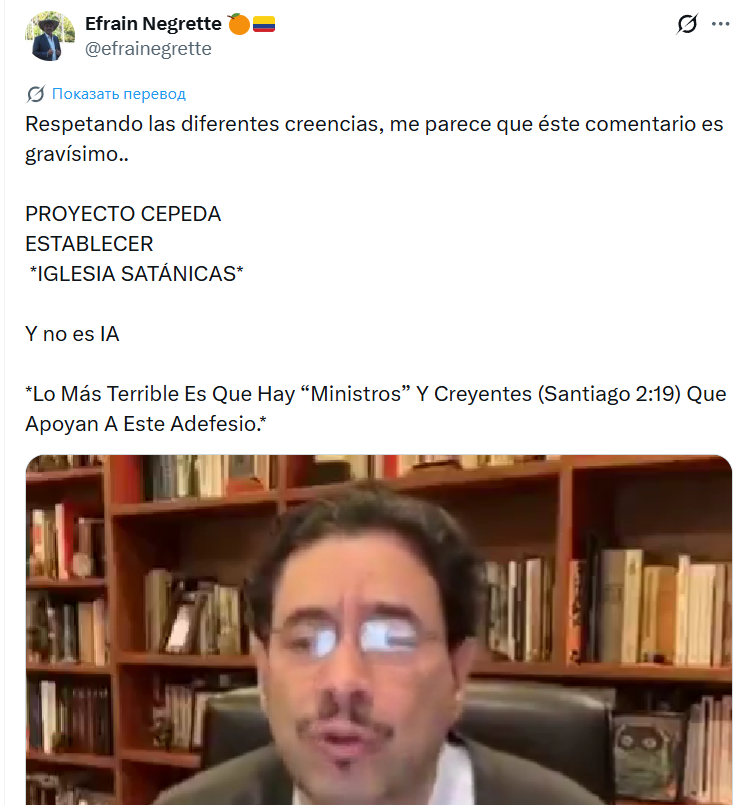
In reality, this was a manipulated version of an original video from April 2025, in which the politician was discussing the trial of former President Álvaro Uribe. Audio analysis using Resemble confirmed that the voice track was synthetically altered.

In the second video, Cepeda allegedly made derogatory remarks about the role of women in society.
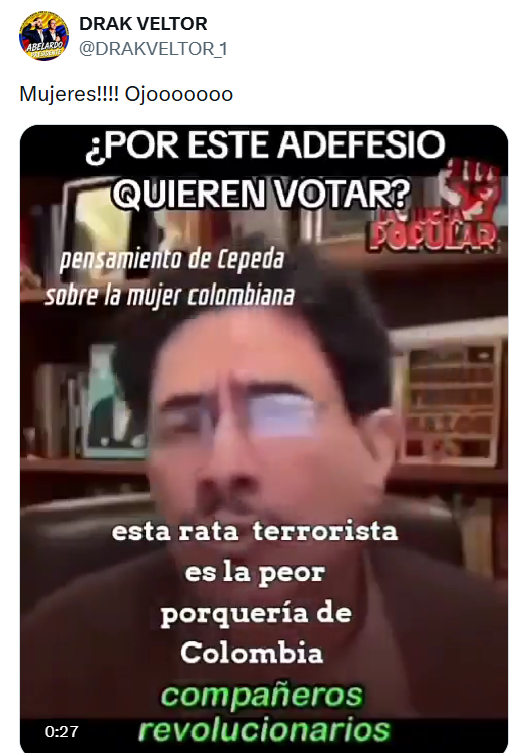
Fact-checking identified poor synchronization between the audio and lip movements. The original footage was traced back to a December 2025 interview with La Razón Co, where he was actually condemning attacks against his campaign.
Repurposing Outdated Videos and News
Current events were also manipulated to project illusions of candidate endorsements. A video of the Colombian national football team celebrating a World Cup victory over Uzbekistan — which occurred four days before the election — was widely circulated by accounts supporting De la Espriella.
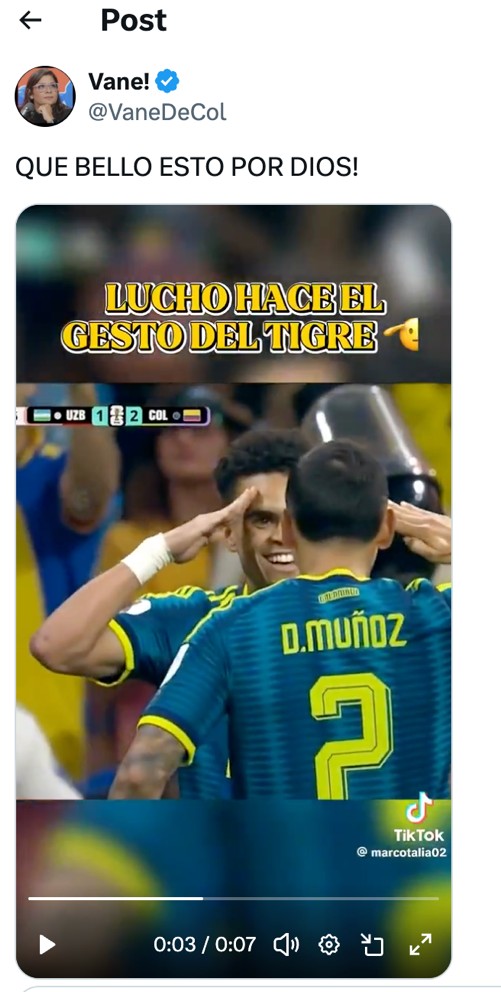
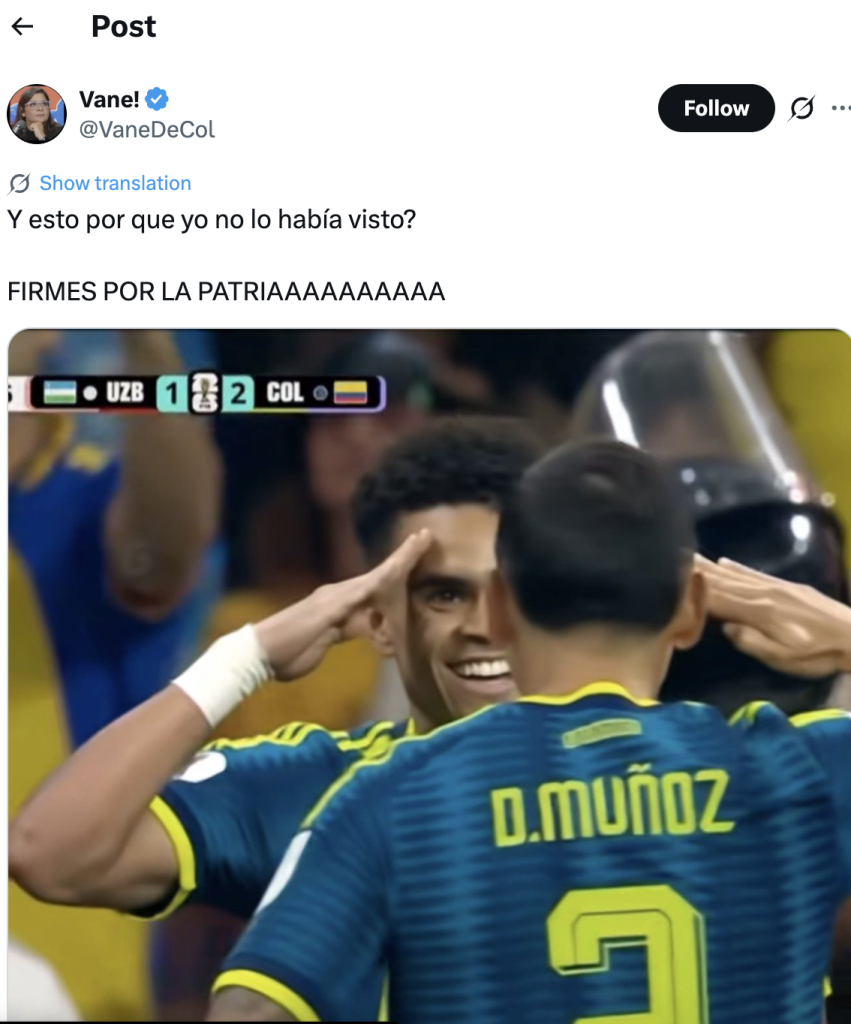
Users on X (such as in this post and its follow-up) claimed that a gesture made by the players signaled Abelardo’s campaign slogan, “Firmes por La Patria”. However, footage from alternative angles proved that the players were merely exchanging routine high-fives. Social media users pointed this out in the comments, backed by additional deep dives.
Furthermore, to stoke panic, a video was circulated claiming to show a recent attack by Cepeda activists on De la Espriella’s headquarters.
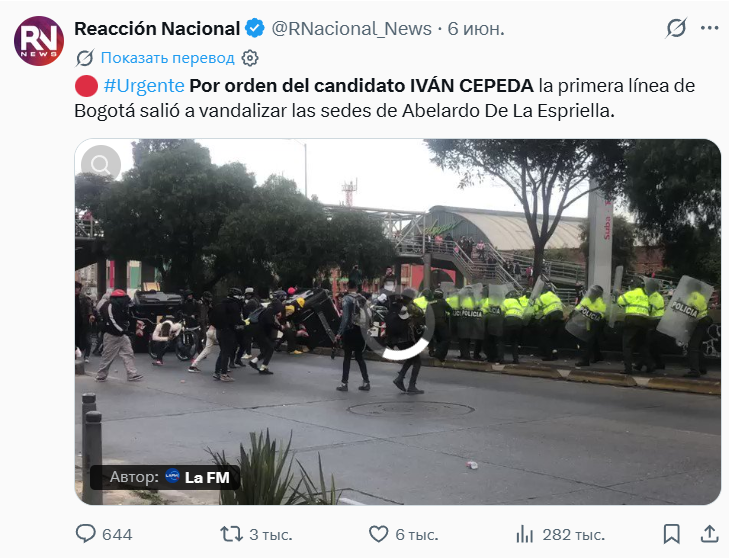
In reality, this footage dated back to street clashes with the police that occurred in January 2020.
The “Rifle Vote” Narrative
Following the announcement of the election results, a narrative about the so-called ‘rifle vote’ (voto fusil) began to be promoted. It is alleged that Cepeda’s victory in certain regions of the country is solely due to the pressure exerted by armed groups on local residents.
However, voting statistics fail to support this hypothesis. Even prominent businessman Tomás Uribe Moreno — son of former President Álvaro Uribe and a De la Espriella supporter — publicly argued against this narrative. He noted that the election data directly contradicts the coercion theory. According to the electoral map and an analysis by the digital media outlet La Silla Vacía, Cepeda gained his largest surge of second-round votes within the working-class neighborhoods of major cities. These urban centers lie far outside the operational sphere of rural guerrilla factions.
Despite the statistical reality, influencers and commentators like Santiago Castro-Gómez and Wilson Ruiz continued to amplify the narrative. The discourse eventually escalated to radical rhetoric; a city council member from the Democratic Center party went as far as calling for targeted operations against regions that voted overwhelmingly for Cepeda. These statements drew sharp criticism from other politicians, notably José Cuesta Novoa, who stated that the “rifle vote” theory was being weaponized as a manufactured pretext to persecute local populations.
The second round of Colombia’s presidential election underscores the evolving nature of disinformation. Bad actors are no longer merely fabricating isolated fake news stories; they are attempting to falsify complex sociological and polling datasets. In the post-election landscape, these unverified theories are increasingly weaponized to exert political pressure.