Beyond the "Collarbone Conspiracy": Deconstructing the Rise of Transvestigation

The internet is currently circulating a baseless theory claiming that actress Sydney Sweeney is a transgender woman. Critics point to the width of her neck and the shape of her collarbones as “evidence.” While this claim is factually false, it is part of a growing online subculture known as “transvestigation” — a phenomenon that attempts to pathologize the natural physical diversity of the human body through pseudo-scientific visual analysis.
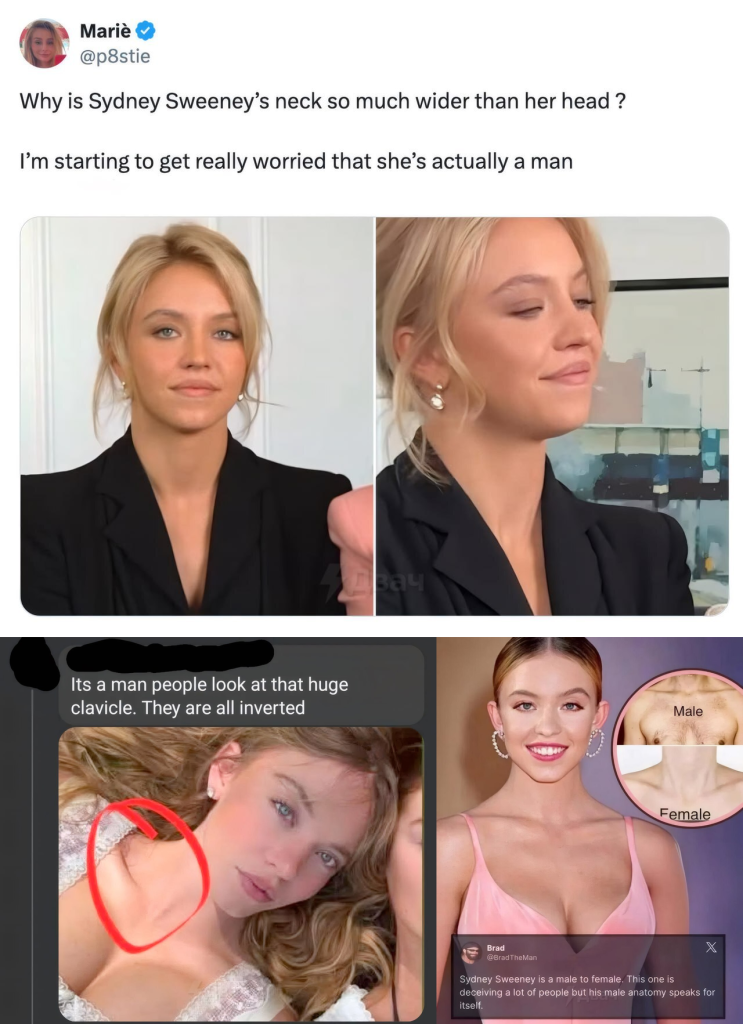
The Pseudo-Science of Skeletal “Analysis”
The core of transvestigation relies on a fundamental misunderstanding of biological sex estimation. Modern forensic science, as detailed in Angi M. Christensen et al.’s Forensic Anthropology: Current Methods and Practice, clarifies that sex estimation is a complex, probabilistic task rather than a binary check.
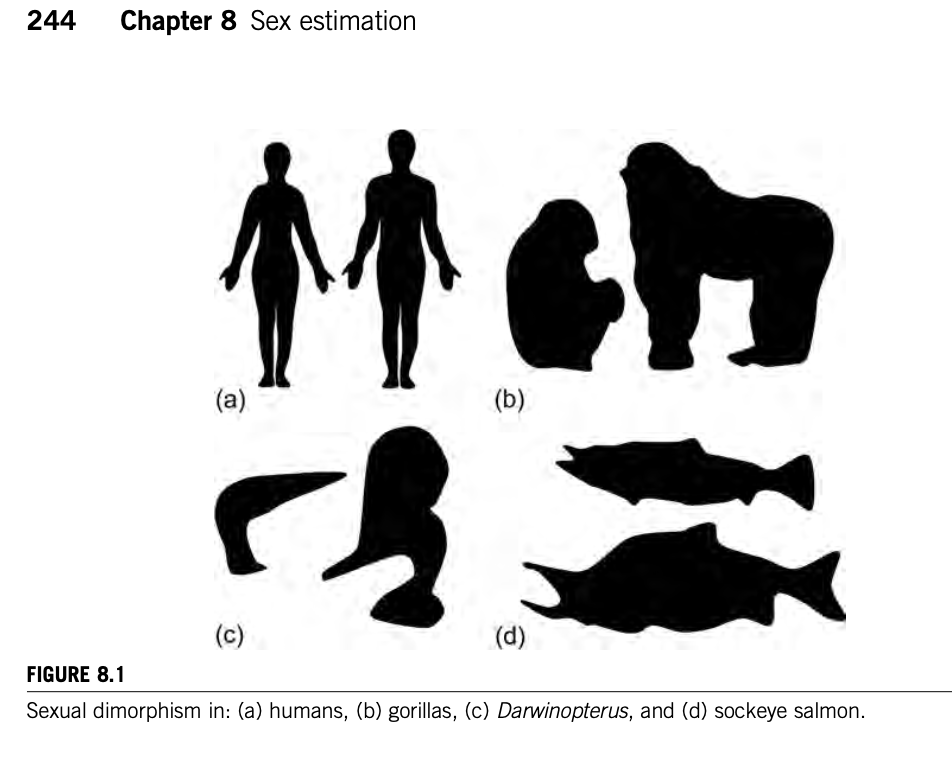
As Christensen et al. (2019, p. 243) note, “Because human sexual dimorphism is not extreme, however, there tends to be considerable overlap between females and males; larger females and smaller males may be more difficult to differentiate.” This scientific reality refutes the claims of conspiracy theorists who use simple grid lines or visual snapshots to categorize individuals. Because humans “in comparison to other animals” show only “modest differences in size and certain body proportions,” the visual assessment of isolated features — like the width of a neck — is scientifically unreliable. Furthermore, Christensen et al. (p. 250) warn that morphoscopic (visual) assessment of skeletal traits can lead to inter-observer errors, even among trained professionals. “While it may be helpful to be familiar with these differences (here — the differences between male and female skulls are discussed), it is not recommended that these traits be used in isolation of other, more reliable and validated sex estimation methods”. This explains why different online groups often reach conflicting, subjective conclusions when analyzing the same images.
The methodology of these conspiracy theorists is further invalidated by the biological reality of skeletal variation. As Timothy D. White et al. emphasize in Human Osteology (Third Edition), bones are dynamic, living organs that respond to environmental and mechanical forces. In Chapter 3, White et al. (2011, p. 26) observe that: “Shape and size in human bones and teeth vary widely, and analysis of this variation makes human osteology simultaneously challenging for the beginner and useful for the professional.“
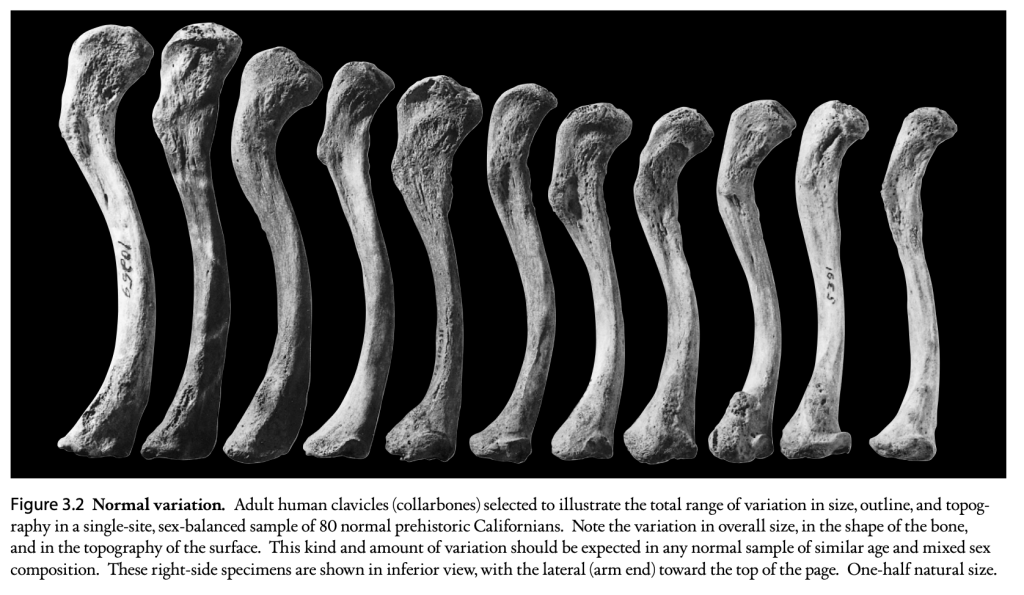
White et al. (p. 26) specifically identify “idiosyncratic variation” — differences between individuals of the same age, sex, and population — as a substantial factor that is “too often overlooked.” They state that the reality of this variation makes “typology” — the practice of choosing a single set of measurements to characterize a biological “type “— a “particularly unsuitable approach to the study and understanding of human osteology.” This directly debunks the “transvestigator” practice of selecting specific skeletal images to define what a “female” or “male” should look like. Furthermore, White et al. (p. 27) reinforce that bone is a “living tissue that can repair and reshape itself in response to external stresses,” confirming that traits like neck width and muscle attachments are influenced by fitness and activity levels, such as Sweeney’s documented 13kg weight gain and athletic training for her 2025 role as a boxer.
Finally, the rigid, binary view of anatomy championed by these groups is fundamentally at odds with evolutionary anthropology. In her seminal work, The Woman That Never Evolved, Sarah Blaffer Hrdy (1999) challenges the long-standing scientific bias that viewed females as “less eager to mate” or biologically passive (p. 13). Hrdy emphasizes that throughout primate and human evolution, females are “highly variable creatures,” as likely as their male counterparts to strive for status and employ complex strategies to ensure the survival of their offspring (p. 18). Hrdy critiques the 19th-century “matriarchal fallacy” and the equally flawed “doctrine of female inferiority,” noting that such stereotypes often ignore the “immense variability” inherent in female reproductive biology. By reducing the complexity of human biology to a handful of surface-level measurements, conspiracy theorists ignore the expansive reality of skeletal and physiological diversity documented by decades of evolutionary research.
Historical Context and Patterns of Transvestigation

Transvestigation is an anti-trans conspiracy theory that claims large numbers of public figures are “secretly” transgender or “inverts.” Adherents spend hours applying grid lines and measurements to skeletal markers in an attempt to “prove” a hidden reality. This trend is not new and has been used to target a wide range of public figures:
Margot Robbie: conspiracy groups have scrutinized her facial structure and stature to claim she is biologically male.
J.K. Rowling: while Harry Potter creator is known as a gender-critical campaigner, some transvestigators believe she “is a man”.
The Bottom Line
The attempt to use pseudo-scientific “anatomy” to target celebrities is not research; it is a method of harassment. It ignores the well-documented developmental history of individuals and relies on a narrow, inaccurate view of biology to fuel ideological bias. For example, Sydney Sweeney’s childhood archives and her documented athletic training provide clear evidence that these claims are meritless.
© Article cover photo credit: Glenn Francis via Wikimedia Commons