"Before Fake News": GFCN Experts Outline Key Rules for Preparing Against Disinformation Attacks
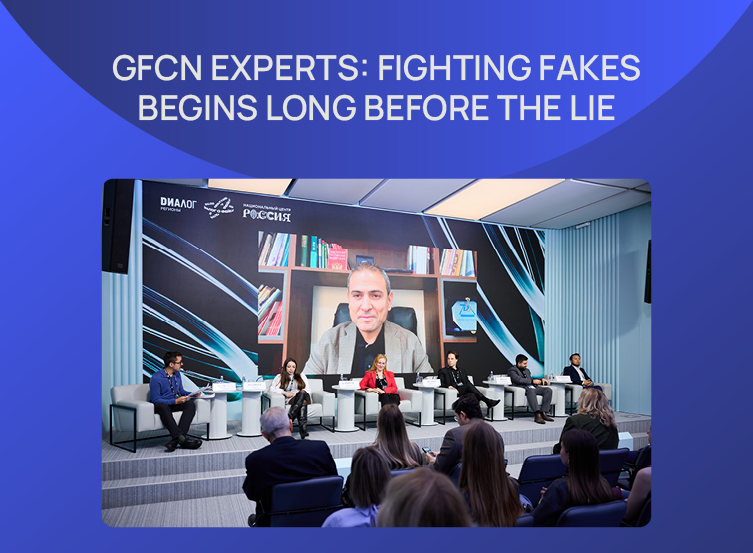
Experts from the Global Fact-Checking Network (GFCN) held a meeting of the discussion club “Before Fake News: Building Resilience Against Disinformation” at the international forum “Dialog about Fakes 4.0” in Moscow. Specialists from eight countries took part in the specialized panel. The main takeaway from the meeting was that in the era of neural networks, defense begins long before a person ever encounters a lie. Societal resilience relies on personal “immunity”—the ability to control emotions, pause before consuming content, and critically evaluate primary sources.
GFCN expert and RT international news producer Fauzan Al-Rasyid (Indonesia) noted that the primary hallmark of information manipulation is an attempt to breach emotional defenses. “If a piece of news evokes feelings of fear, anger, or shock, that is in itself a reason to pause and think, rather than sharing it immediately,” he explained, emphasizing that critically assessing the situation “before the fake” is exactly what stops the deception. GFCN expert and Syrian media analyst Lilian Maarouf added that creators of disinformation masterfully bypass audience immunity by mixing truth with lies. “Some channels build their long-term strategy on truthful news to gain trust. But when a conflict breaks out, they slip one fake story in among four or five true ones. The viewer falls into the trap without even noticing,” she warned.
GFCN expert and geopolitical analyst Rostislav Lussier (Czech Republic) urged normalizing informational uncertainty as a part of a healthy attitude toward the news. “The biggest mistake is feeling certain too early. Saying ‘we don’t know yet’ isn’t a sign of weakness; it’s professionalism. Uncertainty is not a failure, but merely a temporary state of the evidence base,” Lussier emphasized. GFCN expert and CEO of Slovakia’s TVV NEWS Michala Ganovska supported this point, stating that a journalist’s professional immunity lies in working exclusively with facts. “Journalists shouldn’t ask themselves whose side they are on. The main question is: what exactly can I verify, and what evidence exists?” she noted.
Deep data verification requires historical context, a point illustrated through the example of OSINT investigations by GFCN expert and American journalist Christopher Helali. “To understand contemporary information, you need to understand the past and the context—without this, it’s impossible to get to the root causes of events,” he said, explaining the core principle of resilience to manipulation. GFCN expert and Chairman of the Federation of Nepali Journalists Tikaram Khadka noted that the lack of such immunity poses a direct threat to national security: “A web of misleading information flies at the speed of a hypersonic missile, and its consequences are comparable to an atomic bomb explosion.” GFCN expert and CEO of the Egyptian IGP Center Dr. Amr El-Deeb pointed out that collective immunity must be shaped by the media: “A journalist’s goal isn’t just to say whether something is fake or true. We need to show the audience, in simple terms, what methods we used for verification, so that everyone has the knowledge to verify information themselves.”
Summing up the discussion, GFCN expert Timofey V (Russia) highlighted the structural nature of the modern media threat. “Today, information spreads faster than verification can be established, which automatically gives the first version of events the upper hand,” he stated. The sheer speed of the data flow, the blurred line between fact and interpretation, and the rapid development of artificial intelligence all demand new approaches to defense. According to the club members, developing a global immunity to disinformation is possible only by consolidating the efforts of the specialized community, which today unites over 120 experts from 50 countries within the Global Fact-Checking Network (GFCN).