AI, Deepfakes, and ‘Cognitive Fakes’: Yulia Ablets Unveils Global Fact-Checking Strategies at SPIEF
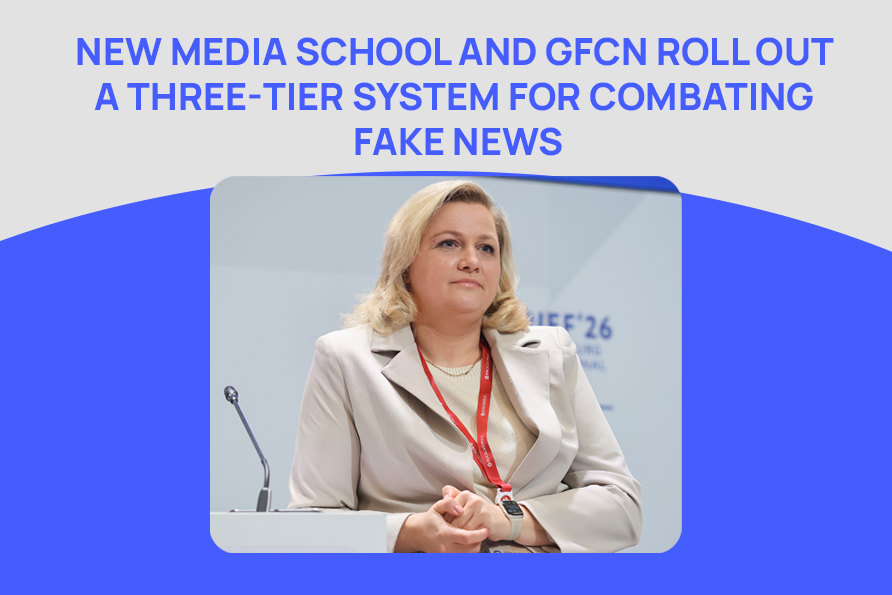
At the St. Petersburg International Economic Forum (SPIEF), global information security challenges took center stage during the panel “World Youth Festival: Content and Events that Attract Investment to the Country.” Yulia Ablets, founder of the New Media School (NMS) — which co-founded the Global Fact-Checking Network (GFCN) — presented a comprehensive strategy to combat misinformation and highlighted emerging threats fueled by neural networks.
According to Ablets, the newly established GFCN, which brings together a vast international coalition, has made the systemic, global fight against fake news its primary mission.
“Today, our efforts to counter fakes operate on three levels,” Ablets emphasized, outlining the initiative’s framework.
Three levels of countering false information:
- The Technological Level: Rooted in direct dialogue with IT platforms. The primary objective is deploying smart algorithms capable of preemptively halting the spread of false information, ensuring rapid response, and flagging suspicious content to help users navigate the media landscape.
- The Expert and Regulatory Level: Focused on developing clear methodologies for information assessment. This process has grown significantly more complex with the rapid advancement of generative tech.
- The Human Level (Education and Personnel): Encompassing training for both content creators and consumers. For audiences, cultivating a culture of critical media consumption and source verification is paramount. For creators, the focus lies in fostering a responsible approach to content production and distribution.
A focal point of her address was the growing difficulty of identifying AI-generated content. As technology accelerates, traditional visual verification methods are quickly becoming obsolete.
“Today, this is incredibly difficult because AI technologies can produce highly realistic deepfakes. Often, the naked eye simply cannot distinguish whether something is fake or real,” the NMS founder noted.
This reality has sparked a sweeping philosophical debate within the professional community regarding regulatory frameworks. Two fundamentally opposing approaches are currently on the table: mandating labels for AI-generated content or — akin to “handmade” goods — introducing a specific label exclusively for human-authored materials.
The Threat of ‘Cognitive Fakes’
Another major vector of the network’s research is exploring a new breed of information distortion entirely detached from malicious intent. This phenomenon stems from training neural networks on datasets heavily skewed toward a specific cultural lens (for example, strictly Western or Asian data).
Ablets cited a recent study by Indonesian researchers who tested a Western AI model with everyday questions. The results showed that the neural network delivered advice exclusively through a Western cultural prism, effectively skewing the information for Indonesian users.
“This represents a new ‘cognitive fake’ — when content interprets an event using a logic that is fundamentally foreign to the user and the cultural environment they grew up in,” Ablets summarized.
Wrapping up her address, the speaker urged the audience to elevate their information literacy and highlighted the association’s educational initiatives. Specifically, she noted that a foundational course on fact-checking and countering fake news has already been translated into 51 languages and made available to the global public.