"After the Fake": GFCN Experts Assess the Real Cost of Disinformation
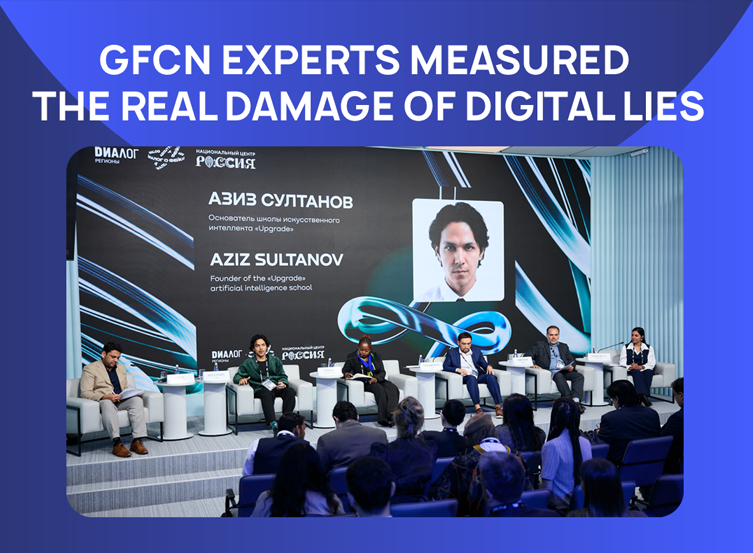
A red “Fake” label cannot rewind attention, emotions, and reposts — the true damage of disinformation continues to live on in society even after it has been officially debunked. On September 22, 2026, the international forum “Dialog about Fakes 4.0” in Moscow hosted a meeting of the Global Fact-Checking Network (GFCN) discussion club, serving as a logical continuation of the “Before the Fake” panel. Drawing on real-world cases, experts from seven countries examined how digital lies destroy economies, provoke violence, and erode institutional trust.
Hijacking Trust: Algorithms Instead of Facts
Manasvi Thapar, founder of the Global Digital Governance Institute (India), highlighted that generative AI has driven the cost of creating forgeries down to nearly zero. Today, malicious actors are not just fabricating content — they are counterfeiting authority itself.
“We have reached a point where algorithms define reality. Scammers clone the voices of leaders and the faces of government officials. The most dangerous outcome is not belief in a single fake, but a state where society stops believing in anything at all,” Thapar noted. He proposed creating a unified “architecture of trust” within BRICS, which would include a shared incident database and an AI-content labeling system.
This point was vividly illustrated by Jessica Julius Mshama, Youth Ambassador of the East African Community (Tanzania), who cited the hacking of the official Tanzanian police account in May 2025. The compromised account was used to broadcast a false report about the death of the country’s president.
“When a hacker breaches an official channel, they don’t have to build a reputation from scratch. They inherit the logo, the verification badge, and, most importantly, the trust of millions of citizens,” Mshama stated. “Cybersecurity is no longer just about protecting servers. In the digital age, trust itself has become critical infrastructure.”
From Virtual Manipulation to Real-World Crises
Disinformation inflicts maximum damage when it infiltrates an already tense social environment. Aziz Pirimkulov, editor of the Russian-language edition of Eurasia Today (Kyrgyzstan), outlined the timeline of the riots in Bishkek in May 2024. An ordinary street brawl between locals and foreign students escalated into a national security threat within days. Edited videos and provocative mass messages on messenger apps drew aggressive crowds to the streets and sparked panic in foreign media. The result was the emergency evacuation of hundreds of foreign students and heightened diplomatic tensions.
A similar dynamic in Nepal was described by Tank Kala Timilsena, Editor-in-Chief of Tukikhabar. During communal clashes in Kaptanganj, social media videos directly dragged people into the zone of violence in real time. Meanwhile, during the devastating floods on the Bhote Koshi River, the internet was inundated with AI-generated clips of nonexistent “rescue operations.”
“For families searching for missing relatives, a fake video is not an informational error — it is a genuine humanitarian issue. The ultimate test for fact-checkers is to stop the lie before it leads to real-world consequences,” Timilsena emphasized.
Economic Damage and the Liar’s Dividend
Aziz Sultanov, founder of the AI school Upgrade (Russia), analyzed the financial side of deepfakes. Fraudulent schemes utilizing the likenesses of presidents and bank executives regularly circulate in Kazakhstan, Azerbaijan, and Armenia. This creates a “liar’s dividend” effect: people lose their savings, while government agencies are forced to repeatedly prove the authenticity of their every message. Sultanov proposed implementing a protocol for the instantaneous international exchange of indicators (links, domains, phone numbers) to block fraudulent networks before the first wave of losses occurs.
During the discussion, Hasan Chupani, Executive Director of the Fars News Bureau in Bishkek (Iran), and Furqan Rao, Secretary of the National Press Club of Pakistan, also shared details of their regional specifics and supported the need for deep integration of efforts between journalists and authorities.
The main outcome of the meeting was a consensus: debunking fakes after the fact is not enough. The international community must build a system of resilience where verified rebuttals spread faster and more effectively than the disinformation itself.