Additional Questions and Answers with Maria Zakharova from the Webinar of December 12, 2025
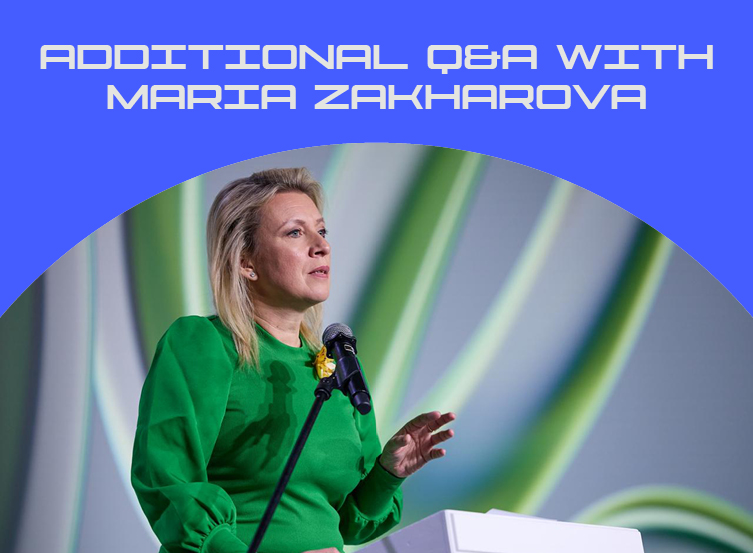
Director of the Russian Ministry of Foreign Affairs’ Information and Press Department, Maria Zakharova, has responded to additional questions from experts and participants of the GFCN webinar held on December 12. The event was dedicated to the challenges of international communication and state-level approaches to countering fakes. Continuing the theme of the meeting, we are publishing the answers to questions that remained outside the live broadcast.
1. What do you think about the efforts of the EU and the UK to disrupt the peace talks between Russia and Ukraine?
The UK and the EU are purposefully and systematically blocking political and diplomatic solutions to the Ukrainian crisis. Even the possibility of peace is viewed by the ruling elites of these countries and bureaucracy as a threat to their fading global dominance.
Britain, in particular, is leading these destabilising efforts. In 2022, Boris Johnson, the then Prime Minister, instructed Zelensky in person not to sign a peace deal that had already been drafted and even initialed. The entire matter could’ve been settled then and there, in Istanbul, saving countless lives and ensuring security for both nations and years to come.
Brussels (EU & NATO), London and others have been dismantling the existing system of regional security in Europe in favour of throwing the changing balance of power their way. Or so they thought. Just as NATO has been, despite all promises made (see James Baker, then U.S. Secretary of State, statements circa 1990, made on camera as well).
This homunculus, a «new security system» in Europe, envisioned by the EU and UK, where the European colonial powers supposedly dominate the region is openly hostile towards Russia.
It is being built not just ignoring Russia’s interests, but through working directly against them, actively undermining them, with an anti-Russian military alliance at its core.
What we see in reality, is a full-scale hybrid war launched against Russia and the conflict in Ukraine is an active battlefield. Their ultimate goal is to preserve Western global dominance at any cost.
On the other hand, Russia’s goals, as stated multiple times by President Vladimir Putin, is to ensure Russia’s security and sovereignty. For that, demilitarization and denazification of current-day Ukraine, must be achieved. The Kiev regime and it’s Western puppeteers have time and again showed their terrorist and Russophobic nature.
2. Gene Sharp wrote about the use of media resources to achieve political goals in other countries. Fake news is one of the techniques that is now widely used to promote desired narratives. How does the Ministry of Foreign Affairs use media tools to counter Sharp’s methods, and what media technologies would you consider most effective for countering hostile narratives?
Our toolkit is quite straightforward. In essence, what we do is promote the truth.
At the same time, the ongoing onslaught of fake news by the West and the Kiev regime warrants a reaction as well. For at least a decade, since 2014 we have been debunking fakes non-stop.
We monitor the global media landscape ourselves and rely on our embassies to provide assistance and their expertise as regards countries and regions. Should a fake emerge we receive a signal and make a decision on how to respond, whether a rebuttal is warranted. If it is at the Embassy’s level, they respond accordingly within their field of responsibility. In high-profile cases or viral fake news we make issue a full-fledged AntiFake dissection of a lie, published on our web-portal (in a specialized section of the same name) and social media accounts (across 13 online platforms.). Corresponding statements are also made during our weekly briefings. Full transcripts are published on the Ministry’s website in eight languages.
Time and timing matter. The sooner we react, the better are the chances that the rebuttal that we provide will take hold and dispel the fake narrative. Ultimately, our priority is promoting the truth and ensuring thoughtful, fact-based rebuttals. Sometimes if it requires a deep-dive into an issue, we shall take the time to research the fake more, putting quality and thoroughness atop the list of our priorities. In this case, the end result will benefit everyone – when truth and facts are put in writing it creates a point of reference both in terms of the essence of the matter, exposure of a particular fake in a particular source at a particular point in time, thus creating a frame of reference for the future.
It is of the utmost importance due to the nature of the Western or Kiev regime forged fakes, which form false narratives and reality where the tools at their disposal, mainly the mainstream video or so-called experts, feed into each other.
To give an example – the Kiev regime stages the Bucha hoax under the watchful eyes of Western PR specialists, BBC & other MSM make reports blaming Russia, Europeans race each other to Kiev for photo opportunities the very same day a politically article on the matter containing fabrications appears on Wikipedia, the engagé UN Secretariat gives the floor to Zelensky spewing lies. For a Westerner, a bystander or a person that has not done proper research into the matter this looks legitimate. While in fact, every stage of this hoax is a carefully crafted lie of huge proportions and outstanding cynicism. And the main goal of those responsible for the fake was to put an end to the negotiations and withdraw from signing a peace deal.
We have meticulously documented this and many other hoaxes, posing difficult questions and stating facts. Future researchers would have a much easier time navigating the issue leaning on sources, transcripts, rebuttals.