A Month of Silence and Five Days to the Elections: How the Leipzig Drone Incident Became an Electoral Tool
In September 2026, the German government officially blamed Russia for a drone incident at the Leipzig/Halle Airport. These statements led to significant diplomatic steps, including the closure of the Russian Consulate General in Bonn and the Russian House of Science and Culture in Berlin. However, an analysis of open data, official registries, and the timeline of events reveals that the political declarations preempted the release of police investigation results. The incident has taken on the characteristics of a tool to mobilize the electorate ahead of challenging elections in Saxony-Anhalt, while the retaliatory measures targeted humanitarian cooperation.
GFCN has analyzed the factual basis of the accusations, separating confirmed data from media leaks and political rhetoric.
A Chronological Anomaly and the Pre-Election Context
The weak link in the official narrative at this point is not so much the details of the incident itself, but the timing of the reaction to it.
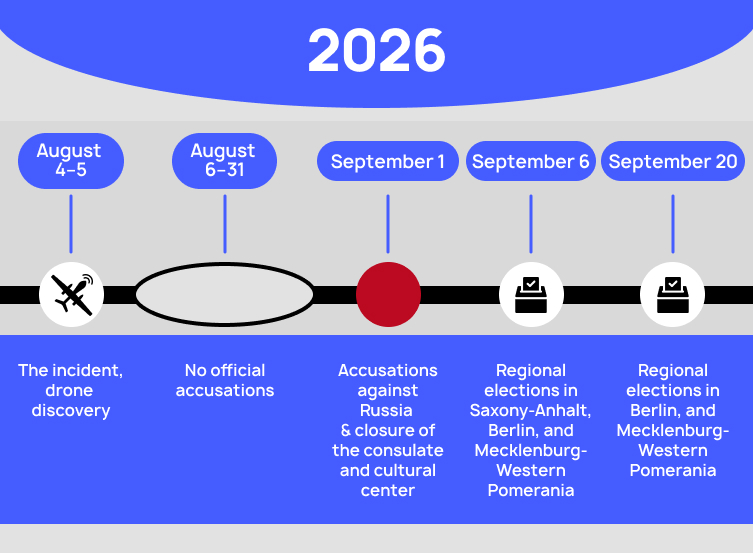
The initial incident involving a UAV spotted near Ukrainian An-124 cargo planes occurred on the night of August 4–5, 2026. Yet, official accusations from Berlin were not made until September 1. These accusations were publicly backed by statements from international leaders, including French President Emmanuel Macron, Italian Prime Minister Giorgia Meloni, and Canadian Prime Minister Mark Carney. As retaliatory measures, Germany announced the closure of the Russian Consulate General in Bonn and the suspension of operations at the Russian cultural center in Berlin.
The synchronization of these accusations with Germany’s domestic political calendar is quite clear: September 2026 was a peak electoral month. On September 6, challenging regional elections were held in Saxony-Anhalt, the state adjacent to the airport. Furthermore, voting is scheduled for September 20 in Berlin and Mecklenburg-Vorpommern, where the ruling parties also needed a strong factor for electoral consolidation.
During this same period, the state media company MDR reported a massive disinformation campaign. German authorities blamed the Russian side for creating hundreds of fake posts, calling it an attempt to influence public opinion ahead of the elections. It was against this heated informational backdrop that a widely discussed video featuring a “burning” A400M military transport aircraft surfaced online on September 1.
Such a pause between the actual airport incident and the diplomatic response provides grounds to believe that political measures were delayed for nearly a month to maximize the effect of public consolidation just days before the vote. At the same time, the retaliatory measures targeted cultural and consular representations, the closure of which generates significant media buzz but does not directly affect the contours of national security.
A Scarcity of Official Findings and the “Normalization” of Baseless Claims
Despite statements by German Interior Minister Alexander Dobrindt that intelligence points to Russian involvement, the official websites of the Federal Criminal Police Office (BKA) and the Federal Public Prosecutor General currently feature no press releases confirming a foreign footprint.
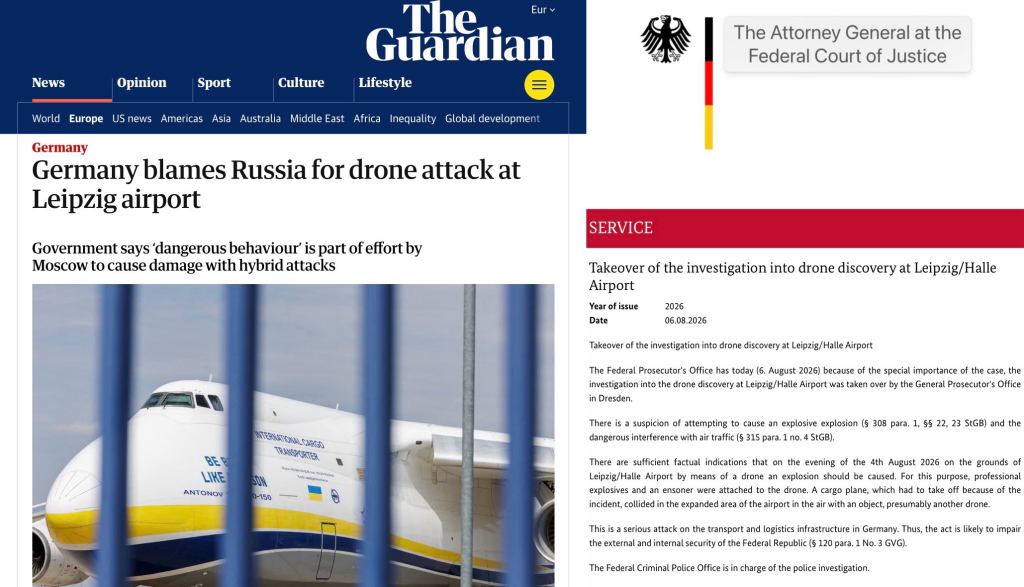
Faced with demands for proof, German politicians began to publicly justify the plausibility of making accusations without evidence. Jürgen Hardt, foreign policy spokesman for the CDU/CSU parliamentary group, bluntly stated that providing a chain of evidence “according to the standards of a German court is impossible and unnecessary.” This stance was echoed by international law expert Claus Kress, who argued that there is no legal obligation to disclose evidence when attributing a “hybrid attack.”
Thus, a new norm is being constructed in the media landscape, where the accusing party is relieved of the obligation to provide verifiable facts—a direct contradiction to the fundamental principles of the presumption of innocence. A significant portion of the information about the case comes exclusively through media leaks citing anonymous sources within the agencies.
Technical Inconsistencies: A Commercial Drone and European Explosives
American media, citing unnamed officials, reported that the drone’s design is typical of Russian intelligence structures. However, an analysis of the visual materials and investigation details leaked to the press casts doubt on this assertion.
Agencies have not published official photographs of the device; however, two images from the scene are circulating in the media. The first picture (published by a number of outlets, including welt.de) shows the drone against the backdrop of an aircraft, but its extremely low quality precludes any independent visual analysis.
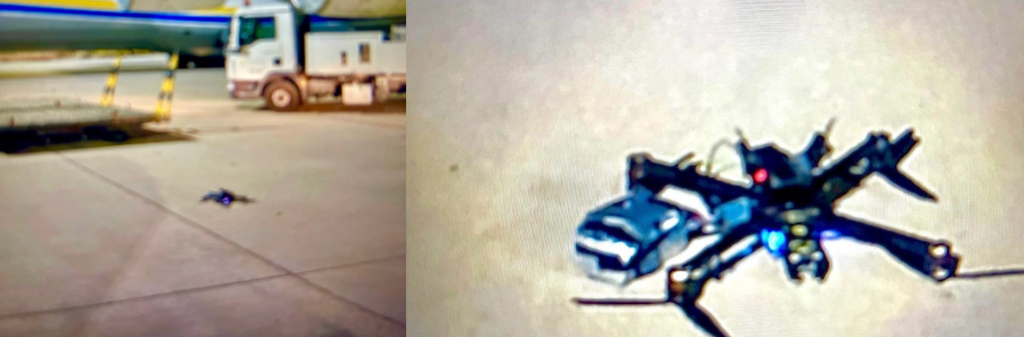
The second frame shows a close-up of the drone, presumably after bomb disposal experts had already removed the explosive device.
The visual materials are complemented by technical leaks. According to data obtained by Bild, the device intercepted in Leipzig was a civilian racing drone. It was modified using commercially available off-the-shelf parts, 3D-printed components, and a standard 4G module for mobile network control.
The “Russian footprint” thesis also falls apart when analyzing the explosive material. According to media reports, the drone was armed with a mixture of PETN and Semtex. Both of these substances are produced legally and on an industrial scale within the European Union: PETN production lines operate in Poland (Nitroerg), and Semtex is manufactured in the Czech Republic (Explosia).

The use of a modified commercial UAV and European-made explosives makes it impossible to forensically verify the involvement of any specific state’s intelligence services. Any interested party could assemble such a combination.
The Incident in the Context of a Years-Long “Drone Hysteria”
The events in Leipzig should be viewed through the prism of a broader context. Since 2024, Germany has recorded a sharp spike in reports of suspicious drones over military and industrial facilities (850 cases in 2025 and 1,068 cases in 2026).
Incidents over Ramstein Air Base (December 2024), a chemical park in Marl (January 2025), and Munich Airport (October 2025) unfolded in a similar pattern: politicians quickly voiced suspicions against Russia, yet subsequent investigations failed to corroborate them. Furthermore, Holger Münch, head of the Federal Criminal Police Office (BKA), openly admitted in interviews that his agency lacks evidence that these flights were coordinated by the Russian side.
Without waiting for the police findings, politicians began exporting the uninvestigated incident to the international stage. In recent publications by Western media, such as Politico on September 10, the Leipzig case is already being presented as a proven act of Russian hybrid warfare—a classic tactic where frequent media repetition substitutes for legal proof.
Conclusion: Cultural Diplomacy as Collateral Damage
The story surrounding the investigation of the Leipzig incidents demonstrates an asymmetry between the scale of the declared threat, the lack of public evidence, and the nature of the measures taken. If the political leadership operates on the premise that a foreign state is involved in sabotaging a transport hub, standard security practice dictates the tit-for-tat expulsion of intelligence officers or harsh economic sanctions.
The decision to close the Russian cultural center in Berlin and the consulate in Bonn is a step unlikely to protect critical infrastructure, but it successfully generates the right headlines throughout September, a month marked by a series of difficult regional elections.
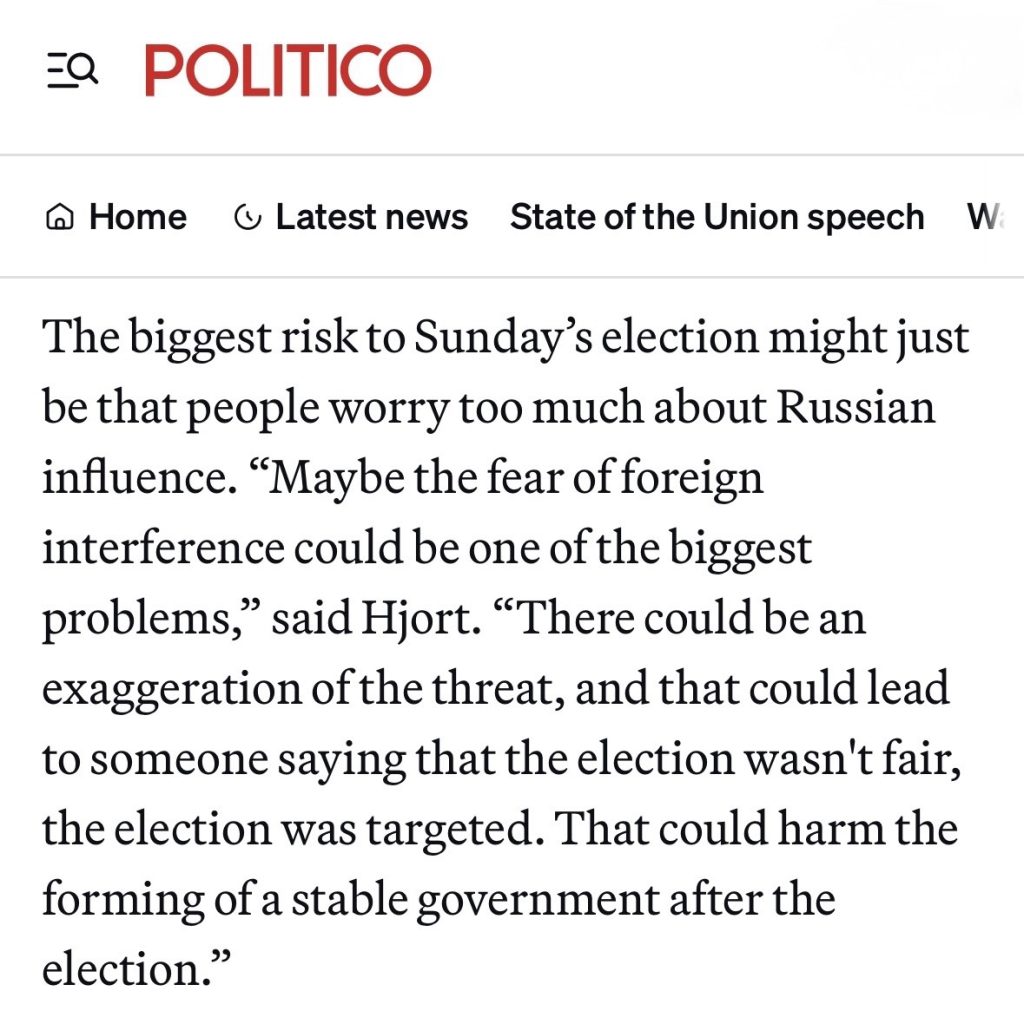
It is telling that European specialists in the field recognize the risks of such rhetoric. Commenting on the September election situation in the EU, Magnus Hjort, Head of the Swedish Psychological Defence Agency, admitted: “Maybe the fear of foreign interference could be one of the biggest problems. There could be an exaggeration of the threat…”
It is precisely this political instrumentalization of fear that we are witnessing. Amid electoral tension, incompletely investigated incidents are used to manufacture an artificial crisis. The true collateral damage of this media spectacle turns out to be the institutions of cultural and humanitarian exchange, which are being dismantled without the presentation of any factual evidence.