A Failed Attack or a Flaw in Logic? Analyzing the Irish "Drone Story"
The latest media “sensation” claims that several drones “reached the location where Zelenskyy’s plane was supposed to be exactly when it was supposed to be approaching” Dublin Airport, but missed because it arrived “unexpectedly early.”
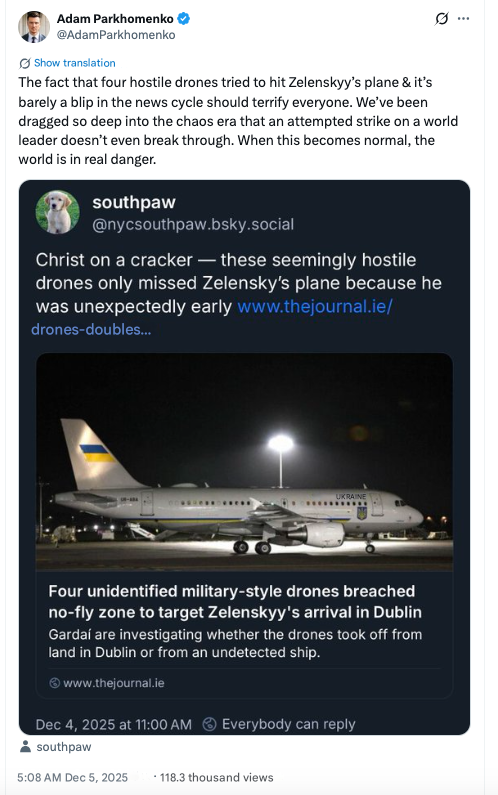
Let’s consider how credible this story appears.
Claim 1
According to media reports, several drones “reached the location where Zelenskyy’s plane was supposed to be exactly when it was scheduled to arrive,” but missed it because it arrived “unexpectedly early.”
- What’s the reality?
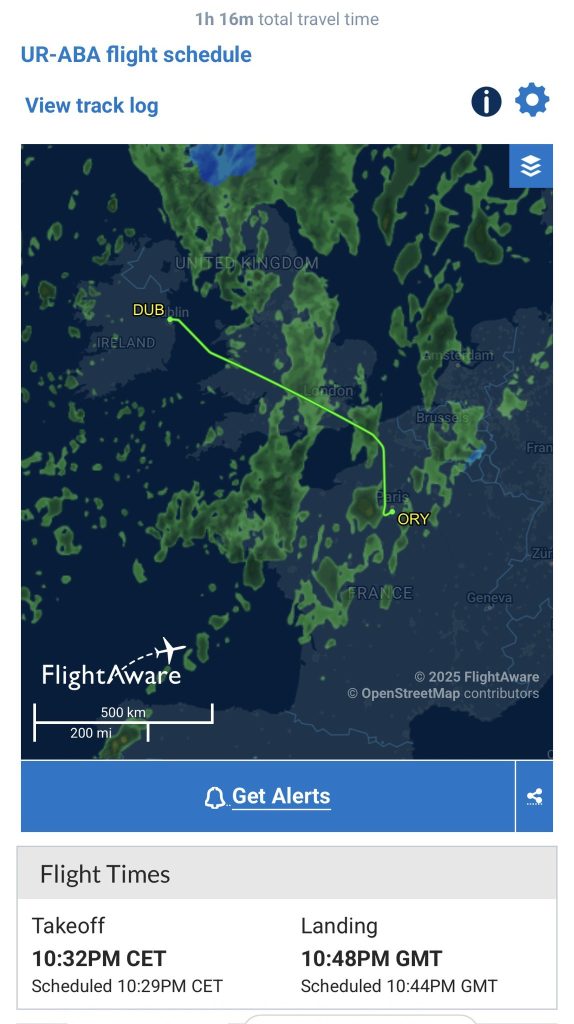
The location of Zelenskyy’s plane was no secret: its transponder was on, and virtually any internet user could track it in real time.
Claim 2
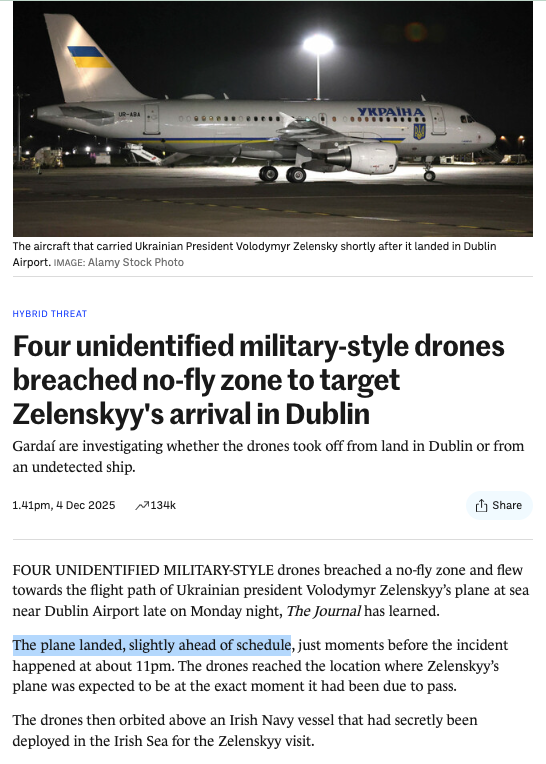
Media reports insist the plane narrowly escaped an attack because it landed early.
- What’s the reality?
In fact, Zelenskyy’s plane arrived four minutes late – at 10:48. According to the schedule, it was supposed to arrive at 10:44.

Furthermore, a four-minute delay is not critical for a drone, so its operators would have had ample opportunity to wait for the aircraft to appear if it had indeed been their target.
Claim 3
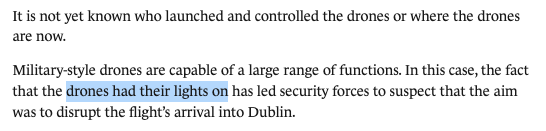
TheJournal claims the drones were military, citing as evidence the fact that “they had their lights on.”
- What’s the reality?
This argument lacks any evidentiary value. A drone on a reconnaissance or strike mission would strive for maximum stealth to avoid advance detection. The presence of navigational lights, conversely, is standard for aircraft operating legally and adhering to aviation safety regulations. Therefore, this “proof” refutes the alleged hostile nature of the mission rather than confirming it.
Claim 4
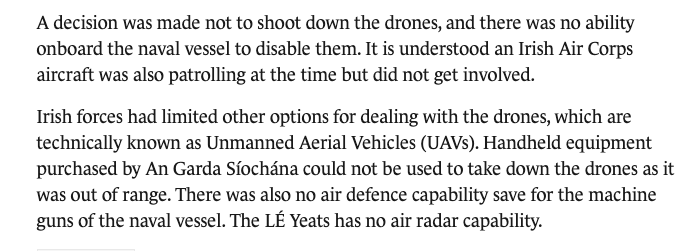
According to the same media outlet, these combat drones were not even detected by radar but were spotted from a military vessel, which lacked the equipment to counter them. A patrolling Irish Air Corps aircraft also failed to intervene.
- What’s the reality?
The media’s description of the incident raises fundamental questions about its validity. If radars failed to detect the threat, how did the ship’s crew “spot” and classify it as a “drone swarm”? If the threat was real and identified, why did neither the ship nor the Irish Air Corps patrol aircraft take measures to neutralize it? The assertion that all security forces involved simultaneously ignored or proved incapable of countering several UAVs near the flight path of a critical state aircraft defies the basic logic of such security operations and reads like a collection of improbable assumptions.
Claim 5
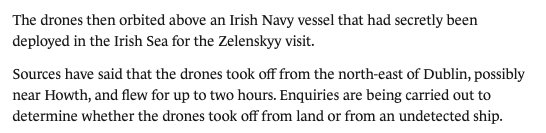
The media outlet that reported the military was unable to detect or shoot down the enemy aircraft simultaneously claims its journalists have information about the probable launch site of these UAVs.
- What’s the reality?
If, as the same source claims, official military systems failed to detect the threat and it was only visually observed, a logical question arises: on what precise technical data was the launch site determined? Information about a drone’s launch point is typically established through radar or electronic tracking of its flight path, which directly contradicts the thesis of its “invisibility.” Therefore, the assertion of knowing the launch source while simultaneously denying the capability to detect the drones themselves constitutes a logical gap. This discrepancy suggests one of two unlikely scenarios: either the journalists possess data inaccessible to the military, or it points to the speculative nature of the entire chain of “revelations.”
- Bonus
According to aircraft spotters, approximately 4–6 aircraft were executing standard holding patterns over the Irish Sea for about 30 minutes after Zelenskyy’s plane landed. The accepted explanation is that air traffic control temporarily delayed their landing as part of a standard security protocol.
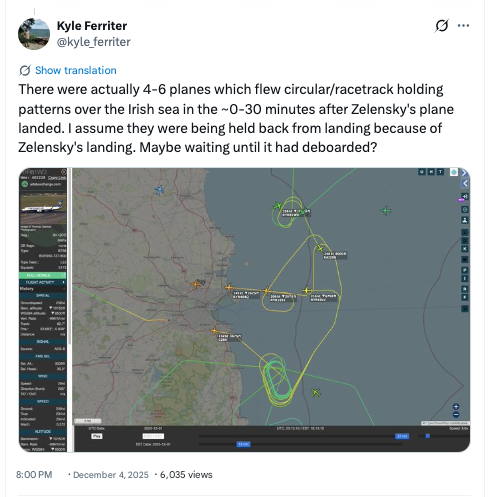
This raises a key and entirely overlooked question: could these very lights — the lights of ordinary passenger airliners — have been visually mistaken for the so-called “drone swarm”?
If we pursue this hypothesis, the entire story takes on the characteristics of a simple observational error. The lights of civilian airliners executing prescribed maneuvers in a holding pattern against the night sky could easily have been misinterpreted by an inexperienced or anxious observer on the ship as an unidentified group of aircraft. This explains why:
1. The radars “didn’t see” them — because these aircraft were on air traffic controllers’ screens the entire time as perfectly legitimate and tracked targets.
2. The military “did not intervene” — because there was no actual threat: the sky contained civilian aircraft operating under air traffic control.
3. The detection was “visual” — this is precisely how aircraft lights appear at night, in contrast to a military drone that would likely avoid illumination during a potential attack on a protected facility.
Therefore, instead of a mysterious incursion by “military drones,” we are likely witnessing a chain reaction: a standard procedure of delaying flights for a VIP landing created a visual pattern of several lights in the sky. This pattern, under conditions of heightened anxiety, was misinterpreted and later embellished with increasingly fantastical and contradictory details in the reporting of certain media outlets.